

How to Use Agentic AI: Building, Deploying, and Scaling AI Agents
 Suyash Raizada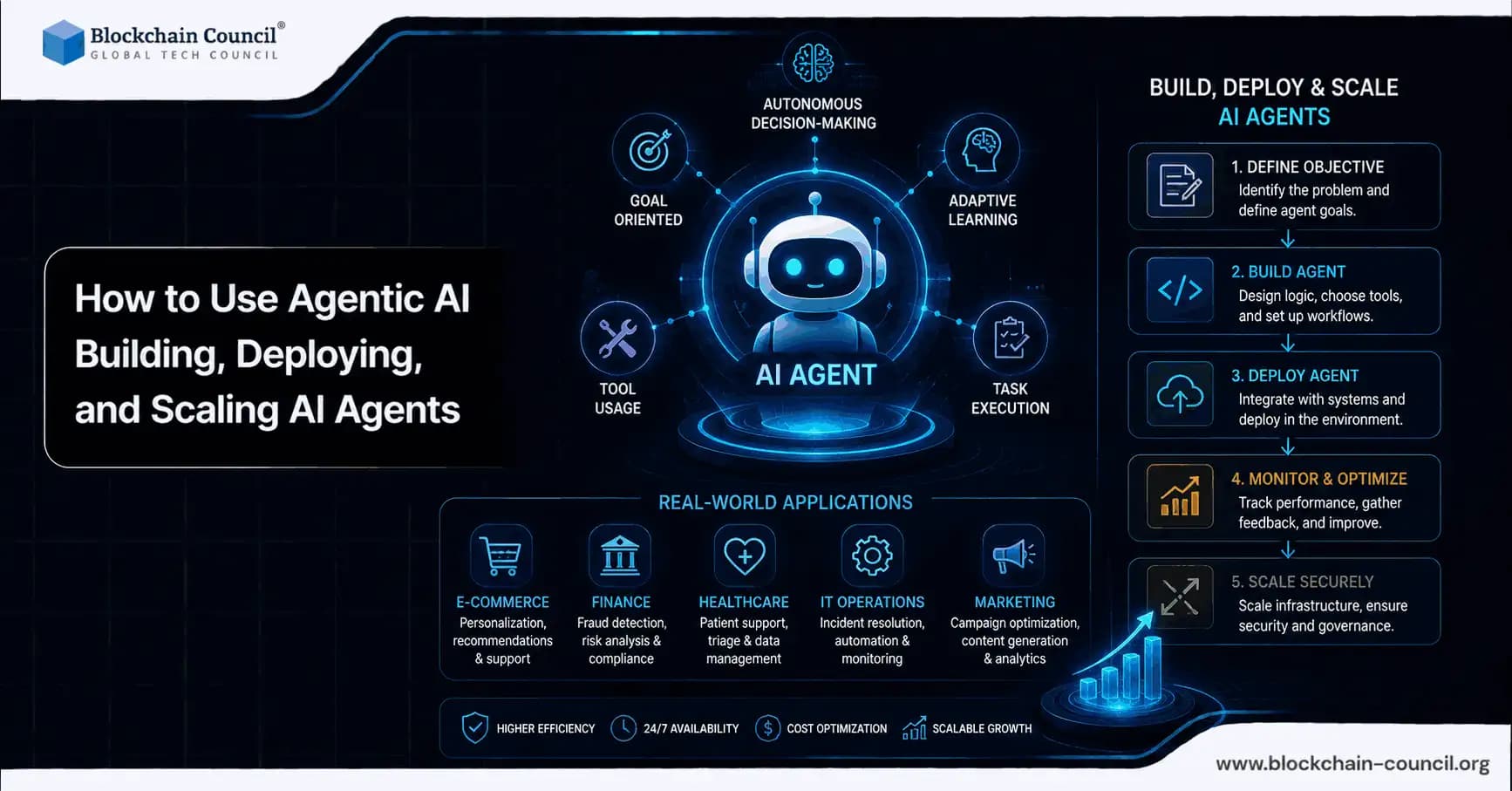
Agentic AI is moving rapidly from experimental prototypes to production systems that plan, decide, and act with minimal human supervision. Unlike prompt-response chatbots, agentic AI systems (often called AI Agents) can break down goals into steps, call tools and APIs, retain context across sessions, and iterate until they reach a defined outcome. Industry data confirms this shift is underway: Docker reports that 60% of organizations have AI agents in production and 94% consider agent development a strategic priority, with most deployments focused on internal productivity and operational efficiency. Learn how to build, deploy, and scale Agentic AI systems capable of autonomous reasoning, task execution, and workflow orchestration by building expertise through an Agentic AI Course, automating AI agent workflows and integrations using a Python certification, and launching AI-driven services with a Digital marketing course.
This guide explains how to use Agentic AI in a practical, enterprise-ready way: where to start, which components matter, how to deploy securely, and how to scale from a single agent to multi-agent workflows.

What is Agentic AI (and How It Differs from Traditional AI)?
Agentic AI refers to autonomous or semi-autonomous AI systems that pursue goals through a loop: observe, plan, act, and reflect. MIT Sloan describes the broader shift as moving from chatbots to systems that can take actions in real time, which increases both the value and the governance requirements.
In practice, an agentic system typically includes:
An LLM backbone for reasoning and decision-making
Tools (APIs, databases, browsers, internal services) to take actions
Memory to retain relevant context across steps and sessions
A planner or policy to decide what to do next and when to stop
Guardrails to reduce unsafe or non-compliant behavior
Where Agentic AI Is Being Used Today
Agentic AI is already deployed across common enterprise workflows. Docker's 2025 findings indicate that most organizations are using agents internally first, particularly where ROI is measurable and risk can be contained.
High-Impact Use Cases
Customer service automation: Gartner projects that by 2029, 80% of common customer issues could be resolved autonomously by AI agents.
Software development: Agent workflows help plan tasks, generate code, debug, and validate changes across the development lifecycle.
Enterprise reporting and analysis: Agents gather data, produce summaries, and draft stakeholder-ready reports.
Security and fraud workflows: Multi-step investigation agents can triage alerts and query internal systems for faster response.
Healthcare triage: Agents can route requests and prepare drafts, with mandatory human review for high-risk decisions.
How to Use Agentic AI: A Step-by-Step Implementation Blueprint
Successful adoption requires treating AI agents as software systems, not just model prompts. The steps below reflect established patterns from frameworks such as LangChain and AutoGen, alongside deployment realities highlighted in Docker's report, including containers, cloud-native workflows, and multi-environment orchestration.
1) Define the Goal, Boundaries, and Success Criteria
Start with a single business objective that benefits from iterative, multi-step work. Examples include resolving password reset tickets, generating a weekly risk report, or triaging inbound sales leads. IBM recommends framing agent work as a reasoning loop: observe, plan, act, reflect.
Define upfront:
Allowed actions: which tools and systems the agent may access
Prohibited actions: anything that requires explicit human authorization
Completion criteria: what "done" means, including required outputs
Quality constraints: accuracy, tone, citation requirements, and formatting standards
Risk tier: low-risk internal tasks versus high-stakes customer-facing or regulated workflows
2) Choose an Agent Framework and Tool Strategy
Framework selection should align with your complexity and governance requirements:
LangChain or LlamaIndex: well-suited for tool calling, retrieval, and common agent patterns.
AutoGen: useful for multi-agent collaboration and role-based task decomposition.
CrewAI or LangGraph: appropriate when you need explicit orchestration, persistent state, and repeatable agent graphs.
Also decide how tools are exposed. Model Context Protocol (MCP) is widely recognized - Docker reports 85% familiarity - but many teams still cite security and manageability as barriers to enterprise readiness. If you adopt MCP, apply strict controls on tool permissions, request validation, and auditing.
3) Build the Agent Core (LLM, Memory, Planning, Tools)
A practical agent architecture includes:
LLM selection: choose based on tool-calling capability, cost, latency, and governance requirements such as model availability within your cloud region.
Memory design: a short-term scratchpad combined with long-term retrieval. Vector stores such as FAISS or Pinecone are commonly used for long-term memory and document retrieval.
Planning strategy: ReAct-style loops (reason, then act) work well for most tasks; hierarchical planning is better suited to complex, multi-phase projects.
Tooling layer: build a curated set of tools with strong input validation and minimal permissions by default.
Most teams start with a single-agent ReAct loop and then move to multi-agent structures - for example, a "researcher" agent paired with a "validator" agent - as reliability requirements increase.
4) Package and Deploy Using Container-Native Workflows
Production deployment is a key differentiator between demos and reliable systems. Docker reports that 94% of teams use containers for agent development and production, and 98% apply cloud-native workflows. Containerization improves portability and helps address vendor lock-in concerns, which Docker reports affect 76% of organizations globally.
Recommended deployment practices:
Containerize the agent service with pinned dependencies and reproducible builds.
Externalize secrets (API keys, database credentials) using a vault or managed secrets store.
Use Kubernetes or managed container platforms for scaling, rollouts, and environment isolation.
Plan for multi-environment orchestration: Docker reports 79% of teams run agents across two or more environments, and 33% encounter orchestration challenges as a result.
5) Add Security, Governance, and Guardrails
Security is consistently reported as the primary barrier to broader adoption. Docker finds 40% of organizations cite security as their top challenge, and 45% specifically struggle with securing agent tools. Treat agents as privileged automation that can directly affect real systems.
Key controls to implement:
RBAC and least privilege: restrict tool and data access by role and environment.
Sandboxing: isolate tool execution, particularly for browser automation or code execution.
Allowlists and policy checks: limit which endpoints, queries, and actions are permitted at runtime.
Audit logs: record prompts, tool calls, outputs, and approvals for full traceability.
Human-in-the-loop controls: require explicit approval for high-stakes actions such as refunds, account changes, or clinical recommendations. Hybrid human-AI review loops are considered critical for high-impact decisions.
6) Evaluate, Monitor, and Control Costs
Agent reliability depends on system behavior over time, across varied inputs, and under tool failures - not just model quality in isolation.
Track the following operational metrics:
Task success rate and documented reasons for failure
Tool error rate and retry frequency
Latency per step and end-to-end
Cost per task (tokens consumed, tool usage, compute)
Safety indicators: policy violations, unsafe tool attempts, and data leakage signals
Also test for common failure modes:
Hallucinated actions: the agent claims it performed a tool call that was never executed
Infinite loops: repeated planning cycles without convergence toward a result
Over-permissioned tools: unnecessary access that introduces security risk
Context drift: the agent loses track of the original goal or operating constraints
Single-Agent vs. Multi-Agent Systems: When to Scale Up
Many workflows function well with a single agent. Multi-agent patterns become useful when tasks require specialization, independent verification, or parallelism. Research on 2025 trends points to increasing multi-agent collaboration, including edge deployment for low-latency use cases.
Common Multi-Agent Patterns
Researcher and Validator: one agent gathers information while the other checks consistency and compliance.
Planner and Executors: a coordinator decomposes work into subtasks; dedicated executor agents handle tool interactions.
Red team agent: probes outputs for security vulnerabilities, privacy risks, and policy failures before deployment.
Scaling to multi-agent systems increases orchestration complexity. Use explicit state machines or graph-based orchestration (such as LangGraph) when reproducibility and auditability are required.
Skills and Certifications to Support Agentic AI Adoption
Agentic AI projects require cross-functional capability spanning AI engineering, security, and cloud-native operations. Building organizational readiness typically involves training paths that cover:
AI agent design: planning loops, tool calling, evaluation frameworks, and memory architectures
LLM application development: retrieval-augmented generation, prompt engineering, and observability
Security and governance: access control, audit logging, data protection, and AI risk assessments
Cloud-native deployment: containers, Kubernetes, and CI/CD pipelines for agent services
Understand how AI agents use memory, planning, tools, APIs, and multi-step reasoning to automate complex business and development tasks by mastering autonomous AI systems through an Agentic AI Course, developing scalable agent architectures using a Node JS Course, and growing AI-powered automation businesses using an AI powered marketing course.
Conclusion: Using Agentic AI Effectively Means Building Trustworthy Systems
Agentic AI is becoming a production standard for automating multi-step knowledge work, not a niche experiment confined to research labs. Survey data indicates rapid adoption alongside clear friction points: security gaps, orchestration complexity across environments, and vendor lock-in concerns. The most effective approach is to start with a bounded, internal workflow, implement a disciplined observe-plan-act-reflect loop, containerize the agent for portability, and enforce strong governance around tools, permissions, and audit trails.
As agent autonomy increases, the organizations that succeed will be those that treat AI agents like any other mission-critical software: well-scoped, thoroughly tested, continuously monitored, and designed to be secure by default.
FAQs
1. What is Agentic AI?
Agentic AI refers to AI systems that can plan, act, and complete tasks with limited human input. These systems use tools, memory, and reasoning loops to reach defined goals. They are more action-oriented than basic chatbots.
2. How is Agentic AI different from traditional AI?
Traditional AI often responds to single prompts or performs narrow tasks. Agentic AI can break goals into steps, use external tools, and adjust its actions as needed. Naturally, humans made software that now needs supervision to supervise itself.
3. What are AI agents?
AI agents are systems designed to observe information, plan actions, use tools, and complete tasks. They may connect with APIs, databases, browsers, or internal business systems. Their purpose is to automate multi-step workflows more intelligently.
4. Where is Agentic AI used today?
Agentic AI is used in customer service, software development, reporting, security, fraud detection, and healthcare triage. These use cases often involve repetitive or multi-step work. Businesses usually start with internal workflows to reduce risk.
5. Why is goal-setting important for AI agents?
Clear goals help agents understand what they must accomplish and when to stop. Without defined outcomes, agents may produce incomplete or irrelevant results. Good goal-setting also supports safer automation.
6. What are boundaries in Agentic AI?
Boundaries define what an AI agent is allowed and not allowed to do. They may include tool limits, approval rules, and restricted actions. These controls prevent agents from making unsafe or unauthorized decisions.
7. What tools do AI agents use?
AI agents can use APIs, databases, browsers, internal services, and document retrieval systems. These tools allow agents to act beyond simple text generation. Tool access should be limited and carefully monitored.
8. What is memory in Agentic AI?
Memory helps AI agents retain useful context across steps or sessions. Short-term memory supports current tasks, while long-term memory can store relevant knowledge for future use. Proper memory design improves consistency and task completion.
9. What is an observe-plan-act-reflect loop?
This loop describes how an AI agent works through a task. It observes information, creates a plan, takes action, and reviews the result. The cycle continues until the goal is completed or stopped.
10. What is an agent framework?
An agent framework helps developers build and manage AI agents. Popular options include LangChain, LlamaIndex, AutoGen, CrewAI, and LangGraph. These frameworks support tool use, planning, memory, and orchestration.
11. Why is tool permission important for AI agents?
Tool permission controls what systems and data an agent can access. Over-permissioned agents can create security, privacy, and compliance risks. Least-privilege access keeps automation safer and less chaotic, which is apparently necessary.
12. How are AI agents deployed in production?
AI agents are often deployed using containers and cloud-native workflows. Containerization helps make builds portable, repeatable, and easier to manage. Production systems also need monitoring, secrets management, and environment isolation.
13. Why are guardrails important in Agentic AI?
Guardrails reduce unsafe, incorrect, or non-compliant agent behavior. They may include approval checks, policy rules, audit logs, and sandboxing. Strong guardrails are essential when agents interact with real systems.
14. What is human-in-the-loop control?
Human-in-the-loop control requires people to approve sensitive or high-risk actions. This is useful for refunds, account changes, medical decisions, or regulated workflows. It keeps humans responsible where automation should not act alone.
15. How should AI agents be monitored?
AI agents should be monitored for success rate, tool errors, latency, cost, and safety issues. Logs should capture prompts, tool calls, outputs, and approvals. Continuous monitoring helps catch failures before they spread.
16. What are common failures in Agentic AI?
Common failures include hallucinated actions, infinite loops, context drift, and unsafe tool use. Agents may also lose track of the original goal during long tasks. Testing and clear constraints reduce these risks.
17. What is the difference between single-agent and multi-agent systems?
A single-agent system uses one agent to complete a workflow. A multi-agent system uses multiple specialized agents, such as a researcher and a validator. Multi-agent systems can improve reliability but add orchestration complexity.
18. When should businesses use multi-agent workflows?
Businesses should consider multi-agent workflows when tasks require specialization, verification, or parallel execution. They are useful for research, compliance review, and complex operational workflows. However, they need stronger coordination and monitoring.
19. What skills are needed for Agentic AI adoption?
Teams need skills in AI agent design, prompt engineering, security, cloud deployment, and evaluation. Knowledge of tool calling, memory systems, and governance is also important. Cross-functional expertise helps build safer and more reliable agents.
20. What is the main takeaway about using Agentic AI?
Agentic AI should be treated as a serious software system, not a clever chatbot with delusions of productivity. It needs clear goals, secure tools, guardrails, monitoring, and human oversight. Used carefully, it can automate complex workflows and improve operational efficiency.
Related Articles
View All
Agentic AI
Agentic AI in Business FAQs: Building, Deploying, and Scaling Autonomous AI Agents with Real ROI
Learn what agentic AI in business is, where it delivers ROI, and how to build, deploy, govern, and scale autonomous AI agents with measurable outcomes.

Agentic AI
AI Agents for Enterprise Operations: Use Cases, Benefits, and Challenges
AI agents for enterprise operations automate cross-system workflows in IT, finance, HR, supply chain, and support, but governance is critical.

Agentic AI
Human-in-the-Loop AI Agents: Why Oversight Matters in Agentic Workflows
Human-in-the-loop AI agents add approval gates, escalation, audit trails, and human judgment to agentic workflows where errors carry real business risk.
Trending Articles

Top 5 DeFi Platforms
Explore the leading decentralized finance platforms and what makes each one unique in the evolving DeFi landscape.
How Blockchain Secures AI Data
Understand how blockchain technology is being applied to protect the integrity and security of AI training data.
What is AWS? A Beginner's Guide to Cloud Computing
Everything you need to know about Amazon Web Services, cloud computing fundamentals, and career opportunities.