

Stablecoins for Tokenized Asset Settlement

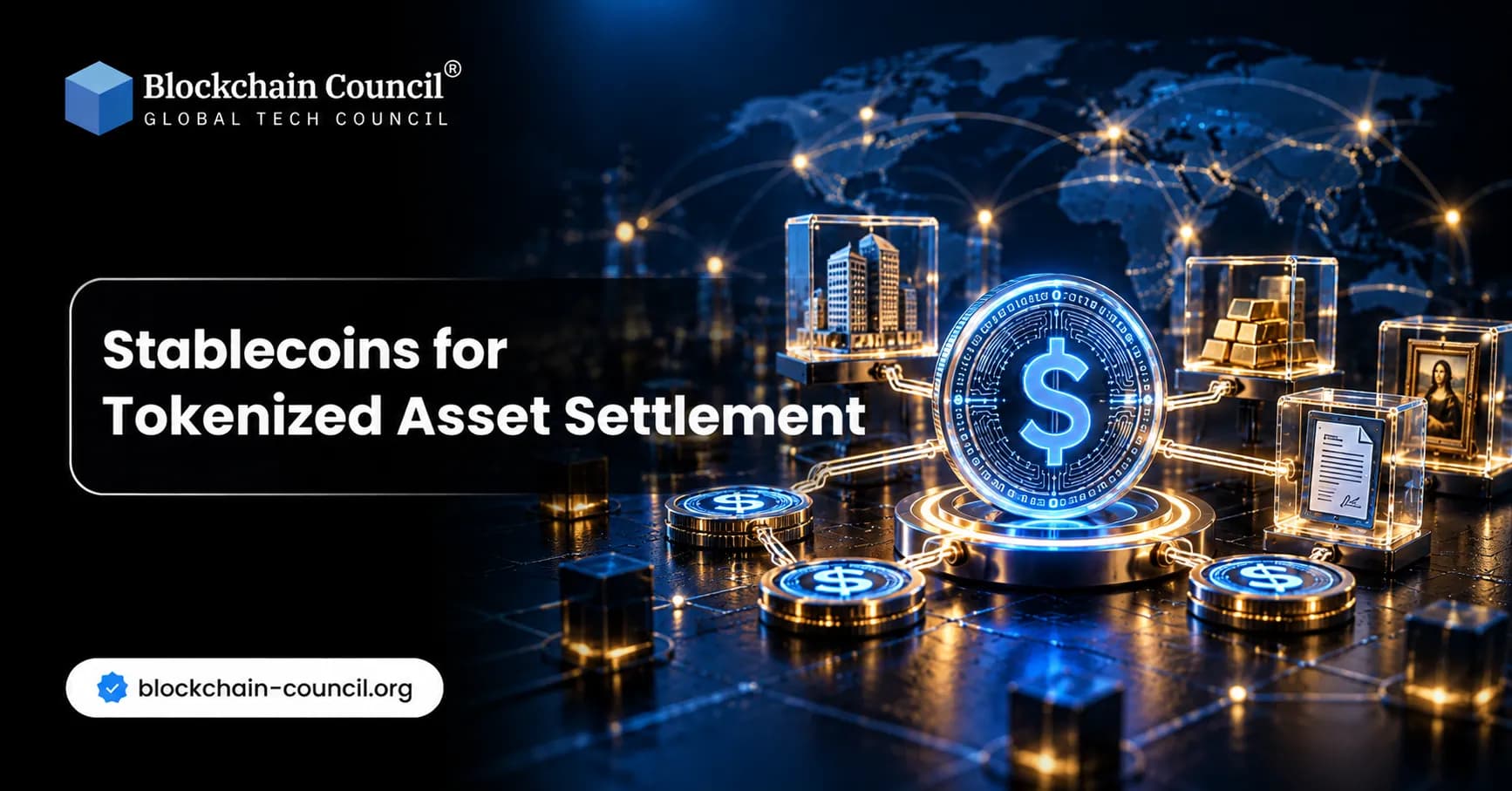
When two parties trade a bond, a fund share, or a piece of property, two things must change hands: the asset and the money. In traditional markets those two moves often happen on different systems and on different days, which leaves each side exposed while it waits. Tokenization offers another path. An asset is represented as a digital token on a blockchain, and a stablecoin can serve as the cash that pays for it. Stablecoins for tokenized asset settlement are attracting attention because both sides of a trade can sit on the same ledger and move together. The market is still early. Securitize, a tokenization platform, reported that tokenized real-world assets, excluding stablecoins, grew from about $5.5 billion to $18.2 billion during 2025, and its own data is not independently verified. This guide explains the basics in plain language, from delivery versus payment to legal ownership and interoperability. Professionals who want structured training in this field can begin with the Certified Stablecoin Payments Professional program.
What Is Tokenized Asset Settlement?
Tokenization in Simple Terms
Tokenization means creating a digital token that represents a real-world asset, such as a government bill, a money market fund share, private credit, or a property interest. The token records who owns the asset and can be moved on a blockchain. Depending on the legal setup, the token may be the asset itself, a claim on it, or a digital record that points to rights held elsewhere.

What Settlement Means
Settlement is the final step of a trade, when ownership and money are exchanged and the deal is complete. In many traditional markets, the process takes about one to two business days after the trade, and intermediaries such as clearing houses and custodians keep records in sync. Tokenized settlement aims to shorten that gap by recording both sides on one shared ledger.
Where the Market Stands
Tokenized government bills and money market funds have led growth. Securitize reported that tokenized Treasuries roughly doubled during 2025, from about $4 billion to $9 billion, and that BlackRock's BUIDL fund became the first tokenized fund from a major Wall Street institution to pass $1 billion in assets.
The Role of Stablecoins as a Settlement Asset
Why a Cash Leg Is Needed
Every trade needs a cash side. If the asset is on a blockchain but the payment must still travel through a bank wire, much of the benefit is lost, because the slow leg sets the pace. A blockchain-based payment asset lets both sides move together. Two common options are stablecoins and tokenized bank deposits, and some projects also test central bank money in tokenized form.
What Stablecoins Offer
A stablecoin is a digital token designed to track the value of a currency such as the US dollar. For settlement, it offers round-the-clock transfers, quick finality on many networks, and easy programming through smart contracts. It also works across many wallets and platforms without special bank connections. People who want a wider grounding in tokens, wallets, and networks can build that base through the Certified Cryptocurrency Expert course.
What to Check Before Relying on One
Not every stablecoin suits institutional settlement. Look at who issues it, what reserves back it, how often reserves are reported, how redemption works, and which laws apply. Under the US GENIUS Act, signed in July 2025, permitted issuers must hold reserves of at least one to one and allow redemption at face value, but final rules were still being completed in 2026. Also consider freeze functions, because major issuers can block addresses, which could affect a trade in progress.
Why the Gap Matters
While a trade is unsettled, either side could fail, markets could move, or a payment could be rejected. Shortening that window lowers the amount of capital that must be held back as protection, which is why banks and asset managers study tokenized settlement closely.
Delivery Versus Payment Explained
The Core Idea
Delivery versus payment, often shortened to DvP, is a rule that the asset is delivered only if the payment is made, and the payment is made only if the asset is delivered. It protects against principal risk, the danger that one side pays or delivers and the other side fails to follow through.
Traditional DvP and Its Gap
In conventional markets, central securities depositories and clearing houses manage DvP, but the process still involves time gaps and layers of reconciliation. Capital stays tied up while trades settle, and participants often hold extra collateral to cover the risk of a failed trade.
Atomic Settlement
On a blockchain, DvP can be made atomic, which means the whole transaction either completes in full or does not happen at all. A smart contract holds both legs, checks that each is present, and swaps them in one step. If any part fails, everything reverses. A prototype tested under the Bank for International Settlements found atomic settlement to be feasible across several currencies and jurisdictions, though the work was an experiment and not a live market.
Benefits and Limits
Supporters point to lower counterparty risk, freed-up capital, less reconciliation work, and the ability to settle at any hour. The limits are real too. The asset and the cash must exist on compatible networks, legal finality must be confirmed, and compliance checks must still run.
Smart Contracts and Transaction Coordination
What Smart Contracts Do
A smart contract is software that runs on a blockchain and follows rules written in advance. In settlement, it can act as a neutral escrow agent. It checks identity or eligibility, confirms the asset and cash are available, executes the swap, and records the result. It can also handle scheduled events such as coupon payments or redemptions.
Coordinating Many Steps
Real trades involve more than two parties. An issuer, a custodian, a broker, a transfer agent, and a regulator may all play roles. Smart contracts can link these steps, but they work only as well as the data they receive. Price feeds, reserve checks, and identity data often come from outside services called oracles, and a faulty feed can cause a faulty trade.
Risks in the Code
Bugs, poorly designed upgrade controls, and weak access rules can all cause losses. Careful testing, independent audits, limits on who can change a contract, and an emergency pause plan are standard good practice. Technical teams who design these systems can benefit from a recognized Tech Certification that supports secure development and vendor review.
A Simple Example
This example is illustrative. A fund holds a tokenized Treasury bill and agrees to sell it for $1 million in a regulated stablecoin. A smart contract checks that the buyer is on an approved list, confirms the stablecoin balance, and swaps the bill and the cash in one step. If the buyer lacks funds or approval, nothing moves. Compare that with a traditional trade, where delivery and payment run through separate systems and can fail separately.
Permissioned vs Public Blockchain Environments
Permissioned Networks
A permissioned blockchain limits who can take part. Participants are known and approved, which helps with regulatory checks, privacy, and clear accountability. Many banks and market infrastructure firms favor this model for sensitive trading. The tradeoff is a smaller network, less liquidity, and weaker links to outside markets.
Public Networks
A public blockchain is open to anyone who follows the protocol. It offers broad reach, strong tooling, and a large pool of stablecoin liquidity. The tradeoff is that privacy is limited, rules must be enforced through token design or application controls, and institutions must be comfortable with open infrastructure.
Hybrid Approaches
Many projects mix the two, using permissioned access controls on top of public networks, or connecting private systems to public ones. The right choice depends on the asset, the investors, and the rules that apply. For regulated securities, controls such as approved wallets, transfer limits, and the ability to freeze or correct records are often required, whichever network type is used.
Legal Ownership, Custody, and Settlement Finality
Who Legally Owns the Asset?
A token is only as strong as the legal rights behind it. Depending on the structure, a token may be the legal asset, a contractual claim, a receipt, or a pointer to rights held in an off-chain register. That choice decides whether an on-chain transfer is effective by itself or needs an extra legal step, such as updating a register. Legal advice should settle this before any trade.
Custody
Ownership often depends on who controls the keys. A custodian may hold legal title while the investor holds a beneficial interest, depending on local law. Documents should match the real key setup, including approvals, backups, and rules on lending or reuse of assets. Ask how assets are segregated and what happens if the custodian fails.
Legal and Technical Finality
On-chain confirmation does not always equal legal finality. A transfer is final in law only if the applicable legal framework says so. The BIS analysis of a multi-currency prototype concluded that settlement finality could be achieved across all seven participating jurisdictions, but technical, operational, and contractual design still had to be aligned with each country's laws.
Insolvency
If a platform or custodian fails, a key question is whether holders have a property claim to specific assets or only a general claim as unsecured creditors. Trusts, special purpose vehicles, and segregated accounts are common tools to protect holders. Check these protections before you trade.
Interoperability and Liquidity Challenges
Fragmented Networks
Tokenized assets live on many separate networks, each with its own rules, wallets, and pools of buyers. A bond on one chain and cash on another cannot settle atomically without a bridge or messaging layer. Swift, the financial messaging network, began experiments in 2023 with major banks and market infrastructure firms to test whether existing connections could instruct transfers across public and private blockchains.
Bridges and Cross-Chain Risk
Cross-chain tools add their own risk. A bridge can be hacked, a wrapped token can lose its backing, and a governance pause can freeze redemption. Remedies and responsibility can be unclear. Use proven tools, keep exposure small, and define fallback steps in advance.
Liquidity
Tokenization does not by itself create buyers. Many tokenized assets trade thinly, and wide gaps between buy and sell prices can erase the speed benefit. Liquidity depends on investor demand, market makers, collateral rules, and links to existing markets. Stablecoin liquidity is deeper on public networks, while private systems may have limited cash options.
Institutional Use Cases and Risks
Use Cases
Collateral and margin: tokenized funds and bills can be moved quickly as collateral, and settlement at any hour helps with margin calls.
Money market funds and Treasuries: investors can subscribe and redeem with stablecoins, which shortens cash cycles.
Cross-border wholesale payments: projects such as the BIS-convened Project Agorá bring central banks and private firms together to test tokenized settlement across currencies.
Private credit and structured products: tokenization can streamline issuance and servicing.
Treasury operations: firms can use stablecoins to move cash between entities while holding tokenized yield-bearing assets.
Regulators and Standard Setters
Public bodies are actively studying this area. The BIS and the Institute of International Finance convened Project Agorá with several central banks and more than 40 private financial institutions to test tokenized cross-border settlement, with real-value testing planned as a next phase.
Key Risks
Main risks include legal uncertainty, smart contract failure, issuer and custody failure, stablecoin depegging, cross-chain breaks, weak liquidity, and compliance gaps. Operational risk also matters, since staff must understand a new set of tools.
Building the Right Team
Stablecoin infrastructure connects digital assets with payment systems, financial services, and blockchain networks. Organisations working in this space need talent with the right mix of technical, financial, and operational knowledge. HireValid's candidate assessment platform is worth exploring for teams looking to evaluate role-specific skills during recruitment.
Practical Steps
Start small. Pick one asset type and one counterparty group, confirm the legal structure, choose a regulated stablecoin and custodian, test settlement with small amounts, and review controls before scaling.
Final Thoughts
Stablecoins for tokenized asset settlement can reduce delays and counterparty risk, but they work best when law, technology, and operations move together. The strongest programs treat the token, the cash, the legal rights, and the custody setup as one design. Teams who explain these projects to clients and regulators build trust through clear messaging, and a Marketing Certification can help them communicate benefits, limits, and safeguards in clear and responsible language.
FAQs
1. What Are Stablecoins for Tokenized Asset Settlement?
Stablecoins for tokenized asset settlement are digital currencies used to complete payments when ownership of assets represented on a blockchain is transferred. They provide a payment method designed to maintain a relatively stable value, often through a peg to a fiat currency such as the US dollar.
2. What Is Tokenized Asset Settlement?
Tokenized asset settlement is the process of exchanging payment and transferring ownership of an asset represented by a digital token on a blockchain. The asset could represent real estate, bonds, equities, commodities, or other financial and physical assets.
3. How Do Stablecoins Work in Tokenized Asset Settlement?
Stablecoins act as the payment component of a blockchain-based transaction. When a buyer purchases a tokenized asset, the stablecoin payment can be transferred to the seller or settlement contract while the asset token is transferred to the buyer, subject to the transaction's rules and conditions.
4. Why Are Stablecoins Used for Tokenized Asset Settlement?
Stablecoins can provide a blockchain-compatible payment method with relatively predictable pricing. They may support faster settlement, reduce dependence on traditional payment intermediaries, enable programmable transactions, and help coordinate payment and asset delivery within a shared digital infrastructure.
5. What Is Delivery Versus Payment (DvP) in Tokenized Asset Settlement?
Delivery versus payment (DvP) is a settlement mechanism in which an asset is delivered only when the corresponding payment is completed. In a blockchain environment, smart contracts can coordinate the transfer of stablecoins and tokenized assets, helping reduce the risk of one party paying without receiving the asset.
6. How Do Smart Contracts Support Stablecoin Settlement?
Smart contracts automate transaction conditions between buyers and sellers. They can verify payment requirements, check asset ownership, and execute transfers when predefined conditions are satisfied. This reduces manual coordination and can make tokenized asset settlement more efficient.
7. What Is Atomic Settlement in Tokenized Assets?
Atomic settlement means that all parts of a transaction happen together or none of them happen. For example, a buyer's stablecoin payment and the seller's tokenized bond transfer can occur simultaneously. This helps reduce counterparty risk and incomplete transactions.
8. Which Stablecoins Are Used for Tokenized Asset Settlement?
Commonly considered stablecoins include USDC and USDT, along with other fiat-backed or regulated stablecoins. The appropriate choice depends on liquidity, issuer credibility, reserve arrangements, redemption rights, blockchain compatibility, and applicable regulations.
9. What Types of Assets Can Be Settled Using Stablecoins?
Stablecoins can potentially support settlement for several tokenized asset categories, including:
Tokenized government bonds
Real estate investment interests
Commodities such as gold
Tokenized money market funds
Digital securities
Private credit and investment products
The legal rights represented by each token depend on its structure and the relevant jurisdiction.
10. How Do Stablecoins Improve Cross-Border Asset Settlement?
Stablecoins can move across supported blockchain networks without depending entirely on traditional banking hours or correspondent banking arrangements. This may simplify international settlement, although currency conversion, liquidity, compliance checks, and local financial regulations still apply.
11. Can Stablecoins Reduce Settlement Time for Tokenized Securities?
They can help reduce settlement delays when the asset and payment components operate on compatible blockchain infrastructure. Smart contracts can coordinate transactions more efficiently than workflows requiring multiple separate confirmations. Actual settlement speed depends on network performance, legal finality, and the systems involved.
12. What Are the Benefits of Using Stablecoins Instead of Traditional Bank Transfers?
Stablecoin settlement can offer 24/7 transaction availability, programmable payment conditions, blockchain-based transaction visibility, and potentially faster cross-border transfers. However, traditional bank transfers benefit from established legal protections and settlement infrastructure. The best option depends on the transaction's risk, cost, and regulatory requirements.
13. What Is the Difference Between Stablecoins and Tokenized Deposits for Asset Settlement?
Stablecoins are privately issued digital tokens designed to maintain a stable value against a reference asset. Tokenized deposits represent commercial bank deposits in digital token form. Both can support programmable settlement, but they differ in issuer obligations, regulatory treatment, redemption arrangements, and their relationship with the banking system.
14. What Are the Risks of Using Stablecoins for Tokenized Asset Settlement?
Major risks include stablecoin depegging, issuer failure, reserve liquidity problems, smart contract vulnerabilities, blockchain congestion, wallet security breaches, and regulatory uncertainty. Businesses and financial institutions should assess these risks before selecting a settlement asset.
15. How Does Blockchain Security Affect Tokenized Asset Settlement?
Blockchain security helps protect transaction records and token transfers through cryptographic mechanisms and network consensus. However, the broader settlement process can still be exposed to compromised wallets, vulnerable smart contracts, faulty integrations, and incorrect transaction data. Security audits and operational controls remain essential.
16. Are Stablecoin-Based Tokenized Asset Settlements Regulated?
Yes, they may be subject to several regulatory frameworks depending on the asset, token issuer, payment provider, transaction participants, and jurisdiction. Relevant requirements can include securities laws, stablecoin regulations, anti-money-laundering controls, investor protection, custody rules, and transaction reporting.
17. Can Stablecoins Support Institutional Tokenized Asset Markets?
Yes. Stablecoins can provide a digital payment mechanism for institutional transactions involving tokenized bonds, funds, and other financial instruments. Institutional adoption requires reliable custody, sufficient liquidity, regulatory compliance, transaction controls, and suitable settlement infrastructure.
18. What Role Does Liquidity Play in Stablecoin Asset Settlement?
Liquidity ensures that buyers can obtain the required stablecoins and sellers can convert or redeem received tokens when needed. Insufficient liquidity can delay transactions, increase conversion costs, and create settlement difficulties. Institutions must consider market depth, redemption access, and liquidity arrangements before relying on a stablecoin.
19. What Is the Difference Between On-Chain and Off-Chain Settlement?
On-chain settlement occurs directly through blockchain transactions, where digital asset transfers are recorded on a distributed ledger. Off-chain settlement uses external systems, such as banks, custodians, or traditional financial infrastructure, to complete or confirm parts of a transaction. Some tokenized asset arrangements combine both approaches.
20. What Is the Future of Stablecoins in Tokenized Asset Settlement?
Stablecoins may become an important settlement option as financial institutions explore tokenized securities, programmable financial products, and cross-border digital transactions. However, their long-term role will depend on regulatory clarity, reliable redemption, liquidity, interoperability, and trust in the underlying settlement infrastructure. Tokenized deposits and central bank digital money may also play important roles in future tokenized markets.
Related Articles
View All
Stablecoin
Stablecoins for AI Agent Payments: Use Cases and Risks
AI agents may need ways to pay for digital services or coordinate machine-to-machine transactions. This article examines how stablecoins could fit into those workflows and the controls required around authorisation, spending, custody, and monitoring.
Stablecoin
Stablecoin Payment Settlement and Finality
A stablecoin transaction appearing on-chain does not always mean a business should treat it as fully settled immediately. Learn about confirmations, finality models, network conditions, and payment acceptance policies.
Stablecoin
Stablecoin Payment Risk Management Framework
Stablecoin payment risk spans the issuer, reserve assets, blockchain network, wallets, service providers, compliance obligations, and business operations. Learn how organisations can identify exposures, assign controls, and prepare for incidents.
Trending Articles
The Role of Blockchain in Ethical AI Development
How blockchain technology is being used to promote transparency and accountability in artificial intelligence systems.
AWS Career Roadmap
A step-by-step guide to building a successful career in Amazon Web Services cloud computing.
Top 5 DeFi Platforms
Explore the leading decentralized finance platforms and what makes each one unique in the evolving DeFi landscape.