

Stablecoins for AI Agent Payments: Use Cases and Risks

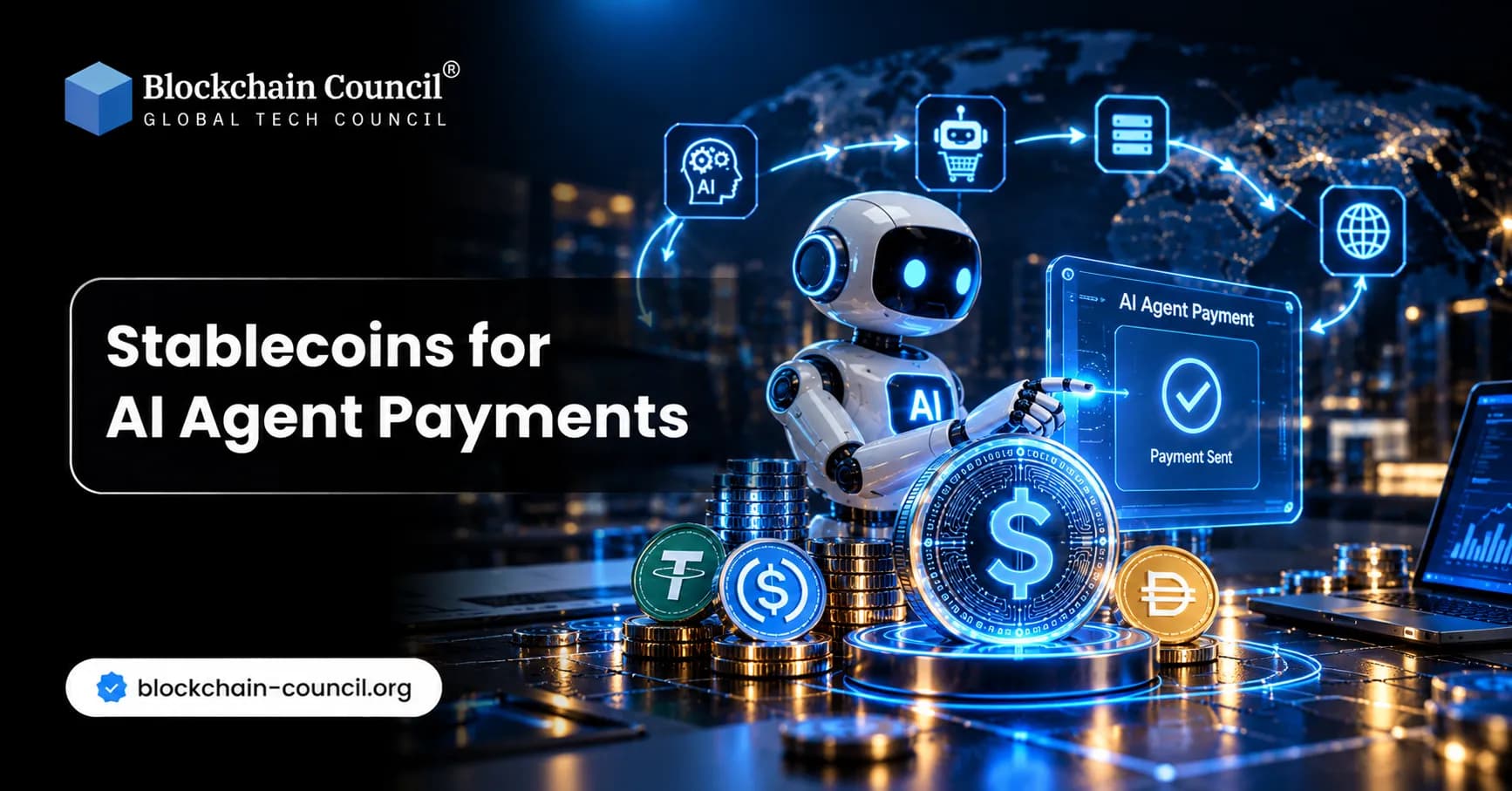
Software is starting to shop, subscribe, and pay on its own. An AI agent can book a trip, buy a dataset, or pay a small fee to read an article, often without a person clicking anything. That raises a practical question: what money can a machine use, and how do we keep it safe? Many builders point to stablecoins for AI agent payments as one answer. A stablecoin is a digital token designed to hold the value of a currency such as the US dollar, and it moves over a blockchain at any hour. This guide explains the idea in plain language, walks through a typical payment flow, and covers limits, security, fraud, and compliance. It also separates early evidence from marketing claims, because most public numbers come from companies that sell these tools. Readers who want structured training can start with the Certified Stablecoin Payments Professional program.
What Are AI Agent Payments?
A Simple Definition
An AI agent is software that can plan steps and take actions toward a goal, such as researching suppliers or renewing a subscription. An AI agent payment is a payment that the agent starts or completes on behalf of a person or a company. The agent may select the product, check the price, and trigger the transfer, while a human sets the rules in advance.

Human-Present and Human-Not-Present Payments
Two patterns are worth separating. In a human-present payment, the person reviews a cart and approves it, and the agent only helps. In a human-not-present payment, the person grants permission ahead of time, for example "buy this item if the price falls below a set amount," and the agent acts later alone. Google's Agent Payments Protocol, known as AP2, describes both patterns using signed permission records called mandates.
Machine-to-Machine Payments
Some agent payments never involve a shop at all. One program pays another for a data lookup, a computing job, or an answer from a paid service. These payments are often tiny, a fraction of a dollar each, and they can happen thousands of times a day. They are the use case that traditional card systems handle worst.
Why Stablecoins Are Being Explored for Machine Payments
Small Payments Need Low Fixed Costs
Card payments often carry a fixed fee of around 30 cents plus a percentage, which makes a payment worth a few cents impractical. One 2026 industry report, produced with companies active in the field, found that about 76 percent of observed agent transactions fell below that fee floor. Stablecoin transfers on low-cost networks can cost a small fraction of a cent, which is why they suit tiny, frequent payments.
Always On, Quick, and Programmable
Banks close, and transfers can take days. A stablecoin moves in seconds on weekends and holidays, which fits software that never sleeps. Payments can also be tied to code, so a transfer can be released only when a condition is met. The same report said that about 98.6 percent of the agent transactions it measured settled in USDC, though it was a vendor-linked study and should be treated as indicative only.
A Stable Unit of Account
An agent budgeting $4.50 for a data call needs $4.50 to stay $4.50. Stablecoins aim to avoid the price swings of other digital assets, so budgets, limits, and invoices make sense. Anyone who wants a wider base in tokens, wallets, and networks can build it through the Certified Cryptocurrency Expert course.
The Honest Caveats
Stablecoins are not magic. They still depend on issuers, reserves, and the banks behind them, and turning them back into bank money costs time and fees. Agents also need funded wallets, and buying stablecoins usually involves identity checks, so the phrase "permissionless" describes the payment step more than the whole journey.
Example Workflow: Agent, Wallet, and Payment Provider
The Players
Four parts appear in most designs. The owner is the person or company that deploys the agent. The agent is the software that decides what to buy. The wallet holds the stablecoins and signs transfers. The payment provider, often called a facilitator, checks the payment and submits it to the blockchain.
A Step-by-Step Example Using x402
The x402 protocol revives an old web signal, HTTP status code 402, meaning "payment required." Coinbase published the idea in 2025, and the x402 Foundation was formed with Cloudflare that September. According to one summary of the specification, the flow works like this:
The agent asks a paid web service for data.
The service replies "payment required" and states the price, token, network, and recipient.
The agent signs a payment authorization with its wallet.
The agent repeats the request and attaches the signed authorization.
The facilitator verifies the signature and sends the transfer.
The service returns the data along with a receipt containing the transaction reference.
The whole exchange can take seconds, and the agent never fills in a form.
Where AP2 Fits
AP2 and x402 do different jobs. AP2 focuses on proving that the user authorized the purchase, using signed mandates built on verifiable credentials. x402 focuses on settling the payment with stablecoins. Google's materials describe stablecoin support through an x402 extension, so the two can work together.
Programmable Spending Limits and Approval Rules
Why Limits Matter
An agent can be wrong, confused, or tricked. Spending limits turn a possible disaster into a capped loss. The key rule is that limits must be enforced outside the agent's own reasoning. If the only protection is an instruction in the agent's prompt, a clever message can talk it out of the rule.
Common Controls
Per-payment caps: a maximum for any single transfer.
Session and daily budgets: a ceiling on total spending over a task or a day.
Allowlists: payments only to approved recipients, services, or categories.
Time windows and expiry: permissions that end automatically.
Network and token limits: only named stablecoins on named networks.
Velocity checks: a pause when the pace of spending suddenly jumps.
Where to Enforce Rules
The strongest designs check the rules in the signing path, before the wallet signs anything. Providers describe approaches such as scoped tokens limited to one seller, amount, and time period, or wallet policies that run in secure infrastructure. A policy that sits only in a document cannot stop a transaction.
Wallet Security and Key Management
The Key Is the Money
A wallet is controlled by a private key. Whoever holds the key can move the funds, and a blockchain transfer is usually final. That makes key management the center of agent security. A key stored in plain text next to an agent's code is a serious risk.
Custody Options
Teams usually choose among three models:
Self-custody: the organization holds the keys, which gives control but demands strong practices.
Custodial wallets: a regulated provider holds the keys, which is simpler but adds provider dependence.
Shared-key designs: techniques such as multi-party computation split a key so no single party, including the agent, can sign alone.
Practical Safeguards
Use separate wallets for separate agents so one breach does not drain everything. Keep balances small and top up as needed. Prefer hardware-backed storage for important keys, rotate credentials, and keep a tested kill switch that freezes an agent quickly. Log every request, approval, and transfer so you can reconstruct what happened.
Attack Paths to Understand
Prompt injection is the best-known threat. A malicious web page or tool response can contain hidden instructions that try to steer the agent into paying an attacker. Others include poisoned software libraries, fake services that take payment and return nothing, and repeated requests that cause duplicate payments. Teams that design these systems can benefit from a recognized Tech Certification that supports secure architecture and testing.
Identity, Fraud, and Transaction Monitoring
Who Is the Agent?
A wallet address says little about who is behind it. Identity work for agents tries to answer three questions: who deployed this agent, what is it allowed to do, and can the claim be verified? Some firms issue signed credentials that state an agent's owner and permitted scope. Others rely on the signed mandates that AP2 describes. These ideas are still young, and no single standard dominates.
Fraud Patterns
Expect familiar fraud with a new twist. Attackers may impersonate trusted agents, run fake merchants that accept payment and never deliver, or flood a service with automated activity. Agent-generated traffic also looks like bot traffic, which many fraud tools were built to block, so legitimate agents can be wrongly rejected.
Monitoring in Practice
Good monitoring combines on-chain and off-chain signals. Watch for spending spikes, payments to new addresses, transfers just under a limit, repeated failed attempts, and recipients linked to sanctions or known scams. Blockchain analytics tools can screen addresses, and alerts should reach a person who can act quickly.
A Warning About the Numbers
Be careful with adoption statistics. Coinbase reported roughly 165 million x402 transactions and about $50 million in volume by April 2026, with average payments of only cents. Yet one summary noted that independent analyses believed a large share of early activity was testing or bot-driven. Real usage is smaller and messier than headlines suggest.
Compliance and Accountability Questions
Who Is Responsible?
The central legal point is simple to state and hard to apply: an AI agent is not a legal person. Responsibility falls on the person or company that deploys it. A legal commentary on "know your agent" argues that regulators will look for the identified entity behind each agent, though it also notes that no US regulator has adopted a formal rule by that name.
Anti-Money Laundering and Sanctions
Providers that move or exchange funds usually have duties to verify customers, screen against sanctions lists, and report suspicious activity. Because an agent cannot be a customer, the deploying business typically completes the checks. The travel rule, an international standard for sharing sender and receiver details, may also apply to some transfers, depending on the provider and the jurisdiction.
Rules Still Being Written
In the United States, the GENIUS Act created a federal framework for payment stablecoins. It was signed in July 2025, and its main provisions take effect on the earlier of January 18, 2027, or 120 days after final rules. Agencies were still finishing rules in 2026. As of mid-2026, commentary noted that proposals did not specifically address AI agents. In the European Union, the Markets in Crypto-Assets Regulation applies to many stablecoin services.
Loss Allocation
Card and bank systems have rules for unauthorized payments, but those rules were written for humans. Whether they protect a customer who handed credentials to an agent is unsettled. Stablecoin transfers have no built-in chargeback, and one summary of x402 noted that the protocol has no dispute process. Contracts should state who bears the loss when an agent overspends or a counterparty fails to deliver.
Current Limitations and Emerging Use Cases
Limitations
The technology is early. Standards are still forming, with AP2, x402, and card network programs all competing or overlapping. Few production deployments are publicly documented. Dispute handling is weak, and identity standards are immature. Agents themselves are unreliable at open-ended tasks: in a May 2026 experiment by the research group METR, as summarized by one source, an agent given $5,000 and four days earned nothing across four runs, often blocked by login checks. Forecasts of huge agent-driven commerce, such as multi-trillion-dollar projections from consultancies and analysts, are predictions and not measurements.
Emerging Use Cases
Pay-per-use data and APIs: agents pay cents per query instead of buying monthly plans.
Content access: publishers charge agents for each page or answer.
Cloud computing and tools: software buys compute, storage, or translation as needed.
Procurement helpers: agents reorder supplies within preset budgets and supplier lists.
Business-to-business settlement: agents settle invoices between companies on a schedule.
Building the Right Team
Stablecoin infrastructure connects digital assets with payment systems, financial services, and blockchain networks. Organisations working in this space need talent with the right mix of technical, financial, and operational knowledge. HireValid's candidate assessment platform is worth exploring for teams looking to evaluate role-specific skills during recruitment.
Final Thoughts
Stablecoins for AI agent payments solve a real problem: machines need a fast, cheap, programmable way to pay small amounts at any hour. They do not solve identity, accountability, or fraud by themselves. The safest programs pair stablecoin rails with strict spending limits, strong key management, clear ownership, and honest record keeping. Teams who explain these projects to customers, partners, and regulators build trust, and a Marketing Certification can help them communicate benefits, limits, and safeguards in clear and responsible language.
FAQs
1. What Are Stablecoins for AI Agent Payments?
Stablecoins for AI agent payments are digital currencies that autonomous AI systems can use to pay for products, services, APIs, and computing resources. These tokens are designed to maintain a relatively stable value, often against currencies such as the US dollar, making them useful for automated machine-to-machine transactions.
2. How Do Stablecoin Payments Work for AI Agents?
An AI agent can receive a payment request from a service, check the price against its authorized budget, and initiate a stablecoin transaction through a connected wallet. Once the payment is verified on the blockchain, the service can provide access to the requested resource.
3. Why Are Stablecoins Suitable for AI Agent Payments?
Stablecoins offer several characteristics that can support autonomous payments:
Relatively predictable transaction values.
Programmable blockchain transactions.
Around-the-clock payment availability.
Support for small-value transactions.
Integration with automated payment protocols.
These features can help AI agents purchase digital services without requiring manual payment approval for every transaction.
4. What Are the Main Use Cases of Stablecoins for AI Agents?
Common and emerging use cases include:
API payments: Paying for access to external APIs.
Cloud computing: Purchasing processing power and storage.
Data services: Paying for research, datasets, and information.
Agent-to-agent transactions: Compensating other AI agents for services.
Automated subscriptions: Managing recurring service payments.
Digital commerce: Purchasing eligible online products and services.
5. What Is Machine-to-Machine Payment in AI?
Machine-to-machine (M2M) payment refers to financial transactions conducted directly between software systems without requiring a person to manually initiate each payment. AI agents can use this approach to purchase computing resources, exchange data, and access services automatically under predefined permissions.
6. How Does the x402 Protocol Enable Stablecoin Payments for AI Agents?
The x402 Protocol uses the HTTP 402 Payment Required response to enable automated payments. A service communicates its payment requirements, the AI agent provides an authorized payment credential, and the service verifies the payment before delivering the requested resource. The protocol supports stablecoin-based payment workflows.
7. Can AI Agents Use USDC and USDT for Payments?
Yes. AI agents can use supported stablecoins such as USDC and USDT through compatible wallets, blockchain networks, and payment infrastructure. USDC and USDT are commonly used because they are designed to maintain a value linked to the US dollar. Actual availability depends on the payment provider and network.
8. How Do AI Agents Pay for APIs Using Stablecoins?
AI agents can access paid APIs through payment-enabled HTTP endpoints. When an API returns a payment requirement, the agent evaluates the requested amount, checks its spending permissions, and submits an authorized stablecoin payment. After verification, the API provides the requested information or service.
9. Can AI Agents Pay Other AI Agents Using Stablecoins?
Yes. Stablecoins can facilitate transactions between autonomous agents operating in different applications or environments. For example, one agent could pay another for market research, data processing, software development, or specialized computational services. Payment protocols and compatible wallets can help automate these transactions.
10. How Can Stablecoins Support Autonomous AI Commerce?
Stablecoins can provide the payment infrastructure for AI agents that independently discover services, compare prices, and purchase resources. With appropriate authorization, an agent could complete eligible purchases, manage service renewals, and coordinate transactions without requiring a human to approve every individual payment.
11. What Are the Main Risks of Stablecoin Payments for AI Agents?
Major risks include unauthorized spending, wallet compromise, smart contract vulnerabilities, stablecoin depegging, incorrect payment decisions, fraud, and regulatory uncertainty. Autonomous systems can also make repeated mistakes quickly, making spending restrictions and transaction monitoring particularly important.
12. How Can Businesses Prevent Unauthorized AI Agent Payments?
Businesses can reduce unauthorized spending by implementing:
Transaction and daily spending limits.
Wallet permissions and restricted access.
Approved merchant and recipient lists.
Human approval for high-value transactions.
Real-time transaction monitoring.
Automated alerts and emergency spending controls.
These safeguards help ensure that agents operate within clearly defined financial boundaries.
13. Are Stablecoin Payments for AI Agents Secure?
They can be secure when supported by reliable wallet infrastructure, strong cryptographic controls, audited smart contracts, and appropriate authorization policies. However, blockchain security does not automatically protect an AI agent from malicious instructions, compromised credentials, or flawed decision-making.
14. What Is the Role of Smart Contracts in AI Agent Payments?
Smart contracts execute predefined transaction rules on a blockchain. They can enforce spending limits, verify payment conditions, manage escrow arrangements, and automate transfers between agents and service providers. This helps make certain payment operations more predictable and transparent.
15. How Do Stablecoin Payments Reduce Friction in AI Agent Transactions?
Traditional online payments often require account registration, payment credentials, billing information, and manual approval. Stablecoin payment protocols can allow agents to pay for individual services programmatically. This can simplify access to digital resources and support automated payments for small transactions.
16. What Is the Difference Between Traditional AI Agent Payments and Stablecoin-Based Payments?
Traditional AI agent payments may rely on credit cards, banking systems, payment processors, or stored payment credentials. Stablecoin-based payments use blockchain networks and digital wallets to transfer tokenized value. The two approaches differ in settlement infrastructure, transaction controls, fees, and regulatory requirements.
17. Do Stablecoin Payments for AI Agents Require Human Approval?
Not necessarily for every transaction. Businesses can authorize agents to make payments within predefined budgets and conditions. However, human approval should remain available for unusual transactions, high-value purchases, new recipients, and activities that exceed the agent's assigned permissions.
18. What Regulatory Challenges Affect Stablecoin Payments for AI Agents?
Regulatory challenges may involve anti-money-laundering requirements, sanctions screening, identity verification, consumer protection, custody, financial licensing, and transaction reporting. Questions about responsibility for an autonomous agent's financial decisions also remain important. Requirements vary by jurisdiction and the specific payment arrangement.
19. How Can Businesses Integrate Stablecoin Payments Into AI Agent Systems?
Businesses can integrate stablecoin payments using compatible wallets, payment APIs, smart contracts, and protocols such as x402 or the Machine Payments Protocol (MPP). A practical implementation should include agent authentication, payment authorization, spending limits, transaction verification, monitoring, and accounting reconciliation.
20. What Is the Future of Stablecoins in AI Agent Payments?
Stablecoins could become an important payment option for autonomous digital services, API marketplaces, AI-powered commerce, and machine-to-machine transactions. As payment protocols and wallet infrastructure mature, businesses may increasingly allow AI agents to manage limited financial operations. Wider adoption will depend on security, regulatory clarity, reliable infrastructure, and effective human oversight.
Related Articles
View All
Stablecoin
Stablecoin Payments ROI: A Business Evaluation Guide
Stablecoin payment ROI depends on the business's payment routes, transaction volume, conversion costs, integration effort, and risk controls. Use this framework to compare total costs and benefits against existing payment methods.

Stablecoin
Stablecoins for Tokenized Asset Settlement
Stablecoins may be used as a settlement leg in some tokenized asset workflows. Learn how delivery versus payment can work, which infrastructure components are involved, and why legal ownership and settlement finality still matter.

Stablecoin
Stablecoin Cross-Border Supplier Payments
Businesses with international suppliers may evaluate stablecoins as one option for cross-border settlement. This guide explains how a transaction can move from payer to supplier and the practical issues around conversion, compliance, and records.
Trending Articles
The Role of Blockchain in Ethical AI Development
How blockchain technology is being used to promote transparency and accountability in artificial intelligence systems.
Can DeFi 2.0 Bridge the Gap Between Traditional and Decentralized Finance?
The next generation of DeFi protocols aims to connect traditional banking with decentralized finance ecosystems.
How to Create Claude Skills?
Claude Skills are one of the most important features Anthropic has introduced for users who want automation that is structured, consistent and reusable. Instead of giving Claude long instructions ever