

Stablecoin Transaction Monitoring
 Suyash Raizada
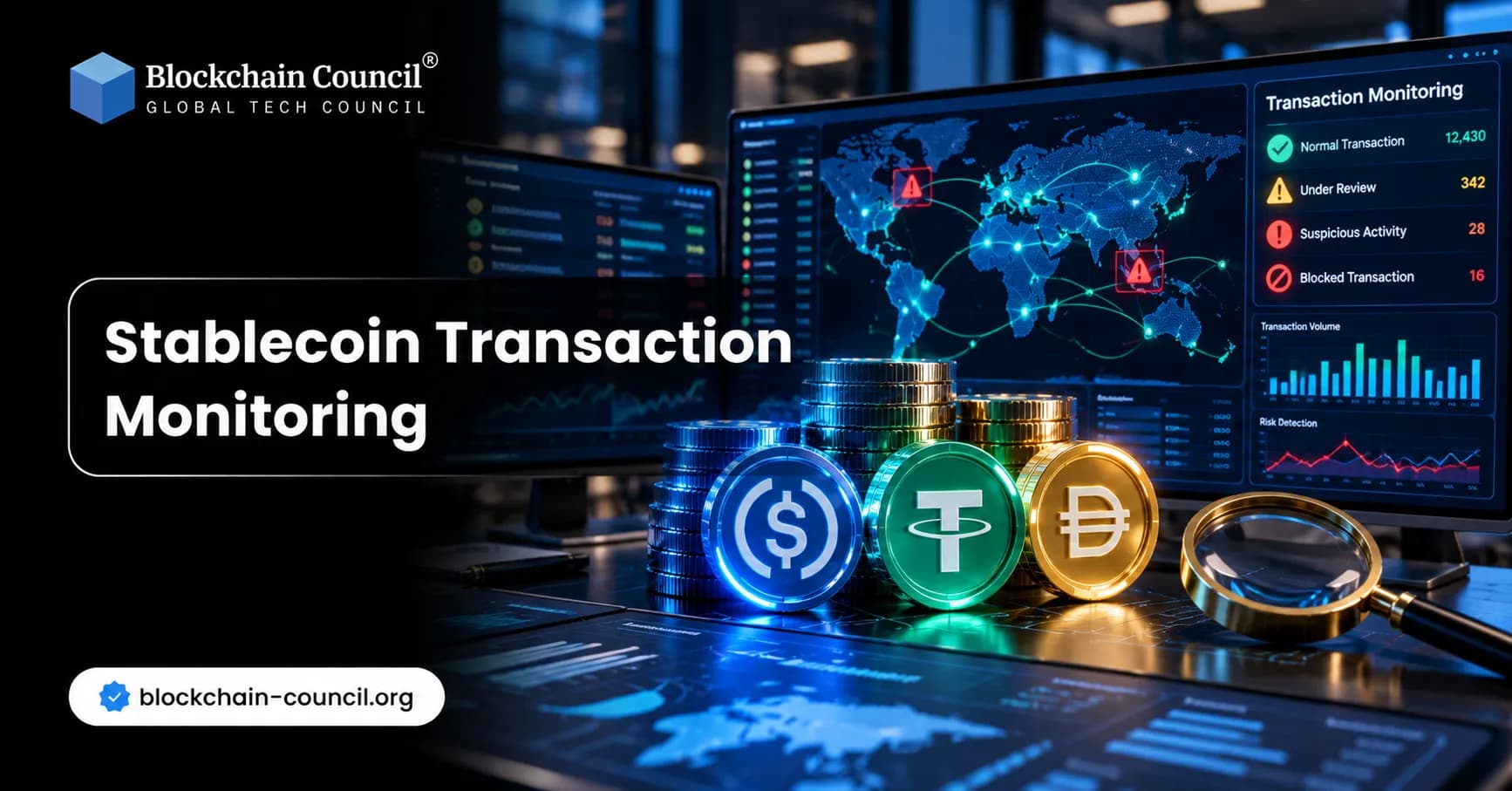
Every stablecoin payment leaves a digital trail. That trail can show a business paying a supplier, a worker sending money home, or, in rare cases, a criminal trying to hide stolen funds. The job of telling these stories apart falls to compliance and risk teams, and the main tool they use is Stablecoin Transaction Monitoring.
This guide explains what monitoring is, how it works, and how to build a process that catches real risk without drowning your team in noise. The language is simple enough for beginners, and the structure is detailed enough for experienced professionals. If you want a wider foundation in how stablecoin payments are built and managed, the Certified Stablecoin Payments Professional program is a useful place to start.

What Is Stablecoin Transaction Monitoring?
Transaction monitoring is the ongoing review of payments to spot activity that looks unusual, risky, or illegal. In the stablecoin world, it means watching deposits, withdrawals, transfers, swaps, and payments that move through a provider's platform or across public blockchains.
The Basic Goal
Monitoring serves three goals. First, it helps detect money laundering, fraud, terrorist financing, and sanctions evasion. Second, it helps firms meet legal duties under anti-money laundering rules. Third, it protects the business from financial loss and damage to its reputation.
How It Differs From Onboarding Checks
When a customer signs up, the provider checks identity and risk once. Monitoring picks up after that and never stops. A customer who looked safe on day one can behave very differently six months later. Monitoring is how you notice.
Why Stablecoins Need Their Own Approach
Stablecoin payments run all day, settle fast, and cross borders easily. Once funds leave a platform, they cannot always be pulled back. That makes early detection more valuable than after-the-fact review. At the same time, public blockchains offer a rich data source that traditional bank payments do not, which gives monitoring teams more to work with.
Who Needs It
Issuers, exchanges, custodians, wallet providers, payment processors, and banks that handle stablecoin flows all need some form of monitoring. The scale and design differ, but the principle is shared across all of them.
On-Chain Data and Customer Context
Good monitoring depends on good data. Two data types matter most, and the best programmes combine them.
On-Chain Data
On-chain data is the public record on the blockchain. It shows wallet addresses, amounts, timestamps, token types, and the path funds take between addresses. Anyone can read it, though turning it into useful insight takes tools and skill. Analysts can follow a payment across several hops, view how much a wallet has received over time, and see which services an address has interacted with.
Off-Chain Customer Context
On-chain data alone cannot say who a person is or what they plan to do. That information lives inside the provider's own systems. It includes verified identity, country, business type, expected payment size, source of funds, and the stated reason for using the service. This is often called customer context or know-your-customer data.
Why You Need Both
Imagine a wallet that receives 50,000 dollars in stablecoins in one day. For a trading firm that regularly moves millions, that may be routine. For a student account opened last week, it is a major red flag. The same number tells different stories depending on context. Joining both data types gives a fuller picture.
Building a Behavioral Baseline
A baseline is a picture of what normal looks like for each customer or customer group. It tracks typical amounts, frequency, destinations, and timing. Alerts then fire when behavior drifts far from that baseline. This is more precise than using the same fixed limits for everyone.
Data Quality Matters
Out-of-date addresses, missing fields, and inconsistent records weaken every alert. Teams should check data feeds regularly, fix gaps, and log changes. For readers who want a broader view of how wallets, exchanges, and digital assets fit together, the Certified Cryptocurrency Expert certification provides helpful background knowledge.
Risk Indicators and Alert Rules
Alert rules turn risk ideas into automatic checks. Each rule asks a question about a payment or a pattern of payments.
Common Red Flags
Some patterns show up again and again in investigations. These include:
Many small transfers just below a reporting or review limit, a pattern known as structuring
Funds that arrive and leave within minutes with no clear purpose, often called pass-through or rapid movement
Sudden activity on a long-quiet account
Use of many new wallets in a short period
Transfers to or from services linked to scams, stolen funds, or sanctioned parties
Repeated swaps between different tokens or chains with no business reason
Payments that do not match the customer's stated business
Rule Types
Threshold rules fire when a value passes a set limit, such as daily volume above a chosen amount. Velocity rules look at how fast activity happens. Pattern rules look for shapes, such as funds fanning out to many wallets and then converging again. Geographic rules look at risky countries. Behavioral rules compare activity with the customer's own baseline.
Risk-Based Tuning
Not every customer needs the same rules. A high-risk customer can have tighter limits and more checks, while a low-risk customer can have looser ones. Matching rules to risk helps focus effort where it matters most.
Writing Clear Rules
Every rule should have a written purpose, a clear trigger, an owner, and a review date. If nobody can explain why a rule exists, it probably creates more noise than value. Document each change so you can show regulators how your system evolved.
Wallet Screening and Exposure Analysis
Because blockchain addresses do not carry names, monitoring teams rely on screening and exposure analysis to understand who may be on the other side.
What Wallet Screening Means
Wallet screening checks an address against lists and databases of known risk. These can include sanctioned addresses, darknet markets, ransomware wallets, scam clusters, and stolen-fund trails. Screening runs when a customer first adds an address and each time funds move.
Direct and Indirect Exposure
Direct exposure means funds came straight from, or are going straight to, a risky address. Indirect exposure means risk sits further away, a few steps back in the chain. A payment that passed through two or three addresses before reaching your customer may still carry risk. Teams set rules about how many hops to trace and how much exposure to tolerate.
Risk Scores and Their Limits
Many analytics tools give each address a score. Scores help prioritise work, but they are not final judgments. A high score might come from a harmless link, such as a shared exchange wallet. A low score might hide risk that the tool has not yet seen. Human review is still needed.
Special Cases to Watch
Mixers and privacy tools make tracing harder. Cross-chain bridges move value between networks, which can break an easy trail. Peer-to-peer platforms and unhosted wallets have no regulated firm on the other side. Each of these usually deserves extra attention.
Teams building and tuning these systems can deepen their engineering skills through the Tech Certification programs, which cover blockchain, security, and system design topics.
Alert Triage and Investigation Workflows
An alert is only the start. What happens next decides whether monitoring is effective.
Step 1: Prioritise
Not all alerts are equal. Triage sorts them by risk, value, customer type, and deadline. Alerts tied to sanctions or large sums go to the top of the queue. Clear service-level targets, such as reviewing high-priority alerts within a set number of hours, keep work moving.
Step 2: Gather Facts
The analyst reviews the customer profile, past activity, the specific transactions, the counterparties, and any wallet screening results. They compare what happened against the customer's baseline and stated purpose. They may also check open-source information, such as news reports.
Step 3: Ask the Customer When Needed
Sometimes the best way to resolve an alert is to ask. A short request for an invoice, a contract, or an explanation of the funds can clear up a case quickly. Requests should be polite, specific, and recorded. Staff must take care not to reveal that a suspicious report is being considered.
Step 4: Decide and Document
The analyst reaches one of three outcomes. They can close the alert as a false alarm, keep monitoring with added controls, or escalate. Whatever the choice, they write a short, clear note on the evidence and reasoning. A good note lets a different person understand the case months later.
Step 5: Learn From Outcomes
Track which alerts led to real findings and which did not. Feed that back into rule design. Over time, the workflow should get sharper and faster.
False Positives and Model Governance
A false positive is an alert that looks risky but turns out to be harmless. They are the biggest daily headache in monitoring.
Why False Positives Hurt
Too many false alerts waste analyst time, delay genuine cases, and cause staff fatigue. In the worst case, real risk is missed because the queue is overloaded. Customers also suffer when legitimate payments are delayed without good reason.
Ways to Reduce Them
Teams use several tactics. They tune thresholds using real data. They group customers into peer segments so each group has fair limits. They add context, such as customer type and payment history, to rules. They suppress repeat alerts on cases already reviewed. They also test rule changes on past data before switching them on.
The Balance With False Negatives
Cutting alerts too hard risks missing true crime, known as a false negative. The goal is balance. Test changes carefully and measure both sides, so you know what you gain and what you give up.
Model Governance
When rules or machine learning models drive decisions, governance keeps them trustworthy. Good governance includes clear ownership, written documentation, version control, approval steps before changes, regular performance testing, and independent validation. If a model is hard to explain, regulators may question it, so aim for transparency.
Using Machine Learning Wisely
Machine learning can spot complex patterns that fixed rules miss. It still needs good training data, careful testing for bias, and human oversight. Treat it as a strong assistant, not a replacement for judgment.
Escalation, Reporting, and Recordkeeping
When an investigation suggests real wrongdoing, the process moves into formal escalation.
Escalation Paths
Cases that look serious go to a senior compliance officer, often called the money laundering reporting officer. That person reviews the evidence and decides whether to file a report with the authorities. Clear rules on who can escalate, who decides, and how quickly keep the process fast and consistent.
Suspicious Activity Reports
In most regions, regulated firms must report suspected criminal activity to a national financial intelligence unit. These reports are usually confidential, and staff are normally barred from telling the customer, a rule called tipping off. Deadlines vary by country, so build calendars and reminders into the workflow.
Sanctions Actions
If a sanctions match is confirmed, the firm may need to freeze assets, block transfers, and notify the right authority right away. Stablecoin issuers may also have technical tools to restrict certain addresses. Policies should describe when these powers are used and how decisions are reviewed.
Recordkeeping
Regulators expect firms to keep records of alerts, investigations, decisions, and reports. These typically include the evidence reviewed, the reasoning, and the people involved. Retention periods differ across regions, and five years or more is common. If something is not written down, it can be treated as not done.
Regulatory Landscape
Rules are still developing. The Financial Action Task Force sets global standards, including the Travel Rule on sharing sender and receiver data. The European Union's MiCA framework and the United States GENIUS Act also shape stablecoin duties. Details differ across regions and business types, so confirm current rules for each market you serve.
Selecting Monitoring Tools
Most firms use specialist software, either built in-house or bought from a vendor. Choosing well saves cost and risk.
Features to Look For
Coverage of the blockchains and stablecoins you support
Real-time or near-real-time alerting
Strong wallet screening and exposure tracing
Flexible rules that your team can adjust without heavy coding
Case management with audit trails
Easy links to your identity, payments, and reporting systems
Clear reporting and dashboards for management
Questions for Vendors
Ask how often risk data is updated, how the vendor labels addresses, how accuracy is measured, and how the tool handles new chains. Ask for customer references and for details on data privacy and security. Request a trial using your own past data so you can see real results.
Build, Buy, or Blend
Building gives control but requires heavy engineering and ongoing upkeep. Buying is faster and brings specialist data. Many firms blend the two, using a vendor for data and analytics while building custom rules and workflows on top.
People and Skills
Stablecoin infrastructure connects digital assets with payment systems, financial services, and blockchain networks. Organisations working in this space need talent with the right mix of technical, financial, and operational knowledge. HireValid's candidate assessment platform is worth exploring for teams looking to evaluate role-specific skills during recruitment.
Measuring Success
Track simple measures. These include alert volume, time to review, share of alerts that become reports, false positive rate, and audit findings. Review them often and share results with leadership. Clear messaging to customers about why checks exist also builds trust, and the Marketing Certification programs can help teams explain security steps in friendly, understandable language.
Final Thoughts
Stablecoin Transaction Monitoring works best when data, rules, people, and governance all pull in the same direction. Combine on-chain data with customer context, write clear rules, screen wallets, triage with discipline, manage false positives, and keep strong records. Choose tools that fit your business, and keep improving as threats and regulations change. Done well, monitoring protects customers, supports growth, and builds lasting trust in stablecoin payments.
FAQs
1. What Is Stablecoin Transaction Monitoring?
Stablecoin transaction monitoring is the process of tracking and analyzing stablecoin transfers to identify suspicious activity, financial crime risks, and potential regulatory violations. Businesses use automated tools, blockchain analytics, and compliance procedures to review transaction patterns and investigate unusual behavior.
2. Why Is Transaction Monitoring Important for Stablecoins?
Transaction monitoring helps stablecoin issuers, exchanges, payment providers, and financial institutions identify potentially illicit transfers and manage financial risks. It supports anti-money laundering (AML) compliance, sanctions screening, fraud prevention, and regulatory reporting while improving visibility into transaction activity.
3. How Does Stablecoin Transaction Monitoring Work?
Stablecoin transaction monitoring typically involves collecting transaction data, analyzing activity against predefined risk rules, generating alerts, and investigating suspicious patterns. Compliance teams may review wallet histories, transaction amounts, counterparties, and other relevant information before deciding whether additional action is required.
4. What Types of Stablecoin Transactions Should Businesses Monitor?
Businesses may monitor stablecoin deposits, withdrawals, transfers between wallets, merchant payments, cross-border payments, exchange transactions, and transactions involving liquidity providers. The monitoring scope depends on the business model, applicable regulations, customer risk profiles, and available transaction data.
5. What Are the Common Red Flags in Stablecoin Transactions?
Potential warning signs include unusually large transfers, rapid movement of funds through multiple wallets, repeated transactions inconsistent with a customer's profile, interactions with high-risk addresses, and unusual transaction patterns across jurisdictions. These indicators require contextual review and do not automatically prove illegal activity.
6. How Does Blockchain Analytics Support Stablecoin Transaction Monitoring?
Blockchain analytics helps compliance teams trace transaction flows, examine wallet relationships, identify exposure to known high-risk addresses, and investigate patterns across public blockchain networks. These tools provide useful insights, but they may not establish the real-world identity of a wallet owner or reveal every off-chain activity.
7. What Is the Role of AI in Stablecoin Transaction Monitoring?
Artificial intelligence can analyze large transaction datasets, identify unusual patterns, prioritize alerts, and help detect emerging risk indicators. Machine learning models can supplement traditional rule-based systems, but their effectiveness depends on data quality, model validation, ongoing monitoring, and human oversight.
8. How Does Real-Time Stablecoin Transaction Monitoring Work?
Real-time monitoring evaluates transaction activity as it occurs or as quickly as the relevant systems receive data. Depending on the infrastructure, it can flag suspicious transfers, trigger additional checks, or route transactions for review. Actual intervention capabilities depend on the platform, blockchain design, and applicable legal authority.
9. What Is the Difference Between On-Chain and Off-Chain Transaction Monitoring?
On-chain monitoring analyzes transactions recorded on a blockchain, including wallet addresses, transaction values, and transfer histories. Off-chain monitoring examines activity recorded in systems outside the blockchain, such as exchange accounts, customer records, payment platforms, and bank transfers. Combining both can provide a more complete compliance picture.
10. How Does Stablecoin Transaction Monitoring Support AML Compliance?
Transaction monitoring supports AML programs by identifying activity that may require further investigation. Compliance teams can assess transaction patterns, verify customer information, investigate fund sources, maintain records, and submit suspicious transaction reports when required by applicable laws.
11. What Is Wallet Risk Scoring in Stablecoin Monitoring?
Wallet risk scoring assigns a risk level to a blockchain address based on relevant indicators, such as exposure to sanctioned entities, known illicit services, suspicious transaction patterns, or other risk signals. Scores help prioritize investigations but should be interpreted carefully because data can be incomplete or incorrectly attributed.
12. How Can Businesses Monitor Cross-Border Stablecoin Transactions?
Businesses can monitor cross-border stablecoin transfers by reviewing transaction flows, screening relevant parties and addresses, assessing geographic exposure, and verifying customer and counterparty information where required. They should also consider local AML regulations, sanctions requirements, and applicable information-sharing obligations.
13. What Is the Difference Between Transaction Monitoring and Wallet Screening?
Wallet screening checks a blockchain address against risk intelligence, sanctions information, and other relevant indicators. Transaction monitoring examines transaction behavior and patterns over time. The two processes complement each other: wallet screening provides address-level risk information, while monitoring can identify suspicious activity even when an address has no known risk history.
14. How Can Stablecoin Businesses Reduce False-Positive Alerts?
Businesses can reduce false positives by improving risk rules, using reliable customer information, adjusting thresholds to reflect transaction context, and regularly reviewing alert outcomes. Risk-based automation and carefully validated analytics can help prioritize genuine concerns without removing necessary compliance safeguards.
15. What Challenges Do Businesses Face in Stablecoin Transaction Monitoring?
Common challenges include high transaction volumes, pseudonymous wallet addresses, multiple blockchain networks, fragmented risk intelligence, rapidly changing criminal techniques, and inconsistent regulations across jurisdictions. Businesses may also struggle with false positives, limited off-chain visibility, and the cost of maintaining effective monitoring systems.
16. What Information Is Needed for Effective Stablecoin Transaction Monitoring?
Effective monitoring may require blockchain transaction data, wallet addresses, transaction timestamps and values, customer identity information where available, counterparty details, and relevant risk intelligence. Regulated providers may also need records associated with transfers and customer relationships to meet applicable reporting and recordkeeping requirements.
17. How Does Stablecoin Transaction Monitoring Help Prevent Fraud?
Monitoring can identify unusual payment behavior, suspicious wallet interactions, unexpected transaction frequency, and transfers that differ from a customer's established activity. When combined with account security, identity verification, and fraud investigation procedures, it can help businesses detect and respond to potential scams or unauthorized activity.
18. What Are the Regulatory Requirements for Stablecoin Transaction Monitoring?
Requirements vary by jurisdiction and the type of service being provided. Covered businesses may need to implement risk-based AML controls, monitor transactions, screen for sanctions exposure, maintain records, and report suspicious activity. Businesses should consult the laws and regulatory guidance applicable to their operations rather than assume a single global standard applies.
19. How Should Businesses Choose a Stablecoin Transaction Monitoring Solution?
Businesses should evaluate blockchain coverage, alert accuracy, risk intelligence quality, integration options, investigation tools, reporting capabilities, scalability, data security, and total cost. They should also assess whether the provider supports their compliance obligations and offers transparent information about detection methods and limitations.
20. What Is the Future of Stablecoin Transaction Monitoring?
Stablecoin transaction monitoring is likely to become more automated, with greater use of AI-assisted investigations, cross-chain analytics, improved risk intelligence, and real-time detection. As stablecoin adoption expands, businesses will need adaptable monitoring systems that combine technology, reliable data, human judgment, and jurisdiction-specific compliance procedures.
Related Articles
View All
Stablecoin
Stablecoin Payment Risk Management Framework
Stablecoin payment risk spans the issuer, reserve assets, blockchain network, wallets, service providers, compliance obligations, and business operations. Learn how organisations can identify exposures, assign controls, and prepare for incidents.

Stablecoin
Stablecoin Payments ROI: A Business Evaluation Guide
Stablecoin payment ROI depends on the business's payment routes, transaction volume, conversion costs, integration effort, and risk controls. Use this framework to compare total costs and benefits against existing payment methods.

Stablecoin
Stablecoin Payment Fraud Prevention Guide
Stablecoin transactions can create operational risks when businesses send funds to incorrect addresses, fall for impersonation, or fail to detect suspicious activity. This guide outlines prevention controls and response procedures for payment teams.
Trending Articles
The Role of Blockchain in Ethical AI Development
How blockchain technology is being used to promote transparency and accountability in artificial intelligence systems.
AWS Career Roadmap
A step-by-step guide to building a successful career in Amazon Web Services cloud computing.
Top 5 DeFi Platforms
Explore the leading decentralized finance platforms and what makes each one unique in the evolving DeFi landscape.