

Stablecoin Issuer vs Payment Provider Explained

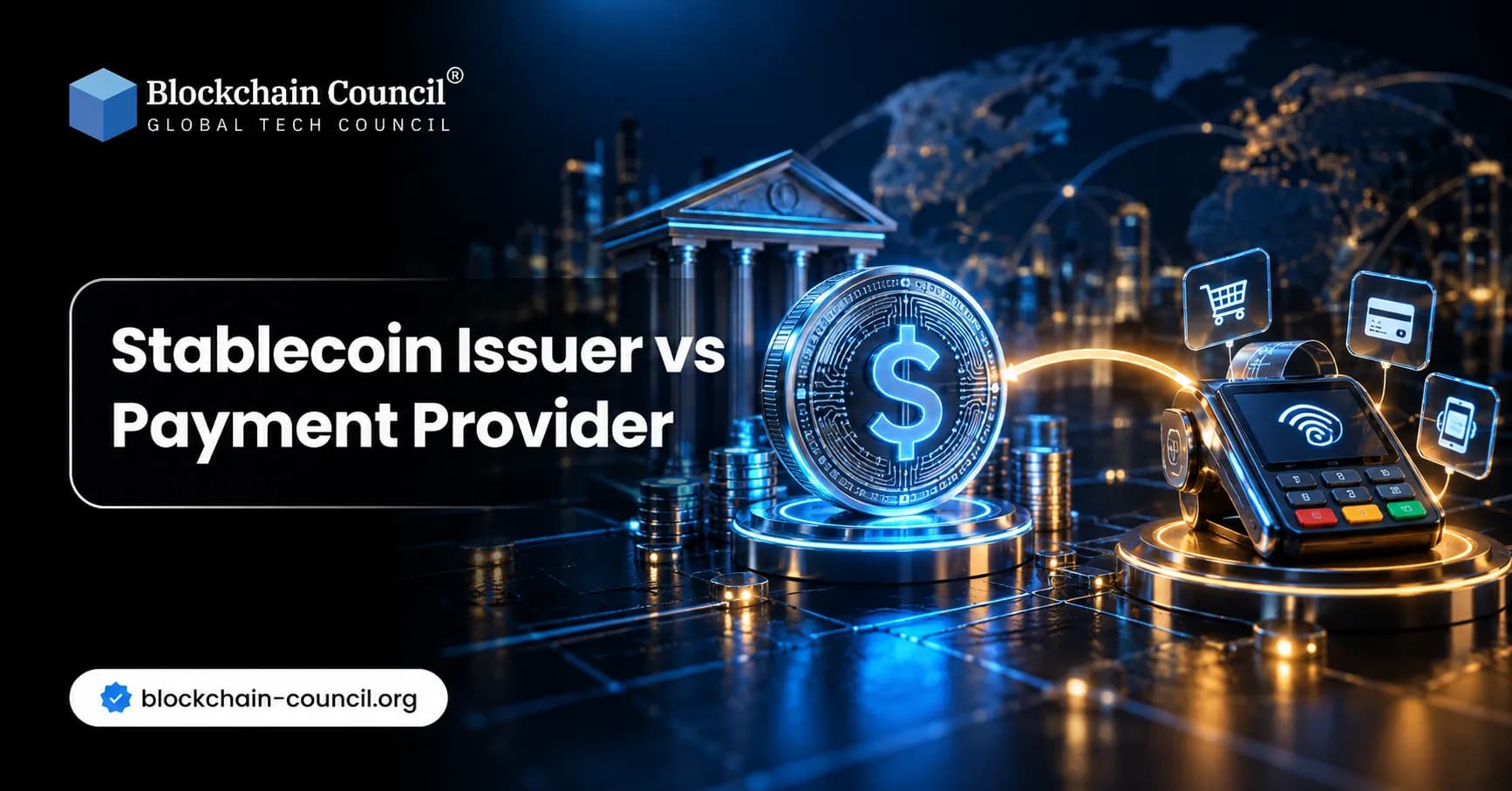
Two kinds of companies sit behind every stablecoin payment, and many buyers confuse them. One creates the token. The other helps businesses and customers use it. Understanding Stablecoin Issuer vs Payment Provider roles helps you choose partners, split responsibilities, and avoid nasty surprises when something goes wrong. A merchant who picks a payment provider is not choosing the company that holds the reserves behind the token, and that difference matters. Finance leaders, product managers, and compliance teams can build deeper expertise through a Certified Stablecoin Payments Professional credential. This guide explains each role in plain language and compares them side by side. It is general information, not legal advice.
What Does a Stablecoin Issuer Do?
A stablecoin issuer creates the digital token and promises to redeem it for a fixed amount of money, usually one U.S. dollar. Circle, which issues USDC, and Tether, which issues USDT, are well-known examples. Paxos issues PYUSD, the token that PayPal offers to its users.

Think of an issuer as a mint combined with a vault. It creates tokens when customers deposit money, and it destroys tokens when customers redeem them. It also holds the reserves that back every token in circulation.
Core Jobs of an Issuer
Minting: Create new tokens when approved customers deposit funds.
Burning: Remove tokens from circulation when customers redeem.
Reserve management: Hold cash, bank deposits, and short-term government securities that back the tokens.
Disclosure: Publish information about reserves and policies.
Redemption: Honor requests to convert tokens back to currency.
Compliance: Run anti-money-laundering and sanctions programs and respond to lawful orders, including token freezes.
Technical control: Maintain the smart contract that defines how the token works.
Who Regulates Issuers?
Rules are tightening. In the United States, the GENIUS Act of July 2025 created a federal framework for permitted payment stablecoin issuers. The Office of the Comptroller of the Currency issued a final rule on October 21, 2026, and the law takes effect on January 18, 2027. In the European Union, MiCA limits euro and dollar-style tokens to licensed credit institutions and electronic money institutions. An issuer's license status is therefore a key sign of quality.
What Does a Stablecoin Payment Provider Do?
A stablecoin payment provider helps people and businesses send, receive, and manage stablecoin payments. It does not usually create the token. Instead, it builds the tools that make payments simple, such as checkout pages, wallets, APIs, and payout systems.
Imagine a payment terminal in a shop. The terminal does not print money. It connects the customer to the payment network and tells the merchant when the payment arrives. A stablecoin payment provider plays a similar role for digital dollars. Learners who study for a Certified Cryptocurrency Expert credential often explore these building blocks and how they connect to blockchains.
Core Jobs of a Payment Provider
Payment acceptance: Create invoices, addresses, and payment links.
Blockchain monitoring: Watch networks and confirm that transfers arrive.
Wallet services: Manage wallets for customers or merchants.
Conversion: Swap stablecoins for local currency, or the reverse.
Payouts: Send funds to bank accounts, wallets, or other recipients.
Reporting: Provide records for accounting and reconciliation.
Compliance support: Screen wallets, monitor transactions, and share Travel Rule data.
Developer tools: Offer APIs, webhooks, and plugins for stores and apps.
Types of Payment Providers
Payment providers come in several forms. Some are crypto-native gateways. Others are traditional payment companies that added stablecoin features. Banks and fintech apps may also act as providers for their customers. Some are custodial, which means they hold funds for you, and others are non-custodial.
Who Regulates Providers?
Regulation depends on what the provider does and where it works. In the United States, many are money transmitters and register with FinCEN and with state regulators. In the EU, many are crypto-asset service providers under MiCA, and some are licensed as payment or e-money institutions. Always check the provider's licenses for each market you serve.
How Issuance and Payment Processing Differ
The simplest way to see the difference is to follow the money.
Question | Stablecoin issuer | Payment provider |
|---|---|---|
Creates the token? | Yes | No |
Holds reserves backing the token? | Yes | No, unless it also issues |
Main customers | Exchanges, institutions, partners | Merchants, platforms, businesses |
Main revenue | Income earned on reserves | Fees, spreads, and subscriptions |
Core product | The stablecoin itself | Checkout, wallets, APIs, and payouts |
Typical regulation | Issuer licensing and reserve rules | Money transmission or crypto service rules |
Main risk | Reserve quality and redemption | Operations, custody, and compliance |
A Simple Example
Suppose a customer pays an online store with USDC. Circle is the issuer of that USDC. The store uses a payment provider that creates the invoice, watches the blockchain, and turns the funds into local currency. The issuer stands behind the token's value. The provider delivers the payment experience.
Why Roles Sometimes Blur
Some companies play both roles. A large issuer may also run a payment platform, and a payment company may launch its own token or partner closely with an issuer. Always ask which entity does what in your specific arrangement. A single brand can hide several legal entities.
Understanding these differences requires some technical knowledge about tokens, wallets, and networks. A broad Tech Certification path can help professionals build the foundation to read documentation, evaluate vendors, and ask sharper questions.
Custody, Redemption, and Conversion Roles
Three words often cause confusion: custody, redemption, and conversion.
Custody
Custody means holding and protecting the keys that control funds. An issuer holds the reserve assets that back the token. A payment provider may hold the tokens themselves on behalf of customers, in a custodial wallet. These are two different kinds of custody, and a failure in one does not automatically mean a failure in the other.
Redemption
Redemption means turning a token back into money at face value. This is the issuer's duty. In practice, many issuers offer direct redemption mainly to approved institutional customers, often with minimum amounts and onboarding steps. Everyday users usually redeem through exchanges or payment providers. In the EU, MiCA gives holders of electronic money tokens a right to redeem at par at any time, and the GENIUS Act requires issuers to honor redemption under published policies.
Conversion
Conversion means swapping one asset for another, such as USDC for euros. A payment provider often handles this through liquidity partners, exchanges, or banks. It may charge a fee or a spread, which is the gap between the market rate and the rate you receive.
Who Does What in a Payment
Step | Usually done by |
|---|---|
Create or destroy tokens | Issuer |
Hold reserve assets | Issuer and its custodians |
Accept payment from the customer | Payment provider |
Hold tokens for the merchant | Payment provider or merchant |
Convert to local currency | Payment provider or partner |
Redeem for currency directly | Issuer, for approved customers |
Pay out to the bank | Payment provider |
Compliance Responsibilities Across the Payment Chain
Compliance duties follow the roles, and they overlap in some places.
Issuer Duties
Issuers must follow licensing rules, keep proper reserves, and publish disclosures. They must also run anti-money-laundering programs and sanctions controls. The proposed U.S. rules from FinCEN and OFAC would treat permitted payment stablecoin issuers as financial institutions under the Bank Secrecy Act, and they would require blocking capability. Issuers can also freeze tokens at specific addresses when they receive lawful orders.
Payment Provider Duties
Payment providers must know their customers, screen wallets, and monitor transactions. They must follow sanctions rules and keep records. When they send funds to other regulated firms, they may need to share sender and receiver information under the Travel Rule. They may also have licensing duties as money transmitters or crypto service providers.
Merchant Duties
Merchants still carry responsibilities. They must follow tax rules, consumer protection laws, and sanctions rules for their own business. They should also choose providers carefully and keep records.
Why Shared Duties Need Clear Contracts
Because duties overlap, contracts matter. A good agreement states who screens what, who stores records, who answers regulator requests, and who pays when a problem arises. Do not assume the other side will handle a task unless the contract says so.
Who Handles Customer Support and Disputes?
Support splits across the chain, and unclear roles frustrate customers.
Payment Questions Go to the Provider or Merchant
If a customer asks, "Where is my payment?" the payment provider or the merchant usually answers. They can see the invoice, the transaction on the blockchain, and the order status. They handle failed payments, wrong amounts, and late transfers.
Token and Reserve Questions Go to the Issuer
Questions about redemption, reserves, or the token's rules belong to the issuer. For instance, a holder who cannot redeem tokens at face value must contact the issuer or the platform that offers redemption.
Disputes Work Differently Than Cards
Blockchain payments are final once confirmed. There is no card-style chargeback system. Refunds are new transfers, so the merchant or provider must send them. For that reason, merchants should publish clear refund rules, and providers should offer tools for returning funds.
Plan the Escalation Path
Write down who handles each type of issue and how fast. For serious problems, such as a suspected theft or a frozen address, define contacts at the provider, the issuer, and your own legal team. In stablecoin theft cases, speed matters because issuers may be able to freeze tokens quickly, though recovery is never guaranteed.
Counterparty and Operational Risks
Every link in the chain carries risk.
Issuer Risks
Reserve risk: Reserves may be poorly managed or held with weak institutions.
Redemption risk: The issuer may delay or limit redemptions in stress.
Regulatory risk: An issuer may lose a license or face enforcement, which can limit where its token can be used.
Freeze risk: Tokens at a flagged address may be frozen.
Depeg risk: The token's market price may drift from one dollar during panic.
Payment Provider Risks
Custody risk: If the provider holds your funds, its hack or failure can hurt you.
Operational risk: Outages, bugs, or slow support can disrupt sales.
Compliance risk: A provider's weak controls can lead to account freezes or partner losses.
Concentration risk: Relying on one provider or one stablecoin creates a single point of failure.
Business risk: Providers change terms or exit markets. For example, one industry report says a major gateway stopped serving merchants outside the United States and Singapore in March 2026.
Reduce Risk With Simple Steps
Use more than one provider where possible.
Convert funds to local currency promptly if you do not need stablecoins.
Review reserve disclosures and license status regularly.
Keep exportable records so you can switch providers.
Run small tests before you scale.
Questions to Ask Before Selecting a Provider
Use this checklist when you talk to vendors.
About the Company
Which legal entity will we contract with, and where is it licensed?
Which stablecoins and networks do you support?
Who is the issuer of each token you handle, and what is its regulatory status?
What is your track record, ownership, and financial strength?
About Custody and Funds
Do you hold our funds, or do we hold them?
How do you secure keys, and what audits do you have?
How fast can we withdraw or convert funds?
What happens to our balances if you fail or are acquired?
About Costs
What are all fees, including network fees, spreads, and payout charges?
Are there minimums, caps, or hidden charges?
About Compliance and Support
How do you handle sanctions screening and Travel Rule data?
What reports and records can we export?
How do you manage refunds, errors, and disputes?
What support hours and response times do you offer?
About Technology
Do you offer a sandbox, clear documentation, and signed webhooks?
What are your uptime records and incident history?
How easy is it to leave if we need to switch?
Why Skills and Smart Hiring Matter in Stablecoin Operations
Stablecoin infrastructure connects digital assets with payment systems, financial services, and blockchain networks. Organisations working in this space need talent with the right mix of technical, financial, and operational knowledge. HireValid's candidate assessment platform is worth exploring for teams looking to evaluate role-specific skills during recruitment.
Conclusion
The Stablecoin Issuer vs Payment Provider question comes down to roles. The issuer creates the token, holds the reserves, and promises redemption. The payment provider builds the experience around it, with checkout, wallets, conversion, payouts, and reporting. Both carry compliance duties, and both carry risk. A problem at either link can affect your business.
Choose partners carefully, read the contracts, and ask the hard questions about licenses, custody, redemption, and support. Spread risk where you can, and keep your own records.
Marketing and communication teams also help customers understand these roles. People often assume one company handles everything, so clear explanations build trust. A recognised Marketing Certification can help professionals explain complex payment structures in plain language and set the right expectations. When strong partnerships meet clear communication, stablecoin payments become easier for everyone to trust.
FAQs
1. What Is the Difference Between a Stablecoin Issuer and a Payment Provider?
A stablecoin issuer creates and manages a stablecoin, including its reserve backing and redemption process. A payment provider helps businesses and customers send, receive, process, or settle payments. An issuer focuses on the digital asset, while a payment provider focuses on payment services and transactions.
2. What Is a Stablecoin Issuer?
A stablecoin issuer is an organization responsible for issuing a stablecoin designed to maintain a relatively stable value, often through a peg to a currency such as the US dollar. Depending on its structure, the issuer may manage reserves, mint and burn tokens, and provide redemption services.
3. What Is a Stablecoin Payment Provider?
A stablecoin payment provider offers infrastructure that enables businesses to accept or send stablecoin payments. Its services may include payment processing, checkout integration, transaction monitoring, wallet connectivity, conversion to fiat currency, and merchant settlement.
4. How Does a Stablecoin Issuer Make Money?
A stablecoin issuer may generate revenue from interest or other returns on reserve assets, redemption or transaction-related fees, and institutional services. Its revenue model depends on its reserve structure, operating costs, contractual arrangements, and applicable regulations.
5. How Does a Stablecoin Payment Provider Make Money?
A stablecoin payment provider may earn revenue through processing fees, currency conversion spreads, withdrawal charges, subscription plans, and enterprise payment services. Pricing varies by provider, supported blockchain, transaction volume, and settlement options.
6. Who Controls Stablecoin Reserves: The Issuer or the Payment Provider?
The issuer typically manages or arranges the backing reserves for its stablecoin, subject to its legal and operational structure. A payment provider generally does not control those reserves simply because it processes payments using the token. However, a provider may separately hold customer funds or stablecoins if its service includes custody.
7. What Is the Role of a Stablecoin Issuer in Blockchain Payments?
A stablecoin issuer supports the availability and operation of the token used for payment. Depending on the token, it may manage issuance, redemption, reserve reporting, and certain administrative controls. The blockchain network itself records token transfers, while payment providers can make those transfers easier to use commercially.
8. What Is the Role of a Payment Provider in Stablecoin Transactions?
A payment provider connects the customer's payment experience with the merchant's systems. It may generate payment instructions, monitor blockchain confirmations, notify merchants of successful payments, manage refunds, and support transaction reconciliation.
9. Can a Stablecoin Issuer Also Be a Payment Provider?
Yes. A company can offer both stablecoin issuance and payment services. However, these functions involve different responsibilities. Issuance concerns the creation and backing of the token, while payment services involve processing transactions, supporting merchants, and managing settlement workflows.
10. What Are Examples of Stablecoin Issuers?
Examples include Tether, which issues USDT, and Circle, which issues USDC. These companies are associated with stablecoin issuance, although their products and services extend into other areas of digital financial infrastructure.
11. What Are Examples of Stablecoin Payment Providers?
Examples include Coinbase Commerce, BitPay, and BVNK, which offer different forms of cryptocurrency or stablecoin payment infrastructure. Their supported assets, merchant services, settlement methods, and geographic availability vary, so businesses should check each provider's current offering.
12. Is a Stablecoin Issuer the Same as a Crypto Exchange?
No. A stablecoin issuer creates and manages a particular stablecoin, while a crypto exchange enables users to buy, sell, or trade digital assets. Some companies operate in multiple categories, but issuing a stablecoin and operating an exchange are distinct functions.
13. Is a Stablecoin Payment Provider the Same as a Traditional Payment Gateway?
They perform similar functions, but their payment rails can differ. A traditional payment gateway commonly connects merchants to card networks and banking systems. A stablecoin payment provider can facilitate blockchain-based transfers and may also offer fiat conversion or connections to traditional payment infrastructure.
14. Who Is Responsible When a Stablecoin Loses Its Peg?
Responsibility depends on the cause and the parties involved. The issuer may be responsible for obligations relating to reserves and redemption under its terms and applicable law. Market liquidity, trading conditions, blockchain disruptions, and third-party service failures can also affect a stablecoin's price. A payment provider cannot automatically guarantee that a token will maintain its peg.
15. Are Stablecoin Issuers and Payment Providers Regulated Differently?
They can be. Issuers may face requirements involving reserves, redemption rights, disclosures, and issuance authorization. Payment providers may face rules covering payment services, custody, money transmission, anti-money-laundering controls, and consumer protection. The exact requirements depend on the jurisdiction, business activities, and legal structure.
16. Which Is More Important for a Business Accepting Stablecoin Payments?
Both can matter, but their importance depends on the business model. The issuer's reliability, reserve transparency, and redemption arrangements affect confidence in the stablecoin. The payment provider's security, transaction reliability, fees, settlement options, and integration capabilities affect the merchant's day-to-day operations.
17. Can Businesses Accept Stablecoins Without Working Directly With an Issuer?
Yes. Businesses can often use a payment provider that supports established stablecoins. The provider handles the payment integration, while the stablecoin issuer remains responsible for its own issuance and related obligations. Businesses should still assess the token, the provider, and the applicable legal requirements.
18. How Do Stablecoin Issuers and Payment Providers Handle Compliance?
Issuers may implement controls related to issuance, redemption, reserves, sanctions, and suspicious activity, as required by their obligations. Payment providers may conduct customer verification, transaction monitoring, sanctions screening, and merchant onboarding. Responsibilities can overlap, but using one service does not automatically satisfy every compliance requirement.
19. How Should Businesses Choose Between a Stablecoin Issuer and a Payment Provider?
Businesses should first identify what they need. Organizations creating a stablecoin need to evaluate issuance infrastructure, reserve management, redemption, governance, and legal requirements. Merchants accepting stablecoin payments should compare payment providers based on supported tokens and networks, fees, settlement options, security, integrations, and geographic coverage.
20. What Is the Future of Stablecoin Issuers and Payment Providers?
Stablecoin issuers and payment providers may become increasingly interconnected as digital assets are used for cross-border transfers, business payments, and settlement. Issuers can focus on trustworthy tokens and redemption infrastructure, while payment providers can make stablecoin transactions more accessible to merchants and customers. Clear regulation, strong security, and reliable settlement will remain essential.
Related Articles
View All
Stablecoin
Stablecoin Payment APIs Explained
Stablecoin payment APIs connect business applications with payment providers and blockchain infrastructure. Learn how API-based payment initiation, transaction monitoring, confirmations, and reconciliation fit into a stablecoin payment workflow.
Stablecoin
Stablecoin Payment Risk Management Framework
Stablecoin payment risk spans the issuer, reserve assets, blockchain network, wallets, service providers, compliance obligations, and business operations. Learn how organisations can identify exposures, assign controls, and prepare for incidents.

Stablecoin
Stablecoin Payment Fraud Prevention Guide
Stablecoin transactions can create operational risks when businesses send funds to incorrect addresses, fall for impersonation, or fail to detect suspicious activity. This guide outlines prevention controls and response procedures for payment teams.
Trending Articles
The Role of Blockchain in Ethical AI Development
How blockchain technology is being used to promote transparency and accountability in artificial intelligence systems.
How Blockchain Secures AI Data
Understand how blockchain technology is being applied to protect the integrity and security of AI training data.

Can DeFi 2.0 Bridge the Gap Between Traditional and Decentralized Finance?
The next generation of DeFi protocols aims to connect traditional banking with decentralized finance ecosystems.