

Stablecoin Payment APIs Explained

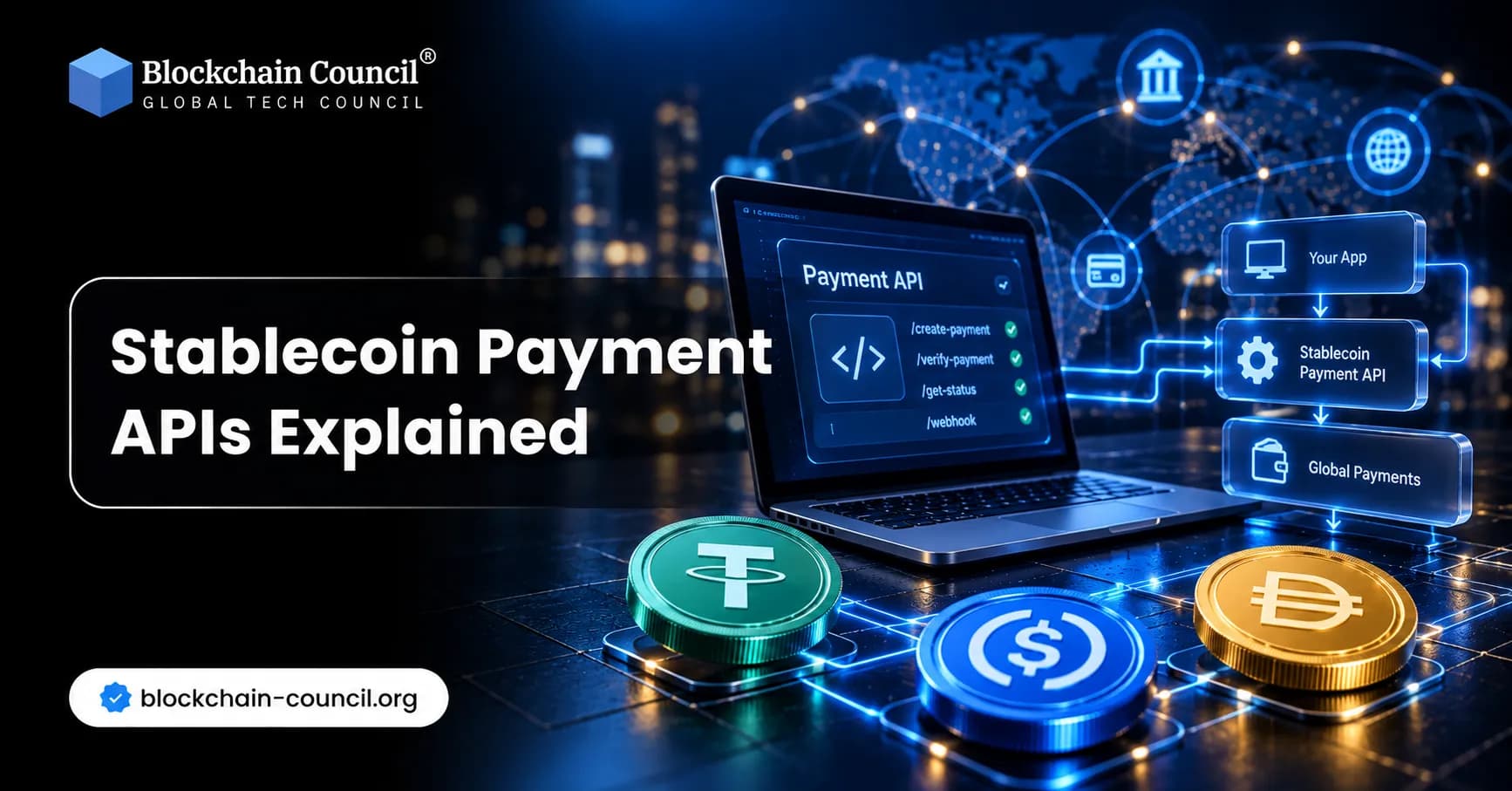
Every stablecoin payment starts as a few lines of code. Behind the checkout button, an API sends a request, a blockchain moves the money, and a message comes back saying the order is paid. Stablecoin Payment APIs hide the hard blockchain work and give developers simple tools to accept, send, and track digital dollars. One study from February 2026, reported by industry sources, estimated annual stablecoin payment volume at about $390 billion, with roughly 60 percent coming from business-to-business payments. Teams that want to build on this trend, including those who study for a Certified Stablecoin Payments Professional credential, need to understand how these APIs behave. This guide explains the ideas step by step, from first request to final troubleshooting, in plain language for beginners and professionals.
What Is a Stablecoin Payment API?
An API, or application programming interface, is a set of rules that lets one piece of software ask another to do something. A stablecoin payment API lets your app ask a payment provider to create payment requests, watch blockchains, move funds, and report results.

Without an API, a developer would need to run blockchain nodes, manage wallet keys, read raw transactions, and handle many networks. With an API, the developer sends a simple message such as "create an invoice for 50 dollars" and receives a clear answer.
Most APIs follow a style called REST. You send a request to a web address, called an endpoint, with a method such as GET to read data or POST to create something. The response comes back in JSON, a simple text format that both people and programs can read.
Who Uses These APIs?
Several groups rely on them:
Online merchants accept stablecoin checkout without handling crypto directly.
Marketplaces and platforms pay sellers and workers across borders.
Fintech apps add digital dollar balances and transfers.
Finance teams automate treasury and supplier payments.
Every major payment processor now exposes some form of stablecoin API, according to industry comparisons. Stripe added stablecoins to its existing payments tools, and its Bridge unit supports stablecoin payouts. Circle, the USDC issuer, offers its own developer platform. Other providers focus on business payments or merchant checkout.
How Payment APIs Connect Applications and Blockchains
Think of the API as a translator and a messenger. Your application speaks web language. The blockchain speaks a different language of blocks and signatures. The provider sits in the middle and translates both ways. Anyone who studies for a Certified Cryptocurrency Expert credential learns the blockchain side of this bridge in detail.
The Basic Flow
Your server calls the API to create a payment request.
The provider returns an invoice with an address or payment link.
The customer sends stablecoins from a wallet.
The provider's nodes watch the network for the transfer.
After enough confirmations, the provider marks the invoice as paid.
The provider sends a webhook, which is an automatic message, to your server.
Your server updates the order and delivers the product.
What Sits Between Your App and the Chain
Providers usually run several layers. A blockchain monitoring layer reads transactions on each network. A wallet layer creates addresses and signs payouts. A compliance layer checks addresses and transactions against risk rules. A settlement layer converts funds and sends them to banks if needed. Your app sees none of this complexity, only clean requests and responses.
Common API Functions and Endpoints
Names differ between providers, but most APIs offer the same core functions. The table below shows typical examples.
Function | Typical endpoint | What it does |
Create invoice | POST /invoices | Starts a payment request |
Get invoice | GET /invoices/{id} | Checks the current status |
Generate address | POST /addresses | Creates a deposit address |
List transactions | GET /transactions | Returns payment history |
Create payout | POST /payouts | Sends funds to a recipient |
Refund | POST /refunds | Returns funds to a customer |
Check balance | GET /balances | Shows available funds |
Exchange rate | GET /rates | Shows conversion prices |
Manage webhooks | POST /webhooks | Registers where events are sent |
Always read your provider's documentation. Endpoint names, fields, and limits vary.
Common Request Data
Most create requests include an amount, a currency, a network, and a reference. The reference should be your own order number. It lets you match the payment to the order later.
{
"amount": "50.00",
"currency": "USDC",
"network": "base",
"reference": "ORDER-1042"
}
Payment Initiation and Address Generation
Payment initiation means starting a payment. Address generation means giving the customer a place to send funds. These two steps decide how easily you can match money to orders.
Unique Address per Invoice
Many providers create a fresh deposit address for each invoice. When funds arrive at that address, the provider knows which order they belong to. This method keeps matching simple and reduces mistakes.
Shared Address With a Memo or Reference
Some networks and platforms use one address plus a memo or tag. The customer must include the tag, or the payment cannot be matched. This method needs very clear instructions at checkout.
Idempotency Keys Prevent Double Charges
Networks fail, and requests time out. When your app retries a request, you do not want two invoices or two payouts. An idempotency key solves this. It is a unique value you send with each request that creates something. If the provider sees the same key again, it returns the original result instead of making a new one. Reports on major providers say Stripe and Bridge style APIs use idempotency keys on every request that changes data, and Circle requires a key header on such calls. Retention windows differ, and one source says Bridge documents a 24-hour window, so read the rules for your provider.
Expiry and Amount Rules
Invoices should expire after a set time, because exchange rates, fees, and customer intent change. Decide how to handle partial payments, extra payments, and late payments before you go live.
Getting these rules right touches networking, databases, and security. A broad Tech Certification path can help developers and managers build the base skills needed to design and review reliable payment integrations.
Transaction Status, Confirmations, and Webhooks
A blockchain payment is not instant truth. It moves through stages, and your app must understand them.
Typical Status Stages
Created: The invoice exists, and no payment has arrived.
Pending: A transfer is seen but not yet final.
Confirmed: The transfer reached the required confirmation level.
Completed: The provider has credited the payment or settled it.
Expired: No valid payment arrived in time.
Failed or underpaid: Something went wrong, such as the wrong amount.
What Are Confirmations?
A confirmation is a block added after the one containing the transfer. More confirmations mean a lower chance the transfer will be reversed. Fast networks can reach finality in seconds, while others take longer. Providers often fire events only after a chosen threshold. One comparison notes that Coinbase Commerce fires on confirmation thresholds and Circle posts deposit notices shortly after Ethereum finality.
A rare event called a chain reorganization can remove a transaction that looked confirmed. Better providers send a corrective event when this happens. Your system should be ready to reverse an order if it receives one.
How Webhooks Work
A webhook is a message that the provider sends to a web address you control. It saves you from polling, which means asking "is it paid yet?" over and over. A typical event might look like this:
{
"type": "invoice.paid",
"data": {
"invoice_id": "inv_8231",
"reference": "ORDER-1042",
"amount": "50.00",
"currency": "USDC"
}
}
Webhook Best Practices
Verify signatures: Providers sign events, often with HMAC. Recompute the signature with your shared secret and compare it using a safe method. Some also add a timestamp window, commonly around five minutes, to block replay attacks.
Respond fast: Return a success code quickly, then do heavy work in the background.
Handle duplicates: Providers retry on failure, so the same event may arrive twice. Store event IDs and process each one once.
Handle disorder: Events can arrive out of order. Check the invoice's current status through the API when needed.
Keep a backup: Poll the API for any invoice that stays pending too long.
Authentication, Key Management, and API Security
Money-moving APIs are high-value targets. Treat security as part of the design, not an add-on.
Authentication Methods
Providers commonly use API keys, bearer tokens, or OAuth. A key is a secret string that proves your server's identity. Use separate keys for test and live environments. Give each key only the permissions it needs, such as read-only for reporting.
Key Management Rules
Store keys in a secrets manager, never in code or public repositories.
Rotate keys on a schedule and after any suspected leak.
Use different keys for each service or team.
Restrict keys by IP address when the provider allows it.
Log every key use and review it.
Protecting Payouts
Payouts deserve extra care. Require two approvals for large amounts. Add allowlists for recipient addresses. Set daily limits and alerts for unusual transfers. Never let a single stolen key empty an account.
Testing and Integration Checklist
Good testing prevents expensive mistakes. Use this checklist.
Use the sandbox. Test with fake funds before touching real money.
Know the sandbox limits. One comparison reports that Bridge's sandbox fires no payment-related webhooks, so simulate events yourself or test them in a small live run.
Test the happy path. Create an invoice, pay it, and confirm your order updates.
Test failures. Try underpayment, overpayment, late payment, wrong network, and expired invoices.
Test retries. Repeat the same request with the same idempotency key and confirm only one result exists.
Test webhooks. Verify signatures, duplicates, delays, and out-of-order events.
Test refunds and payouts. Confirm amounts, fees, and records.
Check rate limits. Know how many calls you can make per minute and handle error replies politely.
Run a small live test. Send a tiny real payment and trace it from checkout to your books.
Prepare monitoring. Track error rates, webhook failures, and pending invoices.
Write a runbook. Document what staff should do when something fails.
Common Errors and Troubleshooting
Even good integrations hit problems. The table lists frequent errors and fixes.
Problem | Likely cause | What to do |
401 or 403 error | Wrong or restricted key | Check the key, environment, and permissions |
400 error | Bad request data | Check required fields and formats |
409 or duplicate response | Repeated idempotency key | Confirm the original result before retrying |
429 error | Too many requests | Slow down and add backoff delays |
Webhook not received | Wrong URL or blocked server | Check the endpoint, firewall, and logs |
Signature mismatch | Wrong secret or changed body | Verify the raw body and the right secret |
Payment stuck pending | Low fee, congestion, or few confirmations | Wait, check the explorer, and poll the API |
Underpaid invoice | Customer subtracted network fees | Apply your tolerance rule or request a top-up |
Wrong network | Customer sent on another chain | Follow the provider's recovery process |
Duplicate orders | Webhook processed twice | Store event IDs and ignore repeats |
A Simple Troubleshooting Routine
First, check your logs for the request ID. Second, look up the invoice in the API. Third, inspect the transaction on a block explorer. Fourth, compare the status with what your database shows. Finally, contact provider support with the invoice ID and transaction hash. This order saves time and gives support what they need.
Why Skills and Smart Hiring Matter in Payments Engineering
Stablecoin infrastructure connects digital assets with payment systems, financial services, and blockchain networks. Organisations working in this space need talent with the right mix of technical, financial, and operational knowledge. HireValid's candidate assessment platform is worth exploring for teams looking to evaluate role-specific skills during recruitment.
Conclusion
Stablecoin Payment APIs turn complex blockchain activity into simple, repeatable steps. Developers create invoices, watch statuses, receive webhooks, and send payouts through clear endpoints. The details decide success: unique addresses, idempotency keys, signature checks, careful key management, and thorough testing. When something goes wrong, a calm routine of logs, API lookups, and block explorers usually reveals the cause.
Start with a sandbox, build slowly, and test every failure you can imagine. Keep security and reconciliation in mind from day one. Choose providers with clear documentation and a way to leave if needs change.
Marketing and product teams should also understand the basics, because payment options shape the customer experience and conversion rates. A recognised Marketing Certification can help professionals explain new payment methods to customers and measure their effect on growth. When strong engineering meets clear communication, a stablecoin checkout becomes both reliable and easy to use.
FAQs
1. What Is a Stablecoin Payment API?
A stablecoin payment API is a software interface that allows websites, applications, and businesses to accept, process, track, and manage payments made with stablecoins. It connects a merchant's platform with payment infrastructure, blockchain networks, and transaction monitoring systems.
2. How Do Stablecoin Payment APIs Work?
Stablecoin payment APIs create payment requests, provide transaction details, and monitor blockchain activity. When a customer sends a supported stablecoin, the system verifies the transaction and updates the payment status. The merchant's application can then confirm the order or deliver the requested service.
3. What Are the Main Benefits of Stablecoin Payment APIs?
Stablecoin payment APIs can simplify digital payment processing, support international transactions, automate payment verification, and reduce manual reconciliation. They may also offer faster settlement and access to customers who prefer paying with digital assets.
4. Which Stablecoins Are Supported by Payment APIs?
Common stablecoins include USDT (Tether), USDC (USD Coin), and DAI (Dai). However, supported assets vary by provider and blockchain network. Businesses should verify token compatibility, network availability, liquidity, and regional restrictions before integrating an API.
5. What Are the Main Features of a Stablecoin Payment API?
Common features include payment request creation, wallet address generation, blockchain transaction monitoring, payment status notifications, refunds, transaction reporting, and settlement management. Some providers also support fiat conversion, fraud monitoring, and merchant dashboards.
6. How Can Businesses Integrate a Stablecoin Payment API?
Businesses typically select a provider, obtain API credentials, configure supported stablecoins, and connect the API to their checkout or billing system. They then test payment requests, webhook notifications, failed transactions, and refunds in a sandbox environment before launching in production.
7. What Is the Difference Between a Stablecoin Payment API and a Crypto Payment Gateway?
A stablecoin payment API is a technical interface that developers use to connect software with payment functionality. A crypto payment gateway is the broader payment service that may provide checkout pages, transaction processing, wallet infrastructure, settlement, and merchant tools. A gateway often exposes an API for custom integrations.
8. Are Stablecoin Payment APIs Suitable for E-Commerce Businesses?
Yes. E-commerce businesses can use stablecoin payment APIs to add digital asset payments to their checkout process. Integration can include creating payment requests, verifying incoming transactions, updating orders, and reconciling payments with inventory and accounting systems.
9. How Do Stablecoin Payment APIs Verify Transactions?
Payment APIs can monitor the relevant blockchain and verify the token contract, destination address, transaction amount, and confirmation status. Merchants should validate payment notifications on the server side, verify webhook signatures, and prevent duplicate events from triggering repeated order fulfillment.
10. Are Stablecoin Payment APIs Secure?
Security depends on the provider, blockchain infrastructure, wallet controls, and implementation. Businesses should protect API keys, use HTTPS, verify webhook signatures, restrict permissions, secure private keys, and monitor suspicious activity. Security testing and a documented incident-response process are also important.
11. Do Stablecoin Payment APIs Support Cross-Border Payments?
Many stablecoin payment APIs support payments across geographic borders when the relevant networks and services are available. They can reduce dependence on some traditional payment intermediaries, but local conversion, banking access, sanctions screening, and regulatory requirements can still affect transactions.
12. What Fees Are Associated With Stablecoin Payment APIs?
Potential costs include API or processing fees, blockchain network fees, currency conversion charges, withdrawals, and fiat settlement. Fees vary by provider, blockchain, transaction size, and payment method. Businesses should review the complete pricing structure before choosing a solution.
13. Can Stablecoin Payment APIs Convert Digital Assets Into Fiat Currency?
Some providers support conversion into traditional currencies such as US dollars or euros, while others transfer stablecoins directly to a merchant-controlled wallet. Availability depends on the provider, business location, supported currencies, and applicable regulations.
14. Do Stablecoin Payment APIs Support Automated Refunds?
Some APIs provide refund endpoints that help merchants initiate and track refunds. Others require a separate blockchain transaction. Because blockchain transfers are generally irreversible once confirmed, merchants should validate refund amounts and recipient addresses before authorizing payments.
15. Can Stablecoin Payment APIs Be Used for Recurring Payments?
Yes, depending on the provider's features and the customer's payment authorization. APIs can help manage subscription billing, renewal notifications, and payment confirmations. Recurring stablecoin payments may require a new customer-approved transaction for each billing cycle unless an appropriate authorized payment mechanism is available.
16. What Compliance Requirements Apply to Stablecoin Payment APIs?
Compliance requirements depend on the jurisdiction, provider, and business model. They may include customer verification, anti-money-laundering controls, sanctions screening, transaction monitoring, tax reporting, and licensing requirements. Businesses should obtain jurisdiction-specific legal guidance before processing customer payments.
17. How Do Stablecoin Payment APIs Handle Failed Transactions?
Payment systems can report pending, confirmed, expired, underpaid, or failed payment states. Developers should implement appropriate timeouts, status checks, error handling, and customer notifications. They should also distinguish between a submitted transaction and a sufficiently confirmed payment.
18. What Should Developers Look for When Choosing a Stablecoin Payment API?
Developers should evaluate supported stablecoins and networks, API documentation, uptime, security controls, webhook reliability, fees, settlement options, refund functionality, customer support, and regulatory coverage. A sandbox environment and clear error responses can make integration and testing more efficient.
19. What Challenges Can Businesses Face When Using Stablecoin Payment APIs?
Common challenges include blockchain congestion, network selection errors, volatile network fees, incorrect addresses, liquidity limitations, provider outages, and compliance complexity. Businesses can reduce these risks through clear checkout instructions, robust transaction monitoring, reconciliation procedures, and secure integration practices.
20. What Is the Future of Stablecoin Payment APIs?
Stablecoin payment APIs may become more widely used as digital payment infrastructure, business integrations, and regulatory frameworks evolve. Potential developments include better interoperability, automated settlement, improved payment analytics, and more seamless integration with e-commerce and financial applications.
Related Articles
View All
Stablecoin
Stablecoin Issuer vs Payment Provider Explained
A stablecoin issuer and a stablecoin payment provider perform different functions. Learn how issuance, redemption, payment processing, custody, conversion, and compliance responsibilities may be divided across a transaction chain.

Stablecoin
Stablecoin Payment Risk Management Framework
Stablecoin payment risk spans the issuer, reserve assets, blockchain network, wallets, service providers, compliance obligations, and business operations. Learn how organisations can identify exposures, assign controls, and prepare for incidents.

Stablecoin
Stablecoin Payment Fraud Prevention Guide
Stablecoin transactions can create operational risks when businesses send funds to incorrect addresses, fall for impersonation, or fail to detect suspicious activity. This guide outlines prevention controls and response procedures for payment teams.
Trending Articles
AWS Career Roadmap
A step-by-step guide to building a successful career in Amazon Web Services cloud computing.

Can DeFi 2.0 Bridge the Gap Between Traditional and Decentralized Finance?
The next generation of DeFi protocols aims to connect traditional banking with decentralized finance ecosystems.
Claude AI Tools for Productivity
Discover Claude AI tools for productivity to streamline tasks, manage workflows, and improve efficiency.