

Stablecoin On-Ramps and Off-Ramps

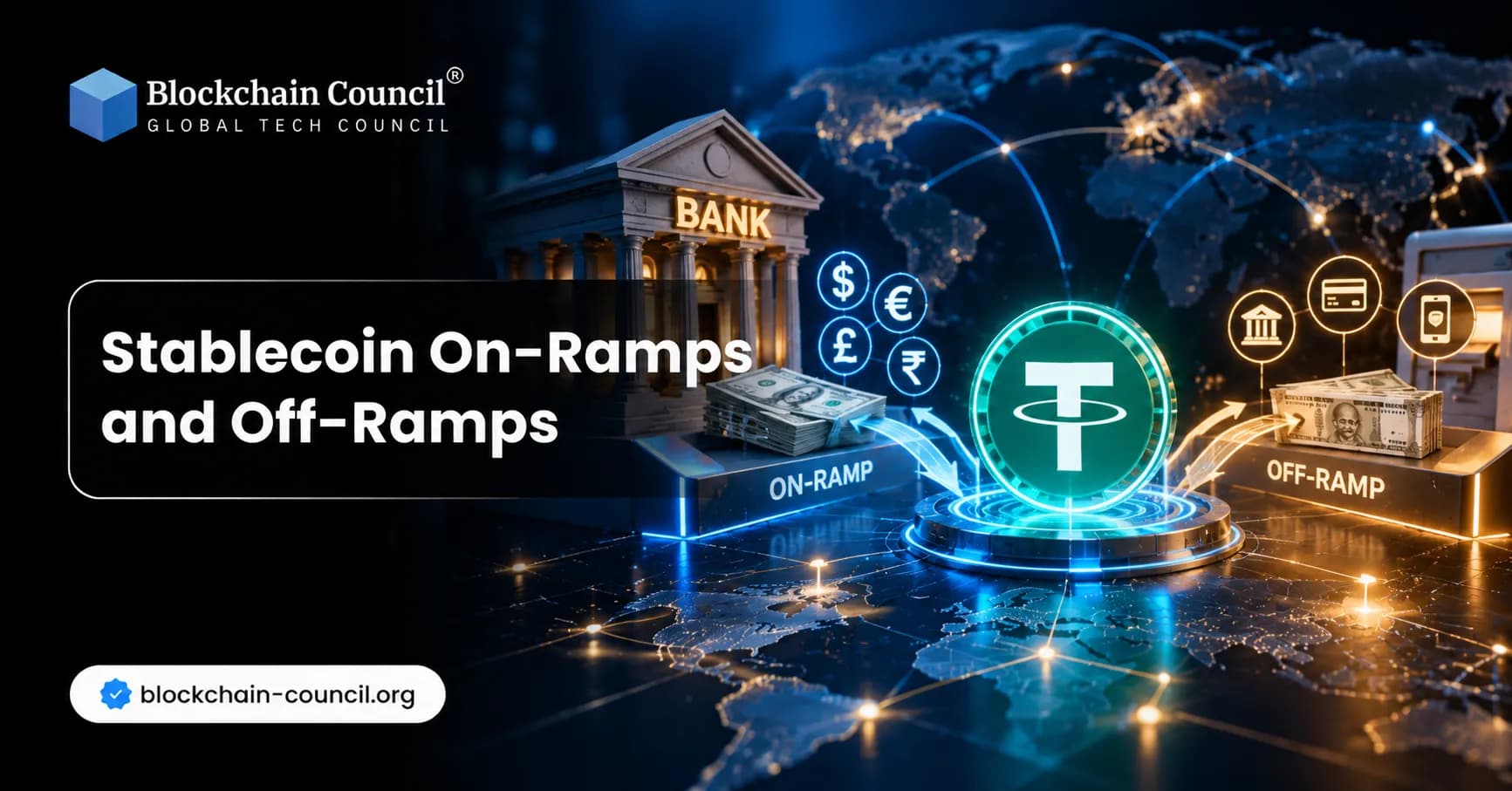
A stablecoin can cross the world in minutes, yet money still has to start and end somewhere real. A buyer pays with a bank account. A seller wants local currency in a bank account. The step in between, where regular money turns into digital tokens and back again, is where most of the cost, delay, and risk now sits. Those steps are called stablecoin on-ramps and off-ramps. A stablecoin is a digital token designed to track the value of a currency such as the US dollar, and these two services connect it to the traditional banking world. Understanding how they work helps beginners avoid mistakes and helps professionals choose better partners. This guide explains what each ramp does, the typical workflow, compliance checks, fees, banking dependencies, provider selection, and business uses. If you want structured training in this field, the Certified Stablecoin Payments Professional program is a useful place to begin.
What Is a Stablecoin On-Ramp?
A Simple Definition
An on-ramp is a service that turns regular money, also called fiat currency, into stablecoins. A user chooses an amount, pays with a card, bank transfer, or local payment method, and receives stablecoins such as USDC or USDT in a digital wallet. Think of it as the entrance to a highway: you start with money in a bank and end with tokens on a blockchain.

Who Offers On-Ramps
Several kinds of companies offer on-ramps. Crypto exchanges let users buy tokens from their accounts. Payment providers and wallet apps embed buying tools inside their products. Developers can add an on-ramp through an embedded widget, an application programming interface, or an orchestration layer that routes between providers. The user may never leave the app they are in.
What Happens Behind the Scenes
An on-ramp has more moving parts than it seems. It must collect money through a payment processor, verify the customer, screen for sanctions, source stablecoins from a liquidity provider, and deliver them to the right wallet. One industry guide describes four core parts: payment processing, identity and anti-money laundering checks, liquidity, and fiat settlement. Any of the four can become a point of failure.
Common Ramp Types
On-ramps and off-ramps come in a few forms. Centralized exchanges let users buy and sell inside an account. Peer-to-peer platforms match individuals directly, which can add fraud risk. Over-the-counter desks serve large trades. Embedded API services let apps and businesses offer conversion inside their own products. The right choice depends on your size, country, and how much control you need.
What Is a Stablecoin Off-Ramp?
A Simple Definition
An off-ramp does the reverse. It turns stablecoins into local currency and sends it to a bank account, mobile wallet, or other payout method. It is how digital tokens become spendable cash. A freelancer who is paid in USDC uses an off-ramp to pay rent. A business that receives stablecoins from a customer uses one to fund payroll.
How an Off-Ramp Works
The process usually has three steps. First, the provider receives the stablecoin. Second, it converts the tokens into fiat at a quoted rate, using liquidity from exchanges, market makers, or its own reserves. Third, it sends the money through the destination country's payment system, such as Pix in Brazil, SPEI in Mexico, SEPA in Europe, or ACH and wires in the United States. Compliance checks run through the whole process, not only at the end.
Why Off-Ramps Matter So Much
Many people focus on how fast a blockchain is, but the off-ramp often decides whether the experience works. Providers may be strong in one region and absent in another. A recipient who cannot cash out cheaply or reliably gains little from instant transfers. Professionals who want to understand tokens, wallets, and exchanges in more depth can build that knowledge through the Certified Cryptocurrency Expert course.
Typical Conversion Workflow
Step by Step: Fiat to Stablecoin
The user selects an amount and a payment method.
The provider verifies identity and screens for risk.
The provider collects the payment.
The provider sources stablecoins at a quoted rate.
The tokens arrive in the user's wallet, often within minutes.
Step by Step: Stablecoin to Fiat
The user or business sends stablecoins to the provider.
The provider checks the source of funds and the recipient.
The provider converts the tokens at a quoted rate.
The provider sends local currency through a bank rail.
The recipient sees the funds in a bank account or mobile wallet.
What Sets the Pace
The blockchain leg usually takes seconds to minutes. The bank leg decides the total. Instant systems such as Pix or SEPA Instant can finish within minutes, while standard bank transfers can take one to two business days. In practice, the slowest step sets the speed of the whole journey, so always check the payout rail, not only the network.
KYC, AML, and Geographic Availability
Know Your Customer and Anti-Money Laundering
Because ramps connect crypto to banks, they are heavily regulated. Providers must verify identity, which is called know your customer, or KYC. For businesses, the equivalent is know your business. They must also screen against sanctions lists, monitor transactions, and report suspicious activity. Checks are often progressive: small amounts may need only an email and phone number, while larger amounts need identity documents and proof of address.
The Travel Rule
The travel rule is an international standard from the Financial Action Task Force. It asks providers to share sender and receiver information on qualifying transfers. A 2026 update from the task force noted progress in adopting the rule, but also that almost half of the jurisdictions with travel rule laws had not yet taken any supervisory or enforcement action under them. This means practice is uneven, and users may see different requirements in different countries.
Where Ramps Are Available
Availability varies widely. Some providers focus on certain regions, support only a few currencies, or face regulatory limits in specific countries. A long coverage list does not always mean strong local service, because real coverage often depends on direct links to local payment rails and local licenses. Before you rely on a provider, confirm that it supports your exact country, currency, payment method, and transfer size.
Building Compliant Systems
Teams that build or integrate ramps need engineers who understand identity checks, monitoring tools, security, and data protection. A recognized Tech Certification can help technical staff design safe, compliant payment flows and review vendors with confidence.
Fees, FX Spreads, and Settlement Times
Where Fees Come From
Ramp costs usually have three layers. A processing or gateway fee is often a low single-digit percentage that depends on the payment method, and cards cost more than bank transfers. A network fee pays the blockchain. Conversion or FX spreads apply when the stablecoin and the payout currency differ. Some countries also add local taxes on foreign exchange transactions.
Reading the True Price
The headline fee can hide the real cost. A provider may show a low charge but offer a poor exchange rate. Always compare the rate you are offered with the mid-market rate on a trusted currency site, and ask when the rate is locked, at the start of the transfer or at settlement. Fees may fall on the sender, the receiver, or both.
Settlement Times
On-chain settlement is fast. Fiat settlement follows the bank rail and the provider's bank partners. Some rails run all day, every day, while others work only during banking hours. A weekend transfer to a rail that closes on weekends will wait until Monday, even if the blockchain step took seconds.
A Simple Example
This example is illustrative and uses made-up numbers. A company wants to pay a supplier $5,000. Its on-ramp charges 1 percent, or $50. The network fee is $0.50. The supplier's off-ramp charges 1 percent, or $50, plus a 0.5 percent conversion spread, or $25. The total is about $125, or 2.5 percent. If the supplier keeps the stablecoins and pays a local vendor in tokens, the off-ramp cost could vanish. This is why the full path matters.
Liquidity and Banking Dependencies
What Liquidity Means
Liquidity means how easily a provider can buy or sell large amounts of stablecoins at a fair price. Deep liquidity keeps rates tight. Thin markets cause slippage, which means the price moves against you as your order is filled. Providers in smaller markets often have less liquidity, which can mean wider spreads.
The Banking Layer
Every ramp depends on banks. A provider's settlement speed, currency support, regional coverage, and reliability all depend on its banking partners. Banking relationships in the crypto sector have been closed before, a risk often called de-risking, where banks restrict access for crypto-related firms. If a bank exits, a provider can lose payout routes overnight.
Why It Matters for Small Payments
Small businesses feel liquidity and banking limits most. A provider with shallow markets may quote worse rates on small orders, and payout minimums can make tiny transfers impractical. Ask about minimums, caps, and daily limits before you plan regular payments.
Questions to Ask
Ask providers which banks they use, how long settlement takes, whether they have backup banks in each region, and what happens if a bank leaves. Providers with several banking partners and local licenses are usually more resilient than those with a single route.
Provider Selection and Risk Checks
What to Compare
A practical order for comparison is geographic coverage, payment method fit, KYC quality, banking resilience, and ease of integration. Also compare the full fee stack, not only the advertised rate. Check supported stablecoins and networks, payout methods, minimums, refund handling, and customer support.
Licensing and Compliance Checks
In the United States, a business that handles funds or convertible digital currency for users generally registers with FinCEN as a money services business and obtains state money transmitter licenses where required. New York has its own regime. In Europe, the Markets in Crypto-Assets Regulation sets requirements for many token services. Verify licenses directly with the regulator rather than trusting a website badge, and ask whether the provider holds customer funds, since custody brings heavier rules. Confirm requirements with qualified legal counsel.
Common Mistakes
New users often choose a provider on the lowest advertised fee, ignore the exchange rate, send to the wrong network or address, or skip a small test payment. Another frequent error is assuming a ramp that works in one country works in the next. Each corridor has its own rails, rules, and limits.
Risk Checks
Look for rate transparency, clear screening on every payout, strong security, and a clear policy for failed or delayed transfers. Test with a small payment before sending large amounts. Beware of providers who disclose rates only after funds move.
Building the Right Team
Stablecoin infrastructure connects digital assets with payment systems, financial services, and blockchain networks. Organisations working in this space need talent with the right mix of technical, financial, and operational knowledge. HireValid's candidate assessment platform is worth exploring for teams looking to evaluate role-specific skills during recruitment.
Business Use Cases
Cross-Border Payments
Companies use on-ramps to fund stablecoin balances and off-ramps to pay suppliers and staff abroad. The strongest cases involve corridors where bank transfers are slow or costly and local payout rails are fast.
Payroll and Contractor Payouts
Employers and platforms pay remote workers in stablecoins, and workers cash out locally. Employers must check labor and tax rules, since some places require wages in local legal tender.
E-Commerce and Marketplaces
Online sellers accept stablecoins and convert to local money automatically, so they never hold tokens. Marketplaces use ramps to pay sellers in many countries.
Treasury and Finance Teams
Treasury teams move cash between subsidiaries and keep working balances in stablecoins for faster access. They must plan for peg risk, accounting treatment, and bank access.
Final Thoughts
Stablecoin on-ramps and off-ramps are the bridge between old and new payment systems, and their quality often decides whether stablecoin payments save time and money. Compare coverage, compliance, banking resilience, and total cost, then test with small transfers before scaling. Teams who explain these services to customers and partners can build trust through clear messaging, and a Marketing Certification can help them communicate benefits, fees, and limits responsibly.
FAQs
1. What Are Stablecoin On-Ramps and Off-Ramps?
Stablecoin on-ramps and off-ramps are services that connect traditional money with stablecoins. An on-ramp lets users convert fiat currency, such as US dollars or euros, into stablecoins. An off-ramp allows users to convert stablecoins back into fiat currency or withdraw funds through supported payment methods.
2. How Do Stablecoin On-Ramps Work?
A stablecoin on-ramp allows users to purchase stablecoins using supported payment methods, such as bank transfers, debit cards, or other approved funding options. The provider verifies the transaction, processes the purchase, and delivers the stablecoins to the user's account or wallet.
3. How Do Stablecoin Off-Ramps Work?
A stablecoin off-ramp enables users to sell or redeem stablecoins and receive traditional currency. Depending on the provider, users may withdraw funds to a bank account, receive a supported local payment, or use another approved payout method.
4. Why Are Stablecoin On-Ramps and Off-Ramps Important?
On-ramps and off-ramps make stablecoins more practical for everyday financial activity. They help users move between traditional financial systems and blockchain-based services, supporting payments, remittances, online purchases, business settlements, and access to digital financial applications.
5. Which Stablecoins Can Users Buy Through On-Ramps?
Common examples include USDT (Tether), USDC (USD Coin), and DAI (Dai). Availability depends on the provider, country, blockchain network, and local regulations. Users should verify the supported token, network, purchase limits, and redemption options before making a transaction.
6. What Payment Methods Do Stablecoin On-Ramps Support?
Depending on the provider and location, supported methods may include bank transfers, debit cards, credit cards, and local payment systems. Each method can have different processing times, fees, purchase limits, and verification requirements.
7. How Can Users Convert Stablecoins Into Local Currency?
Users can convert stablecoins through supported exchanges, regulated payment providers, or other authorized off-ramp services. The provider processes the conversion and sends the resulting funds through an available payout method. Exchange rates, withdrawal fees, and local banking restrictions affect the final amount received.
8. What Fees Are Associated With Stablecoin On-Ramps and Off-Ramps?
Potential fees include purchase or sale charges, payment processing fees, blockchain network costs, exchange-rate spreads, and withdrawal charges. The total cost varies by provider, payment method, currency, network, and transaction size. Comparing the final amount received is more useful than checking one advertised fee.
9. How Long Do Stablecoin On-Ramp and Off-Ramp Transactions Take?
Processing times vary by payment method and provider. Some card-funded purchases or blockchain transfers may complete quickly, while bank transfers, compliance reviews, and fiat withdrawals can take longer. Users should check both the provider's processing time and the blockchain's confirmation requirements.
10. Are Stablecoin On-Ramps and Off-Ramps Secure?
Security depends on the provider's safeguards, account protection, wallet infrastructure, and transaction verification processes. Users should choose reputable services, enable multifactor authentication, verify recipient details, and avoid sharing private keys or recovery phrases. Stablecoins also carry issuer, liquidity, and depegging risks.
11. Do Stablecoin On-Ramps and Off-Ramps Require KYC Verification?
Many providers require Know Your Customer (KYC) checks to verify identity and meet applicable financial regulations. Depending on the jurisdiction and transaction, users may need to submit identification, proof of address, or additional information. Requirements vary across providers and countries.
12. Are Stablecoin On-Ramps and Off-Ramps Available Worldwide?
No. Availability depends on local laws, licensing requirements, banking relationships, supported currencies, and the provider's operating regions. A service available in one country may not support residents or transactions in another. Users should confirm eligibility and payout options before signing up.
13. What Is the Difference Between a Stablecoin Exchange and an On-Ramp Provider?
A stablecoin exchange enables users to trade digital assets, while an on-ramp focuses on converting traditional money into digital assets. Some platforms provide both services and may also support off-ramping. Their fees, available payment methods, custody arrangements, and regulatory obligations can differ.
14. Can Businesses Use Stablecoin On-Ramps and Off-Ramps for Payments?
Yes. Businesses may use these services to fund digital-asset wallets, receive stablecoin payments, convert customer payments into fiat currency, and pay eligible suppliers. Businesses should evaluate transaction limits, accounting requirements, settlement options, security controls, and compliance obligations.
15. How Do Stablecoin On-Ramps and Off-Ramps Support Cross-Border Payments?
They can connect local bank accounts and payment methods with blockchain-based transfers. A sender may convert fiat currency into a stablecoin, transfer it across a supported network, and have the recipient convert it into local currency. Fees, transfer restrictions, and conversion availability affect whether this approach is practical.
16. What Are the Main Challenges of Stablecoin On-Ramps and Off-Ramps?
Common challenges include high conversion fees, limited payment methods, identity verification delays, liquidity constraints, banking restrictions, and regulatory uncertainty. Network errors and differences between stablecoin prices and their intended pegs can also affect transactions.
17. What Is the Difference Between Custodial and Non-Custodial Stablecoin On-Ramps?
A custodial provider holds or controls digital assets on behalf of users. A non-custodial arrangement allows users to retain control of their own wallets and private keys. Some on-ramp providers send purchased stablecoins directly to a user-controlled wallet, while others initially credit a custodial account.
18. How Can Developers Integrate Stablecoin On-Ramps and Off-Ramps?
Developers can integrate a provider's API or SDK to support purchases, conversions, identity verification, transaction status updates, and withdrawals. A secure implementation should protect API credentials, validate webhook notifications, handle failed transactions, and clearly communicate fees and payment status to users.
19. How Should Users Choose a Stablecoin On-Ramp or Off-Ramp Provider?
Users should compare supported stablecoins, payment methods, exchange rates, total fees, transaction speed, security measures, withdrawal options, customer support, and regional availability. Businesses should additionally review API documentation, settlement controls, reporting features, and regulatory coverage.
20. What Is the Future of Stablecoin On-Ramps and Off-Ramps?
Stablecoin on-ramps and off-ramps may become easier to use as payment APIs, wallet infrastructure, local payout networks, and compliance tools improve. Greater interoperability and simpler conversion experiences could support broader adoption in remittances, e-commerce, international payments, and business finance.
Related Articles
View All
Stablecoin
Stablecoin Payment Risk Management Framework
Stablecoin payment risk spans the issuer, reserve assets, blockchain network, wallets, service providers, compliance obligations, and business operations. Learn how organisations can identify exposures, assign controls, and prepare for incidents.

Stablecoin
Stablecoin Payments ROI: A Business Evaluation Guide
Stablecoin payment ROI depends on the business's payment routes, transaction volume, conversion costs, integration effort, and risk controls. Use this framework to compare total costs and benefits against existing payment methods.

Stablecoin
Stablecoin Payment Fraud Prevention Guide
Stablecoin transactions can create operational risks when businesses send funds to incorrect addresses, fall for impersonation, or fail to detect suspicious activity. This guide outlines prevention controls and response procedures for payment teams.
Trending Articles
The Role of Blockchain in Ethical AI Development
How blockchain technology is being used to promote transparency and accountability in artificial intelligence systems.
AWS Career Roadmap
A step-by-step guide to building a successful career in Amazon Web Services cloud computing.
What is AWS? A Beginner's Guide to Cloud Computing
Everything you need to know about Amazon Web Services, cloud computing fundamentals, and career opportunities.