

Front-Running in Smart Contracts: MEV Risks and Prevention Strategies

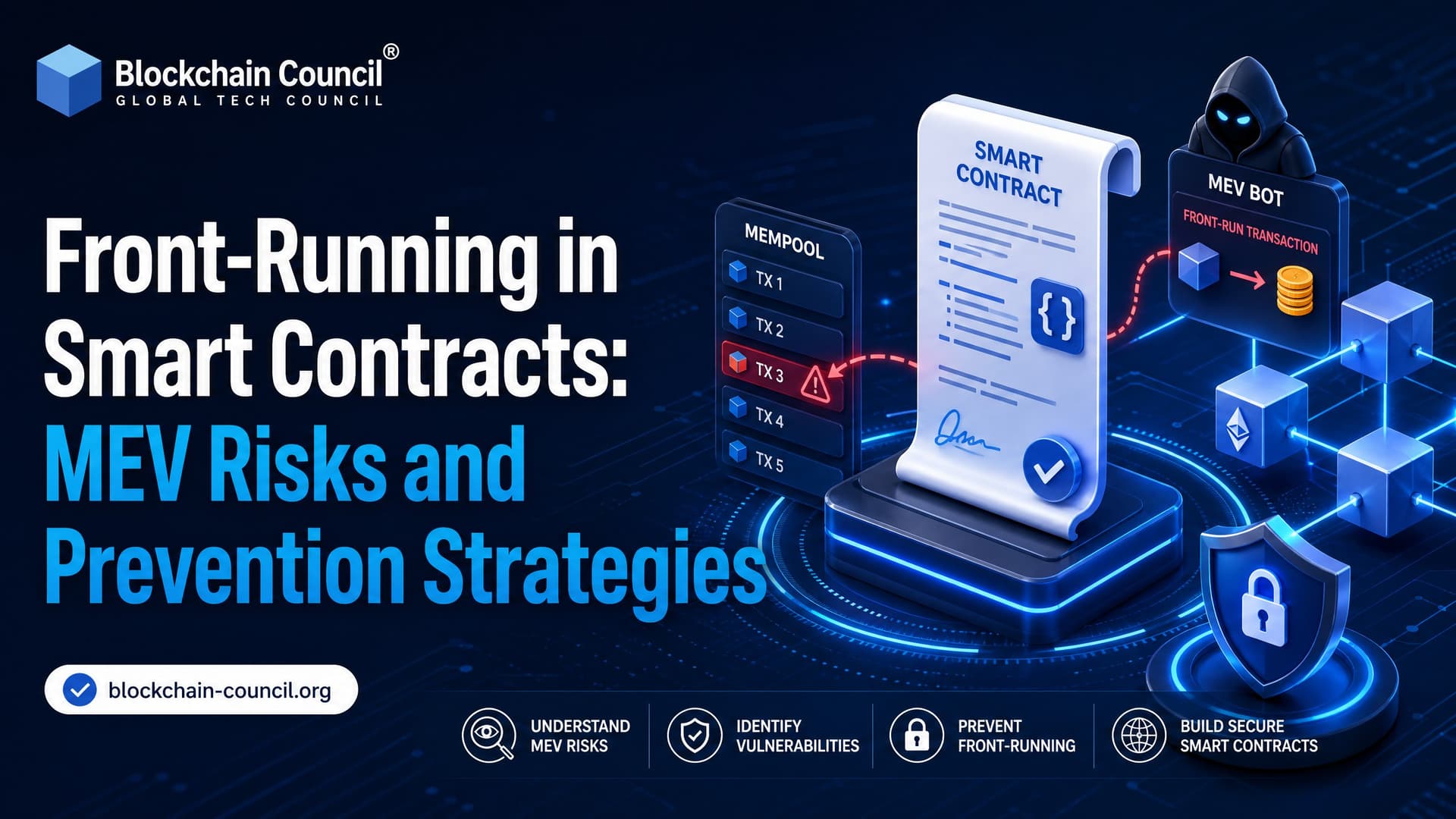
Front-running in smart contracts is not a minor trading nuisance. It is one of the most visible forms of Maximal Extractable Value, or MEV, where bots, validators, builders, or searchers profit by changing the order of transactions before they are confirmed on-chain.
If you build DeFi contracts, trade through DEXs, design governance systems, or audit Solidity code, treat front-running as a design risk. Not just a wallet setting. Not just a gas problem.

What Is Front-Running in Smart Contracts?
Front-running happens when an actor sees a pending transaction, usually in a public mempool, and submits another transaction that executes first. The attacker may pay a higher priority fee, use a private relationship with a builder, or send a bundle that pays for favorable ordering.
MEV is the broader category. It refers to value extracted by reordering, inserting, or censoring transactions inside a block, beyond normal block rewards and transaction fees. Ethereum's post-Merge block production model, with validators, builders, relays, and searchers, has made this more specialized. The old mental model of miners simply picking the highest gas transactions is no longer enough.
The root issue is simple:
- Pending transactions are often visible before execution.
- Smart contracts execute deterministically.
- Many DeFi outcomes depend heavily on ordering.
- Bots react faster than humans and most front ends.
That combination creates a market for transaction ordering.
How MEV Front-Running Works in Practice
Sandwich attacks
A sandwich attack is the classic DEX example. You submit a large swap on an automated market maker. A bot sees it, buys the asset first, your trade pushes the price further against you, then the bot sells after you. You get a worse execution price. The bot captures the spread your own trade created.
This is why setting amountOutMin to zero in a Uniswap V2 style router call is a bad habit. In real testing, the protective failure you want to see is UniswapV2Router: INSUFFICIENT_OUTPUT_AMOUNT. Beginners often treat that revert as an annoyance. It is actually your slippage guard doing its job.
Displacement and race attacks
In a displacement attack, the attacker copies or mimics a profitable transaction and pays more to execute first. This can hit NFT mints, arbitrage trades, liquidation calls, and first-come-first-served reward claims.
Suppression and blocking
An attacker may flood the mempool, bid aggressively, or coordinate inclusion so that another transaction is delayed. This is not always visible to the victim. You may only see a failed transaction, a worse fill, or a missed liquidation.
Oracle and liquidation MEV
Lending protocols are especially exposed. Liquidation bots monitor collateral ratios and race to capture bonuses. If pricing relies on a single spot price or a stale oracle, attackers can combine ordering with price manipulation. The Vee Finance exploit, reported at about 34 million USD, and the Mango Markets incident, reported at about 116 million USD, are reminders that pricing design and transaction ordering cannot be separated.
Why This Risk Is So Large
Public estimates vary, but the scale is no longer debatable. Security researchers have estimated that front-running extracts more than 500 million USD per year from DeFi users. One 2024 academic thesis cited estimates of 550 million to 650 million USD in front-running-related losses on Ethereum alone. Hacken has reported that MEV bots have earned at least 1 billion USD since June 2020 across Ethereum, BNB Chain, and Solana.
Flashbots transparency data, summarized by industry analysts, showed more than 526,000 ETH of realized MEV on Ethereum between September 2022 and early June 2024. That was roughly 1.1 billion USD over the period, depending on ETH prices.
OWASP also lists front-running in its Smart Contract Top 10, a useful signal for auditors and engineering managers. This is not an edge case. It is a standard threat model item.
Where Smart Contracts Become Vulnerable
Front-running usually appears when contract logic gives an advantage to whoever arrives first, sees information early, or controls ordering. Watch for these patterns during design reviews:
- Open swap execution: The contract calls a DEX without enforcing a minimum output.
- Single-source oracles: One price feed controls lending, minting, or collateral logic.
- First-come-first-served claims: Rewards, mints, or allocations go to whoever wins the gas race.
- Time-sensitive governance: Pending parameter changes create obvious opportunities for attackers.
- Public liquidation calls: Bots compete aggressively and may destabilize the market during stress.
- Block timestamp assumptions: Contracts depend too much on block.timestamp or block.number for critical outcomes.
To be blunt, if a profitable action is visible before execution and the contract rewards being first, someone will automate against it.
Prevention Strategies for Developers and Protocol Teams
1. Enforce slippage limits in contracts
Do not rely only on front-end settings. If your contract routes swaps, pass a sane amountOutMin or equivalent minimum return value. OpenZeppelin and Chainlink both recommend minimum output checks for price-sensitive operations.
A user can still choose a bad slippage tolerance, but your protocol should not make zero-protection swaps the default. For treasury operations, liquidations, and automated strategies, store slippage parameters explicitly and test revert paths.
2. Use commit-reveal for sensitive actions
Commit-reveal schemes split an action into two phases. First, the user submits a hash of the intended action. Later, they reveal the underlying data. Since the initial transaction hides the content, bots cannot easily decide whether to front-run it.
This pattern fits auctions, sealed bids, games, governance signaling, and some NFT distribution models. It is not free. You add latency and UX complexity. Still, for high-value actions, the trade-off is often worth it.
3. Prefer batch auctions for trading systems
Batch auctions collect orders over a period and execute them at a uniform clearing price. This reduces the benefit of being one transaction earlier inside the same block. CoW-style trading systems use this idea to cut harmful MEV by matching intents and settling batches.
If your protocol is building a trading venue, batch execution is often cleaner than trying to patch a naive sequential order book after launch.
4. Harden oracle design
Use time-weighted average prices where appropriate. Add staleness checks. Cross-check multiple sources for critical valuations. A single spot price is easy to manipulate during thin liquidity or market stress.
For Solidity 0.8.x contracts, also test oracle failure modes directly. What happens if the feed is stale? What if decimals differ? What if the answer is zero or negative on an interface that returns signed integers? These boring checks prevent expensive incidents.
5. Redesign liquidation incentives
Liquidations need to happen, but priority wars are not the only model. Consider partial liquidations, capped bonuses, Dutch auctions, or shared liquidation rewards. The goal is to keep the protocol solvent without giving bots a reason to burn huge gas and extract maximum value from distressed users.
6. Avoid deterministic ordering assumptions
Do not build critical logic that assumes honest first arrival. On public chains, arrival order is an adversarial input. Randomization, delayed reveals, rate limits, and cooldown periods can help, depending on the use case.
User-Side Protections Against MEV
Users cannot fix protocol design, but they can reduce exposure:
- Set tight but realistic slippage limits for DEX swaps.
- Use wallets or RPC services that support protected transaction routing.
- Avoid trading large size through thin liquidity pools.
- Split orders carefully, but remember that predictable splitting can also be gamed.
- Check whether a DEX or aggregator supports batch auctions or MEV protection.
Raising gas fees alone is not a defense. It may help you win one race, but it also feeds the same priority market that MEV bots dominate.
Infrastructure and Protocol-Level Mitigations
Protected mempools, private RPC endpoints, Flashbots Protect, MEV-Blocker, and similar systems aim to keep transactions away from public mempool scanning. They can reduce sandwich risk for users, especially on large swaps.
There is a trade-off. Private orderflow can concentrate power in relays, builders, and wallet providers. That may protect individual users while creating new centralization concerns. Protocol designers should not treat private routing as the only answer.
Researchers are also exploring encrypted mempools, enforced sequencing rules, cryptographic ordering commitments, and intent-centric architectures. The direction is clear: high-value applications will need MEV-aware transaction design from day one.
How to Test for Front-Running Risk
Add MEV scenarios to your audit checklist. A practical test plan should include:
- Run fork tests against real DEX liquidity using Hardhat or Foundry.
- Simulate a victim transaction and an attacker transaction before it.
- Test sandwich conditions around swaps and oracle updates.
- Check whether slippage, deadline, and minimum return values actually revert.
- Model liquidation races under volatile prices.
- Review governance functions for last-minute ordering abuse.
If your tests only check happy paths, you will miss MEV. A good smart contract audit now needs economic attack simulation, not just reentrancy and access control checks.
Learning Path for Smart Contract Professionals
If you build or review production contracts, MEV belongs in your core skill set. Blockchain Council learners can connect this topic with certifications such as Certified Smart Contract Developer™, Certified Smart Contract Auditor™, and Certified Blockchain Expert™. Developers should focus first on Solidity security, DeFi mechanics, oracle design, and testing with Hardhat or Foundry.
Auditors should go further. Learn how mempool visibility, EIP-1559 fee mechanics, private relays, and builder incentives affect contract behavior. The bug may not be in one line of Solidity. It may be in the market the contract creates.
Final Takeaway
Front-running in smart contracts is a structural MEV risk, not a rare exploit. The best defense is layered: enforce slippage, use safer oracle design, consider commit-reveal or batch auctions, route sensitive transactions through protected infrastructure, and test adversarial ordering before deployment.
Your next step is practical. Pick one contract you maintain, identify every function where ordering changes profit, and write a front-running test for it. If that test is hard to write, that is usually a sign the design needs a closer look.
Related Articles
View All
Smart Contracts
Upgradeable Smart Contracts Explained: Benefits, Risks, and Implementation
Learn how upgradeable smart contracts work, why proxy patterns matter, and how to manage governance, storage, and security risks.

Smart Contracts
Integer Overflow and Underflow in Smart Contracts: Risks and Fixes
Integer overflow and underflow in smart contracts can corrupt balances and enable theft. Learn the risks, Solidity 0.8 fixes, and audit steps.

Smart Contracts
Upgradable Smart Contracts: Proxy Patterns, Risks, and When to Use Them
Learn how upgradable smart contracts work, compare proxy patterns like transparent, UUPS, beacon, and diamond, and understand key risks, governance controls, and best-use cases.
Trending Articles

Top 5 DeFi Platforms
Explore the leading decentralized finance platforms and what makes each one unique in the evolving DeFi landscape.
Claude AI Tools for Productivity
Discover Claude AI tools for productivity to streamline tasks, manage workflows, and improve efficiency.
How to Install Claude Code
Learn how to install Claude Code on macOS, Linux, and Windows using the native installer, plus verification, authentication, and troubleshooting tips.