

What Is Quantum Annealing? How It Solves Optimization Problems

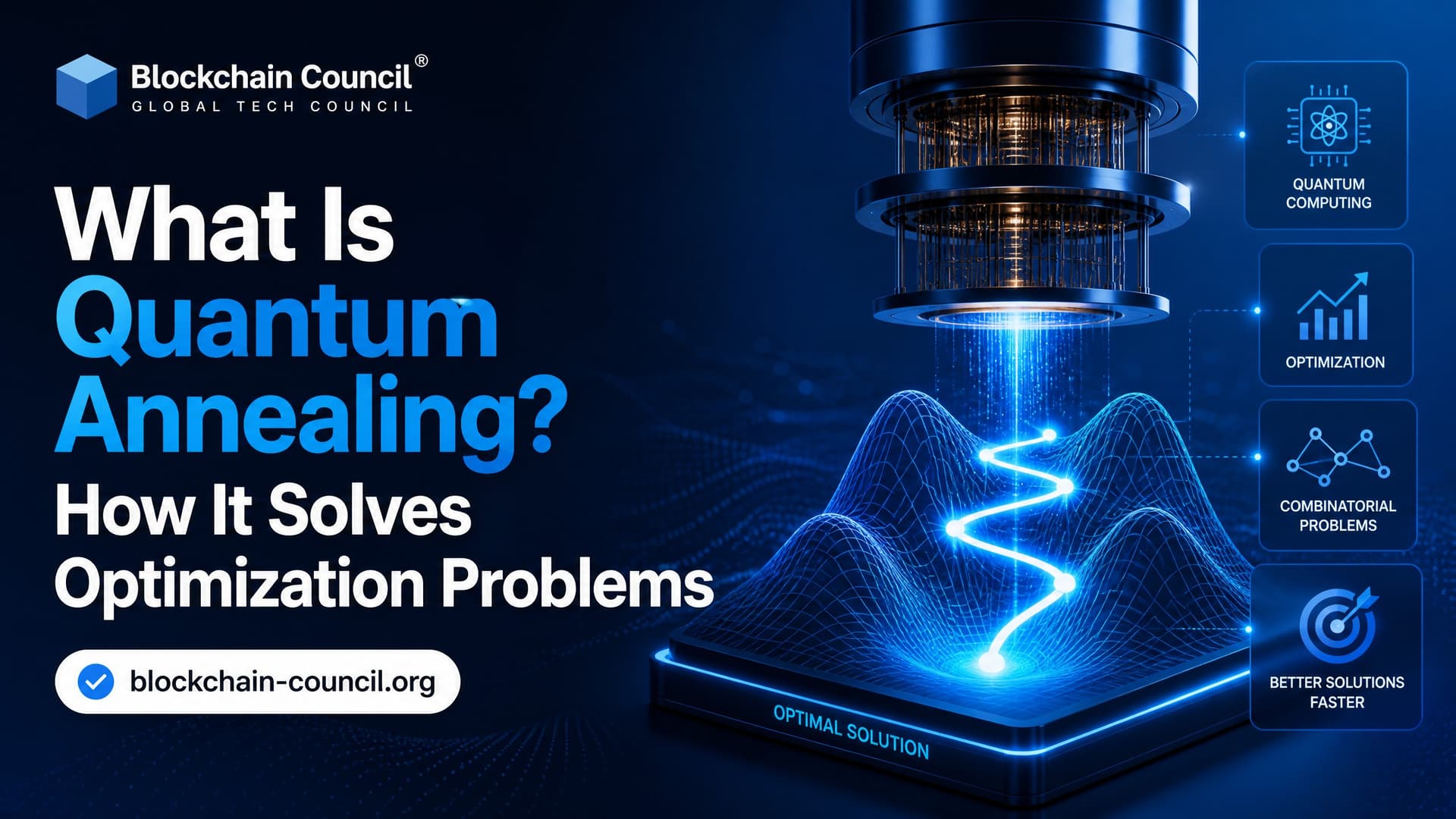
Quantum annealing is a specialized form of quantum computing built for optimization. Instead of running gate-based circuits like IBM Quantum or Google-style processors, a quantum annealer maps a problem to an energy landscape, then searches for low-energy states that represent good answers. For routing, scheduling, portfolio selection, graph problems, and other combinatorial tasks, that framing can be useful.
Be careful with the hype. Quantum annealing is not a magic replacement for CPLEX, Gurobi, simulated annealing, or well-tuned local search. It is a heuristic. It can return strong candidate solutions, sometimes very quickly, but the result depends heavily on the problem mapping, hardware noise, embedding overhead, and classical post-processing.

What Is Quantum Annealing?
Quantum annealing, often shortened to QA, is an analog quantum computing method for finding the minimum of an objective function. The system represents possible answers as quantum states of qubits. Each state has an energy value, also called a cost. The lower the energy, the better the answer.
The goal is simple. Prepare the system, encode the optimization problem, let the system evolve, then measure the final state. The measured bit string is read as a candidate solution.
Most practical quantum annealing systems use the Ising model or the equivalent QUBO formulation, which stands for quadratic unconstrained binary optimization. A QUBO problem minimizes a quadratic expression over binary variables:
minimize sum_i h_i x_i + sum_ij J_ij x_i x_j
Here, x_i values are binary variables, usually 0 or 1. The h_i terms set individual variable biases. The J_ij terms define pairwise interactions. That quadratic structure is why problems such as Max-Cut, graph partitioning, SAT variants, scheduling, and simplified traveling salesperson formulations show up so often as QA examples.
How Quantum Annealing Solves Optimization Problems
1. Convert the business problem into binary variables
You start by making choices binary. Should a delivery vehicle visit stop A before stop B? Should asset X be included in the portfolio? Should employee Y work shift Z? Each decision becomes one or more binary variables.
This step is where many projects fail. Not in the quantum hardware. In the formulation.
Use too many variables and the problem will not fit efficiently. Scale your constraints poorly and the annealer may prefer invalid answers. Set penalty terms too large and hardware autoscaling can compress the meaningful differences in the objective. Anyone who has used D-Wave Ocean has seen this: the sample set looks feasible, but the actual objective quality is poor because the penalty weights dominated everything.
2. Encode the objective as QUBO or Ising
After defining variables, you express the goal as a cost function. For example:
- Logistics: minimize delivery distance while satisfying capacity and time-window constraints.
- Finance: choose a portfolio that balances expected return, risk, and budget limits.
- Scheduling: assign people or machines to tasks without conflicts.
- Graph optimization: split a graph into useful partitions or maximize cut value.
Constraints are usually added as penalty terms. If exactly one vehicle must serve a delivery location, any assignment with zero or multiple vehicles gets an energy penalty. Choosing penalty weights is part math, part engineering. Too small, and constraints are ignored. Too large, and the optimizer stops caring about the real objective.
3. Map the logical problem to physical qubits
Quantum annealing hardware does not provide arbitrary all-to-all connectivity. Physical qubits are wired in a specific topology, such as D-Wave's Chimera, Pegasus, or newer Zephyr graph structures. If your QUBO graph has edges that do not exist physically, the software must perform minor embedding.
Minor embedding represents one logical variable using a chain of physical qubits. That costs capacity. It also introduces chain breaks, where physical qubits in the same chain disagree after measurement. In D-Wave workflows, you often inspect fields such as chain_break_fraction, because a low-energy answer with many broken chains may not be trustworthy.
4. Run the anneal and sample many times
The system begins in an easy-to-prepare quantum state. It then gradually changes according to an annealing schedule until the final Hamiltonian represents the problem. If the process stays near the ground state, the output is close to the global optimum.
On real hardware, adiabatic perfection is not guaranteed. Noise, temperature, control errors, and finite anneal time all matter. So you run the anneal many times, collect a distribution of samples, repair broken chains, and evaluate candidate solutions classically.
Quantum Tunneling: Why QA Can Escape Some Local Minima
Classical simulated annealing uses thermal jumps. It may escape a local minimum by climbing over an energy barrier, then cooling slowly. Quantum annealing uses quantum fluctuations and tunneling, which means the system can pass through some barriers rather than climb over them.
That distinction matters when the energy landscape has many narrow barriers. In theory, tunneling can move the search away from traps that slow classical heuristics. In practice, the advantage is problem-specific. Wide barriers, noisy hardware, and poor embeddings can erase the benefit.
To be blunt: if a good mixed-integer programming solver already handles your problem cheaply, quantum annealing is probably the wrong first tool. QA gets more interesting when the combinatorial core is hard, the QUBO is compact, and the answer does not need a formal proof of optimality.
Quantum Annealing vs Gate-Based Quantum Computing
Quantum annealing differs from gate-model quantum computing. Gate-based machines run circuits made of gates such as H, CX, RZ, and measurement operations. Algorithms such as QAOA, VQE, and Shor's algorithm belong to that model.
Quantum annealers are built around energy minimization. They are less general, but they align directly with optimization and sampling. That narrower design is why annealing systems have reached thousands of qubits for specific workloads while fault-tolerant universal quantum computers remain a long-term goal.
For professionals learning the field, this distinction matters. If you want optimization engineering, study QUBO, Ising models, embeddings, anneal schedules, and hybrid solvers. If you want universal quantum algorithms, study circuits, linear algebra, error correction, and complexity theory. Blockchain Council's Certified Quantum Computing Expert™ covers both models in a structured way if you need that grounding.
Real-World Use Cases of Quantum Annealing
Logistics and transportation
Routing, container loading, last-mile delivery, crew assignment, and farm-to-market distribution are natural candidates because they involve many discrete choices under constraints. D-Wave case materials have often highlighted logistics-style optimization as a practical test area.
Finance
Portfolio construction can be expressed as choosing assets under budget, risk, and diversification constraints. Fraud detection and campaign optimization also include combinatorial selection problems. The hard part is not saying finance uses optimization. The hard part is building a QUBO that respects real constraints without exploding in variable count.
Healthcare and pharma
Protein folding, drug discovery subproblems, clinical trial design, and resource scheduling have all been explored in research settings. Some are better framed as sampling tasks than pure minimization tasks, which suits annealers because they can return distributions of low-energy samples.
Scientific computing and statistics
Researchers have tested QA for maximum likelihood estimation, experimental design, matrix-related optimization, and probabilistic modeling. This is still early work, but it shows that annealing is not limited to vehicle routing examples.
Recent Research and Performance Claims
Recent studies describe quantum annealing as one of the main near-term quantum optimization approaches, alongside variational gate-based methods such as QAOA. Some benchmarking work reports large speedups on selected combinatorial instances, with a QA-based solver landing slightly higher on accuracy and orders of magnitude faster than a chosen classical baseline.
Those numbers are interesting. They are not a universal promise.
Benchmark results depend on the selected problem instances, hardware configuration, embedding method, anneal settings, and the strength of the classical baseline. A weak comparison tells you little. A fair comparison must include tuned classical heuristics, preprocessing time, embedding time, and post-processing time.
Key Limitations You Should Know
- No guaranteed optimum: QA returns candidate low-energy solutions with some probability. You still need validation.
- Noise affects quality: Current annealers are not fault-tolerant machines. Hardware noise can distort results.
- Connectivity is limited: Minor embedding can consume many physical qubits for one logical problem.
- Formulation is difficult: A poor QUBO can make a good solver look bad.
- Classical solvers remain strong: For many workloads, classical optimization is cheaper, clearer, and easier to audit.
The best near-term pattern is hybrid. Use classical code to clean data, reduce the problem, generate the QUBO, evaluate samples, and repair solutions. Use the quantum annealer for the dense combinatorial search where it may help.
Skills Professionals Need to Work With Quantum Annealing
If you want to build with QA, focus on practical skills rather than vague quantum theory. Learn:
- QUBO and Ising formulations.
- Penalty methods for constrained optimization.
- Graph embeddings and chain-strength tuning.
- Classical baselines such as simulated annealing, tabu search, and mixed-integer programming.
- Python tools, especially D-Wave Ocean, NumPy, NetworkX, and optimization libraries.
- Benchmark design, including fair timing and solution-quality metrics.
If your work also touches AI optimization or blockchain-based resource markets, you may connect this topic with the Certified AI Expert™ and Certified Blockchain Expert™ learning paths. The overlap is real. Optimization sits behind model training, scheduling, security analytics, and decentralized infrastructure planning.
Future Outlook for Quantum Annealing
Quantum annealing will likely improve through better qubit connectivity, lower control noise, larger processors, and smarter hybrid solvers. Domain-specific tooling will matter more than raw qubit count. A logistics team does not want a physics experiment. It wants a reliable optimizer that beats its current workflow on cost, time, or solution quality.
Expect QA to grow first in targeted enterprise pilots, research computing, and sampling-heavy AI applications. Do not expect it to replace classical optimization across the board. The near-term value is narrower, but still worth watching.
Your next step: take a small optimization problem you understand, such as Max-Cut or a shift assignment model, formulate it as a QUBO, solve it classically, then compare it with an annealing workflow. If you can explain the penalty weights and embedding trade-offs, you understand quantum annealing better than most slide decks do.
Related Articles
View All
Quantum Computing
Quantum Computing in Optimization: Solving Complex Business Problems Faster
Quantum computing in optimization is helping enterprises test faster solutions for routing, scheduling, portfolios, manufacturing, and energy planning.

Quantum Computing
Quantum Algorithms for Beginners: Shor's, Grover's, and Optimization Techniques
Learn quantum algorithms for beginners with clear explanations of Shor's and Grover's algorithms, plus QAOA, VQE, and core optimization techniques for 2026.

Quantum Computing
Quantum Computing Certification: Benefits, Career Value, and How to Choose One
Learn how quantum computing certification supports career growth, what employers value, and how to choose a credential with real technical depth.
Trending Articles
What is AWS? A Beginner's Guide to Cloud Computing
Everything you need to know about Amazon Web Services, cloud computing fundamentals, and career opportunities.

Can DeFi 2.0 Bridge the Gap Between Traditional and Decentralized Finance?
The next generation of DeFi protocols aims to connect traditional banking with decentralized finance ecosystems.
How to Install Claude Code
Learn how to install Claude Code on macOS, Linux, and Windows using the native installer, plus verification, authentication, and troubleshooting tips.