

Web3 and Crisis Response in an Iran War: Can Decentralized Identity and Transparent Aid Work?

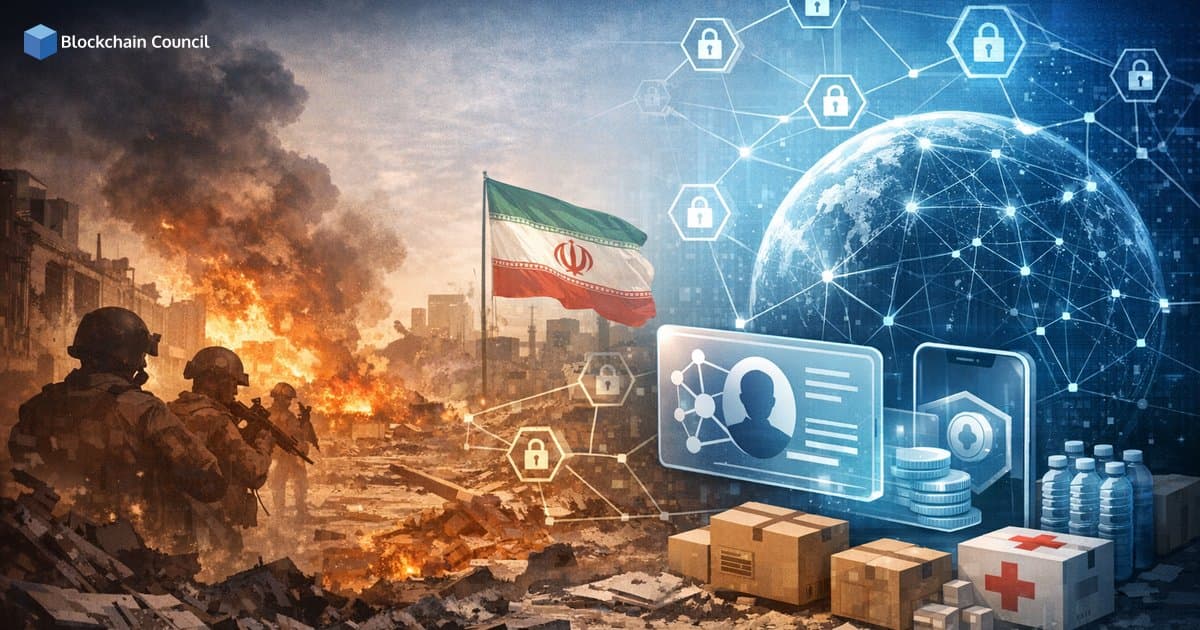
Web3 and crisis response is moving from theory to field tests, with pilots in refugee camps, disaster zones, and conflict-affected regions. Applying decentralized identity and transparent aid distribution during a high-intensity interstate war involving Iran presents a harder problem. Iran's connectivity controls, sanctions exposure, cybersecurity threats, and the ethics of identity in a high-repression environment all shape what can realistically work and what could put civilians at risk.
This article reviews what has been tried globally, what constraints are specific to an Iran war scenario, and which Web3 patterns are most feasible for humanitarian outcomes.

Why an Iran War Is a Stress Test for Web3 and Crisis Response
War conditions break the assumptions that many Web3 products rely on: continuous internet access, reliable on-ramps to stablecoins, and safe end-user device custody. In an Iran war context, the digital environment becomes even more constrained due to state-driven network controls and a broader trend toward digital sovereignty.
Connectivity Limits: Shutdowns, Throttling, and the National Information Network
Iran has repeatedly restricted connectivity during periods of unrest and cyber escalation, increasingly routing domestic activity through its National Information Network (NIN), a semi-walled domestic intranet. In April 2026, after a prolonged disconnection, connectivity was reported as partially restored with traffic largely limited to domestically hosted services, supported by filtering approaches such as deep packet inspection and routing controls documented by cybersecurity research teams including Palo Alto Networks Unit 42.
For Web3 and crisis response, this matters because:
Public blockchains require access to global nodes, explorers, RPC providers, and exchanges.
Wallet onboarding and recovery flows commonly assume stable internet and access to app stores that may be blocked.
VPN and satellite access may be targeted, degraded, or criminalized under wartime conditions.
A Splintered Internet Increases Operational Uncertainty
Analysts have described the Iran conflict as accelerating a fragmented digital order in which states seek tighter control over routing, cloud dependencies, and information flows. This environment raises the operational bar for any identity or aid system that depends on cross-border infrastructure.
Decentralized Identity in Crisis Settings: What It Is and Why It Matters
Decentralized identity, often implemented using W3C Decentralized Identifiers and verifiable credentials, allows people to hold cryptographic credentials in a wallet and prove claims about themselves without relying on a single central identity provider.
Identity Is Now a Security Requirement, Not Just a UX Feature
Generative AI and automated bots have weakened older assumptions about online trust. Industry analysts have noted that traditional Turing Test proxies are no longer sufficient for proving a human is present. In wartime, deepfakes, synthetic propaganda, and automated fraud can multiply rapidly, making robust identity verification essential for protecting aid pipelines.
What Decentralized Identity Looks Like in Practice
Even when the technology is decentralized, governance is still anchored in trusted issuers. In humanitarian settings, these issuers typically include UN agencies, NGOs, clinics, schools, and occasionally governments. Verifiable credentials can support selective disclosure - for example, proving eligibility for aid without revealing a full identity profile - and they can be verified even if the issuer is temporarily offline.
Teams building capability in this area benefit from cross-disciplinary training that covers shared terminology and threat modeling. Identity, endpoint security, and AI-driven fraud detection converge in crisis deployments, making foundational certification in blockchain, cybersecurity, and AI increasingly relevant for practitioners.
Transparent Aid Distribution: What Has Worked Elsewhere
No large-scale, publicly documented Web3 aid system has been deployed inside a heavily sanctioned, partially isolated economy during a high-intensity interstate war. Several precedents, however, demonstrate what is possible under more favorable conditions.
Crypto Donations and Public Traceability in Conflicts
During the 2022 invasion of Ukraine, official wallets and NGO initiatives reportedly raised over 100 million USD in cryptocurrency according to blockchain analytics reporting. Public blockchains enabled external observers to track inflows and some outflows, although transparency into real-world procurement and final delivery still required traditional audits and disclosures.
Key lesson: on-chain transparency can improve visibility of financial flows, but it does not automatically prove end use or prevent diversion without off-chain controls.
Blockchain-Based Vouchers and Cash Assistance Pilots
Humanitarian pilots such as the World Food Programme's Building Blocks demonstrated e-voucher workflows where beneficiaries transact at approved merchants and activity is recorded on a permissioned ledger. These deployments emphasized auditability and reduced intermediary fees, but remained centrally governed and often tied identity to biometrics and UN registration systems.
Key lesson: operational success depends on governance, onboarding, device access, and local merchant networks, not only on blockchain design.
Can Web3 and Crisis Response Work During an Iran War?
It can work in limited, carefully scoped settings, but the highest-value opportunities are often outside Iran, particularly among refugee populations and cross-border operations. Inside Iran, the combination of connectivity restrictions, sanctions compliance risk, and surveillance threats sharply limits safe deployment options.
Constraint 1: Intermittent Connectivity and Censorship
In an Iran war scenario, systems should assume extended periods of degraded connectivity. Practical architectures tend to become hybrid:
Public blockchain rails for external settlement and donor-side transparency when global connectivity is available.
Local-first operations using offline signing, QR codes, and periodic synchronization.
Fallback channels such as SMS or USSD where smartphones or full internet access are unreliable.
Constraint 2: Sanctions, AML/CFT, and the Limits of Open Rails
Iran's sanctions environment shapes nearly every design choice. Major exchanges and stablecoin issuers typically restrict sanctioned jurisdictions and entities to comply with AML/CFT obligations. Humanitarian exceptions exist in some regimes, but they are narrow and administratively complex, and large organizations tend to be risk-averse in how they interpret them.
Practical implication: large-scale open Web3 value flows into Iran are unlikely without explicit humanitarian licensing and strict controls. This pushes realistic pilots toward refugee-hosting countries or controlled corridors with regulatory clarity.
Constraint 3: Identity Can Become a Target
In high-repression environments, digital identity can expose individuals to surveillance, blacklisting, or reprisals. A wallet containing sensitive attributes becomes a liability if a device is confiscated or if metadata is correlated by hostile parties.
Safer identity design patterns for Web3 and crisis response include:
Minimal disclosure credentials that prove eligibility without revealing unnecessary data.
User-held keys with secure recovery that avoids building a single high-value identity database.
Assuming endpoint compromise and implementing layered defenses, including operational security training.
Keeping sensitive data off-chain, using hashes or references only when necessary.
Constraint 4: Governance and Who Is Trusted to Issue Credentials
DID systems still depend on trust frameworks. During an Iran war, government-issued credentials may not be trusted by all groups, while international agencies may have limited access inside the country. Community organizations may be trusted locally but not recognized by major donors or regulators.
A realistic model is multi-issuer identity, where individuals hold multiple credentials - for example, NGO registration combined with clinic-issued health credentials - and donors define which credentials satisfy eligibility for specific aid programs.
Most Plausible Web3 Use Cases in an Iran War Scenario
1) Refugee and IDP Identity Wallets in Neighboring Countries
This is the strongest near-term fit. Displaced populations often need portable proof of registration, vaccination history, education records, and eligibility for services. Verifiable credentials can preserve continuity across borders and providers, building on cautious experimentation by agencies such as UNHCR and WFP.
2) Transparent On-Chain Accounting for Donor-to-NGO Funds
Donors and coordinating organizations can use on-chain treasuries to improve auditability and reduce disputes about disbursement timing and amounts. Final-mile delivery may remain off-chain - cash, vouchers, or in-kind transfers - to reduce risk to beneficiaries. Care is needed to avoid exposing sensitive partner identities or locations through public transaction analysis.
3) NGO-to-Local-Partner Funding with Traceable, Controlled Spending
Where legally permitted, stablecoins or tokenized vouchers can be distributed to vetted partners with spending rules enforced at approved merchants. This approach is more feasible in refugee-hosting jurisdictions than inside Iran, unless a clearly licensed humanitarian corridor exists.
4) Diaspora-to-Individual Crypto Remittances (High Risk)
Peer-to-peer transfers may occur, but they carry significant sanctions and personal security risks. Conversion to local purchasing power may be difficult if exchanges, OTC networks, or merchants face restrictions.
Cybersecurity and Operational Security Requirements
Cybersecurity researchers including Unit 42 have warned about increased targeting of telecommunications, financial infrastructure, and cloud providers during Iran-related escalations, alongside disinformation and phishing campaigns. Web3 systems fail more often at the endpoints than at the protocol layer.
Minimum security controls should include:
Hardened key management - hardware-backed keys where feasible, robust recovery procedures, and role-based controls for organizations.
Smart contract audits and conservative upgrade policies.
Partner due diligence aligned with AML/CFT requirements.
Incident response playbooks covering compromised devices, coercion scenarios, and account takeover.
The cross-disciplinary skills needed for secure humanitarian deployments span blockchain architecture, smart contract development, and cybersecurity - areas covered by professional certification programs designed for practitioners working at this intersection.
Conclusion: Where Decentralized Identity and Transparent Aid Can Realistically Help
Web3 and crisis response can function during an Iran war, but not as a blanket replacement for traditional humanitarian infrastructure. Technically, decentralized identity and transparent ledgers can improve portability, auditability, and coordination. Operationally and ethically, the hardest problems remain connectivity shutdowns, sanctions compliance, and the safety of civilians whose devices and data may be surveilled or seized.
The most realistic near-term impact is concentrated in three areas: on-chain transparency for donor-side accounting, identity and aid wallets for refugees in neighboring countries, and limited, licensed pilots with vetted partners. At national scale inside Iran during active conflict, decentralized identity and transparent aid distribution are unlikely to be feasible or safe without major changes in connectivity access, regulatory permissions, and human security safeguards.
Related Articles
View All
News
Ledger AI Agents for Crypto Asset Management: Stronger Web3 Security Through Hardware Approval
Ledger AI agents separate AI-driven crypto asset management from signing authority, using hardware approval to reduce prompt injection and Web3 security risks.

News
AI Agents on Blockchain: The Next Frontier for Decentralized Automation
AI agents on blockchain are now transacting, trading, and paying on-chain. Learn the use cases, standards, risks, and skills professionals need.

News
Post-Quantum Blockchain Security: Why Web3 Developers Are Moving Now
Post-quantum blockchain security is now an engineering priority as NIST standards, Q-Day risk, and long migration timelines pressure Web3 teams to act.
Trending Articles
The Role of Blockchain in Ethical AI Development
How blockchain technology is being used to promote transparency and accountability in artificial intelligence systems.

Top 5 DeFi Platforms
Explore the leading decentralized finance platforms and what makes each one unique in the evolving DeFi landscape.
Claude AI Tools for Productivity
Discover Claude AI tools for productivity to streamline tasks, manage workflows, and improve efficiency.