

Solana Goes Faster and Adds a Hong Kong-Regulated Stablecoin

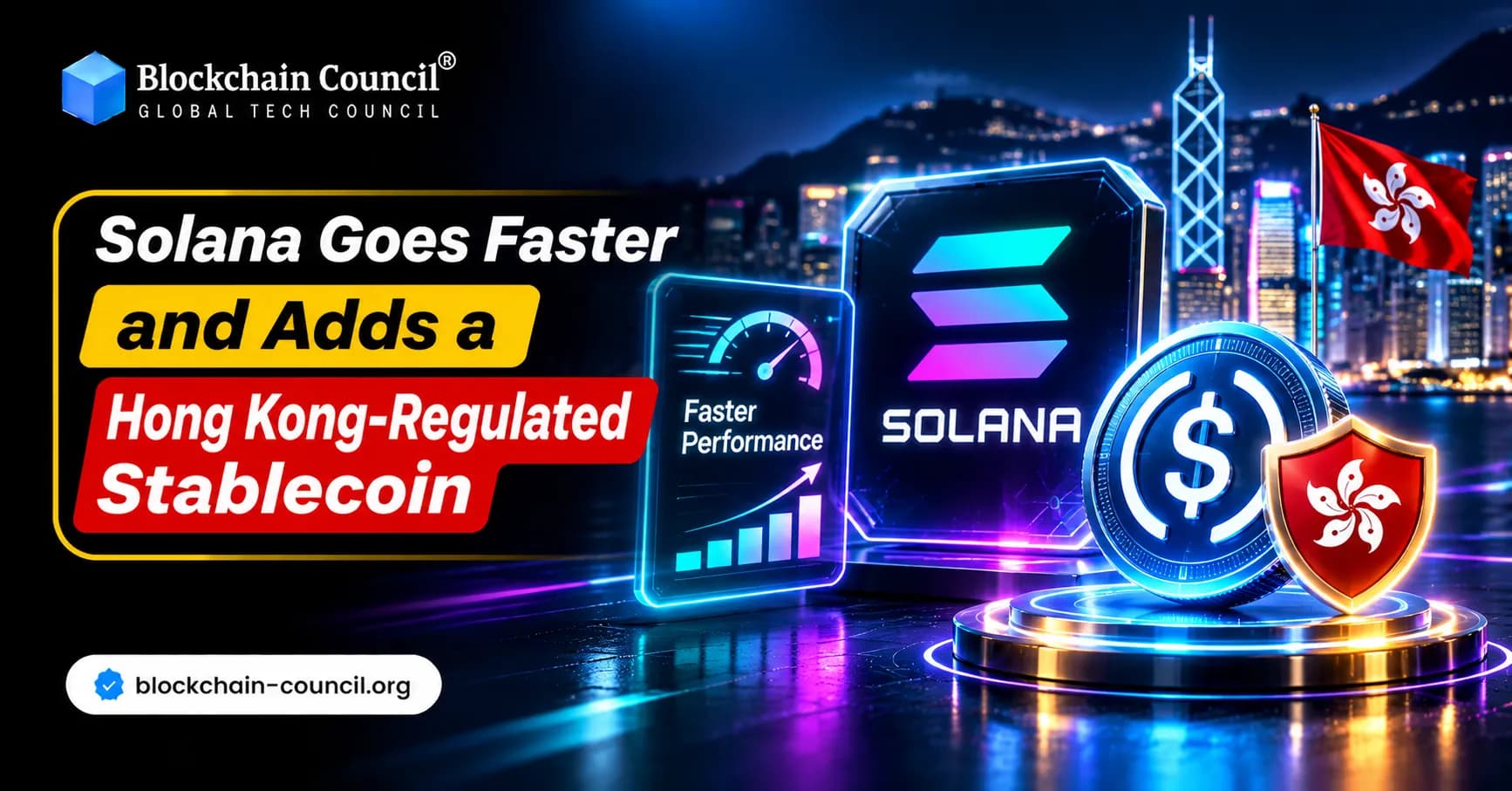
Two big pieces of news landed for Solana within days of each other. On October 21, 2026, the network switched on Alpenglow, a major upgrade that targets transaction finality of about 150 milliseconds, down from roughly 12.8 seconds. Around the end of October, Anchorpoint, a Standard Chartered-backed issuer licensed by the Hong Kong Monetary Authority (HKMA), announced a collaboration with the Solana Foundation to bring its HKDAP stablecoin to the network. Together they form a clear Solana Hong Kong-regulated stablecoin story: faster rails meeting a regulated local-currency token.
One caution before the details. The speed upgrade is live, but the HKDAP move on Solana is described as a plan, with no launch date or Solana token address published yet. Anyone who wants to understand how stablecoin payments work in the real world can start with the Certified Stablecoin Payments Professional program. This guide explains both announcements in plain language, from beginner basics to professional detail.

Solana Alpenglow: What Went Live on October 21
The Official Announcement
Anza, the core developer behind a major Solana validator client, announced on October 21, 2026 that Alpenglow is live on mainnet-beta. Its message said the new consensus protocol reduces finality from 12.8 seconds to 150 milliseconds. Solana’s official upgrades page also lists Alpenglow as live on mainnet, with a target finality of about 150 milliseconds. The activation was scheduled for epoch 1064 at roughly 15:00 UTC. Reports quoting Anza say the transition itself took 900 milliseconds with 654 validators participating.
What Finality Means in Simple Terms
Finality is the moment a transaction becomes permanent and cannot be reversed. Think of the difference between a card payment that is “pending” and one that is fully settled. Before Alpenglow, Solana took around 12.8 seconds to reach that point. The new target is about 0.15 seconds, which is a drop of nearly 99%, or about 85 times faster.
How Alpenglow Works
Alpenglow replaces the older TowerBFT voting system with a new component called Votor. Reports describe two changes that matter most:
Off-chain voting: Validator votes no longer need to be recorded as regular on-chain transactions. Coverage notes that vote transactions made up roughly 75% of network traffic, so removing them frees up room.
Two voting paths: The system can finalize a block in one round when most validators respond quickly, and in two rounds if conditions are less ideal.
The validator community approved the plan, known as SIMD-0326, in September 2025. Solana’s upgrades page also shows that slot times were cut from 400 milliseconds to 200 milliseconds and the maximum transaction size rose to 4,096 bytes from 1,232.
Important Limits to Understand
The 150 millisecond figure is a target under normal conditions, not a guarantee for every wallet or app. Developers have noted that block propagation does not change with this upgrade, and that some RPC nodes may receive finality information later than validators that vote directly. Real-world results will depend on how validators and applications perform over time. Market reaction has also been cool so far, with one report noting that the price of SOL fell about 11% from roughly $107 on launch day. A technical upgrade does not guarantee a price rise.
What Is HKDAP and Who Is Anchorpoint?
The Issuer
Anchorpoint Financial Limited is a joint venture of Standard Chartered Bank (Hong Kong), the telecom company HKT, and Animoca Brands. The HKMA granted it a stablecoin issuer licence in April 2026, reported as April 10, alongside HSBC. Those two were chosen from an initial group of 36 applicants. The licence is issued under Hong Kong’s Stablecoins Ordinance, which took effect on August 1, 2025.
The Token
HKDAP stands for “HKD At Par.” It is a Hong Kong dollar-backed stablecoin with a value of HK$1.00 per token. Under the rules, the issuer must hold reserve assets worth at least HK$1 for every token outstanding, and holders must be able to redeem at par. Hong Kong’s regime also requires licensed issuers to manage risks around reserves, redemption, and technology.
Where HKDAP Stands Today
According to the latest coverage, HKDAP is currently in an Ethereum-only beta, and Anchorpoint’s wider retail launch is targeted as early as the end of 2026, subject to readiness. Professionals who want to understand crypto assets, token standards, and market structure in more depth can build that base with the Certified Cryptocurrency Expert program.
The Solana and Anchorpoint Collaboration
What Was Announced
The Solana Foundation and Anchorpoint announced a strategic collaboration to bring HKDAP to Solana. Anchorpoint said it plans to support native minting and redemption of HKDAP on Solana, with near-instant settlement. Both sides also plan to make HKDAP and related tokenized products available through corporate partners and consumer apps. Some coverage calls the agreement a memorandum of understanding, which is a statement of shared intent, not a finished product.
What Is Planned, Not Yet Live
This is the key point for accuracy. Reports from several outlets say that no Solana launch date has been announced and no official HKDAP contract address on Solana has been published. Until Anchorpoint publishes an official address, a token on Solana using the HKDAP name cannot be checked against a verified source. Readers should be careful of look-alike tokens and should only use addresses published through Anchorpoint’s official channels.
Solana’s Hong Kong Push
The same announcement says Solana joined Hong Kong’s OASES programme and plans to set up a local presence in the city. Reports link this to a wider Hong Kong push that includes a second spot Solana ETF being lined up. Mainland China still restricts crypto trading, so Hong Kong’s licensed approach gives global firms a rule-based entry point to the region.
Why These Two Stories Fit Together
Speed Helps Payments
Stablecoins are only useful for payments if they settle fast and cheaply. A shop owner will not wait 13 seconds for a payment to feel final, but 150 milliseconds is close to the speed of a card tap. Faster finality may also help trading, tokenized assets, and real-time transfers between companies. Professionals following how networks and standards evolve can build wider context through a recognized Tech Certification path.
Regulation Builds Trust
A speed upgrade does not tell users whether a stablecoin is safe. That is where a licence matters. A HKMA-licensed issuer must hold full reserves and honor redemptions. Pairing a fast network with a regulated token is the kind of combination that banks and large companies tend to look for.
A Local Currency Option
Most stablecoins today track the US dollar. A Hong Kong dollar stablecoin would give global traders, businesses, and tokenized asset markets a way to hold and settle in that local currency on a public blockchain. This may help cross-border payments, where moving between currencies is often slow and costly.
Quick Comparison: What Is Live and What Is Planned
Item | Status | Key detail |
|---|---|---|
Alpenglow on Solana mainnet | Live since October 21, 2026 | Target finality of about 150 ms, down from 12.8 s |
Slot time | Live | 200 ms, down from 400 ms |
Anchorpoint HKMA licence | Granted April 2026 | Issued under the Stablecoins Ordinance |
HKDAP on Ethereum | Beta | Retail launch targeted as early as end of 2026 |
HKDAP on Solana | Planned | No launch date or token address published yet |
Official Sources and Announcements
For readers who want to check the facts first-hand, these official pages are useful:
Solana’s upgrade tracker: solana.com/Upgrades, which lists Alpenglow as live on mainnet.
Anza’s activation announcement: posted on X on October 21, 2026 by @anza_xyz.
Standard Chartered’s press release on Anchorpoint’s HKMA licence: sc.com press release.
Anchorpoint and the Solana Foundation: the joint announcement of the HKDAP collaboration, published at the end of October 2026.
Always confirm token addresses and launch details on these official channels before using any new stablecoin.
What This Means for Different Readers
For Beginners
Think of Solana as a payment network and HKDAP as a digital version of the Hong Kong dollar. The upgrade makes the network faster, and the stablecoin, once live on Solana, would be a regulated way to hold Hong Kong dollars on it. Do not buy anything called HKDAP on Solana until the issuer publishes an official address.
For Developers and Businesses
Faster finality can improve user experience in apps that need quick confirmation, such as point-of-sale payments, trading platforms, and settlement tools. Test carefully, since real-world finality will vary with network conditions. Businesses exploring stablecoin payments should also check legal and compliance requirements in each region.
For Investors
Technical progress and regulated partnerships are positive signs, but they do not guarantee returns. SOL’s price has dropped since the upgrade, and a separate report mentions whale transfers and ETF outflows. This article is not financial advice, and crypto assets can lose value quickly.
For Hiring Teams and Workers
Digital assets and AI-driven finance are creating new roles in compliance, engineering, and operations. As artificial intelligence becomes part of everyday business operations, employers increasingly need people who can apply AI knowledge responsibly and effectively. Evaluating candidates on relevant skills, reasoning, and practical understanding can support stronger hiring decisions. HireValid can be explored by organisations seeking structured candidate assessments.
For Marketers and Communicators
Stablecoin and blockchain news is often confusing for ordinary customers. Brands that explain products clearly, avoid hype, and separate “live” from “planned” will earn more trust. Marketers who want to improve this skill can strengthen their strategy with a respected Marketing Certification that covers messaging, audience research, and digital growth.
What to Watch Next
Alpenglow performance: Independent data on real finality times under heavy use.
HKDAP on Solana: The launch date and the official token address.
Retail launch of HKDAP: Whether Anchorpoint meets its target of as early as the end of 2026.
Partner apps: Which wallets, payment firms, and corporate partners support HKDAP.
Hong Kong regulation: New licences, rule updates, and further steps under the Stablecoins Ordinance.
Solana’s local presence: The planned Hong Kong office and any new ETF approvals.
Upcoming Solana upgrades: The upgrade tracker lists Agave releases expected in November and December 2026.
Conclusion: Key Takeaways
The Solana Hong Kong-regulated stablecoin story combines a finished upgrade with an upcoming partnership. Alpenglow is live on mainnet and aims to cut finality from 12.8 seconds to about 150 milliseconds. Anchorpoint, licensed by the HKMA and backed by Standard Chartered, HKT, and Animoca Brands, has announced plans to bring HKDAP to Solana with native minting and redemption.
The honest summary is that speed has arrived, while the stablecoin part is still on the way. No launch date or official Solana token address has been shared, and HKDAP currently runs in an Ethereum beta. If Alpenglow delivers in real conditions and Anchorpoint follows through, Solana could become a strong home for regulated Hong Kong dollar payments. Until then, readers should rely on official announcements and treat every new token claim with care.
FAQs
1. What is the latest development involving Solana and Hong Kong?
Solana has activated its Alpenglow network upgrade, targeting transaction finality of approximately 150 milliseconds. Separately, Anchorpoint Financial is partnering with the Solana Foundation to explore bringing its regulated Hong Kong dollar stablecoin, HKDAP, to the network.
2. What is Solana's Alpenglow upgrade?
Alpenglow is a major consensus upgrade designed to make Solana transactions reach finality much faster. It changes how validators communicate and agree on blocks, reducing the time needed to confirm that transactions are settled.
3. How fast can Solana transactions become with Alpenglow?
Alpenglow targets approximately 150 milliseconds for transaction finality under normal network conditions. This is a significant improvement over the previous multi-second settlement process, although actual user experience can vary.
4. What does transaction finality mean in blockchain?
Transaction finality is the point at which a blockchain transaction is considered permanently settled. Once finality is reached, applications can treat a payment or transfer as completed with greater confidence.
5. What is HKDAP?
HKDAP is a Hong Kong dollar-backed stablecoin issued by Anchorpoint Financial Limited. It is designed to maintain a value linked to the Hong Kong dollar and support digital payments, settlements, and financial applications.
6. Who issues the HKDAP stablecoin?
HKDAP is issued by Anchorpoint Financial, a joint venture involving Standard Chartered, Animoca Brands, and Hong Kong Telecommunications. Anchorpoint received a stablecoin issuer licence from the Hong Kong Monetary Authority in April 2026.
7. Why is HKDAP being brought to Solana?
The collaboration aims to use Solana's high-speed blockchain infrastructure to expand HKDAP's potential applications. These include payments, tokenized asset trading, and transactions requiring fast settlement.
8. Will HKDAP be natively issued on Solana?
Anchorpoint and the Solana Foundation are exploring native HKDAP minting and redemption on Solana. This would allow eligible participants to issue and redeem the stablecoin directly through the network.
9. Is HKDAP officially regulated in Hong Kong?
Yes. Anchorpoint Financial holds a stablecoin issuer licence granted by the Hong Kong Monetary Authority under the Stablecoins Ordinance. The HKMA's public register lists Anchorpoint as a licensed issuer.
10. What makes a regulated stablecoin different from an ordinary cryptocurrency?
A regulated stablecoin is issued under specific legal and supervisory requirements and is designed to maintain a stable value against a reference currency. Other cryptocurrencies, such as Bitcoin and Solana's SOL, can experience significant price fluctuations.
11. How could HKDAP support cross-border payments?
HKDAP could enable businesses and eligible users to transfer Hong Kong dollar-denominated value through blockchain infrastructure. Faster settlement and digital availability may help streamline international payments, subject to regulatory and distribution requirements.
12. Can HKDAP be used for everyday payments?
Potentially, yes. Anchorpoint's collaboration with Solana is intended to explore retail payments and broader access to HKDAP. However, wider retail availability depends on rollout plans, supported applications, and applicable requirements.
13. How could Solana benefit from adding HKDAP?
The integration could expand Solana's stablecoin ecosystem, attract financial institutions, and create more opportunities for payment applications and tokenized financial products.
14. What role does Solana play in stablecoin transactions?
Solana provides the blockchain infrastructure for processing transfers, recording transactions, and supporting smart-contract applications. Its speed and transaction capacity can make it suitable for payment and settlement use cases.
15. Does Alpenglow reduce Solana transaction fees?
Alpenglow primarily improves transaction finality rather than directly changing transaction fees. Solana's existing fee structure and application experience remain unchanged by the upgrade.
16. Will users need a new wallet to use Solana after Alpenglow?
No. Users can continue using their existing Solana-compatible wallets. The upgrade changes the network's underlying consensus process rather than requiring users to adopt new wallets.
17. How could HKDAP support tokenized asset trading?
HKDAP could act as a digital settlement currency for tokenized assets. Buyers and sellers may use it to exchange value on-chain, potentially reducing settlement delays and simplifying transactions.
18. What is the role of the Hong Kong Monetary Authority in this development?
The HKMA oversees licensed stablecoin issuers under Hong Kong's regulatory framework. Its requirements cover areas such as reserve management, redemption arrangements, risk controls, and anti-money-laundering measures.
19. When will HKDAP become available on Solana?
Anchorpoint announced the collaboration on October 30, 2026, but a specific launch date for HKDAP on Solana has not been announced. The parties are exploring the technical and ecosystem arrangements needed for expansion.
20. What does this development mean for the future of blockchain payments?
The combination of faster blockchain settlement and regulated stablecoins could strengthen the connection between traditional finance and digital assets. Solana's Alpenglow upgrade and the proposed HKDAP expansion illustrate how blockchain networks may support payments, cross-border transfers, and tokenized financial markets.
Related Articles
View All
News
Visa's Open USD Stablecoin Platform: What It Means for Digital Payments
Visa's backing of Open USD through VSP could make stablecoins a core layer for settlement, treasury, cross-border payments, and enterprise finance.

News
DTCC Tokenized Securities Trading Goes Live: What It Means for Capital Markets
DTCC's live tokenized securities trading marks a major shift in U.S. market infrastructure, with real DTC-held assets moving on-chain.

News
Revolut Adds AI Assistants to Crypto Trading on Revolut X
Revolut X now connects with AI assistants for crypto analysis, alerts, backtesting, and order staging, while keeping every trade subject to user approval.
Trending Articles
The Role of Blockchain in Ethical AI Development
How blockchain technology is being used to promote transparency and accountability in artificial intelligence systems.
Top 5 DeFi Platforms
Explore the leading decentralized finance platforms and what makes each one unique in the evolving DeFi landscape.
What is AWS? A Beginner's Guide to Cloud Computing
Everything you need to know about Amazon Web Services, cloud computing fundamentals, and career opportunities.