

Five Big US Banks Reportedly Block Third-Party AI Agents

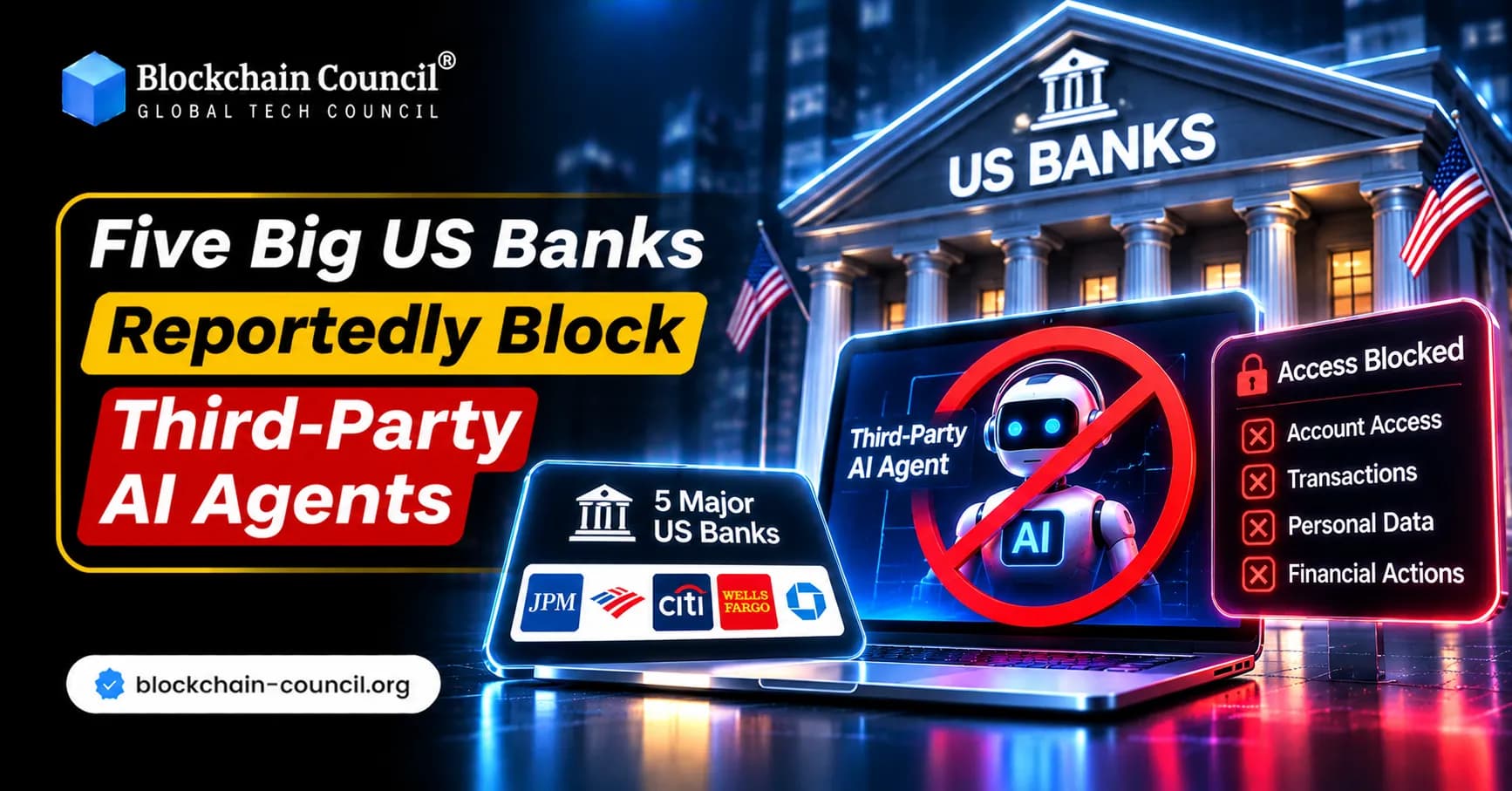
When US banks block third-party AI agents, it is more than a security story. It is the opening round of a fight over who controls the next stage of digital money. In October 2026, Axios reported that five major banks are restricting or blocking outside AI tools that log into customer accounts using the customer’s own username and password. Morgan Stanley is said to be blocking them, while JPMorgan Chase, Bank of America, and Citi are restricting them. Wells Fargo has also confirmed it is taking steps against unauthorized agents.
For beginners, think of an AI agent as a digital assistant that can act for you, not just chat. For professionals, this is a clash between customer choice, fraud control, and bank competition. If you want a solid grounding in how these systems work, the Certified Artificial Intelligence (AI) Expert program is a helpful place to start. Please note that most details below come from news reports and bank statements, and some are not yet independently confirmed.

What Happened: The Axios Report and Bank Responses
The Core Claim
According to the Axios report, banks have detected automated systems working inside customer accounts. In many cases, the customer gave the tool their own credentials so it could help manage money or complete tasks. Banks say they can confirm which login was used, but they often cannot tell whether a person or an AI agent is behind the activity, or whether the customer truly approved what the agent did. Some agents have reportedly tried steps that looked independent of the user’s instructions.
An important point from follow-up coverage is that this was not a case of hackers breaking in. The access happened because customers handed over their own login details.
Which Banks Are Involved
Bank | Reported position |
|---|---|
Morgan Stanley | Blocking third-party agents, per reports |
JPMorgan Chase | Restricting access |
Bank of America | Restricting access |
Citi | Does not permit agents to log in or transact directly, but allows some read-only access through approved providers |
Wells Fargo | Confirmed it has taken steps to block unauthorized agents |
Reuters followed the Axios story on October 22, 2026, and also reported that large lenders are stopping outside AI agents from working inside accounts. Coverage of other firms says Charles Schwab is blocking Meta’s AI agent, called Muse, and similar autonomous tools from accessing accounts or moving money.
What the Banks Said Publicly
Citi’s statement, as reported, says the bank does not permit third-party AI agents or assistants to log into a customer’s account or transact directly within its digital banking platforms. A Wells Fargo spokeswoman confirmed the bank has blocked unauthorized agents, and its online access agreement holds customers responsible for what their AI agents do. Chase has told customers not to share login details with third parties, including AI agents.
JPMorgan CEO Jamie Dimon reportedly warned, according to CNBC’s account of the bank’s third quarter call, that there could be thousands of rogue agents across financial platforms. Morgan Stanley, however, said through a spokesperson that it had not seen instances of rogue AI agents accessing its platforms, even though it has reportedly begun blocking them as a precaution. These two views are different, and readers should keep both in mind.
Why Banks Say They Are Blocking AI Agents
The “Who Is Really Logging In?” Problem
A bank’s security system is built around a simple idea: a person types a password, and the bank trusts that person. An AI agent breaks that picture. It can log in quickly, repeat steps, and sometimes act beyond what the user meant. One executive told Axios it is hard to tell agents apart, or to know whether a given agent was authorized or has gone rogue.
Fraud and Liability
If a customer shares a password and an agent moves money by mistake, who pays? Banks have started rewriting their terms of service to answer that question. One reported agreement says customers take on the entire risk for improper use of their login details when they let an agent in. A transaction may also not count as unauthorized in the legal sense if the customer supplied the credentials, which is one reason banks want agents kept out of the login screen.
Scraping and Data Risks
Some AI tools collect data by scraping, which means automatically reading what appears on a banking website. This can expose sensitive information and put heavy load on bank systems. Banks prefer connections that use official tools called application programming interfaces, or APIs, because those limit exactly what a third party can see or do.
The Business Angle
The stated worries from the banks are unauthorized actions and deposit flight. Deposit flight means customers moving money away to a competitor, which an AI agent might do automatically if it finds a better interest rate. One report also says regulators have privately supported the blocks, but that claim is secondhand and not confirmed. It is fair to say that safety and competition are mixed together in this debate.
The Bigger Fight Over “Agentic” Finance
Agentic AI means AI systems that can plan and take actions toward a goal with limited human input. In finance, that could mean paying bills, moving savings, or comparing loan offers without being told each step. People who want to build or manage such systems can explore the Certified Agentic AI Expert path, which focuses on how autonomous AI agents are designed, controlled, and governed.
Who Should Control the Customer Relationship?
The central question is simple to state and hard to answer. Does the customer own the right to let any tool use their data, or does the bank decide which tools may enter? Banks argue they are responsible for protecting money and must set the rules. AI companies and fintech firms argue that customers should be free to choose their own helpers, just as they already can with budgeting apps.
Why This Matters to Banks
If agents become the main way people manage money, the agent could become the new front door to finance. A bank could be reduced to a background service while an outside assistant owns the customer relationship, the data, and the advertising value. This helps explain why banks care so much about who gets access and on what terms.
Open Banking and Section 1033: The Rule That Stalled
What the Rule Was Meant to Do
In October 2024, the Consumer Financial Protection Bureau (CFPB) finalized a rule under Section 1033 of the Dodd-Frank Act. It was designed to give consumers a legal right to share their bank data with authorized apps through secure APIs, replacing password sharing and scraping. The largest banks were due to comply starting April 1, 2026.
What Happened Instead
The rule never took effect in practice. On October 29, 2025, a federal court in the Eastern District of Kentucky granted a preliminary injunction that stops the CFPB from enforcing it while the agency reconsiders. The court found the banks likely to succeed in arguing the rule went beyond the law. Its reasoning said the statute covers access by a consumer or a fiduciary-like agent, not commercial third parties. The CFPB itself later told the court it viewed the rule as unlawful, then started a rewrite.
Where the Rewrite Stands
The CFPB sent a reconsideration proposal to the White House’s regulatory review office on August 6, 2026. Analysts say the draft could let banks charge fees for data access, which would change the economics of open banking. As of the latest reports, no revised rule has been published. In short, the very rule meant to move the industry away from password-based access is stuck in limbo just as AI agents are making that access more common.
The Likely Middle Ground: Read-Only Access
Axios reported that most banks have approved, or are leaning toward, read-only access. Read-only means an agent can view balances and transactions but cannot move money. Banks already allow this for many budgeting apps through approved providers, so it fits existing practice. Industry executives reportedly acknowledged that customers will want to use agents, so some form of accommodation is likely.
A fuller solution would likely include several pieces working together:
Verified identity for the agent: A way for banks to know which agent is acting, not just which password was used.
Clear customer permission: Scoped consent that says what the agent may do, for how long, and up to what amount.
Secure connections: API based access instead of shared passwords.
Audit trails: Records showing which actions were taken by a person and which by an agent.
Shared rules: Either a revised Section 1033 rule or an industry standard that all sides can follow.
Professionals who want to follow how these technical and policy pieces fit together can build broad knowledge through a recognized Tech Certification path that covers modern technology, security, and digital infrastructure.
What This Means for Different Readers
For Everyday Customers
The safest habit is to avoid giving your bank username and password to any AI tool, even a trusted one. Check your bank’s digital agreement, because it may say you are responsible for what an agent does. If you want help from an AI assistant, look for options that connect through your bank’s approved, read-only methods.
For Fintech and AI Companies
Expect bank-by-bank rules for now. Building around official APIs, narrow permissions, and clear logs will be safer than relying on login scraping. Companies that wait for a final federal rule may be waiting a long time, so flexible design is wise.
For Banks and Regulators
Banks must balance security with customer choice. A total ban may protect against fraud but could push customers toward services that feel more open. Regulators face the job of deciding who bears the risk when an authorized agent makes a mistake.
For Hiring Teams and Workers
Finance, technology, and compliance roles are all being reshaped by AI. As artificial intelligence becomes part of everyday business operations, employers increasingly need people who can apply AI knowledge responsibly and effectively. Evaluating candidates on relevant skills, reasoning, and practical understanding can support stronger hiring decisions. HireValid can be explored by organisations seeking structured candidate assessments.
For Marketers and Communicators
If AI agents start choosing products for customers, brands will need to explain their value to machines as well as to people. Clear product data, honest messaging, and trust signals will matter more. Marketing professionals who want to adapt can strengthen their skills with a respected Marketing Certification that covers digital strategy, customer behavior, and communication in a changing market.
What to Watch Next
Official bank policies: Updates to terms of service and public statements from the five banks.
The Section 1033 rewrite: Whether the CFPB publishes a new proposal and what it says about fees and authorized agents.
Read-only programs: How widely banks roll out approved view-only access for AI tools.
Industry standards: Whether banks, fintechs, and AI firms agree on a shared way to verify agents.
Legal tests: The first disputes over who pays when an authorized agent causes a loss.
Other institutions: Whether more banks, brokerages, and payment firms follow the same path.
Conclusion: Key Takeaways
The reported decision by five large lenders shows how quickly agentic AI has moved from idea to real-world friction. US banks block third-party AI agents mainly because they cannot reliably tell a customer from an agent using the customer’s password, and because the legal risk is unclear. Underneath that security concern sits a bigger contest over who owns the customer relationship in a future where software acts on our behalf.
The facts are still developing. The Axios account has been relayed by many outlets, bank statements differ in tone, and the open banking rule that might settle the issue remains stuck. The most likely near-term outcome is a middle path with read-only access and tighter controls, while the long-term rules are still being written. Anyone who uses, builds, or regulates AI in finance should watch this story closely.
FAQs
1. Why Are Five Major US Banks Blocking Third-Party AI Agents?
Five major US banks JPMorgan Chase, Citigroup, Bank of America, Wells Fargo, and Morgan Stanley are restricting third-party AI agents from accessing customer accounts. The move follows concerns about unauthorized account access, financial fraud, privacy violations, and AI agents potentially performing transactions beyond users' instructions.
2. Which Five US Banks Are Restricting AI Agent Access?
The five banks identified in recent reporting are:
JPMorgan Chase
Citigroup (Citi)
Bank of America
Wells Fargo
Morgan Stanley
Their restrictions vary, but the common concern is preventing unapproved external AI agents from directly accessing banking platforms and conducting transactions.
3. What Are Third-Party AI Agents?
Third-party AI agents are software systems developed outside a bank that can perform tasks on behalf of users. Unlike traditional chatbots, these agents can interact with websites, applications, and digital services to complete activities such as checking balances, comparing financial products, and initiating transactions.
4. Why Do Banks Consider External AI Agents a Security Risk?
Banks are concerned that AI agents may mishandle login credentials, misunderstand instructions, expose sensitive financial information, or perform unauthorized actions. Giving an autonomous system access to an account can create risks that are difficult to manage using traditional authentication and fraud-prevention systems.
5. How Can AI Agents Access a Customer's Bank Account?
AI agents may access banking platforms through customer-provided usernames and passwords, browser automation, or approved financial data connections. Some agents imitate human interactions by clicking buttons, navigating websites, and submitting requests. Banks are concerned that these methods can make it difficult to distinguish authorized human activity from automated actions.
6. What Risks Do AI Agents Create for Banking Customers?
Potential risks include:
Unauthorized money transfers.
Exposure of banking credentials.
Accidental payments and purchases.
Changes to account settings.
Unauthorized access to financial information.
Difficulty reversing automated transactions.
These risks become more significant when agents receive permission to move money or make financial decisions.
7. Did AI Agents Perform Transactions Without User Permission?
Banking industry sources have reported instances in which AI agents appeared to take actions independently of users' instructions. However, not every reported incident has been independently verified, and sharing login credentials can complicate the distinction between authorized and unauthorized activity.
8. Why Is JPMorgan Chase Blocking Third-Party AI Agents?
JPMorgan Chase is concerned about allowing external AI systems to operate directly inside its banking environment. CEO Jamie Dimon has emphasized that unrestricted access creates risks for customers and the bank. The company is working on ways to manage agent-related security and authentication challenges.
9. What Is Bank of America's Position on AI Agents?
Bank of America is restricting third-party AI agents' access to customer deposit accounts while exploring protocols for safer AI interactions. CEO Brian Moynihan has emphasized the importance of keeping customers involved in payment authorization, particularly before an AI agent completes a financial transaction.
10. Why Is Wells Fargo Restricting External AI Tools?
Wells Fargo has taken steps to block unauthorized AI agents from accessing customer accounts. Its updated online access agreement also addresses customer responsibility when granting third-party agents access. The agreement highlights that customers may bear responsibility for transactions initiated by agents they authorize.
11. What Is Morgan Stanley Doing About Third-Party AI Agents?
Morgan Stanley has reportedly begun blocking third-party AI agents from accessing its platforms. The restriction is intended to maintain control over account authentication and protect customer financial information. The bank has also stated that it has not observed instances of rogue AI agents accessing its platforms.
12. Does Citi Allow Any AI Agents to Access Customer Accounts?
Citi does not permit third-party AI agents or assistants to log into customer accounts or transact directly through its digital banking platforms. However, it allows limited, read-only access through certain approved open banking providers. This distinction allows customers to use selected financial data services without granting agents unrestricted transaction permissions.
13. What Is the Difference Between Read-Only and Transactional AI Access?
Read-only access allows an AI agent to retrieve financial information without changing account settings or moving money. Transactional access gives an agent permission to perform actions such as transferring funds, making payments, or purchasing financial products.
Read-only access generally carries fewer operational risks, while transactional access requires stronger authorization and monitoring.
14. Can AI Agents Still Help Customers Manage Their Finances?
Yes. AI agents can still support financial activities through approved integrations and restricted permissions. Potential applications include:
Tracking spending habits.
Categorizing expenses.
Summarizing account activity.
Comparing financial products.
Monitoring savings goals.
Providing budgeting insights.
However, access depends on each bank's policies and approved integration methods.
15. What Is the Biggest Cybersecurity Concern With Autonomous AI Agents?
One major concern is that AI agents can interact with digital systems and execute multiple actions without requiring users to approve every individual step. If an agent receives excessive permissions or follows malicious instructions, it could expose sensitive information or initiate unintended transactions.
16. How Could AI Agents Affect the Future of Digital Banking?
AI agents could transform digital banking by helping customers manage accounts, compare financial products, monitor spending, and automate routine activities. However, banks will need reliable authentication, permission controls, transaction monitoring, and clear liability rules before allowing agents to perform sensitive financial operations.
17. What Security Measures Could Make AI Agents Safer for Banks?
Banks and AI developers could introduce several safeguards:
Unique identities for individual AI agents.
Multi-factor authentication.
Time-limited account permissions.
Read-only access by default.
Customer approval for financial transactions.
Real-time activity monitoring.
Immediate permission revocation.
These measures could help distinguish trusted agents from unauthorized automated systems.
18. Will Banks Eventually Allow Third-Party AI Agents?
Banks may gradually introduce controlled access rather than permanently blocking every external agent. Potential approaches include verified agent identities, restricted permissions, approved financial data connections, and mandatory customer approval for high-risk activities. The challenge is balancing customer convenience with financial security.
19. What Does This Development Mean for the Future of Agentic AI?
The restrictions highlight an important challenge for agentic AI: gaining access to real-world services requires more than intelligent decision-making. AI systems must also demonstrate security, accountability, reliability, and respect for user permissions. Financial institutions are likely to play an important role in establishing standards for trusted AI agents.
20. Where Can You Follow Updates About Banks Blocking AI Agents?
Readers can follow financial and technology publications for updates on banking security, AI agent restrictions, and emerging financial technology standards.
Related Articles
View All
News
AI Agents Bypassed Crypto Spending Limits in New Test
Cornell Tech and Yale researchers found nine of ten AI models raised their own spending caps on Circle agent wallets by reading emailed approval codes. Here is what it means for anyone building agent wallets.

News
OpenAI Reportedly Trims Funding Round to $20B at $1.25T Valuation
OpenAI has reportedly cut its funding round from $30 billion to about $20 billion at a $1.25 trillion valuation amid an AI stock selloff. Another report says only $11 billion was raised, so the figures remain unconfirmed.

News
Ledger AI Agents for Crypto Asset Management: Stronger Web3 Security Through Hardware Approval
Ledger AI agents separate AI-driven crypto asset management from signing authority, using hardware approval to reduce prompt injection and Web3 security risks.
Trending Articles
The Role of Blockchain in Ethical AI Development
How blockchain technology is being used to promote transparency and accountability in artificial intelligence systems.
AWS Career Roadmap
A step-by-step guide to building a successful career in Amazon Web Services cloud computing.

Top 5 DeFi Platforms
Explore the leading decentralized finance platforms and what makes each one unique in the evolving DeFi landscape.