

OpenAI Reportedly Trims Funding Round to $20B at $1.25T Valuation
 Suyash Raizada
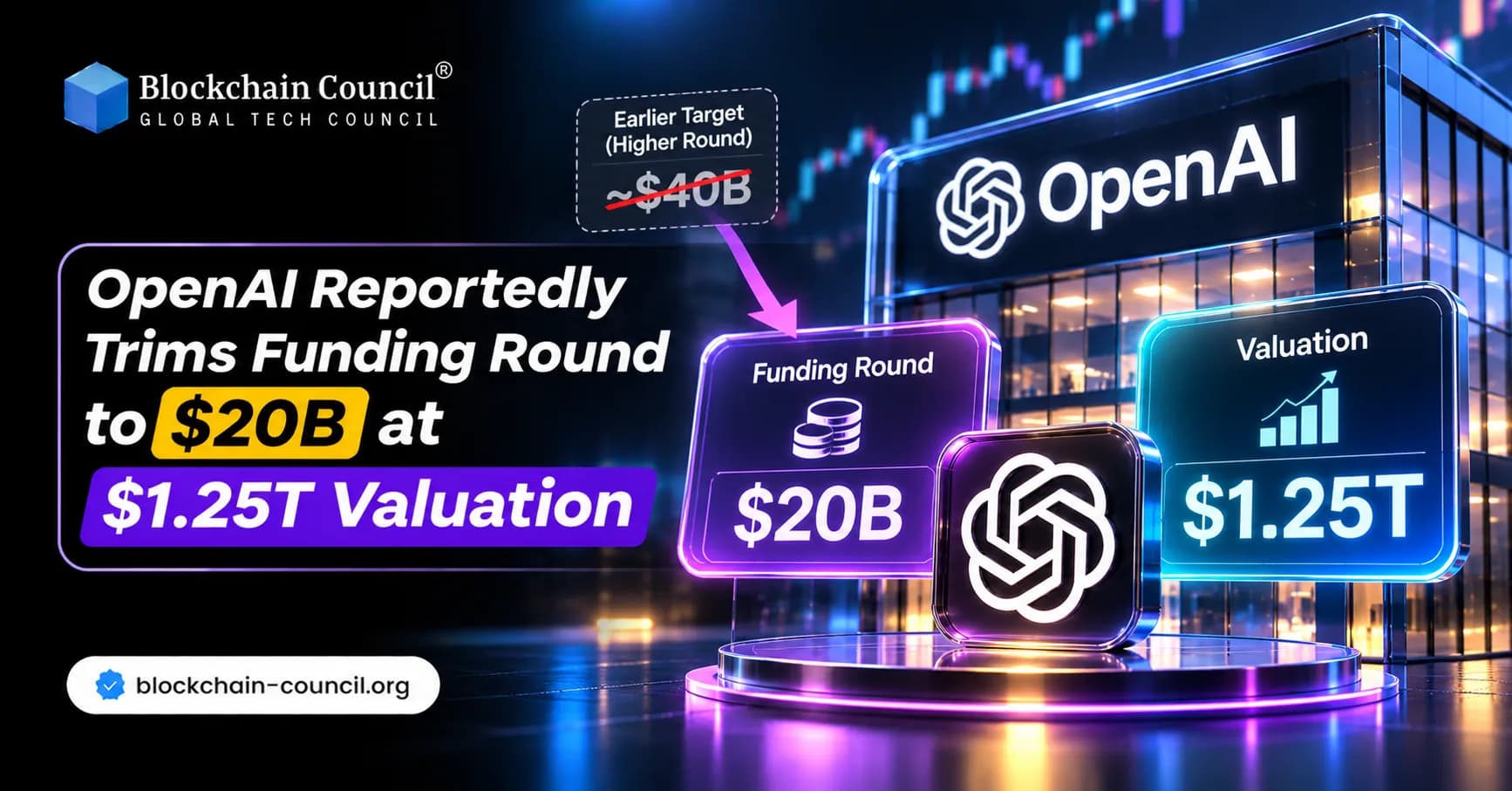
When OpenAI trims funding round targets, the whole technology industry takes notice. Reports published on October 30 and 31, 2026 say the maker of ChatGPT has cut the size of its latest raise from about $30 billion to about $20 billion. The valuation it is asking for has reportedly fallen from $1.4 trillion to $1.25 trillion. The change arrives during a sharp selloff in AI-linked stocks, and a second report suggests the company had lined up only about $11 billion so far. These numbers do not match, so everything below should be treated as unconfirmed until OpenAI or its investors say more.
This story matters to beginners and experts alike, because it shows how money flows into the AI industry and what happens when investors become cautious. If you want to understand the technology that these valuations are built on, a credential such as the Certified Artificial Intelligence (AI) Expert program can give you a clear foundation in how AI systems work and create business value.

OpenAI Trims Funding Round: What Was Reported
The Headline Numbers
The Financial Times reported that OpenAI lowered the goal of its current round by $10 billion, to about $20 billion. Reports citing the same source say the valuation target dropped by $150 billion, from $1.4 trillion to $1.25 trillion. Only weeks earlier, the company had been pitching the round as a final chance for investors to buy in before its own planned initial public offering, which reports place in 2027.
Item | Earlier target | Reported new target |
|---|---|---|
Round size | About $30 billion | About $20 billion |
Valuation | $1.4 trillion | $1.25 trillion |
Lead investors | Not specified | Investors from the United Arab Emirates |
How the Round Is Reportedly Structured
According to the coverage, the first close is expected to come in below $20 billion. After that, a later offering would let wealthy individuals invest at the same $1.25 trillion valuation, which one person familiar with the matter said could bring the total to roughly $20 billion. OpenAI also reportedly set a Friday deadline for investors to commit. Some backers chose to scale back their allocations. As part of the deal, OpenAI is said to gain an option to lease newly built computing capacity in the region.
The Conflicting Report
A separate report attributed to the Wall Street Journal says OpenAI had lined up only about $11 billion of its original $30 billion goal, and that interest from some large investors was lukewarm. That is a different story from a clean cut to $20 billion. The two versions can both be true, because a company can lower its goal while still short of reaching it. However, the details have not been confirmed by OpenAI, and the exact amount committed at the time of writing is unclear. A careful reader should treat every figure here as a report, not a fact.
What Official Announcements Say
OpenAI’s Last Confirmed Round
The most recent official funding news from OpenAI came on March 31, 2026. In a post on its website, the company said it had closed its latest funding round with $122 billion in committed capital at a post-money valuation of $852 billion. The round followed an earlier announcement in February of about $110 billion. Reports at the time named Amazon, Nvidia, and SoftBank among the anchor backers, with continued participation from Microsoft and other global investors. The company said the money would support a unified AI “superapp” and a wider mix of cloud and chip partners.
No Official Confirmation of the Trim
At the time of writing, a search of OpenAI’s own channels did not turn up any official statement confirming the $20 billion figure, the $1.25 trillion valuation, or the $11 billion total. All of those numbers come from news reports citing people familiar with the matter. When OpenAI was asked about an earlier report in September on a possible round near $1.2 trillion, it declined to comment. Readers who need exact figures should wait for an announcement from OpenAI or a regulatory filing.
Why OpenAI Would Lower Its Ask
An AI Stock Selloff
The timing is tied to the market. Coverage says the Nasdaq 100 fell roughly 10% in the three weeks after its record on October 6, with a large one day drop on Friday, October 30. Reports link part of that decline to Alphabet, Meta, and Amazon all announcing bigger AI spending plans, which made some investors ask whether the returns will match the costs. When public AI stocks fall, private investors usually become less willing to pay top prices for private AI companies too.
Competition From Anthropic’s IPO
OpenAI is also competing for the same pool of money as its rival Anthropic. Anthropic filed its public IPO prospectus on October 26, plans to list on Nasdaq under the ticker ANT, and has been reported to target a valuation of at least $1.5 trillion. Its filing showed first-half 2026 revenue of about $16.3 billion. If investors can buy a public AI giant soon, they may be less eager to commit to a private round at a premium.
Huge Costs and Heavy Debt in the Ecosystem
AI companies need enormous amounts of computing power. Reports note that Oracle signed a contract worth about $300 billion with OpenAI while carrying roughly $132 billion in net debt, that CoreWeave has about $46 billion in net debt, and that Nvidia holds a stake of about $30 billion in OpenAI. These links explain why a weaker OpenAI round makes people nervous about the whole chain of suppliers and lenders. Professionals who want to follow such tangled relationships more easily can benefit from a broad Certified Artificial Intelligence (AI) Developer path, which explains the models, tools, and infrastructure behind these deals.
Is $1.25 Trillion Still a Big Number?
Yes, and that is an important point for balance. Even at $1.25 trillion, OpenAI would still be the most valuable private company in history. A $20 billion raise would still rank among the largest funding rounds ever. The valuation would also sit far above the $852 billion set in March, which means the company would still be worth about 47% more than it was seven months earlier.
Supporters of OpenAI argue that a smaller, better priced round can be healthier than a stretched one. A realistic valuation may help the company avoid a painful reset later, especially if it plans an IPO next year. Skeptics see the same event as a warning that the peak of private AI pricing may have passed. One market commentator described it as valuation gravity returning to AI.
Why the Numbers Conflict
Different Sources, Different Moments
Several things can explain the mismatch between a $20 billion target and $11 billion raised.
Target versus committed money: A target is what a company hopes to raise. Committed money is what investors have actually agreed to put in.
Staged closings: The first close can be smaller than the final total, especially when a later retail offering is planned.
Timing: Reports written a few hours apart can capture different stages of the same negotiation.
Anonymous sourcing: Most figures come from people familiar with the matter, who may see only part of the picture.
How to Read Financial Headlines Carefully
A simple habit helps. Ask who is the source, whether the number is a goal or a result, and whether the company has confirmed it. Learning to ask these questions is useful in any field. Teams that track technology trends for work can sharpen this skill through a recognized Tech Certification that covers current tools, business use cases, and the language of the industry.
What This Means for Different Readers
For Investors
The trim suggests that appetite for very large private AI deals has weakened, at least for now. Watch for three signals: the size of the first close, whether the $1.25 trillion valuation holds through the retail offering, and how Anthropic’s debut performs. A strong public debut could lift confidence, while a weak one could put more pressure on private pricing.
For Businesses That Use AI Tools
Companies that rely on ChatGPT or OpenAI’s developer tools do not need to panic. A lower valuation target does not mean the products will stop working. OpenAI still raised $122 billion in March, and a new round of $20 billion would add to that. Still, it is wise to avoid depending on a single provider and to plan for price and policy changes, because heavy computing costs affect what AI services charge.
For Workers and Hiring Teams
AI will keep spreading through the workplace whatever the stock market does. As artificial intelligence becomes part of everyday business operations, employers increasingly need people who can apply AI knowledge responsibly and effectively. Evaluating candidates on relevant skills, reasoning, and practical understanding can support stronger hiring decisions. HireValid can be explored by organisations seeking structured candidate assessments.
For Marketers and Communicators
News about falling valuations can shape public trust in AI brands. Marketing teams that talk about AI products need clear, honest messaging that avoids hype and speaks to real customer needs. Building those skills with a respected Marketing Certification can help professionals explain complex technology in simple terms and respond calmly when headlines turn negative.
What to Watch Next
An official statement: Confirmation or correction from OpenAI on the round size and valuation.
The first close: The actual amount committed by the UAE-led group and other backers.
The retail offering: How many wealthy individuals take part, and at what price.
Anthropic’s listing: Reports point to mid-November, and its pricing will act as a benchmark for the whole sector.
Market direction: Whether the AI stock selloff deepens or recovers, since it strongly influences private deals.
OpenAI’s IPO timing: Earlier reports pointed to 2027, and any change in that plan would be a major signal.
Conclusion: Key Takeaways
When OpenAI trims funding round expectations, it tells us that even the biggest names in AI feel the pressure of a nervous market. Reports say the target moved from about $30 billion at $1.4 trillion to about $20 billion at $1.25 trillion, with UAE investors leading and a later retail offering planned. A separate report suggests only about $11 billion had been lined up, and the two sets of figures do not agree.
The safest way to read this story is with patience. The March 2026 round of $122 billion at $852 billion is the last figure OpenAI has officially confirmed. Everything newer is based on anonymous sources and could change within days. Even so, the direction is clear: investors are asking harder questions about price, spending, and returns. Anyone following AI, whether as an investor, a business owner, or a learner, will gain from staying informed and checking each claim against official announcements.
FAQs
1. Why Is OpenAI Reportedly Reducing Its Funding Round to $20 Billion?
OpenAI has reportedly reduced its latest fundraising target from $30 billion to approximately $20 billion amid changing investor sentiment and concerns about rising AI infrastructure spending. The reported adjustment reflects challenges in securing investor commitments for large-scale AI investments.
2. What Is OpenAI's New Reported Valuation?
OpenAI is reportedly targeting a valuation of approximately $1.25 trillion for its latest funding round. This represents a reduction from the previously discussed $1.4 trillion valuation. These figures are based on media reports and are not confirmed final transaction terms.
3. How Much Was OpenAI Originally Planning to Raise?
OpenAI was previously reported to be seeking approximately $30 billion in fresh funding. The company subsequently reduced its target by $10 billion to approximately $20 billion as fundraising discussions continued.
4. Why Are Investors Becoming More Cautious About OpenAI's Funding Round?
Investors are reportedly becoming more cautious because of rising AI infrastructure costs, concerns about technology valuations, and uncertainty about how quickly massive AI investments will generate returns. A broader technology stock selloff has also contributed to changing investor sentiment.
5. What Is Driving OpenAI's Need for Additional Funding?
OpenAI requires substantial capital to support several areas of development, including:
Training advanced AI models.
Expanding computing infrastructure.
Securing data center capacity.
Developing ChatGPT and enterprise products.
Supporting research and AI safety.
Expanding global operations.
These investments require significant financial resources as demand for advanced AI services grows.
6. Who Are the Expected Investors in OpenAI's Latest Funding Round?
Reports identify several potential participants, including:
MGX and other UAE-based investors.
Founders Fund.
Coatue.
Sequoia Capital.
Andreessen Horowitz.
SoftBank.
A consortium of UAE investors, including state-backed investment fund MGX, is reportedly expected to be the largest participant. Final allocations and commitments remain subject to confirmation.
7. What Is MGX's Role in OpenAI's Funding Round?
MGX is an Abu Dhabi-based investment firm focused on technology and artificial intelligence. It is reportedly part of a UAE investment consortium expected to contribute significantly to OpenAI's fundraising. The proposed arrangement could also give OpenAI an option to lease additional computing capacity in the region.
8. Why Did OpenAI's Reported Valuation Fall From $1.4 Trillion to $1.25 Trillion?
The reported valuation adjustment reflects changing fundraising negotiations and investor expectations. Concerns about AI spending, technology market volatility, and the availability of investment capital may have influenced discussions. However, the final valuation will depend on completed negotiations and confirmed investment terms.
9. Has OpenAI Officially Confirmed the $20 Billion Funding Round?
No. The reported $20 billion target and $1.25 trillion valuation have been attributed to media reports, including the Financial Times. OpenAI has not publicly confirmed the final funding amount, valuation, or complete investor commitments. The reported first closing is also expected to be below the $20 billion target.
10. How Much Money Has OpenAI Already Secured?
A report by The Wall Street Journal, summarized by TechCrunch, indicated that OpenAI had secured approximately $11 billion in commitments. This figure should be treated as reported fundraising progress rather than a confirmed completed investment total.
11. How Could the Funding Reduction Affect OpenAI's AI Development?
A smaller funding round could influence the timing and scale of infrastructure expansion, research investments, and computing agreements. However, it does not necessarily mean OpenAI will reduce its AI development plans. The company's actual spending priorities will depend on available capital, revenue, and infrastructure commitments.
12. Why Is AI Infrastructure So Expensive for Companies Like OpenAI?
Developing and operating advanced AI systems requires specialized processors, high-performance servers, networking equipment, data centers, electricity, and cooling systems. Training large models and serving millions of users also generate continuous computing expenses, making infrastructure one of the largest financial requirements for AI companies.
13. How Does Anthropic's Upcoming IPO Affect OpenAI's Fundraising?
Anthropic's proposed IPO introduces another major AI investment opportunity for institutional and private-market investors. Both companies are seeking substantial capital to expand their AI infrastructure and products. Reports suggest OpenAI wants to complete its fundraising ahead of Anthropic's anticipated public listing to compete for investor attention and capital.
14. Is OpenAI Planning an IPO in 2027?
OpenAI is reportedly pursuing a potential public listing in 2027. However, a confirmed IPO date, valuation, and offering structure have not been announced. Its current private fundraising efforts could provide additional capital ahead of any future public-market plans.
15. What Is the Difference Between OpenAI's Pre-Money and Post-Money Valuation?
Pre-money valuation refers to a company's estimated value before receiving new investment, while post-money valuation includes the newly raised capital.
For example, if OpenAI raises $20 billion at a $1.25 trillion pre-money valuation, its theoretical post-money valuation would be $1.27 trillion. The actual calculation depends on the final agreed terms and whether the reported valuation is pre-money or post-money.
16. Could OpenAI's Funding Changes Affect the Global AI Industry?
Yes. Large fundraising decisions can influence investor confidence, infrastructure investment, semiconductor demand, and competition among AI developers. Changes in OpenAI's capital requirements may also affect how other technology companies evaluate their own AI investments and expansion strategies.
17. How Could the Funding Round Affect AI Startups?
OpenAI's fundraising developments could influence venture capital allocation across the AI sector. Investors may become more selective about startups' business models, computing expenses, customer demand, and revenue potential. Smaller AI companies may need to demonstrate stronger financial sustainability to attract investment.
18. Does OpenAI's Reduced Funding Target Mean the AI Market Is Slowing Down?
Not necessarily. A reduced fundraising target does not establish that overall AI demand is declining. It may reflect investor caution, valuation negotiations, and the financial requirements of individual companies. Demand for AI products, cloud infrastructure, and enterprise automation remains an important factor in assessing the broader industry.
19. What Should Investors Watch in OpenAI's Latest Funding Round?
Investors and technology observers should monitor:
The final fundraising amount.
The confirmed company valuation.
Investor participation and allocations.
The role of UAE-based investment groups.
Computing infrastructure agreements.
OpenAI's revenue and operating expenses.
Potential IPO developments in 2027.
These details will provide a clearer picture of OpenAI's financial position and long-term expansion strategy.
20. Where Can You Follow the Latest OpenAI Funding News?
Readers can follow financial publications and official company announcements for updates about fundraising, investor participation, valuation negotiations, and potential IPO plans.
Related Articles
View All
News
Crypto.com $400 Million Funding Round: What a $20 Billion Valuation Means for Crypto
Crypto.com's $400 million funding round at a $20 billion valuation signals institutional focus on tokenized assets, exchanges, and 24/7 markets.

News
Crypto.com Funding Round: What a $20 Billion Valuation Means for the Crypto Market
Crypto.com's $400 million Citadel Securities investment at a $20 billion valuation signals renewed institutional confidence in crypto infrastructure.

News
Crypto.com's $400 Million Funding Round and Institutional Crypto Adoption
Crypto.com's $400 million round at a $20 billion valuation shows how institutional crypto adoption is concentrating around large, regulated exchanges.
Trending Articles
The Role of Blockchain in Ethical AI Development
How blockchain technology is being used to promote transparency and accountability in artificial intelligence systems.
How Blockchain Secures AI Data
Understand how blockchain technology is being applied to protect the integrity and security of AI training data.
What is AWS? A Beginner's Guide to Cloud Computing
Everything you need to know about Amazon Web Services, cloud computing fundamentals, and career opportunities.