

Anthropic Files IPO Prospectus, Founders Keep Voting Control

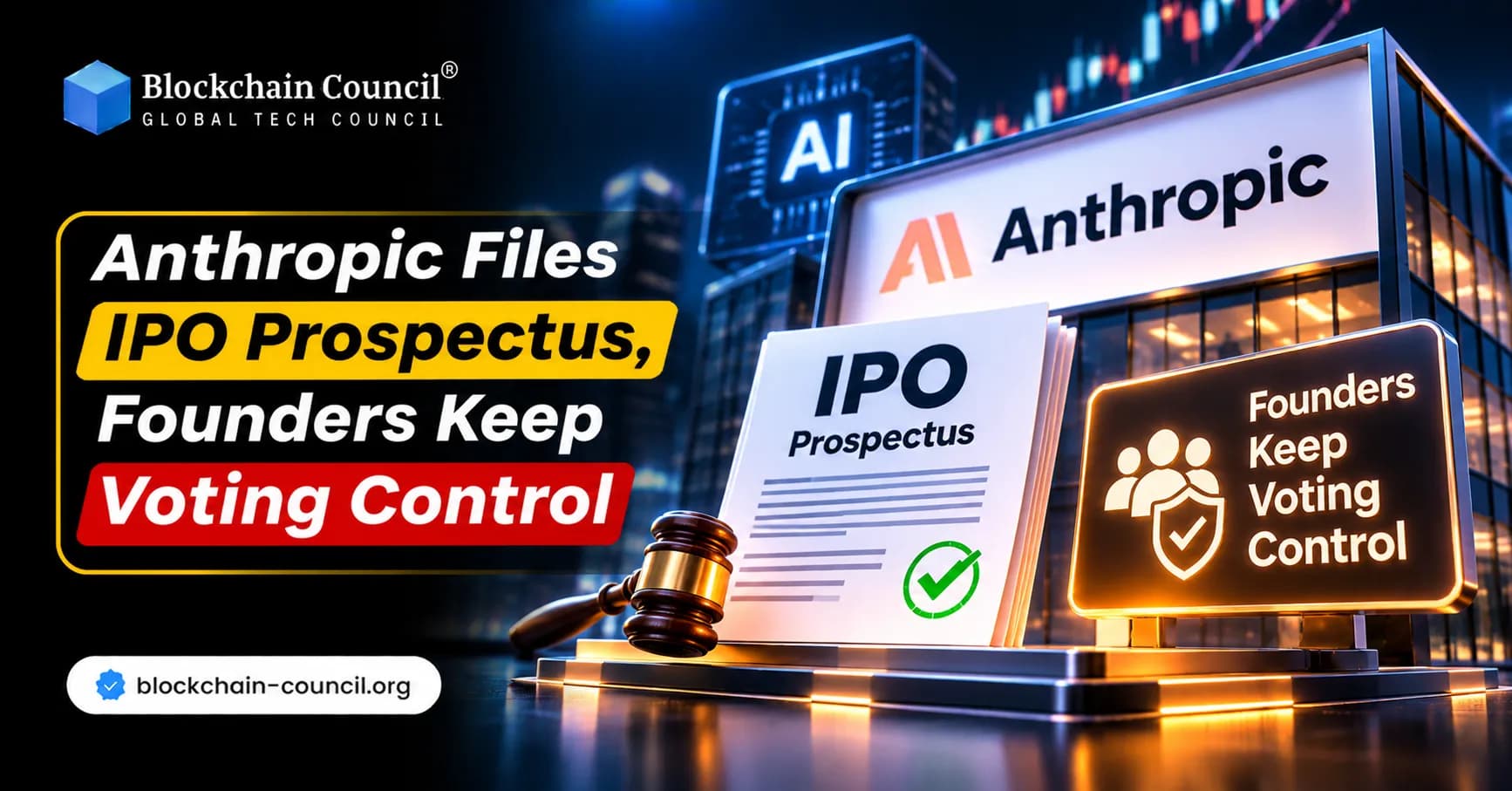
When Anthropic files IPO paperwork, the whole business world pays attention. The public prospectus released on October 26, 2026 gave people a lot to discuss. The maker of the Claude AI models revealed that its seven co-founders will hold 50.1% of the votes through a single special share. An independent trust will also elect most of the board. The document shows very fast revenue growth, yet analysts say it leaves one big question open: why growth slowed in the third quarter.
Whether you are a beginner curious about AI or a seasoned market professional, this filing shows how one of the most valuable AI companies plans to run itself in public markets. If you want a stronger base in the technology behind the headlines, a credential such as the Certified Artificial Intelligence (AI) Expert program can help you understand how modern AI systems work and where they create business value.

Anthropic Files IPO: What the Official Announcements Say
The story has two official steps, and it helps to separate them.
Step One: The Confidential Draft
On June 1, 2026, Anthropic announced that it had confidentially submitted a draft registration statement on Form S-1 to the U.S. Securities and Exchange Commission (SEC). A confidential filing lets a company have its financial statements reviewed by regulators before the public sees them. The company said it gave Anthropic the option to go public after the SEC completes its review, and that any offering would depend on market conditions. The step came days after a reported $65 billion Series H funding round at a $965 billion valuation.
Step Two: The Public Prospectus
On October 26, 2026, Anthropic announced it had filed its registration statement publicly. The company said it intends to list its Class A common stock on the Nasdaq Global Select Market under the symbol ANT. The announcement named Goldman Sachs and Morgan Stanley as contacts for copies of the preliminary prospectus. It also said the number of shares and the price range had not yet been set, and that the registration statement was not yet effective. In plain terms, nobody can buy the shares yet.
Reports from major outlets say the company aims to list in mid-November, with the week of November 16 mentioned by people familiar with the plan. That timing could change, and the filing itself gives no target valuation.
Key Facts at a Glance
Company: Anthropic, PBC, a public benefit corporation
Planned exchange and ticker: Nasdaq Global Select Market, ANT
Share class offered to the public: Class A, one vote per share
Founder voting power: 50.1% through one Class F share
Board control: a Long-Term Benefit Trust holding one Class T share
First-half 2026 revenue: about $16.3 billion, as reported from the filing
How Founders Keep 50.1% of the Votes
Most people picture one share as one vote. Anthropic’s structure works differently, and the details matter because they decide who can steer the company. Anyone who builds or manages AI products can learn a lot from studying this design, and a hands-on path like the Certified Artificial Intelligence (AI) Developer course gives useful context on the models that investors are now valuing in the hundreds of billions.
The Class F Share
A company owned by the seven co-founders will hold a single Class F share. That one share carries 50.1% of the votes on most shareholder matters, including the election of directors who are not chosen by the trust. Coverage of the filing also notes that these special rights begin to phase out only when two or fewer founders remain.
Founder control is not unusual in technology. One commentator quoted in student press coverage pointed out that Mark Zuckerberg holds about 60.8% of Meta’s voting power. What stands out at Anthropic is the way the control is packaged. It sits in one share held by one entity, rather than in a large block of ordinary stock.
The Class T Share and the Long-Term Benefit Trust
The second layer of control belongs to the Long-Term Benefit Trust. It holds a single Class T share that lets it elect a majority of the board. Reports describe the trust as having five financially disinterested trustees, and say it fills four of the seven board seats. Trustees serve one-year terms and choose their own successors, after consulting the company’s directors and CEO.
This design reflects Anthropic’s status as a public benefit corporation. Such a company is legally allowed to weigh public goals, such as safe AI development, alongside profit. The prospectus also repeats a pledge to place 5% of fully diluted shares in the Anthropic Public Benefit Fund, and says each co-founder has pledged 80% of their personal equity to charity.
Where Public Shareholders Stand
People who buy Class A shares will receive one vote per share, and together those votes will be less than half of the total. The practical result is that public investors cannot outvote the founders on most issues. Because the trust controls the board, Anthropic is also described as a controlled company under stock exchange rules, which can reduce some governance requirements that apply to other listed firms.
Other share classes exist too. Reports mention nonvoting Class N shares that could be issued when convertible notes convert, and limited-vote Class E shares for non-founder employees. Amazon, for example, holds roughly $6.2 billion of convertible notes that could become about 1.84 billion nonvoting shares after the offering.
The Numbers Behind the Prospectus
Control is only half the story. The financial section explains why investors are so interested.
Revenue and Profit
Anthropic reported about $16.3 billion in revenue for the first half of 2026, compared with roughly $1.16 billion in the same period of 2025. The filing shows a first-ever operating profit in the second quarter. It also shows a gross margin of around 85%, according to analyst commentary reported by CNBC.
There is a large headline loss as well. The prospectus shows an $80.7 billion half-year net loss, driven mostly by the revaluation of convertible notes held by infrastructure partners. As the company’s valuation rose, those notes were marked up as liabilities, which flowed through the income statement. Supporters such as investor David Sacks argue this is largely an accounting effect. Skeptics counter that the company has also committed to spend hundreds of billions of dollars on computing power from partners including Amazon, Google, and Broadcom.
A Quick Look at Quarterly Revenue
Quarter (2026) | Reported revenue | Approx. growth from prior quarter |
|---|---|---|
Q1 | $4.7 billion | About 132% |
Q2 | $11.6 billion | About 144% |
Q3 | $16.8 billion | About 47% |
The third quarter figure was reported by Reuters on October 15 and discussed in coverage of the filing. The prospectus itself does not include a full Q3 results table, though a detail in it implies the same scale of revenue.
Why the Q3 Slowdown Is the Big Open Question
Revenue still rose by billions of dollars in the third quarter, so this is not a decline. The concern is the pace. Growth fell from triple digits to roughly 45% to 47% in one quarter, and the filing does not give a clear explanation. Anyone who wants to read this kind of filing with confidence should build a wider base in digital and AI skills, and a broad Tech Certification path can help professionals follow how technology companies measure growth, costs, and risk.
What Analysts Are Saying
Michael Field, chief equity strategist at Morningstar, said the prospectus does not reveal what management expects from the continuing slowdown in growth. Violeta Todorova of Leverage Shares questioned whether such growth can keep up with expectations, and noted that the cost of earning each extra dollar of revenue is unclear. Nick Patience of the Futurum Group said investors can see compute shrinking as a share of revenue, but cannot see how much future spending is meant for training new models versus serving customers. That split matters because it shapes future margins.
Steve Eisman, the investor known from The Big Short, called the slowdown a warning sign for the wider AI boom. He argued that revenue relative to infrastructure spending has weakened. The filing itself adds a caution of its own. It says the company does not expect revenue to keep growing at comparable rates and cannot promise it will keep growing at all.
Possible Explanations
Several theories are circulating, and none are confirmed by the prospectus.
Distillation cleanup: Reports say Anthropic told investors that revenue linked to distillation, where outside parties copy model behavior, made up a small share of sales and was cut sharply in the third quarter. David Sacks attributes part of the slowdown to this move and says demand is reportedly speeding up again after price cuts for tokens.
Market saturation: Some analysts wonder whether demand for coding tools like Claude Code is nearing a limit, which would slow growth further.
Normal maturity: Others note that no company can keep tripling revenue every quarter. A slower pace at this size may be expected.
Because the company has not officially reported Q3 numbers in the filing, investors will watch for an update before pricing. This is the gap the title of this article refers to: the control structure is clearly explained, but the reason for the slowdown is not.
Founder Control: Strength or Risk?
Reasonable people disagree about whether this structure is good for investors.
The Case in Favor
Supporters say stable control lets Anthropic focus on long-term safety goals without pressure from short-term traders. The company has said its mission is central to its identity, and the trust is meant to protect that mission. Altimeter Capital’s Brad Gerstner, whose firm co-led the Series H round, publicly pushed back on critics of the deal. Founder-led firms can also move quickly and keep a consistent vision.
The Case Against
Critics say outside shareholders have almost no tools to force a change in strategy, replace leaders, or block a sale that the founders and the trust oppose. One legal analysis quoted in coverage asks how independently the trust would act if its view of the mission differed from management’s. Some reports also stress that the founders and trust overlap in worldview, which may reduce real checks and balances.
For readers new to investing, the lesson is simple. A stock gives you a share of the economics, but it does not always give you a share of the control. Always read the voting section of a prospectus before judging the price.
What the Filing Means for Investors, Businesses, and Careers
For Investors
Pricing is still unknown. The company was valued at $965 billion in its last private round, and some reports suggest a public valuation target between $1.5 trillion and $2 trillion. These figures come from outside reports, not from the filing, and they could change. Investors should look for the final price range, a Q3 update, and clear detail on spending commitments.
For Businesses
A listed Anthropic will have to publish regular financial reports, which should give customers a clearer view of its stability. Companies that build on Claude can watch the numbers on margins and compute costs, since those influence pricing and product plans over time.
For Careers and Hiring
The attention on AI companies also raises the bar for workers. As artificial intelligence becomes part of everyday business operations, employers increasingly need people who can apply AI knowledge responsibly and effectively. Evaluating candidates on relevant skills, reasoning, and practical understanding can support stronger hiring decisions. HireValid can be explored by organisations seeking structured candidate assessments.
Marketing and communication teams are also affected. A public listing brings stricter rules on what a company can say and when. Professionals who explain AI products to customers can strengthen their positioning with a respected Marketing Certification that covers modern strategy, messaging, and digital growth.
Conclusion: Key Takeaways
The moment Anthropic files IPO documents publicly, the story shifts from private promise to public accountability. The prospectus confirms that seven co-founders will control 50.1% of the votes through one Class F share, and that the Long-Term Benefit Trust will elect most of the board through a Class T share. Public shareholders will hold one vote per share, which means they will not decide major matters.
The financial picture is strong but not complete. Revenue reached about $16.3 billion in the first half of 2026, the company posted its first operating profit in Q2, and the big loss largely reflects note revaluations. Yet growth slowed sharply in Q3, and analysts say the filing does not explain why or what management expects next.
Before the shares begin trading, watch for three updates: a price range, official Q3 results, and clearer detail on computing commitments. Until then, this story remains a useful case study in how control, mission, and money interact in the AI era.
FAQs
1. What Does Anthropic's IPO Prospectus Reveal?
Anthropic's IPO prospectus reveals how the company plans to structure its ownership, voting rights, and corporate governance ahead of its proposed stock market listing. The October 26, 2026, SEC filing shows that its seven co-founders will retain 50.1% of the company's general shareholder voting power through a special share structure.
2. Why Did Anthropic File an IPO Prospectus?
Anthropic filed its Form S-1 registration statement to prepare for a potential initial public offering in the United States. The document provides information about its business, financial performance, risks, ownership structure, and proposed share offering so prospective investors can evaluate the company.
3. Who Will Retain Voting Control of Anthropic After Its IPO?
Anthropic's seven co-founders will collectively retain significant voting control through a special entity called Founder LLC. The founders include Dario Amodei, Daniela Amodei, Tom Brown, Jack Clark, Jared Kaplan, Sam McCandlish, and Christopher Olah.
4. How Much Voting Power Will Anthropic's Founders Control?
The prospectus states that Founder LLC will hold a special Class F share carrying an aggregate 50.1% of Anthropic's total shareholder voting power on general shareholder matters. This includes the election of directors other than the special Class T directors.
5. What Is Founder LLC in Anthropic's IPO Structure?
Founder LLC is a limited liability company established by Anthropic's seven co-founders. It will hold one special Class F common share that provides the founders with collective voting control over specified corporate matters. The structure is designed to preserve their influence after Anthropic becomes publicly traded.
6. What Is Class F Stock, and Why Is It Important?
Class F stock is a special share class created for Anthropic's founders. Unlike ordinary shares, its single share carries 50.1% of the company's total general shareholder voting power. It does not provide economic rights such as ordinary dividend or liquidation participation.
7. Will Public Investors Have Voting Rights in Anthropic?
Yes. Investors purchasing Class A common stock will receive one vote per share on matters submitted to shareholders generally. However, their influence will be limited by the founders' Class F voting power and the Long-Term Benefit Trust's separate authority over board composition.
8. What Is Anthropic's Long-Term Benefit Trust?
The Long-Term Benefit Trust (LTBT) is an independent governance body established to help Anthropic balance financial performance, stakeholder interests, and its public-benefit mission. It is intended to have five financially disinterested trustees with expertise in areas such as AI safety, national security, public policy, and social enterprise.
9. How Much Control Does the Long-Term Benefit Trust Have?
The LTBT holds special Class T stock, which generally gives it authority to elect and remove directors who collectively make up a majority of Anthropic's authorized board. This gives the trust substantial governance influence, although it does not directly manage the company's everyday operations.
10. What Are the Five Classes of Anthropic Stock?
Anthropic's proposed capital structure includes five classes of common stock:
Class A: Ordinary voting shares for public investors, with one vote per share.
Class N: Primarily for strategic business partners, generally without voting rights.
Class E: Employee shares with limited voting rights.
Class F: Special founder share carrying 50.1% of general shareholder voting power.
Class T: Special trust share used to appoint and remove a majority of the board.
Each class has different voting, economic, and conversion rights.
11. Why Is Anthropic Using a Dual-Class or Multi-Class Share Structure?
Anthropic's multi-class structure is designed to preserve long-term strategic control while allowing public investors to participate financially in the company. It also aims to protect the company's stated AI safety mission from short-term shareholder pressure. However, it gives public shareholders less influence over certain important decisions.
12. What Is Anthropic's Public-Benefit Corporation Status?
Anthropic is incorporated as a Delaware public-benefit corporation (PBC). This structure requires the company to balance shareholder financial interests, the interests of stakeholders affected by its activities, and its specific public-benefit purpose: the responsible development and maintenance of advanced AI for the long-term benefit of humanity.
13. How Could Anthropic's Voting Structure Affect Public Shareholders?
Public shareholders may have limited influence over board elections, governance decisions, and potential changes in corporate control. Even if they collectively own a significant economic stake, their voting power may not reflect their percentage ownership because of the special Class F and Class T arrangements.
14. Will Anthropic's Founders Control Every Company Decision?
No. Founder voting control does not mean the founders personally make every operational decision. The company's board oversees corporate affairs, while management handles daily operations. The LTBT also has a separate role in selecting and removing a majority of board directors.
15. What Happens if Anthropic's Founders Leave the Company?
The prospectus describes conditions under which the special Class F voting rights could end. These include requirements concerning the continued participation of qualifying founders and minimum ownership conditions. The structure also contains provisions governing the potential termination of the special voting arrangements. Investors should consult the prospectus for the precise conditions and timelines.
16. How Does Anthropic's IPO Structure Compare With Other Technology Companies?
Anthropic's approach resembles governance structures used by some founder-led technology companies, where special share classes preserve voting control despite public ownership. However, its combination of founder voting rights, a public-benefit corporation structure, and an independent trust with board-selection authority makes its arrangement distinctive.
17. What Financial Information Does Anthropic's IPO Prospectus Reveal?
Anthropic reported substantial revenue growth:
2024 revenue: Approximately $386 million.
2025 revenue: Approximately $4.59 billion.
First-half 2026 revenue: Approximately $16.29 billion.
First-half 2026 operating loss: Approximately $693 million.
These figures highlight rapid commercial expansion alongside the significant costs of developing and operating advanced AI systems.
18. What Are the Main Risks Mentioned in Anthropic's IPO Filing?
Important risks include high computing expenses, infrastructure commitments, competition in the AI industry, regulatory uncertainty, cybersecurity threats, and challenges associated with advanced AI development. The governance structure itself is another consideration because public shareholders will have limited influence over certain corporate decisions.
19. What Does Anthropic's IPO Mean for the Future of AI Companies?
Anthropic's proposed listing could influence how other AI companies approach public-market financing, founder control, corporate governance, and AI safety commitments. Its structure highlights an important question for the AI industry: how can companies balance investor expectations with long-term responsibility in developing powerful AI technologies?
20. Where Can Investors Read Anthropic's Official IPO Prospectus?
Investors can review Anthropic's SEC registration statement for detailed information about its financial performance, share classes, voting rights, governance arrangements, and investment risks.
Related Articles
View All
News
OpenAI vs Anthropic: Enterprise AI Competition and Business Automation
OpenAI vs Anthropic is reshaping enterprise automation as businesses move from chatbots to governed AI agents, model portfolios, and workflow-level AI systems.

News
OpenAI vs Anthropic: How Enterprise AI Competition Is Reshaping Business Automation
OpenAI vs Anthropic is reshaping enterprise automation through AI agents, coding copilots, long-context analysis, and stricter governance.

News
AI Technology Stocks Keep Rising as Infrastructure Spending Reshapes Global Markets
AI technology stocks continue to rise as chips, data centers, memory, and networking spending reshape global market leadership and risk.
Trending Articles
What is AWS? A Beginner's Guide to Cloud Computing
Everything you need to know about Amazon Web Services, cloud computing fundamentals, and career opportunities.
Can DeFi 2.0 Bridge the Gap Between Traditional and Decentralized Finance?
The next generation of DeFi protocols aims to connect traditional banking with decentralized finance ecosystems.
How to Install Claude Code
Learn how to install Claude Code on macOS, Linux, and Windows using the native installer, plus verification, authentication, and troubleshooting tips.