

AI and Blockchain Integration: Intelligent Automation for Web3, Finance, and Industry

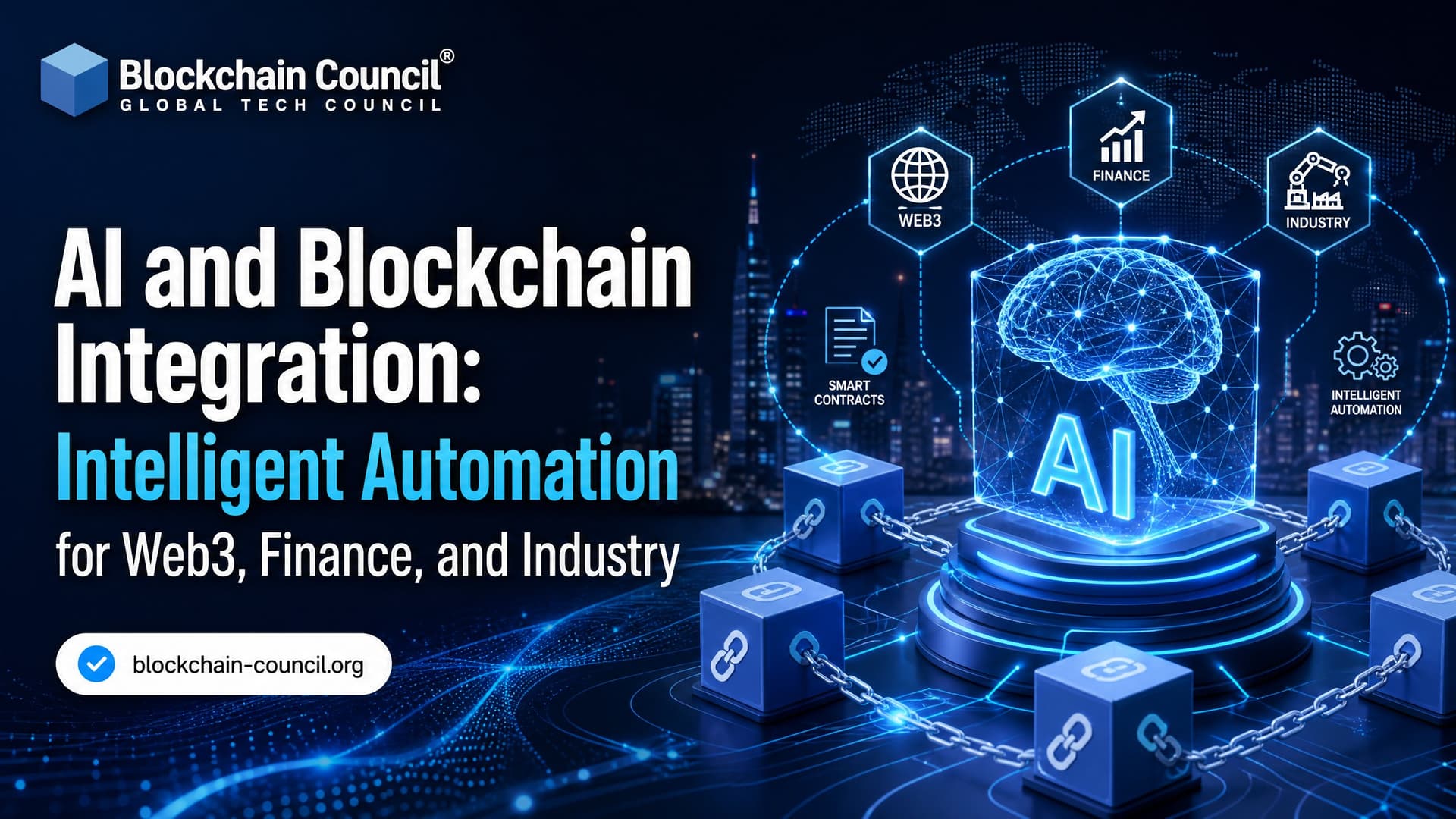
AI and blockchain integration is moving into production systems that need automation without giving up auditability. Web3 teams use AI agents to monitor smart contracts. Banks are testing machine learning against blockchain transaction records for fraud signals. Manufacturers are combining trusted supply chain data with predictive analytics. The shared idea is simple: AI makes systems adaptive, while blockchain makes records harder to tamper with.
That pairing matters because neither technology solves trust on its own. A model can make a strong prediction from bad data. A blockchain can preserve a bad decision forever. Used carefully, the two create a better control layer for digital finance, decentralized applications, healthcare records, logistics, and industrial operations.

Why AI and Blockchain Integration Is Accelerating
Blockchain gives you a distributed ledger where transactions and state changes can be verified. AI gives you pattern recognition, prediction, classification, and automation. Put them together and you can build systems that not only record what happened, but also respond to what is likely to happen next.
Research published in 2024 on AI-enhanced blockchain systems points to security, consensus, scalability, and interoperability as the main areas where AI can improve blockchain infrastructure. Business-focused studies reach a related conclusion: blockchain can add explainability, privacy, and trust to AI, while AI can improve blockchain usability, personalization, security, and governance.
This is not theory anymore. In DeFi, AI models watch transaction flows for wash trading, oracle manipulation, or suspicious wallet clusters. In supply chains, machine learning models read blockchain-backed provenance records to flag inconsistent shipment data. In healthcare, blockchain can protect data integrity while AI performs analytics on approved records.
How AI Improves Blockchain Systems
Security monitoring and fraud detection
Security is the most practical starting point. AI models can scan smart contract activity, wallet behavior, and transaction graphs to detect anomalies faster than manual review. This helps in DeFi, where a few blocks can separate a suspicious transaction from a drained liquidity pool.
A good model can flag patterns such as:
- Repeated failed contract calls before a successful exploit attempt
- Unusual token approvals to newly deployed contracts
- Flash loan behavior followed by price impact on thin liquidity pools
- Wallet clusters moving funds through mixers or bridge contracts
Still, do not treat AI alerts as proof. Treat them as triage. A model can flag a legitimate arbitrage transaction as suspicious if it has not seen that behavior before. Human review and clear incident playbooks still matter.
Smart contract analysis
AI-assisted code review is now common in smart contract teams, but it works best as a second reviewer, not the lead auditor. Tools can identify reentrancy risk, access control gaps, unchecked external calls, and suspicious logic paths. They can also explain Solidity code to junior developers.
Here is a practical detail that trips people up: if you feed a model flattened Solidity code without the compiler version, it may report false overflow bugs. Solidity 0.8.x includes checked arithmetic by default, so integer overflow behavior is different from older versions. Small context errors like that can make AI output look confident and still be wrong.
Use AI to speed up review, then confirm findings with Slither, Foundry tests, Hardhat tests, and manual inspection. If you are preparing for roles in this area, Blockchain Council's Certified Smart Contract Developer™ and Certified Blockchain Developer™ connect well with hands-on Solidity practice.
Consensus and network performance
AI is also being explored for blockchain performance. Models can forecast congestion, optimize node resource allocation, and support dynamic routing of transactions. On Ethereum, EIP-1559 introduced base fee mechanics, and applications still need to estimate priority fees intelligently. AI can help wallets and infrastructure providers predict fee conditions, though simple heuristics often work well enough for retail users.
To be blunt, not every chain needs AI-tuned consensus. If the bottleneck is poor contract design or underpowered RPC infrastructure, adding machine learning is decoration. Fix the basics first.
How Blockchain Improves AI
Data provenance and model audit trails
AI quality depends on data quality. Blockchain can record where training data came from, who approved access, when a model version changed, and which output was used in a business process. IBM has highlighted this value in enterprise AI governance, especially where audit trails and data security are required.
This matters in regulated industries. If an AI model rejects a loan, recommends a treatment path, or flags a transaction for compliance review, auditors need to know which model version was used and what data sources were involved. A blockchain record can provide a tamper-resistant timeline.
Decentralized AI marketplaces
Platforms such as SingularityNET and Fetch.ai show another pattern: blockchain as coordination infrastructure for AI services and autonomous agents. Developers can publish AI services, users can pay for access, and agents can interact through token-based networks. These systems are still early, but the architecture is useful when no single party should control the marketplace.
The hard question is governance. Who is liable when an autonomous agent makes a bad trade, calls the wrong contract, or pays for a low-quality model? Smart contracts can enforce payment and access rules, but legal accountability still needs people and institutions.
Use Cases Across Web3, Finance, Healthcare, and Industry
Web3 and autonomous agents
AI agents are becoming active Web3 participants. They can hold wallets, monitor on-chain events, call contracts, rebalance positions, and respond to governance proposals. AWS and Web3 builders have described generative AI and blockchain as a growing foundation for autonomous agents and safer decentralized applications.
Developers should be careful here. Giving an agent a private key is not the same as giving it a sandboxed API key. If the agent signs a bad transaction on Ethereum mainnet, chain ID 1, there is no undo button. Use spending limits, multisig approvals, simulation tools, and testnets before any production deployment.
Finance and DeFi
Finance is one of the clearest markets for AI and blockchain integration. AI models can analyze large transaction datasets for fraud, credit risk, liquidity risk, and portfolio signals. Blockchain provides settlement records and transparent transaction history.
Examples include Numerai, which uses machine learning and decentralized participation for hedge fund intelligence, and DeFi monitoring systems that identify suspicious wallet behavior. In accounting and asset management, blockchain records can support cleaner audits, while AI handles classification, reconciliation, and forecasting.
Market research has estimated the combined AI and blockchain market to exceed 703 million USD by 2025, with a 25.3 percent compound annual growth rate from 2020 to 2025. Forecasts vary by methodology, but the direction is clear: enterprises are budgeting for systems that combine intelligent automation with verifiable records.
Healthcare and life sciences
Healthcare needs both privacy and reliable data. Blockchain can help maintain integrity across patient records, consent logs, and clinical trial data. AI can then analyze approved datasets for diagnostics, treatment recommendations, or operational planning.
IBM Watson Health and MediLedger have been cited in industry discussions around AI and blockchain for healthcare data sharing and clinical trial workflows. The practical value is not that every medical record belongs on a public chain. It does not. The value is controlled access, verifiable consent, and traceable changes.
Supply chain and industrial operations
Supply chains generate messy data: invoices, IoT sensor readings, customs records, supplier certificates, warehouse scans. Blockchain can store proofs and transaction events. AI can detect irregularities, forecast delays, and predict equipment failure.
The World Economic Forum has described a broader convergence of AI, blockchain, and spatial computing across retail, healthcare, and financial services. In industrial settings, that convergence may look like computer vision checking product quality, IoT devices logging conditions, and blockchain preserving provenance for audits.
What Enterprises Should Get Right First
Start with the workflow, not the buzzword. AI and blockchain integration works when there is a real need for automation plus verification. If your data is low quality, private, and controlled by one trusted party, a traditional database and an internal ML pipeline may be the better choice.
Before building, ask:
- What needs to be verified? Transactions, model versions, data access, user consent, or audit events?
- What should stay off-chain? Personal data, proprietary model weights, and sensitive business records usually do not belong on a public blockchain.
- Who can override the AI? Autonomous systems need human escalation paths.
- How will you test failure? Simulate bad oracle data, delayed transactions, model drift, and contract reverts.
- Which skills are missing? You need smart contract security, data governance, machine learning operations, and blockchain architecture.
For structured upskilling, look at Blockchain Council's Certified Blockchain Expert™, Certified Artificial Intelligence (AI) Expert™, Certified Web3 Expert™, and Certified Blockchain Developer™ for role-based learning paths.
The Future of Intelligent Automation on Blockchain
The next phase will be less about flashy demos and more about dependable infrastructure. Expect smarter contract monitoring, AI-assisted audits, decentralized identity tied to AI permissions, agent wallets with strict policy controls, and compliance systems that record decisions automatically.
Some predictions are overdone. Fully autonomous finance with no human oversight is a bad idea for most institutions. But AI-assisted finance with blockchain audit trails is realistic. AI-supported supply chains with verifiable provenance are realistic. Smart contract development with automated security review is already here.
If you work in Web3, finance, or enterprise technology, build one small proof of concept: log AI model decisions to a private blockchain, or test an AI agent that only reads on-chain data before it can transact. Keep the scope narrow. Measure accuracy, cost, latency, and audit value. Then decide whether AI and blockchain integration deserves a larger place in your architecture.
Related Articles
View All
News
AI and Blockchain Integration in 2026: Enterprise Use Cases Moving Into Production
AI and blockchain integration in 2026 is moving into production across finance, supply chain, healthcare, identity, and decentralized AI infrastructure.

News
AI and Blockchain Integration in Enterprises: Real-World Use Cases Driving Adoption
AI and blockchain integration in enterprises is moving into production across supply chain, finance, healthcare, identity, compliance, and data infrastructure.

News
Post-Quantum Blockchain Security: How the Industry Is Preparing for the Next Cryptographic Threat
Post-quantum blockchain security is moving from research to engineering as NIST standards, 2030 policy targets, and quantum risk reshape blockchain roadmaps.
Trending Articles
AWS Career Roadmap
A step-by-step guide to building a successful career in Amazon Web Services cloud computing.

Can DeFi 2.0 Bridge the Gap Between Traditional and Decentralized Finance?
The next generation of DeFi protocols aims to connect traditional banking with decentralized finance ecosystems.
Claude AI Tools for Productivity
Discover Claude AI tools for productivity to streamline tasks, manage workflows, and improve efficiency.