

AI and Blockchain Convergence: Driving Digital Innovation

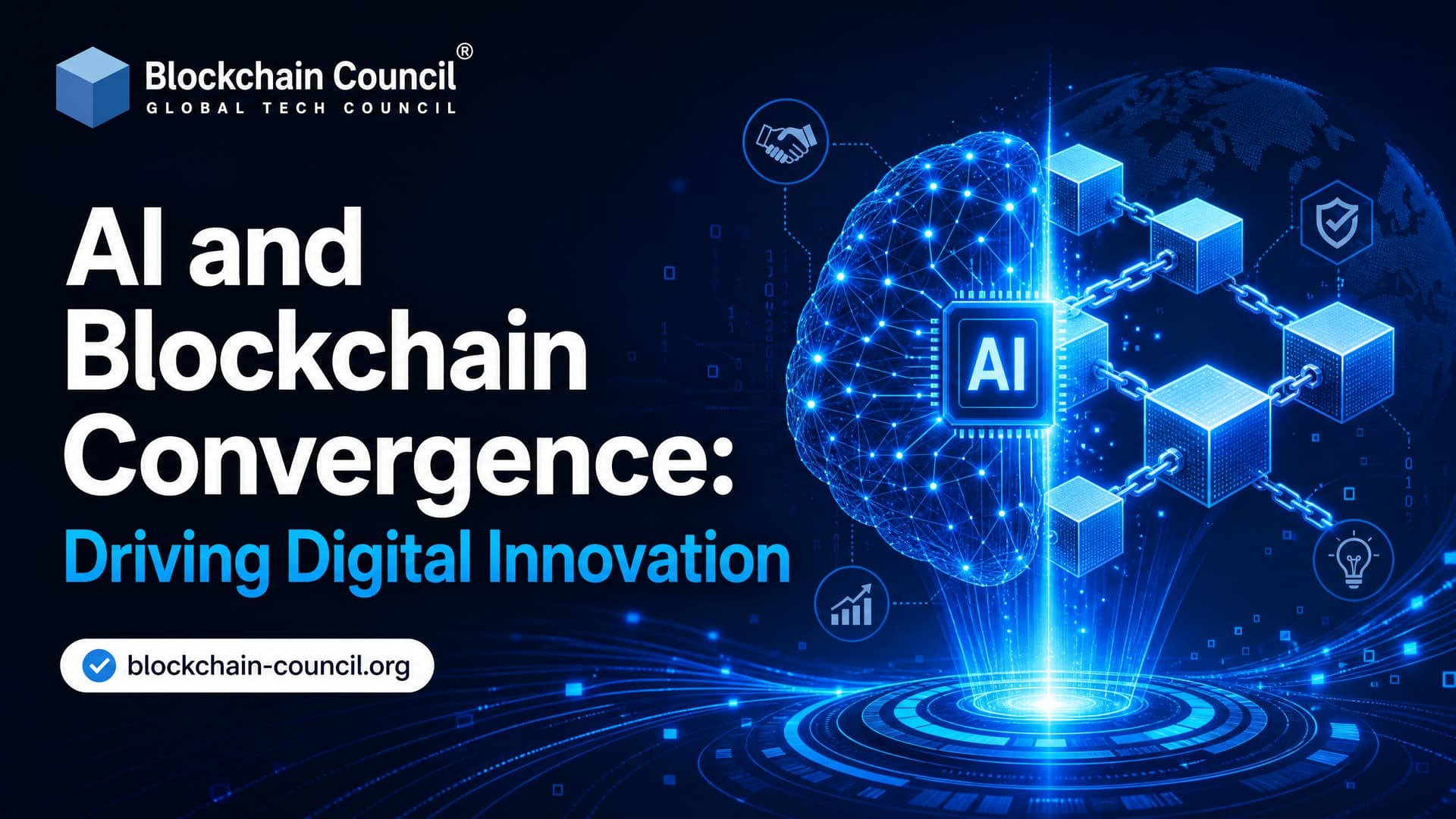
AI and blockchain convergence is becoming a practical infrastructure pattern. AI supplies prediction and automation. Blockchain supplies records, permissions, and settlement. Put simply, AI decides, blockchain records and enforces, and digital assets move value between people, firms, and software agents.
This is not about forcing large language models to run fully on-chain. That is usually the wrong architecture. Model training and inference still belong off-chain in most cases because they need high throughput, low latency, and specialized compute. The blockchain layer handles what it does best: provenance, audit trails, access rights, smart contract execution, and final settlement.

What AI and Blockchain Convergence Really Means
The two technologies solve different problems. AI finds patterns, scores risk, predicts demand, and detects anomalies. It can also act through autonomous agents. Blockchain gives multiple parties a shared record that is hard to alter after the fact. Smart contracts enforce rules without relying on one central operator.
IBM describes this combined value through authenticity, augmentation, and automation: blockchain can prove where data came from, AI can interpret it, and smart contracts can automate the next step. That framing is useful because it avoids the usual hype. The value sits in workflow design, not in attaching a token to every AI product.
The common architecture
Most production designs follow a hybrid pattern:
- AI layer: forecasting, optimization, model scoring, fraud detection, and agent behavior.
- Blockchain layer: identities, permissions, event logs, ownership records, smart contracts, and settlement.
- Asset layer: stablecoins, tokenized real-world assets, native tokens, or future central bank digital currency systems.
The durable idea is verifiable intelligence. You do not need every calculation on a public chain. You need evidence that the right data was used, the correct model version ran, the right approval happened, and the result was settled under agreed rules.
Why the Market Is Moving From Pilots to Production
Industry signals are stronger now than they were a few years ago. Reports describe AI and blockchain convergence in treasury workflows, tokenized asset platforms, risk systems, supply chain verification, and machine-to-machine commerce. Cambridge Judge Business School has pointed to real operational changes, including crypto mining firms repurposing power and cooling infrastructure for AI workloads.
Market sizing is still early, but the direction is clear. Some analyses estimate the global blockchain and AI market at roughly 550 million USD in 2024, with projections near 3.7 billion USD by 2033. Stablecoin transaction volume is already measured in trillions of dollars annually, and several digital asset analyses expect stablecoin supply to pass 1 trillion USD as automated commerce expands. Tokenized real-world assets are also widely projected to reach double-digit trillions of dollars by 2030.
Be careful with token narratives, though. Analysts have noted that AI-linked crypto assets became a dominant market theme, but valuation and real utility still matter. To be blunt, many AI tokens will not survive if they cannot prove demand for compute, data, model access, or settlement.
Key Use Cases for AI and Blockchain Convergence
1. Finance, DeFi, and tokenized assets
Finance is the clearest early adopter because it already depends on data, risk models, auditability, and settlement. AI can score credit risk, detect abnormal trading behavior, forecast liquidity needs, and optimize portfolios. Blockchain can record ownership, execute smart contract rules, and settle transfers through stablecoins or tokenized instruments.
Some forecasts suggest AI-driven asset management and adaptive financial products could become common in digital finance by 2027. That is plausible. A tokenized private credit fund, for example, may use AI to monitor borrower signals while the blockchain records investor positions, transfer restrictions, and distribution events.
2. Supply chain traceability
Supply chains produce messy data. Shipments move across ports, warehouses, carriers, customs systems, and insurers. AI can predict delays, spot anomalies, and optimize routing. Blockchain can anchor product origin, handoff events, certificates, and inspection records.
This matters in food, pharmaceuticals, luxury goods, and electronics, where a false claim can cause real damage. Academic reviews have repeatedly identified food logistics and healthcare supply chains as strong candidates because traceability, authenticity, and safety are not optional.
3. Identity, data rights, and IP ownership
AI systems need data. People and organizations increasingly want proof of who contributed data, how it was licensed, and whether revenue sharing terms were followed. Blockchain can record consent, licensing terms, model update events, and data contribution rights.
This also applies to AI-generated content and intellectual property. A blockchain record cannot solve every copyright dispute, but it can create a timestamped chain of authorship, permission, and usage. That beats a folder of screenshots.
4. Decentralized compute for AI
Training and serving models requires expensive GPUs. Tokenized compute networks try to coordinate idle GPU capacity, payments, reputation, and workload allocation through blockchain mechanisms. Several market observers have highlighted decentralized compute and data infrastructure as one of the more credible intersections of AI and crypto.
The trade-off is simple. Centralized cloud providers still win on reliability, enterprise support, and predictable performance. Decentralized compute becomes attractive when cost, censorship resistance, geographic distribution, or open participation matters more.
5. Cybersecurity and assurance
AI is useful for threat detection because it can spot patterns humans miss. Blockchain adds a tamper-resistant history of events. Together, they support smart contract monitoring, identity anomaly detection, audit evidence, and policy enforcement.
Technical reviews have described AI as a way to improve blockchain efficiency, security, and dependability. The reverse also holds. Blockchain can help govern AI systems by recording model versions, approval workflows, and access events.
What Developers Should Know Before Building
If you are building in this space, start with the boundary between off-chain and on-chain logic. Keep large model inference off-chain unless you have a very specific reason. Put hashes, proofs, permissions, payments, and state changes on-chain.
A common beginner mistake is trusting AI-generated smart contract code without checking the toolchain. For example, OpenZeppelin Contracts 5.x changed constructor expectations for Ownable, which now requires an initial owner argument. If an assistant hands you older Solidity code, your compiler may throw TypeError: No arguments passed to the base constructor. Specify the arguments or mark the contract as abstract. That is not a theoretical issue. It breaks deployments. Pin your package versions, read the changelog, and test on a local network before touching a public chain.
Use practical tools:
- Solidity 0.8.x for Ethereum smart contracts, which includes built-in arithmetic overflow checks.
- Hardhat or Foundry for testing, deployment scripts, and local forks.
- OpenZeppelin Contracts for audited ERC-20, ERC-721, access control, and upgrade patterns.
- Chainlink oracles when off-chain data must trigger on-chain logic.
- Zero-knowledge proofs when you need verification without exposing all underlying data.
Risks That Still Need Hard Engineering
AI and blockchain convergence has real promise, but the hard parts are not solved by a whitepaper.
- Scalability: AI workloads are heavy. Public blockchains replicate data and computation by design. Use off-chain compute and only anchor what must be verified.
- Privacy: AI often needs sensitive data. Public ledgers are transparent. Selective disclosure, encryption, zero-knowledge proofs, and secure multiparty computation are critical design choices.
- Governance: Autonomous agents that can hold assets and trigger contracts need limits, logs, and shutdown procedures.
- Energy use: Repurposing mining infrastructure for AI creates opportunities, but it also raises environmental questions.
- Speculation: A token is not a business model. Check whether the network has real users, real compute, real data, or real settlement activity.
Skills Professionals Need Now
If you work in finance, compliance, cybersecurity, enterprise architecture, or software development, the safest path is to learn both sides at a working level. You do not need to become a model researcher and a protocol engineer at once. You do need enough fluency to design secure workflows.
For structured learning, consider Blockchain Council programs such as Certified Blockchain Expert™, Certified Blockchain Developer™, Certified Smart Contract Developer™, and Certified Artificial Intelligence (AI) Expert™. Each covers a different slice of the stack, from blockchain architecture and smart contracts to AI systems.
The Practical Next Step
Build a small proof of concept before you evaluate platforms or tokens. Take one AI decision, such as a fraud score or a shipment risk score. Store the model version, input hash, approval event, and settlement action on a testnet smart contract. Then ask one question: would an auditor, partner, or user trust this workflow more than a normal database record?
If the answer is yes, AI and blockchain convergence fits. If the answer is no, keep it simpler. Start with the skill gap. Learn smart contract fundamentals, AI governance, and digital asset settlement before moving into autonomous agents or tokenized compute networks.
Related Articles
View All
News
AI and Blockchain Convergence: Key Trends for Digital Innovation in 2026
AI and blockchain convergence is creating verifiable agents, adaptive smart contracts, tokenized assets, and auditable enterprise automation in 2026.

News
Blockchain Payments: What Stripe and PayPal Mean for Global Digital Transactions
Stripe and PayPal are bringing stablecoins into mainstream payments, changing cross-border settlement, creator payouts, B2B flows, and AI billing.

News
Stripe and PayPal Blockchain Payments Partnership: What It Could Mean for Global Digital Commerce
Stripe and PayPal may combine developer payment rails, PYUSD, and stablecoin settlement. Here is what it could mean for global digital commerce.
Trending Articles
AWS Career Roadmap
A step-by-step guide to building a successful career in Amazon Web Services cloud computing.
How Blockchain Secures AI Data
Understand how blockchain technology is being applied to protect the integrity and security of AI training data.
What is AWS? A Beginner's Guide to Cloud Computing
Everything you need to know about Amazon Web Services, cloud computing fundamentals, and career opportunities.