

10 Best Metaverse Platforms to Watch Out in 2026 [UPDATED]
 Michael Willson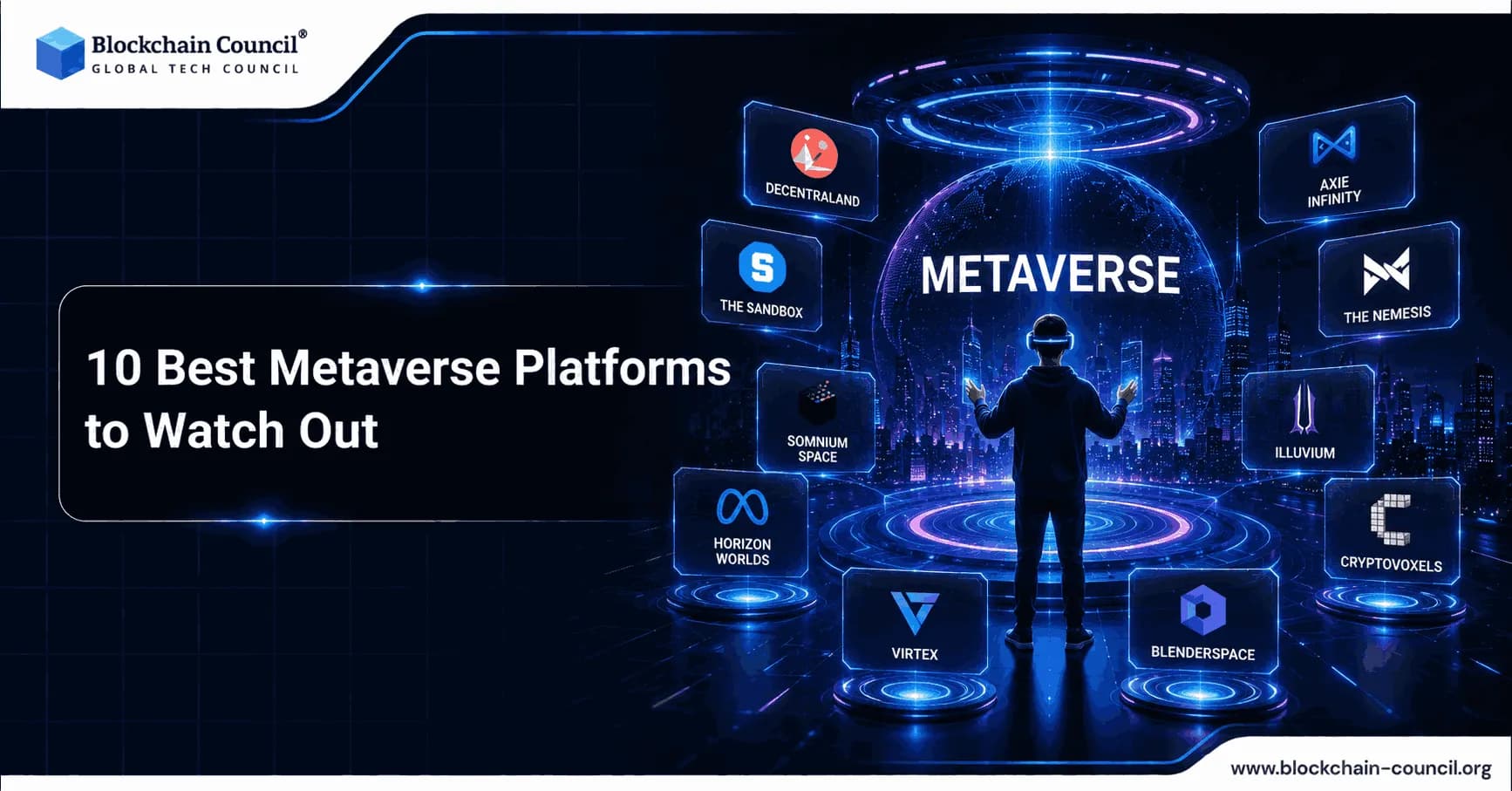
Summary
The Metaverse is an online imitation of reality where users can participate in various activities and interact with each other using virtual personalized avatars
The Metaverse, Web 3.0, and cryptocurrency are some of the emerging technologies that are transforming industries such as entertainment, education, gaming, work, and retail

Several companies are developing their versions of the Metaverse, each with its unique set of network protocols, and cryptocurrencies are used as a means of exchange and store of value in these virtual worlds
There are many Metaverse Blockchain projects in the market that are constantly evolving and competing for attention, and some of the top ones to watch in 2026 include Decentraland (MANA), The Sandbox (SAND), Axie Infinity (AXS), and Gala (GALA), etc.
We remain in the middle of a stretch of rapid change in digital technology, one that is both exciting and hard to keep up with. While the underlying tech is still comparatively young, a number of ambitious projects are already gathering momentum and creating opportunities that could meaningfully shape how we work, play, and socialize.
When it comes to Web 3.0, cryptocurrency, and the Metaverse Blockchain, most people are still finding their footing. Even so, across entertainment, education, gaming, work, retail, and beyond, Metaverse technology and crypto continue to converge to define the next stage of the digital frontier. Heading into the second half of 2026, the sector looks very different than it did a few years ago leaner, more consolidated, and increasingly focused on real usage rather than pure speculation.
A wide range of Metaverse Blockchain projects are still competing for attention, and several have gone through major restructurings, token overhauls, or full platform rebuilds in the past year. As a result, we've put together an updated list of the top Metaverse crypto projects to watch in 2026. But first, let's revisit what the Metaverse actually is.
What is the Metaverse?
The Metaverse is, at its core, an online imitation of reality. In these digital worlds, users can visit art galleries, attend concerts, and explore fictional or real-world-inspired locations through a personalized avatar. Put another way, Metaverse technology is a three-dimensional universe made up of many linked digital domains. In these 3D spaces often described as a preview of a future internet users can interact, socialize, participate, and play games.
It's worth remembering there isn't a single "Metaverse." Many companies are building their own versions, each with its own network protocols. Cryptocurrencies, meanwhile, are used both for everyday real-world transactions and as a medium of exchange and store of value inside these virtual worlds.
Inside the Metaverse, digital items act as a form of currency that can be traded for other goods and services using these technologies and tokens. The Metaverse's rapid knowledge generation has fueled a wave of crypto projects competing to shape the future of digital real estate. Large technology companies Meta, Google, Microsoft, and Tencent among them have continued to pursue Metaverse-adjacent initiatives, though with noticeably less fanfare and more caution than during the 2021-2022 hype cycle.
Want to learn more about the Metaverse and how it works? Check out our comprehensive guide to understand What is the Metaverse?
Why Should You Care about the Metaverse in 2026?
By mid-2026, the Metaverse sector has matured past its speculative boom and is now defined by consolidation, sharper tokenomics, and a slow but real return of enterprise and creator interest. Several major projects that once traded at multi-dollar valuations now sit well below their 2021 highs, yet many of them have used the downturn to rebuild shipping new clients, mobile expansions, and AI-assisted creation tools rather than chasing hype.
This shift can be traced to a few concrete developments. Platforms are increasingly measuring success by active builders and daily unique wallets rather than token price alone. Blockchain technology continues to underpin the decentralized, secure digital ecosystems the Metaverse depends on, and it's still the backbone for buying, selling, and trading digital assets. That's kept the door open for creators, artists, and developers to monetize Metaverse content, even as overall market sentiment toward "Web3 gaming" remains mixed.
Emerging trends that are driving the development of the Metaverse in 2026:
Increased Use of Artificial Intelligence
AI and machine learning have gone from a talking point to genuine infrastructure across the sector in 2026. Several major platforms are now training or licensing custom AI models for 3D asset generation, letting creators generate environments, items, and even game logic without deep technical skills. AI-driven non-player characters and virtual assistants are also becoming more common, adapting to user behavior to create more personalized in-world experiences particularly useful for virtual customer service and companionship-style applications.
Extending the Application of Blockchain Technology
Blockchain remains the foundation for decentralized, secure virtual environments and for the digital assets that can be bought, sold, and exchanged inside them. In 2026, several platforms have gone further, launching their own purpose-built Layer 1 or Layer 2 chains (rather than relying solely on Ethereum) to cut fees and increase throughput for high-frequency in-world transactions.
The Emergence of Innovative Gaming Business Models
The Metaverse continues to lean on gaming as its most active use case. Several platforms have shifted toward "risk-to-earn" or subscription-and-cosmetic models instead of the old play-to-earn structure, aiming for economies that don't collapse under inflationary token emissions. Free-to-play entry points paired with optional real-money or NFT-based progression have become the more common pattern in 2026.
Increased Industry Collaboration
Brand partnerships haven't gone away if anything, they've become more selective and more polished. Major entertainment, retail, and gaming IP continues to show up inside leading Metaverse platforms, while cross-industry collaboration (gaming studios, fashion houses, and traditional entertainment brands) keeps shaping new in-world experiences. Enterprise-focused virtual collaboration tools, such as those used for hybrid team meetings and virtual offices, have also continued to find a niche audience.
Expanded Application of Haptic Technologies
Haptic feedback continues to be positioned as the next frontier for realism in the Metaverse, aimed at giving users a stronger sense of touch and physical feedback. Consumer hardware adoption is still gradual, but as headset makers keep iterating, this remains one of the more forward-looking trends shaping long-term Metaverse design.
Become a Web3 Expert Today!
Certified Web3 Community Expert
Top 10 Metaverse Platforms to Watch Out For
There's still a chance to get involved in the Metaverse, so there's no need to feel like you've missed the window. Here are 10 platforms worth watching in 2026.
Decentraland (MANA)
Decentraland remains one of the most recognizable social virtual platforms in the Metaverse and is still the largest Metaverse cryptocurrency by legacy and community size. Its decentralized autonomous organization (DAO) continues to run key smart contracts that power the Decentraland Metaverse, most notably the LAND contract, which lets users trade virtual real estate on the network. Decentraland users can monetize their LAND through advertising, games, and other features. MANA remains Decentraland's native token, used to buy LAND, wearables, names, and other marketplace items.
Unique Features:
Decentraland gives users access to a wide range of creative tools and SDKs to build and personalize their own virtual environments, including 3D modeling, scripting, and interactive experience design.
The platform is cross-platform compatible, letting users access it from desktop, mobile, and VR headsets and in 2026 that reach has expanded further with a dedicated mobile app for iOS and Android.
Built-in communication tools, including voice chat and messaging, let users connect and collaborate in real time.
Updates:
Decentraland shipped a new, lighter desktop client in 2025 with faster load times, and followed it in April 2026 with a mobile platform expansion, broadening access beyond desktop and VR.
In June 2026, Decentraland's DAO voted to lower the governance proposal passage threshold from 6 million to 5 million Voting Power, aiming to reduce gridlock and boost participation after years of low voter turnout.
The platform's 2026 event calendar has included Metaverse Fashion Week (April), a fifth annual Pride celebration in Genesis Plaza (June), and ongoing brand collaborations, alongside a growing focus on tools and support for independent creators rather than foundational infrastructure alone.
The Sandbox (SAND)
The Sandbox remains one of the most prominent Metaverse tokens and, like Decentraland, runs on a DAO-based architecture. It's still built on Ethereum, with smart contracts enabling virtual land and other assets, while lower-cost Polygon-based options continue to handle much of the day-to-day transaction volume. The Sandbox lets anyone build, own, and monetize games and virtual goods using the SAND token, with creators able to design, publish, and sell NFTs inside partner and community-made experiences.
Unique Features:
The Sandbox has long-standing partnerships with major brands and franchises, letting users explore and interact with familiar characters and settings inside the platform.
Creators can build, upload, and sell their own games, experiences, and virtual goods using a marketplace, a virtual environment editor (VoxEdit and Game Maker), and a developer toolkit.
Updates:
2025 brought a significant internal restructuring at The Sandbox, including major staff reductions, but the platform closed the year with two full Alpha Seasons, more than 144,000 new players, and nearly 8 million completed quests.
Since early 2026, The Sandbox has leaned heavily into user-generated content: Alpha Season 7 (launched February 2026) featured brand collaborations alongside dozens of community-built experiences from Game Jams, and the team has committed to sourcing over half of each season's content directly from creators going forward.
The Sandbox is also piloting "The Sandbox NEXT," a fully mobile, Unreal Engine-powered version of the platform (early playtests began March 2026), and is developing generative AI tools to help creators build 3D assets faster using its library of over 1.7 million existing assets.
AXIE INFINITY (AXS)
Anybody who hasn't been living under a rock has heard of Axie Infinity. With its creature-based avatars and player-driven economy, this Blockchain-based Metaverse game reshaped what "play-to-earn" gaming looked like. AXS and SLP, its two native currencies, continue to power the Ronin-based ecosystem, with AXS serving as the governance token that lets holders vote on updates and treasury decisions.
Unique Features:
Axie Infinity runs on a proof-of-stake system, giving it a far smaller environmental footprint than proof-of-work-based platforms.
The game relies on smart contracts and anti-cheat systems to keep digital assets and transactions secure and transparent.
Axies are unique NFTs built on the Ronin chain (an Ethereum-linked sidechain), each with its own traits and abilities, which continues to drive collector and player demand.
Updates:
Axie has moved away from the original play-to-earn model toward what Sky Mavis now calls a "risk-to-earn" structure. SLP emissions in Axie Origins officially stopped in January 2026 to curb bot farming, while a new in-game reward token, bAXS (Bonded AXS), launched in February 2026 to replace direct AXS payouts for seasonal rewards.
Land-based gameplay has been overhauled: "Terrariums" launched in 2026 to replace the older Homeland system, letting players activate land, place up to 30 Axies on it, and passively earn bAXS or experience points.
The Ronin Network has continued transitioning into a full Ethereum Layer 2, and Sky Mavis's next big swing, an open-world MMO called Atia's Legacy remains in active development after 2025 alpha playtests, with a fuller launch anticipated later in 2026.
GALA (GALA)
Gala is a Blockchain-based entertainment platform that gives creators and players a place to freely exchange virtual goods, combining gaming with NFTs across a growing multi-vertical ecosystem that now spans Gala Games, Gala Music, and Gala Film. Titles such as Town Star (now rebranded as Common Ground), Spider Tanks, Mirandus, and Fortified remain part of its active game library. GALA, the platform's native token, is used for governance, node rewards, and purchases across the ecosystem's marketplace.
Unique Features:
Gala's infrastructure now runs on GalaChain, its own purpose-built Layer 1 blockchain designed to support high-frequency, low-fee microtransactions across games, music, and film.
Founder's Node operators earn rewards tied to their GALA holdings, an incentive model that was overhauled in mid-2025 alongside the introduction of a tokenized staking asset.
Gala's game library spans multiple genres and studios, giving the platform a broader entertainment footprint than a single-game project.
Updates:
In April 2026, GalaChain's community approved a new, disinflationary tokenomics model that shares a portion of network fees with participants while permanently burning another portion, aiming to slow the growth of GALA's circulating supply.
Gala announced a landmark move into the Chinese gaming market in 2026, launching its shooter title Shrapnel there via GalaChain's integration with a state-backed copyright verification system opening a compliant path to hundreds of millions of potential players.
The platform has continued consolidating its web presence, migrating its various game sites into a single unified access point, and is expanding GalaChain's cross-chain support to include assets from other major networks.
Enjin Coin (ENJ)
Enjin remains a long-running Blockchain platform focused on making it easy for game developers to mint and manage NFTs. ENJ, its native token, can be used to purchase virtual goods and back the value of in-game items, while the broader Enjin ecosystem includes a marketplace where creators and players can trade freely.
Unique Features:
"Infusion" lets developers lock ENJ into items such as weapons or skins to certify authenticity, while "melting" lets holders redeem those items back into ENJ creating a built-in floor-price mechanism for digital assets.
Enjin's SDKs make it straightforward for developers to integrate NFTs into many kinds of games, including support for batch transactions and assets shared across multiple titles.
The platform runs on a dual-layer architecture (a Relaychain for consensus and a Matrixchain for asset activity), designed to embed NFT functions directly at the protocol level rather than relying purely on smart contracts.
Updates:
Enjin completed its migration of the Efinity (EFI) token into the unified Enjin Matrixchain, consolidating governance and utility into a single ENJ token.
A mainnet upgrade in December 2025 improved "Fuel Tanks," the feature that lets developers cover players' transaction fees, making onboarding easier for non-crypto-native users.
In May 2026, Enjin opened public beta for "Platform v3," a rewrite that lets a single instance manage assets across multiple blockchains, with new C# and C++ SDKs and dedicated Unity and Unreal Engine plugins on the roadmap.
Metahero (HERO)
Metahero is still one of the more distinctive Metaverse projects, built around 3D-scanning real people and objects to create hyper-realistic avatars and digital items for use in games, social platforms, fashion, and beyond. HERO, its native token, is used to pay for metascans and to access the platform's marketplace.
Unique Features:
Metahero's avatar creation system lets users build highly customizable, true-to-life avatars generated from its proprietary scanning technology.
Procedural generation tools allow the platform to build large, complex environments that would be difficult to design manually.
AI-driven non-player characters can adapt to user behavior, aiming for more dynamic and personalized in-world interactions.
Updates:
The HERO token has settled into a much smaller market capitalization than during its 2021-2022 debut, trading as a lower-cap asset with modest daily volume through much of 2026, alongside a large holder base built up during its early growth phase.
Metahero has continued positioning its metascanning technology as a bridge between physical and digital identity, with ongoing work on expanding scan access and refining its avatar pipeline.
As with many smaller 2021-era Metaverse tokens, updates have slowed compared to the platform's early roadmap, and prospective users should treat any specific growth claims with caution and do independent research.
Star Atlas (ATLAS)
Star Atlas remains a future-set, Metaverse-driven space game where players explore, mine, and battle across a sci-fi universe. ATLAS and POLIS, its two tokens, are still central to the game's economy: ATLAS functions as an in-game currency for trading and participating in the marketplace, where most in-game property exists as an NFT, while POLIS is tied to governance-style participation.
Unique Features:
Star Atlas is built using Unreal Engine 5, giving it high-fidelity graphics that aim to compete with conventional AAA titles rather than typical blockchain games.
The project has undergone multiple third-party security audits of its smart contracts, staking pools, and token architecture.
Star Atlas emphasizes deep world-building, including faction-based gameplay and a persistent, ship- and land-based economy.
Updates:
After years of delayed timelines, Star Atlas's developer, ATMTA, has continued shipping incremental content through its browser-based "Golden Era" and "SAGE" experiences while working toward a fuller MMO release.
In 2025, ATMTA announced Zink, its own zero-knowledge-powered Layer 1 blockchain, moving core infrastructure away from sole reliance on Solana's mainnet, a notable shift for a project long associated with Solana.
The broader "Web3 gaming is dead" debate flared up again in early 2026 after comments from a senior Solana Foundation executive singled out Star Atlas as an example of the play-to-earn model's struggles, underscoring that investor sentiment toward the project and the sector remains divided even as development continues.
Bloktopia
Bloktopia's skyscraper-themed Metaverse concept still centers on a 21-story virtual building where users can learn, socialize, do business, and explore branded spaces sponsored by "anchor tenant" crypto projects and personalities. As with several early Metaverse projects, its rollout has been gradual, with attention now more concentrated among its existing community than during its original 2021 launch hype.
Unique Features:
Bloktopia's physics and interaction systems aim for realistic object and character behavior to make the environment feel more immersive.
The platform emphasizes user data privacy, using encryption and giving users some control over their own stored data.
Bloktopia has framed itself as a social-impact platform as well as a virtual space, with partnerships aimed at charitable and community causes.
Updates:
Bloktopia's development pace has slowed relative to its early roadmap, which is a common pattern among Metaverse projects that launched during the 2021 boom; anyone considering BLOK should verify current activity levels and treat older marketing claims with caution.
The project's original backers including Animoca Brands and several crypto-native investors remain publicly associated with the project, though day-to-day updates are less frequent than competitors like Decentraland or The Sandbox.
High Street (HIGH)
High Street's pitch, a Metaverse built around shopping, remains intact, letting users browse and buy from real and virtual brands using HIGH, alongside some Shopify-linked storefronts. Its half-virtual, half-physical product model still sets it apart from more purely gaming-focused competitors, and NFTs continue to underpin the platform's ability to onboard brands and turn products into digital collectibles.
Unique Features:
High Street offers virtual job-style roles, such as virtual real estate agents and event planners, letting users build skills in marketing, design, and customer service inside the platform.
Multi-language support helps connect a genuinely global user base.
The platform's brand collaborations let users interact with virtual versions of real products, from art galleries to retail try-ons.
Updates:
Like several other 2021-era Metaverse shopping concepts, High Street's activity and update cadence have slowed considerably by 2026 compared to its original funding-round momentum.
Prospective users and investors should check current trading volumes and platform activity directly, since marketing from the project's early days may no longer reflect where development stands today.
Voxels (CVPA)
Inspired by Minecraft-style building, Voxels (formerly Cryptovoxels) remains an Ethereum-based Metaverse built from an interconnected grid of customizable land parcels. Properties can still be traded on NFT marketplaces using ETH, and Voxels' own currency, CVPA, continues to correlate with land purchases in the platform's Origin City. As NFTs, land parcels give holders exclusive custody, and users can build or sell virtual homes and storefronts, including posters, signage, and music.
Unique Features:
Voxels' distinctive low-polygon art style sets it apart from more photorealistic Metaverse platforms, while also keeping the experience lightweight enough to run smoothly on a wide range of devices.
A built-in real-time editor lets users design and build spaces collaboratively, with support for detailed and complex constructions.
All spaces and assets are tokenized on Ethereum, giving users verifiable ownership of what they build.
Updates:
Voxels has continued to add building tools, textures, and lighting features, along with integrations with external design tools like Unity and Blender.
VR headset support, including for devices like Meta Quest, remains part of the platform's feature set for users who want a more immersive way to explore.
As with other long-running early Metaverse platforms, Voxels' pace of new feature releases has slowed compared to 2021-2022, with its most active use now concentrated among a smaller, dedicated community of builders and collectors.
Conclusion
The crypto world and the Metaverse are still evolving, though 2026 looks a lot more sober than the speculative peak of a few years ago. Predicting which platforms and tokens will lead the space is genuinely difficult. Several projects on this list have shrunk significantly from their all-time highs, while others have used the downturn to rebuild real infrastructure, ship mobile clients, and experiment with AI-driven creation tools. This can be seen as part of the broader maturing of the space rather than its disappearance.
There are still plenty of unknowns, and figures, token values, and project roadmaps mentioned above can change quickly always verify current data before making decisions. If you're planning to get involved with any Metaverse crypto project, it's worth seeking out professional or specialist guidance first.
Nevertheless, Blockchain Council is here to help if you want to dive deeper into the crypto and Metaverse world. Blockchain Council's training courses include a Metaverse program and many others. You can sign up for any of the available courses based on what you need.
If you want to keep up with Blockchain industry trends, join our communities on Discord, Reddit and Telegram
FREQUENTLY ASKED QUESTIONS
1. What is a metaverse platform?
A metaverse platform is a digital environment where users can interact through avatars, attend events, socialize, play games, create digital experiences, and in some cases own or trade virtual assets. Many platforms incorporate technologies such as virtual reality (VR), augmented reality (AR), blockchain, artificial intelligence (AI), and digital economies.
2. Which metaverse platforms are considered notable in 2026?
Well-known platforms include Decentraland, The Sandbox, Roblox, Fortnite Creative (UEFN), Horizon Worlds, Spatial, Somnium Space, Otherside, Voxels, and NVIDIA Omniverse for enterprise collaboration. Each platform targets different audiences, industries, and use cases rather than serving the same purpose.
3. What makes a metaverse platform successful?
Successful platforms typically combine engaging user experiences, active communities, creator tools, scalable technology, digital economies, strong security, interoperability initiatives, and continuous platform development. Long-term adoption often depends on practical use cases in addition to entertainment.
4. What is Decentraland?
Decentraland is a blockchain-based virtual world where users can explore digital spaces, attend events, create experiences, and trade virtual land and digital assets. Community governance plays an important role in shaping the platform's development.
5. What is The Sandbox?
The Sandbox is a blockchain-powered virtual world that enables users to build games, create digital experiences, own virtual land, and develop NFT-based assets. Brands, creators, and gaming communities continue to participate in its expanding ecosystem.
6. How is Roblox different from blockchain-based metaverses?
Roblox focuses on user-generated gaming experiences and social interaction rather than blockchain ownership. Although it has a large creator economy, its virtual assets operate within Roblox's own platform rather than through decentralized blockchain infrastructure.
7. What role does Fortnite Creative play in the metaverse?
Fortnite Creative and Unreal Editor for Fortnite (UEFN) allow creators to design immersive multiplayer experiences, interactive events, and branded environments. While not blockchain-based, the platform has become an important example of large-scale virtual world development.
8. What is Horizon Worlds?
Horizon Worlds is Meta's virtual social platform designed for immersive collaboration, entertainment, and community experiences through virtual reality devices. It supports user-created spaces and social interaction within Meta's ecosystem.
9. What is Spatial?
Spatial is a platform that enables creators, businesses, artists, and educators to build immersive virtual environments for collaboration, exhibitions, education, and events. It supports both browser-based and VR experiences.
10. What is NVIDIA Omniverse?
NVIDIA Omniverse is an enterprise-focused collaboration platform that enables teams to create digital twins, 3D simulations, engineering workflows, and AI-assisted industrial applications. It is commonly associated with professional design and manufacturing rather than consumer entertainment.
11. Do metaverse platforms require cryptocurrency?
Not always. Some platforms use cryptocurrencies, NFTs, or blockchain wallets for digital ownership, while others rely entirely on traditional payment systems and centralized virtual economies. Requirements vary depending on the platform.
12. How do NFTs fit into metaverse platforms?
Certain metaverse platforms use NFTs to represent virtual land, avatars, wearable items, collectibles, and other digital assets. Ownership models differ between blockchain-based and centralized platforms, and NFT functionality is not universal.
13. How is AI changing metaverse platforms?
AI is improving virtual assistants, non-player characters (NPCs), content creation, language translation, moderation, personalization, digital humans, and immersive user experiences. AI also supports developers by accelerating world-building and asset generation.
14. Which industries are adopting metaverse platforms?
Industries exploring metaverse technologies include gaming, education, healthcare, manufacturing, retail, architecture, entertainment, tourism, real estate, and enterprise collaboration. Organizations are evaluating virtual environments for training, design, customer engagement, and remote teamwork.
15. What are the risks associated with metaverse platforms?
Potential risks include cybersecurity threats, privacy concerns, digital identity theft, intellectual property disputes, online harassment, market volatility for blockchain-based assets, evolving regulations, and technical limitations. Users should understand platform policies and security practices before participating.
16. How are metaverse platforms regulated?
Regulatory approaches vary across jurisdictions and may involve consumer protection, privacy laws, intellectual property rights, digital asset regulations, taxation, and online safety requirements. Businesses operating in virtual environments should monitor official guidance relevant to their regions.
17. What should users consider before joining a metaverse platform?
Consider the platform's purpose, community size, security features, supported devices, creator tools, business model, ownership structure, transaction costs, privacy practices, and long-term development roadmap. Choosing a platform should depend on your intended use rather than popularity alone.
18. What trends are shaping metaverse platforms in 2026?
Major trends include AI-generated virtual environments, enterprise digital twins, cross-platform interoperability, spatial computing, mixed reality devices, creator economy expansion, tokenized digital assets, decentralized identity solutions, and improved graphics powered by advanced game engines.
19. Are metaverse platforms a good investment opportunity?
Metaverse-related projects may present opportunities, but they also involve significant technological, regulatory, and market risks. Decisions involving digital assets, virtual land, or platform tokens should be based on thorough research, an understanding of the underlying technology, and awareness that values can fluctuate substantially.
20. What is the future of metaverse platforms?
The metaverse is expected to evolve toward more immersive, interconnected, and practical digital experiences across entertainment, education, business, and industry. Platforms that combine strong communities, useful applications, secure infrastructure, and ongoing innovation may be better positioned for long-term adoption, although the sector remains highly competitive and continues to develop. The virtual worlds may become increasingly realistic, but remembering your password will probably remain the least futuristic part of the experience.
Related Articles
View All
Metaverse
10 Best Metaverse Platforms
We remain in the middle of a duration of change, which can be both exciting and difficult to stay on top of. While modern technology is still a reasonably new idea, countless remarkable initiatives are already gaining pace and offering chances that might drastically influence your life.
Metaverse
Metaverse 2026: Key Technologies Powering Virtual Worlds
Metaverse 2026 is a convergence stack: XR, AI, blockchain, spatial computing, and cloud-edge infrastructure powering interoperable, low-latency virtual worlds.
Metaverse
What is the Metaverse? Step-by-Step Beginners Guide 2026
Since Mark Zuckerberg announced the rebranding of Facebook Inc. to Meta, interest in the metaverse has grown significantly. With developments in Meta’s roadmap and the acquisition of Luxexcel, a 3D smart glasses manufacturer, the vision for immersive digital experiences is becoming clearer.
Trending Articles
The Role of Blockchain in Ethical AI Development
How blockchain technology is being used to promote transparency and accountability in artificial intelligence systems.

Top 5 DeFi Platforms
Explore the leading decentralized finance platforms and what makes each one unique in the evolving DeFi landscape.
How to Install Claude Code
Learn how to install Claude Code on macOS, Linux, and Windows using the native installer, plus verification, authentication, and troubleshooting tips.