

Five Best Smart Contract Platforms
 Toshendra Kumar Sharma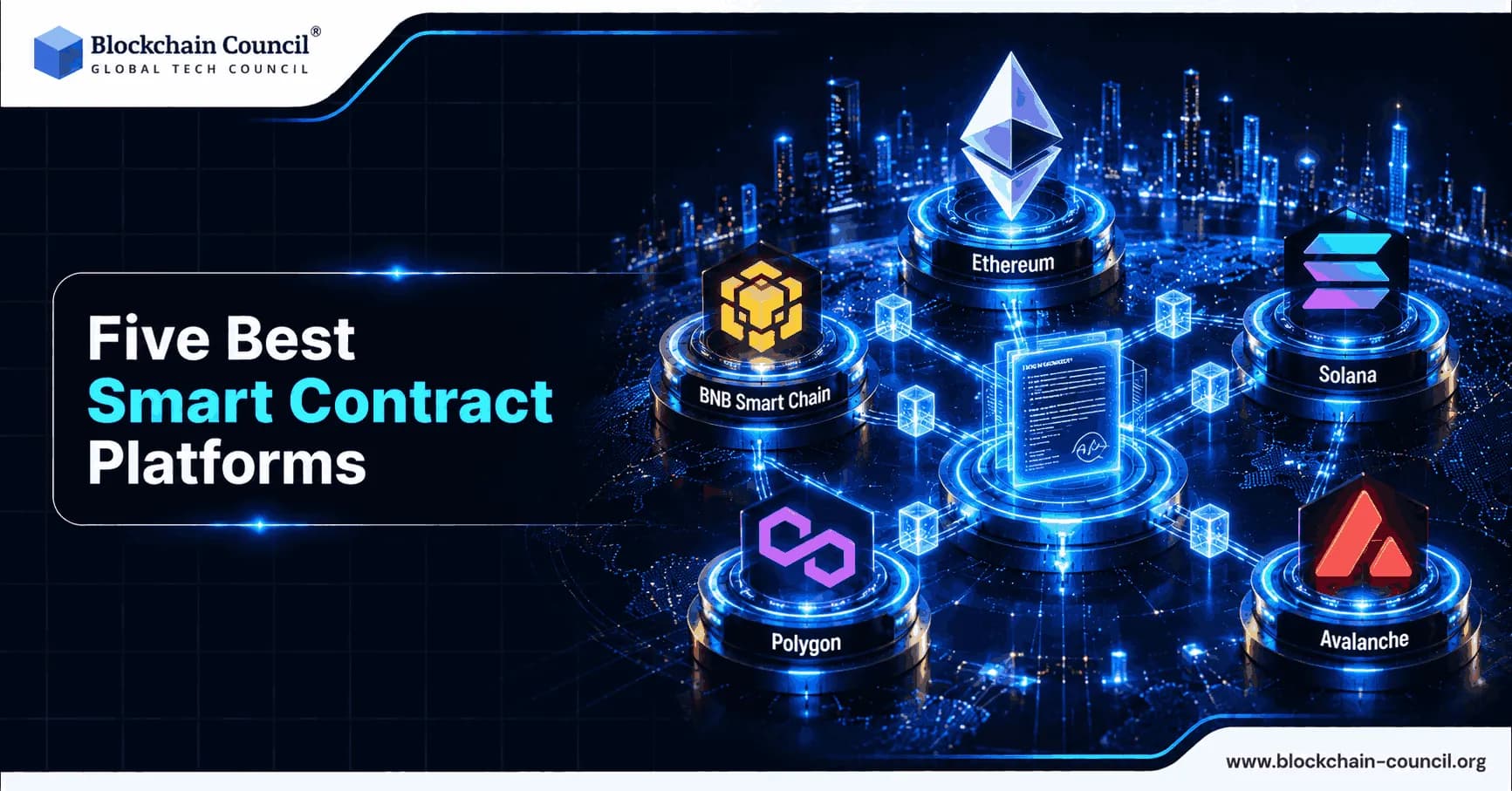
A smart contract is a small program that lives on a blockchain and runs automatically when its conditions are met. It can hold money, enforce an agreement, or run a game without a middleman. Choosing where to build or use one matters a great deal, because each blockchain has its own speed, cost, programming language, and risks. This guide compares five of the best smart contract platforms in 2026, using current data where it is reliable and being clear where it is not. If you want to learn how to write these programs yourself, the Certified Smart Contract Developer program is a practical starting point.
It is written for beginners and professionals alike, in plain language.

What Are Smart Contract Platforms?
Smart contract platforms are blockchains that let developers deploy and run smart contracts. They provide the network, the rules for agreeing on transactions, a programming environment, and tools for wallets and apps. Ethereum was the first major one, and many others have followed with different trade-offs.
Most platforms sit somewhere between three goals: security, speed, and decentralization. A chain that is extremely fast may rely on more powerful hardware, while one that spreads control widely may process fewer transactions. Understanding that trade-off helps you judge any platform fairly.
How We Judge Smart Contract Platforms
No ranking can be perfect, so here are the criteria used for this list:
Security and track record. How long the network has run without major failures, and how well its contracts are protected. Smart contract bugs cause real losses, and professionals who review code for flaws can learn the discipline through the Certified Smart Contract Auditor program.
Liquidity and adoption. How much money and how many users and apps are on the network.
Developer experience. Languages, tools, documentation, and community support.
Cost and speed. Typical fees and how fast transactions finalize.
Fit for the use case. Whether it suits DeFi, gaming, tokenized assets, or enterprise projects.
A word on data: figures such as total value locked, or TVL, change daily and vary by source. DeFiLlama is the most widely cited tracker, and I use it where possible. Treat any number as a snapshot, and remember that TVL measures money deposited in contracts, not safety.
The Five Best Smart Contract Platforms in 2026
1. Ethereum (and Its Layer 2 Networks)
Ethereum remains the leader for liquidity and developer activity. DeFiLlama's August 2026 snapshot listed Ethereum as the top chain by TVL at about $41.8 billion, while the broader DeFi market held roughly $76 billion across all chains. Lido, a liquid staking protocol on Ethereum, was the top protocol at about $18.3 billion. A September 2026 review of the 100 largest DeFi protocols found that 71 of them have a deployment on Ethereum.
Developers mainly use Solidity, with Vyper as another option. Ethereum's scaling strategy relies on Layer 2 networks such as Base, Arbitrum, and Optimism, which bundle transactions and settle them on Ethereum. The base layer keeps improving too. The Fusaka upgrade went live in December 2025 to support more data for Layer 2s, and the next major upgrade, Glamsterdam, was heading into public testing in October 2026, with a mainnet date not yet confirmed.
Best for: DeFi, tokenized assets, and projects that need deep liquidity and the largest developer community.
Watch out for: Higher base-layer fees during busy periods.
2. Solana
Solana is the best-known high-speed alternative. Programs are written in Rust, often using the Anchor framework, which has a steeper learning curve than Solidity but rewards careful developers. The network focuses on fast, low-cost transactions, and its Alpenglow upgrade, rolled out in phases through 2025 and early 2026, was reported to cut finality times sharply.
Solana's DeFi ecosystem includes lenders such as Kamino and a major trading aggregator in Jupiter, along with decentralized exchanges such as Orca. Its TVL is much smaller than Ethereum's, with estimates in the single to low double-digit billions depending on the source and date, but activity and trading volumes are strong.
Best for: Consumer apps, trading, payments, and projects that need very low fees.
Watch out for: The Rust learning curve and a younger track record than Ethereum.
3. BNB Chain
BNB Chain, formerly Binance Smart Chain, is compatible with the Ethereum Virtual Machine. That means developers can often move Ethereum contracts over with few changes, which speeds up development. Fees are typically low, and the chain benefits from a large retail audience connected to the Binance ecosystem. PancakeSwap is its best-known application.
One analysis reported that BNB Chain's share of DeFi has been slipping as Ethereum Layer 2 networks and Solana grow, so its position is strong but not unchallenged. Also, its connection to one large exchange ecosystem is a different centralization trade-off from networks with wider validator sets.
Teams that work across EVM chains need more than contract skills. They must manage wallets, nodes, cloud services, monitoring, and cross-chain security. That is why many developers pair blockchain study with a broader Tech Certification, which covers the technology stack around these platforms.
Best for: Low-cost apps, retail users, and quick ports from Ethereum.
Watch out for: Concentration around a single exchange ecosystem and shrinking relative share.
4. Avalanche
Avalanche launched in September 2020, created by Ava Labs. Its primary network has three chains: the X-Chain for asset transfers, the C-Chain for smart contracts, and the P-Chain for validator coordination. The C-Chain is EVM-compatible, so Solidity developers feel at home.
Its main strength is customization. Developers can launch their own purpose-built networks, originally called subnets, which suit regulated or private use cases such as tokenized funds, private credit, and supply chain tracking. Avalanche also gained institutional visibility when VanEck launched a US-listed spot Avalanche ETF in January 2026.
Best for: Institutional pilots, custom networks, and tokenization projects.
Watch out for: A smaller DeFi base than Ethereum or Solana.
5. Cardano
Cardano takes a research-first approach, with a strong focus on formal methods and careful engineering. Its smart contracts use the extended UTXO model, and developers can work with languages such as Plutus and Aiken. This model can make behavior more predictable, but it also requires different design patterns. For example, handling many users interacting with one contract at the same time needs batching techniques that Ethereum developers rarely think about, which has slowed ecosystem growth.
Cardano's DeFi TVL is small, about $132 million in September 2026 according to one report, so it is not the choice for deep liquidity. It earns its place as a thoughtful option for teams that value predictable behavior and a safety-first culture.
Best for: Security-minded design, governance experiments, and developers who like formal approaches.
Watch out for: Low liquidity and a steeper learning curve.
Quick Comparison
Platform | Main language | Strength | Main trade-off |
|---|---|---|---|
Ethereum and Layer 2s | Solidity, Vyper | Deepest liquidity and community | Base-layer fees |
Solana | Rust | Speed and low fees | Learning curve, younger record |
BNB Chain | Solidity (EVM) | Low cost, easy Ethereum ports | Exchange ecosystem concentration |
Avalanche | Solidity (C-Chain) | Custom networks, institutional interest | Smaller DeFi base |
Cardano | Plutus, Aiken | Predictable, safety-first design | Low liquidity |
Honorable Mentions
Several other smart contract platforms deserve a look. Aptos and Sui use the Move language, which is designed with asset safety in mind. Tron is widely used for stablecoin transfers. Polygon and other Ethereum-compatible networks serve many applications. Ranks shift quickly, so check current data before you commit.
How to Choose the Right Platform
A simple decision guide:
Need maximum liquidity and trust? Start with Ethereum or one of its Layer 2 networks.
Need speed and tiny fees for consumer apps? Look at Solana.
Already know Solidity and want low costs? Consider BNB Chain or Avalanche's C-Chain.
Building a regulated or private network? Explore Avalanche's custom chains.
Care most about predictable, formal design? Consider Cardano.
Be honest about your skills. The best platform is one your team can build and secure well.
Risks to Keep in Mind
Smart contract bugs. Chainalysis reported more than $3.4 billion stolen in crypto in 2025, and DeFiLlama counted $629.7 million hacked in April 2026 alone. Audits and testing are essential on every platform.
TVL is not safety. A large number does not guarantee a protocol is secure.
Conflicting data. Different sources report different totals, so compare more than one.
Fast change. Upgrades, new chains, and market shifts can change rankings within months.
Regulation. Rules for tokens and platforms differ by country and are still evolving.
Your Next Steps
Pick one platform and build a small project, such as a simple token or voting contract, and test it thoroughly. Publish your work, write short explanations of what you learned, and ask others for code reviews. Technical skill matters, but so does communication. A Marketing Certification can help builders explain their products clearly, grow a personal brand, and attract users or employers.
Conclusion
The best smart contract platforms in 2026 each fit a different need. Ethereum and its Layer 2 networks lead for liquidity and community, Solana for speed and low fees, BNB Chain for low-cost EVM apps, Avalanche for custom and institutional networks, and Cardano for careful, formal design. No single platform wins every category, and data changes quickly. Start with your goal, match it to a platform's strengths, test carefully, and never skip security reviews.
FAQs
1. What are smart contract platforms?
Smart contract platforms are blockchain networks that allow developers to deploy and execute programmable code on-chain. They provide the infrastructure needed for decentralized applications, tokenization, DeFi, gaming, and other blockchain-based services.
2. What are the five best smart contract platforms?
Five notable smart contract platforms are Ethereum, Solana, BNB Chain, Avalanche, and Cardano. Each has different strengths in areas such as developer ecosystems, execution models, transaction costs, scalability, and programming languages.
3. Why is Ethereum considered a leading smart contract platform?
Ethereum pioneered general-purpose smart contracts on a public blockchain and has a mature developer ecosystem, extensive tooling, and broad application support. Its EVM also provides a widely adopted environment for executing smart contracts.
4. What makes Solana a popular smart contract platform?
Solana is designed for high-throughput blockchain applications with low transaction costs and fast execution. Its smart contracts, commonly called programs, use the Solana Virtual Machine and can be developed using technologies such as Rust and Anchor.
5. What is BNB Chain used for smart contracts?
BNB Chain provides an EVM-compatible environment for deploying smart contracts and decentralized applications. Its relatively low transaction costs and compatibility with Ethereum development tools make it useful for applications requiring inexpensive on-chain transactions.
6. Why is Avalanche considered a smart contract platform?
Avalanche supports smart contracts through its C-Chain, which is EVM-compatible and supports Solidity-based development. Its broader architecture also allows application-specific blockchain environments, making it useful for projects that require customization.
7. What makes Cardano different from other smart contract platforms?
Cardano uses a research-oriented development approach and the Ouroboros Proof of Stake consensus protocol. Its smart-contract ecosystem includes technologies such as Plutus and Aiken, providing developers with alternatives to the EVM programming model.
8. Which smart contract platform is best for beginners?
Ethereum can be a practical starting point because of its extensive documentation, developer community, tutorials, and established tooling. Beginners should choose a platform based on the programming language and type of application they want to build.
9. Which smart contract platforms are EVM-compatible?
Ethereum, BNB Chain, and Avalanche C-Chain provide EVM-compatible environments. EVM compatibility allows developers to use Solidity and many familiar Ethereum development tools and workflows.
10. Which smart contract platform is best for DeFi?
Ethereum remains a major platform for decentralized finance because of its large ecosystem, liquidity, developer infrastructure, and established DeFi applications. Other platforms such as Solana, BNB Chain, Avalanche, and Cardano also support DeFi, with different trade-offs in cost, speed, and architecture.
11. Which smart contract platform offers low transaction costs?
Solana and BNB Chain are generally associated with low transaction costs, while Avalanche also aims to provide relatively inexpensive transactions. Actual fees fluctuate with network conditions, application demand, and transaction complexity.
12. Which smart contract platform is best for high-throughput applications?
Solana is particularly designed for high-throughput applications and fast transaction processing. It can be attractive for use cases such as payments, gaming, trading, and consumer applications where transaction speed and cost are important.
13. Which smart contract platform is best for enterprise applications?
There is no single answer because enterprise requirements differ. Ethereum and Avalanche can support enterprise-oriented applications, while permissioned platforms such as Hyperledger Fabric and Corda may be more appropriate when organizations require controlled membership and restricted data access.
14. What programming languages are used on these smart contract platforms?
Ethereum, BNB Chain, and Avalanche commonly use Solidity because of their EVM compatibility. Solana primarily uses Rust, while Cardano supports languages and frameworks including Plutus and Aiken.
15. How do Ethereum and Solana smart contracts differ?
Ethereum smart contracts execute within the EVM and commonly use Solidity. Solana uses on-chain programs and a different execution architecture based on the Solana Virtual Machine, so the development model and programming environment are different.
16. Are smart contracts on these platforms secure?
Security depends on both the blockchain infrastructure and the quality of the smart-contract code. Developers should use secure development practices, testing, code reviews, audits, access controls, and careful key management to reduce vulnerabilities.
17. Can smart contracts be upgraded?
Yes, depending on the platform and application architecture. Developers can implement upgrade mechanisms when supported, but upgradeability introduces governance and security considerations that should be evaluated during system design.
18. What factors should I consider when choosing a smart contract platform?
Consider security, scalability, transaction costs, programming language, developer tools, ecosystem size, liquidity, interoperability, decentralization, governance, and application requirements. The best platform is the one whose technical characteristics align with the project's goals.
19. Which smart contract platform is best for Web3 development?
Ethereum remains a major choice because of its mature ecosystem and extensive developer infrastructure. Solana, BNB Chain, Avalanche, and Cardano can also be suitable depending on the application's performance, cost, programming, and ecosystem requirements.
20. How can I start developing smart contracts?
Start by learning blockchain fundamentals, wallets, transactions, cryptography, and decentralized application architecture. Then select a platform, learn its programming model, build small projects on a test network, and study smart-contract security before deploying applications on mainnet.
Related Articles
View AllInfographics
Best ChatGPT Prompts for Critical Thinking
Critical thinking is no longer just an academic skill. It has become essential in business, technology, and everyday decision-making. With the rise of advanced AI tools like ChatGPT, individuals now have a powerful assistant that can enhance reasoning, challenge assumptions, and explore complex ideas. However, the quality of output from ChatGPT depends heavily on the quality of input. This is where prompt engineering plays a crucial role. The right prompts can transform ChatGPT from a simple answering tool into a critical thinking partner. Professionals looking to master these skills often begin with programs like the ChatGPT Expert certification, which focuses on prompt engineering and real-world AI applications.
Infographics
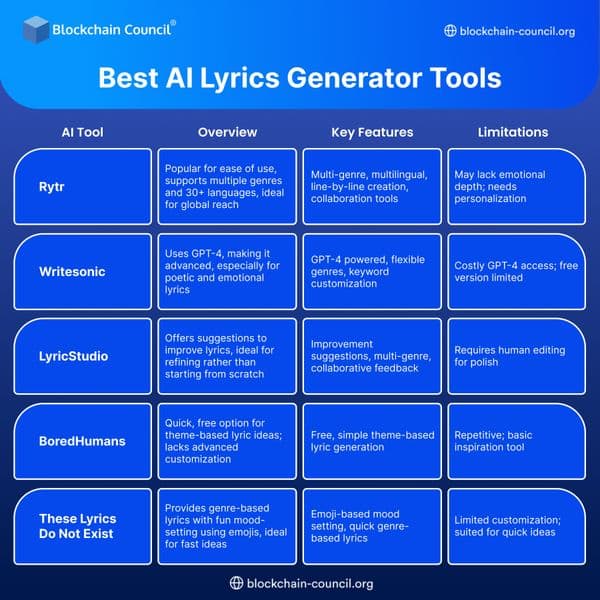
Best Lyrics Generator Tools
AI lyrics generator tools help musicians and creators write songs quickly by generating creative and structured lyrics.
Infographics
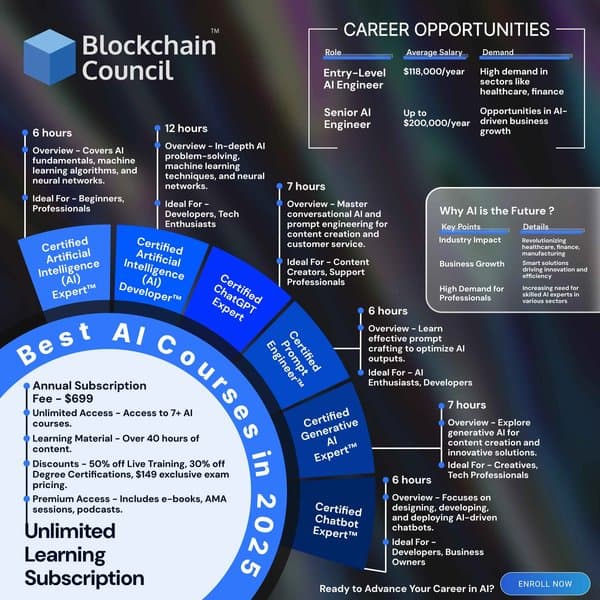
Best AI Courses in 2026
Artificial Intelligence (AI) is revolutionizing industries, creating unprecedented career opportunities for professionals and enthusiasts alike. If you’re looking to excel in this dynamic field, the Blockchain Council offers a curated selection of AI certifications tailored to diverse needs and…
Trending Articles
The Role of Blockchain in Ethical AI Development
How blockchain technology is being used to promote transparency and accountability in artificial intelligence systems.

Top 5 DeFi Platforms
Explore the leading decentralized finance platforms and what makes each one unique in the evolving DeFi landscape.

Can DeFi 2.0 Bridge the Gap Between Traditional and Decentralized Finance?
The next generation of DeFi protocols aims to connect traditional banking with decentralized finance ecosystems.