

Fintech 2026: Top Trends in AI-Driven Banking, Embedded Finance, and Real-Time Payments

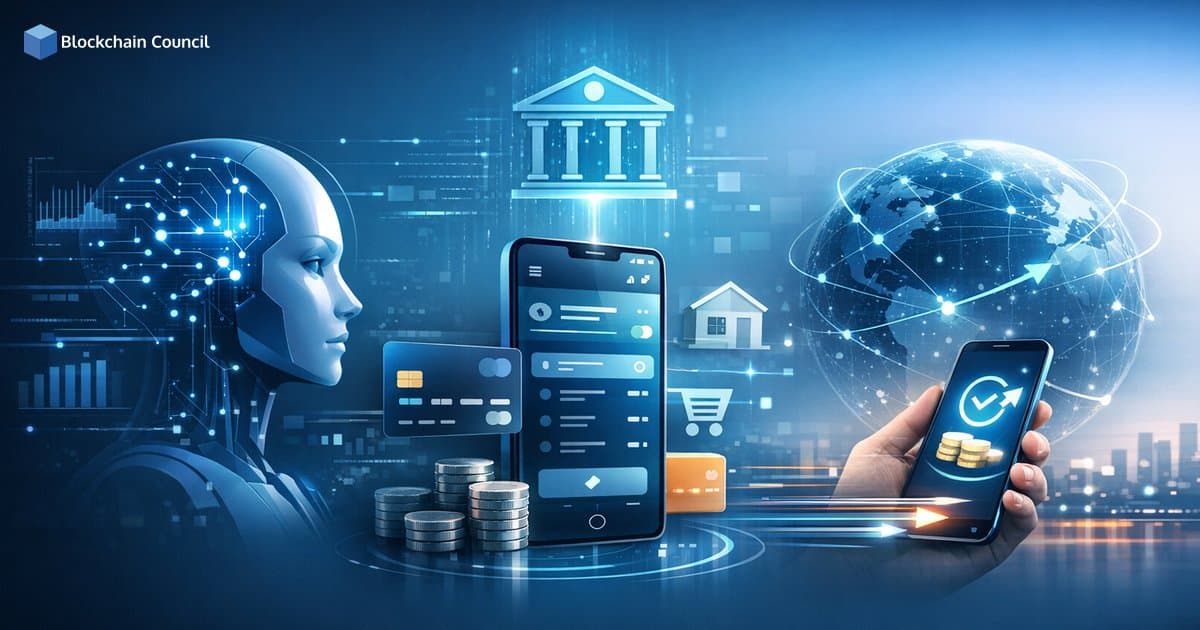
Fintech 2026 is defined by the convergence of AI-driven banking, embedded finance, and real-time payments into a single, API-first and data-intensive financial stack. This convergence is reshaping who delivers financial services, how money moves across rails, and how institutions manage fraud, credit risk, and compliance. As AI becomes embedded in day-to-day banking workflows and instant settlement becomes a baseline expectation, banks, fintechs, and enterprises are entering a new era of composable finance.
By 2025, the global fintech market reached approximately $394.9 billion and is projected to grow to $1,126.6 billion by 2032 at a 16.2% CAGR. In parallel, the AI agents and digital co-pilots market reached approximately $7.84 billion in 2025 and is projected to reach $52 billion by 2030 at a 46.3% CAGR. These figures help explain why AI adoption, embedded distribution, and new payment rails are all accelerating heading into 2026.

1) The 2026 Fintech Stack: AI + APIs + Instant Settlement
Historically, fintech trends were discussed as separate categories: AI in banking, embedded finance partnerships, and faster payments infrastructure. In 2026, they are increasingly inseparable. The institutions that gain competitive advantage will combine:
- AI decisioning for credit, fraud, and personalization
- API-first integration to embed financial services inside non-bank customer journeys
- Multi-rail payments that route value across cards, account-to-account transfers, real-time rails, and tokenized settlement networks
This shift creates a new operating model: financial capabilities are exposed as machine-grade services, AI systems orchestrate decisions and workflows, and settlement happens in seconds rather than days.
2) AI-Driven Banking: From Analytics to Autonomous Finance
AI-driven banking is moving from back-office reporting to front-line execution. A widely cited 2025 survey showed 59% of finance functions using AI, up from approximately 37% in 2023, signaling rapid institutionalization of AI across finance operations.
AI Co-Pilots and Agentic AI Enter Core Workflows
By 2026, co-pilots and agentic AI are expected to be embedded in a large share of enterprise applications, including systems used for banking operations and payments. The practical implication is that AI increasingly progresses from answering questions to completing tasks within governed limits.
Large institutions have already demonstrated measurable outcomes from scaled AI initiatives. JPMorgan Chase has described internal AI tooling that accelerates advisor support and contributes to substantial savings through fraud prevention and operational efficiency improvements.
Where AI Creates the Most Value in Banking
- Credit and underwriting: AI-first lending increasingly uses real-time and alternative data - such as cash-flow signals and behavioral patterns - to speed up decisions and expand credit access compared to traditional scorecard models.
- Fraud and risk: Behavioral analytics, anomaly detection, and real-time transaction scoring are becoming standard. With real-time payments, fraud controls must also operate in real time and remain always-on.
- Customer experience and personalization: Consumer expectations continue to rise. One widely reported data point is that 72% of consumers say personalization influences where they bank, making AI-driven personalization a competitive requirement rather than an optional capability.
Governance Becomes the Differentiator
As AI becomes more operational, regulators and risk teams are focusing increasingly on:
- Explainability and fairness in credit and pricing decisions
- Model risk management for fraud, AML, and collections
- Privacy and data lineage, particularly when open banking data and third-party data sources are involved
For professionals, this raises the value of skills in model governance, monitoring, and secure data engineering. Blockchain Council programs such as Certified AI Expert, Certified Machine Learning Professional, and Certified Data Science Professional provide structured pathways for building these competencies.
3) Embedded Finance: Banking Becomes a Feature Inside Platforms
Embedded finance is no longer a niche capability. Heading into 2026, it functions as a mainstream growth engine, supported by API-centric architectures, open banking capabilities, and the expansion of real-time payment rails. Rather than customers navigating to a bank app, banking increasingly reaches customers inside the applications they already use daily.
What Embedded Finance Includes in 2026
- Embedded payments: in-app wallets, one-click checkout, instant payouts
- Embedded lending: buy now, pay later at checkout, marketplace working capital, and invoice financing within SaaS platforms
- Embedded banking: accounts, cards, onboarding, and treasury functions built into non-bank products
- Embedded insurance and wealth: contextual policies and investment features inside vertical platforms
Well-known examples include gig and mobility platforms offering accounts and debit cards within their apps, illustrating how banking utility is being integrated directly into worker and merchant workflows.
Open Banking APIs and BaaS Expand Distribution
Open banking and open finance APIs form a key backbone for embedded finance. Industry analysis indicates that approximately 87% of global banks have implemented open banking capabilities directly or through partners. This access to account and transaction data supports personalization, underwriting, and onboarding flows.
White-label embedded banking providers and banking-as-a-service models allow software companies to offer financial products without holding banking licenses. This further shifts the customer relationship toward platforms, while regulated banks increasingly provide licensed infrastructure behind the scenes.
Key Risks: Vendor Exposure and Compliance Maturity
Embedded models introduce third-party complexity. A reported 41.8% of fintech breaches originate with third-party vendors, elevating the importance of:
- Supply-chain security and rigorous vendor due diligence
- Zero trust access patterns for APIs and internal systems
- Continuous monitoring for identity, onboarding, and transaction anomalies
For teams building embedded products, Blockchain Council certifications such as Certified Cybersecurity Expert and Certified Blockchain Security Professional provide relevant grounding in vendor risk and secure architecture alongside AI and data tracks.
4) Real-Time Payments and Tokenized Settlement: Always-On Money Movement
Real-time payments are becoming foundational infrastructure. Analysts consistently identify instant payments and real-time account transfers among the most impactful fintech trends for 2026. The operational standard is shifting to 24/7 availability, immediate confirmation, and real-time fraud response.
Multi-Rail Payments Become the Default Architecture
From 2026 onward, banks and payment providers are increasingly expected to operate across multiple rails simultaneously:
- Cards for global acceptance and consumer familiarity
- ACH and account-to-account transfers for established low-cost domestic payments
- Faster payment rails for instant domestic settlement
- Tokenized or blockchain-based rails for programmable settlement and cross-border efficiencies
In this model, orchestration becomes strategic: the system selects the optimal rail based on cost, risk profile, authorization rates, and settlement requirements.
Programmable Money: Stablecoins, Tokenized Deposits, and CBDCs
Tokenization is moving closer to mainstream financial operations. Roadmaps for 2026 commonly highlight regulated stablecoins, tokenized money market instruments, and blockchain settlement rails as components of future payment stacks. Central banks continue CBDC pilots and phased rollouts, while some merchants and fintechs use stablecoins such as USDC to reduce settlement time and lower transaction costs.
Regulatory frameworks are also maturing. In the United States, the GENIUS Act of July 2025 establishes a unified legal framework for stablecoins and payment-related digital assets, while the EU MiCA framework standardizes expectations for crypto-assets and stablecoins across member states. These frameworks can accelerate responsible adoption by clarifying compliance obligations and consumer protection requirements.
Cross-Border Modernization and Real-Time Liquidity
Cross-border payments are modernizing toward real-time or near-real-time settlement through new corridors that connect domestic instant rails with tokenized settlement layers. For treasury and finance teams, this drives a shift from batch-based cash management to intraday and real-time liquidity optimization.
5) Strategic Takeaways for 2026: What to Build, Buy, and Govern
The most important execution question is not whether these trends matter, but how to operationalize them safely and sustainably. Practical priorities for professionals, developers, and enterprises include:
- Design for API-first composability: Adopt composable platforms and machine-grade APIs so AI systems and embedded partners can integrate securely and reliably at scale.
- Make fraud controls real-time: Always-on payments require always-on monitoring, behavioral analytics, and low-latency decisioning engines.
- Invest in AI governance: Build explainability, bias testing, monitoring, and auditability into AI systems used for credit, fraud, and customer-facing decisions.
- Harden third-party and supply-chain security: Embedded finance expands the vendor surface area. Apply zero trust principles, least privilege access, and continuous vendor risk assessment.
- Prepare for tokenized rails: Even if blockchain settlement is not a primary rail today, plan for interoperability, compliance workflows, and ledger integration as tokenized value becomes more common.
For career and capability development, Blockchain Council certifications including Certified Fintech Expert, Certified AI Expert, Certified Cryptocurrency Expert, and Certified Blockchain Expert offer structured pathways depending on whether your focus is banking product management, AI engineering, payments infrastructure, or digital assets compliance.
Conclusion: Fintech 2026 Is Converged, Automated, and Real-Time
Fintech 2026 is not a single trend - it is a converged operating model. AI-driven banking makes decisions faster and more personalized, embedded finance shifts distribution into platforms that own user journeys, and real-time payments change settlement and fraud economics by making speed the default. Together, they create an API-first financial stack where intelligence and execution are increasingly automated, but governance, security, and compliance remain decisive differentiators.
Organizations that modernize their architecture, build strong AI and vendor risk controls, and prepare for multi-rail and tokenized settlement will be best positioned to compete as finance becomes more programmable, embedded, and always-on.
Related Articles
View All
Fintech
Top 10 Innovative Fintech Business Models in 2026
Explore the top fintech business models in 2026, from AI credit scoring and BNPL to digital banking, insurtech, payments, and blockchain tokenization.

Fintech
The Rise of Embedded Finance: How Non-Fintech Brands Add Payments, Lending, and Insurance
Embedded finance lets non-fintech brands offer payments, lending, and insurance inside their apps, boosting conversion and revenue while demanding strong governance and compliance.

Fintech
Open Banking vs. Open Finance: Key Differences, APIs, and Use Cases for Fintech Teams
Learn the key differences between open banking and open finance, how their APIs work, and the most practical fintech use cases for product and engineering teams.
Trending Articles

Top 5 DeFi Platforms
Explore the leading decentralized finance platforms and what makes each one unique in the evolving DeFi landscape.
How Blockchain Secures AI Data
Understand how blockchain technology is being applied to protect the integrity and security of AI training data.
What is AWS? A Beginner's Guide to Cloud Computing
Everything you need to know about Amazon Web Services, cloud computing fundamentals, and career opportunities.