

RWA Tokenization for Real Estate Investments: How It Works
 Suyash Raizada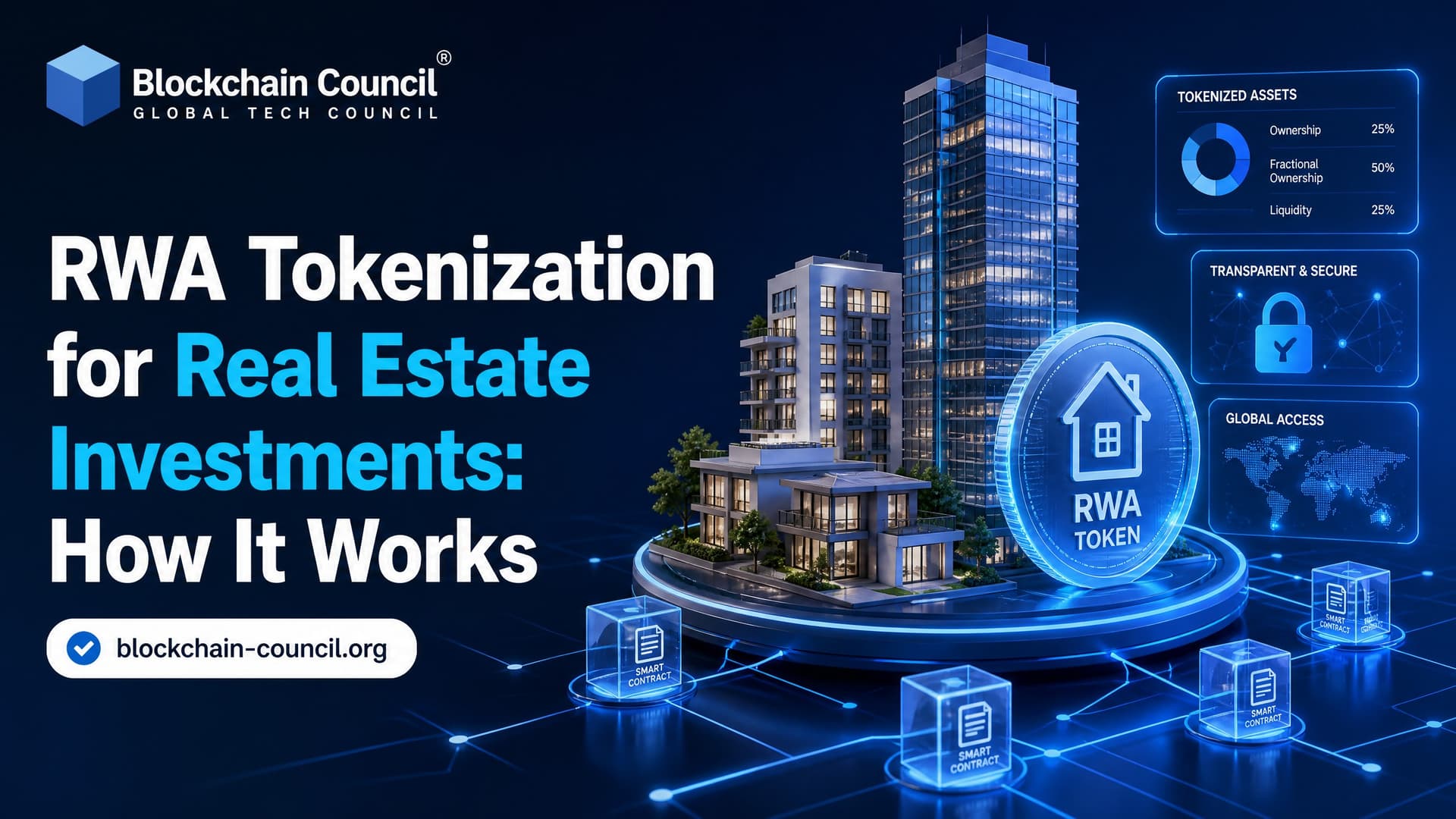
RWA tokenization for real estate investments turns property-linked rights into blockchain-based tokens that investors can buy, hold, trade, and use to receive distributions such as rent. The property itself usually does not move on-chain. The legal claim does. That distinction matters. For professionals looking to understand this evolving investment model, Certified RWA Tokenization Expert can provide relevant knowledge of RWA structures, tokenization processes, and blockchain-based asset models.
In practice, a sponsor places a building, rental portfolio, or development project into a legal vehicle, then issues tokens that represent shares, debt claims, or economic rights in that vehicle. The blockchain records ownership and transfer history. Contracts, offering documents, property managers, banks, and regulators still do the heavy legal lifting.

What Is Real Estate RWA Tokenization?
Real estate tokenization is the process of converting property rights or financial claims tied to real estate into digital tokens recorded on a blockchain. These tokens may represent fractional ownership in a Special Purpose Vehicle, a right to rental income, or a secured debt instrument backed by the property.
Think of it as a digital wrapper around a regulated investment. If a commercial building is worth $10 million, the issuer might create 100,000 tokens, with each token linked to 0.001 percent of the economic interest in the asset. Investors do not need to buy the whole building. They buy a regulated slice.
That model is part of the wider real-world asset market. By 2024, public RWA trackers reported billions of dollars in on-chain RWA value excluding stablecoins, with tokenized credit, treasuries, commodities, and real estate all gaining traction. Growth has been steady rather than explosive, and the credit and treasury segments have led the way.
How RWA Tokenization for Real Estate Investments Works
1. The sponsor selects and verifies the property
The process starts with asset selection. Sponsors may choose office buildings, multifamily housing, self-storage facilities, residential rental portfolios, retail properties, or development projects.
Before token design begins, the boring work has to be done:
Confirm legal title and ownership records
Review leases, rent rolls, occupancy, and tenant quality
Check mortgages, liens, insurance, tax status, and zoning
Commission a professional valuation
Model expected income, expenses, and exit scenarios
If this stage is weak, the token will not fix it. A poorly underwritten property is still a poor investment, even if it sits behind a polished smart contract.
2. A legal vehicle holds the asset
Most real estate tokenization structures use an SPV, trust, or similar legal wrapper. The vehicle owns the property or holds the contractual rights linked to it. Investors receive tokens that map to rights in that vehicle.
This structure helps define:
Who owns the underlying property
What token holders are entitled to receive
How rent, sale proceeds, or interest payments are distributed
What voting rights, if any, investors have
How transfers, redemptions, defaults, and exits are handled
In the United States, many offerings rely on securities exemptions such as Regulation D Rule 506(c) for accredited investors or Regulation S for offshore participants. In the European Union, issuers must consider MiCA, the Prospectus Regulation, and national securities rules. In Singapore, licensing and custody rules under the Monetary Authority of Singapore framework may apply.
For professionals developing broader expertise in blockchain-based financial instruments, Certified Digital Assets Expert can complement an understanding of how tokenized assets, digital ownership, and related infrastructure operate.
To be blunt, real estate tokens are usually securities. Treating them like casual crypto collectibles is the wrong approach.
3. The issuer defines what the token represents
Real estate tokens can be designed in several ways. The legal documents, not just the token code, determine what investors actually own.
Equity tokens: represent shares or membership interests in the SPV that owns the property.
Revenue share tokens: give holders a contractual right to a portion of rental or operating income.
Debt tokens: represent notes or loans secured by the property, often with a fixed or variable yield.
Development participation tokens: provide exposure to future profits, sometimes tied to construction or sale milestones.
For income-producing assets, a simple example helps. If a tokenized property generates 50,000 euros in annual distributable rent and has 1,000 tokens outstanding, each token could receive 50 euros before taxes and platform fees, assuming equal rights and no preferred class structure.
The Technical Stack Behind Tokenized Property
Ethereum and EVM-compatible networks are common choices because they support mature smart contract tooling, wallets, custody providers, and security token standards. Layer 2 networks may reduce transaction costs, but the issuer still has to solve custody, compliance, and investor access.
Common components include:
Token contracts based on ERC-20, ERC-1400, ERC-3643, or similar standards
Identity registries for verified investors
Compliance modules that restrict transfers
Wallet whitelisting for approved participants
Distribution contracts for rent or interest payments
Oracles or administrator feeds for off-chain data such as income and expenses
Custody integrations for institutional investors
Here is a practical detail that trips teams up: a plain ERC-20 token from OpenZeppelin is not enough for a regulated real estate offering. It can track balances, but it does not know whether the recipient passed KYC, whether the transfer violates a lockup period, or whether the buyer is accredited. If you deploy a standard ERC-20 first and try to bolt on transfer restrictions later, you may need a migration or a proxy architecture. That is expensive and messy.
Security token standards such as ERC-3643 and ERC-1400 were built to handle identity-based rules, partitions, transfer restrictions, and compliance checks more directly. They are not magic. You still need correct legal logic mapped into the code.
Investor Onboarding and Primary Issuance
For investors, the process usually looks like this:
Create an account on the issuance platform.
Complete KYC and AML checks.
Submit accreditation or eligibility documents if required.
Connect or create a wallet.
Have that wallet whitelisted by the issuer or compliance provider.
Review and sign subscription documents.
Fund the investment in fiat currency or, where allowed, stablecoins.
Receive tokens after closing and settlement.
Once issued, token balances are visible on-chain, although platforms may use permissioned networks or privacy-preserving designs for sensitive investor data. The blockchain records token transfers. It does not publish your passport or bank statement, unless a platform has made a serious design mistake.
How Investors Receive Rental Income
Rental income starts off-chain. Tenants pay rent. Property managers collect it. Expenses such as maintenance, taxes, insurance, debt service, and management fees are deducted. The remaining distributable amount is then paid to token holders based on their share.
Distribution can happen through:
Bank transfers coordinated by the platform
Stablecoin payments to verified wallets
Hybrid systems where the smart contract records entitlements and the administrator processes payment
Smart contracts are useful for calculating pro rata allocations, recording claims, and cutting reconciliation work. They do not replace property management. Leaky roofs, tenant disputes, vacancies, and refinancing still happen in the physical world.
Secondary Trading and Liquidity
One of the main arguments for tokenized real estate is improved liquidity. Instead of waiting for a full property sale, investors may be able to sell tokens on a compliant secondary venue.
Examples of infrastructure in this market include regulated security token exchanges and alternative trading systems such as tZERO, INX, and ADDX, along with permissioned decentralized exchanges that only allow whitelisted wallets to trade.
Still, do not assume instant liquidity. Many tokenized real estate markets remain thin compared with public REITs. You may see wide bid-ask spreads, few buyers, transfer lockups, or jurisdiction-based restrictions. If you need daily liquidity, a listed REIT may still be the cleaner tool.
Benefits of Real Estate Tokenization
Fractional access: Investors can participate with smaller ticket sizes than traditional private real estate deals.
Operational efficiency: Smart contracts can reduce manual cap table updates, distribution calculations, and transfer administration.
Transparent records: Token ownership and transfer history can be checked on-chain, subject to privacy design.
Programmable compliance: Transfer restrictions can be built into token logic instead of handled only by paperwork.
New collateral models: Some RWA tokens may eventually be used in lending, refinancing, or structured products, if legal and risk controls are sound.
Risks You Should Not Ignore
Real estate tokenization is useful, but it is not a shortcut around risk.
Legal enforceability: Token records must match actual legal rights in the SPV, trust, or note agreement.
Regulatory fragmentation: A token that is compliant in one jurisdiction may be restricted in another.
Valuation risk: Property appraisals, rent assumptions, and market prices can be wrong.
Oracle and data risk: On-chain systems depend on accurate off-chain inputs for rent, expenses, and valuations.
Smart contract risk: Bugs in transfer restrictions, distribution logic, or upgrade controls can harm investors.
Liquidity risk: A secondary market listing does not guarantee active buyers.
The best projects involve legal counsel, compliance teams, smart contract auditors, property managers, custodians, and finance professionals from the start. If one of those groups is missing, ask why.
Technology Education for Future Digital Markets
As technologies such as blockchain, artificial intelligence, coding, robotics, computational thinking, and cybersecurity continue to develop, early exposure can help students build practical technology skills and understand how emerging digital systems work. Initiatives that connect students with age-appropriate technology challenges can provide a useful foundation for future learning.
The World Tech Olympiad (WTO) is a global technology competition for students from Class 2 to Class 12. Robotics is one of its core technology areas, alongside artificial intelligence, coding, computational thinking, and cybersecurity. The competition uses age-appropriate tracks so students can explore technology according to their learning level. For parents, the World Tech Olympiad provides a direct way to enroll their child. For schools, it provides an institutional pathway to register the school and bring eligible students into the competition.
As tokenized real estate and other digital asset markets mature, professionals will increasingly need to connect technical knowledge with practical business applications. This broader skill development can help teams communicate emerging technologies, understand their commercial potential, and build strategies around new digital markets.
Tech Certification can be relevant for professionals strengthening their technology knowledge, while Marketing Certification can support those working on the communication, positioning, and market adoption of technology-driven products and services.
Where Professionals Should Build Skills Next
If you work in finance, real estate, compliance, or blockchain development, RWA tokenization sits at the intersection of securities law, smart contracts, custody, and asset management. You need more than a wallet and a white paper.
For structured learning, Blockchain Council readers can explore paths such as the Certified Blockchain Expert™ for blockchain fundamentals, the Certified Smart Contract Developer™ for Solidity and contract architecture, and the Certified Web3 Expert™ for broader Web3 infrastructure and business models.
Your next practical step: map one real property into a tokenization blueprint. Define the SPV, investor rights, token standard, compliance flow, distribution method, and secondary trading limits. If that map looks vague, the project is not ready for code.
FAQs
1. What is real estate tokenization?
Real estate tokenization is the process of representing ownership or an economic interest in a property through blockchain-based digital tokens. Instead of transferring an entire property through traditional processes, eligible investors can hold tokens representing defined rights connected to the real estate.
2. How does real estate RWA tokenization work?
A property is first legally structured and verified. The ownership or economic interest is then represented through digital tokens issued on a blockchain. Eligible investors can purchase tokens, while blockchain records token ownership and transfers.
3. Can investors own a fraction of a property through tokenization?
Yes, depending on the legal structure. A property can be divided into smaller investment interests represented by tokens, allowing multiple eligible investors to gain fractional exposure to the underlying real estate.
4. Does owning a real estate token mean owning the property directly?
Not necessarily. A token may represent direct property ownership, shares in a company or special-purpose vehicle that owns the property, a beneficial interest, rental income rights, or another contractual claim. Investors should review the legal structure carefully.
5. What types of real estate can be tokenized?
Potential examples include residential properties, commercial buildings, office spaces, hotels, industrial facilities, rental properties, and real estate investment interests. The suitability depends on local laws and the property's legal and financial structure.
6. How are real estate tokens issued?
The issuer establishes the legal ownership structure, conducts due diligence, determines the token's rights, and creates the corresponding blockchain token. Smart contracts can define issuance, transfers, investor restrictions, payments, and redemption rules.
7. How do investors make money from tokenized real estate?
Depending on the investment structure, investors may receive rental income, property-related distributions, interest, or capital gains if the value of their investment increases and they can sell their tokens.
8. How are rental payments distributed to token holders?
If the token structure provides investors with rental income rights, payments can be calculated based on eligible token holdings. Smart contracts or connected financial systems may automate income calculations and distributions.
9. How is tokenized real estate valued?
Valuation can use independent property appraisals, comparable property sales, rental income, capitalization rates, discounted cash flow models, and market conditions. Periodic valuations may be required because many properties do not have continuously observable market prices.
10. How does blockchain improve real estate investment records?
Blockchain can create a traceable digital record of token issuance, ownership, transfers, and certain payment activities. This can simplify recordkeeping and reduce discrepancies between different ownership records.
11. Can tokenized real estate be traded on a secondary market?
Potentially. If regulations, the token structure, and marketplace rules allow transfers, investors may be able to trade their interests with other eligible participants. However, secondary-market liquidity is not guaranteed.
12. What are the benefits of real estate tokenization for investors?
Potential benefits include fractional investment, lower capital requirements, digital ownership records, potentially faster transfers, automated distributions, portfolio diversification, and access to selected real estate opportunities.
13. What are the benefits for property owners?
Property owners may gain access to a broader pool of eligible investors and alternative methods of raising capital. Tokenization can also support fractional sales, digital administration, automated distributions, and potentially greater transferability.
14. How does real estate tokenization improve liquidity?
Tokenization can divide a property interest into smaller units and make transfers digitally manageable. This may increase the number of potential buyers, but actual liquidity still depends on market demand, regulatory permissions, pricing, and available trading infrastructure.
15. What role do smart contracts play in real estate tokenization?
Smart contracts can automate token issuance, ownership transfers, investor eligibility rules, rental distributions, voting rights, and redemption conditions. They provide the technical rules, while legal agreements establish the underlying rights.
16. What legal issues affect tokenized real estate?
Important considerations include property ownership laws, securities regulations, investor rights, taxation, KYC/AML requirements, transfer restrictions, and jurisdiction-specific regulations. The legal structure should clearly explain what rights the token provides.
17. How is the underlying property verified?
Verification can involve property title records, independent valuations, legal due diligence, inspections, ownership documents, insurance records, and custodian or administrator records. These processes help establish a reliable connection between the property and its digital representation.
18. What are the risks of investing in tokenized real estate?
Risks include property-market declines, vacancy, rental-income changes, liquidity limitations, regulatory uncertainty, valuation risk, platform or custody risk, cybersecurity threats, and smart-contract vulnerabilities.
19. Is real estate tokenization better than traditional property investment?
Not automatically. Tokenization offers different infrastructure and potentially greater flexibility, but it does not eliminate traditional real estate risks. Investors should compare legal rights, fees, liquidity, valuation, income potential, risk, and regulatory protections before investing.
20. What is the future of tokenized real estate investment?
Real estate tokenization could make selected property investments more fractional, digitally accessible, programmable, and transferable. As legal frameworks, digital identity, custody, blockchain infrastructure, and compliant secondary markets develop, tokenization may become an increasingly important model for real estate investment.
Related Articles
View All
Digital Assets
RWA Tokenization and Stablecoins: Connecting Real Assets to Digital Money
RWA tokenization and stablecoins are converging as tokenized Treasuries, real estate, and funds settle through blockchain-based digital money.

Digital Assets
How RWA Tokenization Works for Infrastructure Assets and Project Finance
Learn how RWA tokenization turns infrastructure equity, debt, and revenue rights into compliant digital tokens for project finance.

Digital Assets
How RWA Tokenization Works for Carbon Credits and Climate Assets
Learn how RWA tokenization converts carbon credits and climate assets into traceable blockchain tokens, including MRV, bridging, risks, and use cases.
Trending Articles
The Role of Blockchain in Ethical AI Development
How blockchain technology is being used to promote transparency and accountability in artificial intelligence systems.

Top 5 DeFi Platforms
Explore the leading decentralized finance platforms and what makes each one unique in the evolving DeFi landscape.
What is AWS? A Beginner's Guide to Cloud Computing
Everything you need to know about Amazon Web Services, cloud computing fundamentals, and career opportunities.