

CBDC vs Stablecoin: Issuance, Backing, and Risk Explained
 Suyash Raizada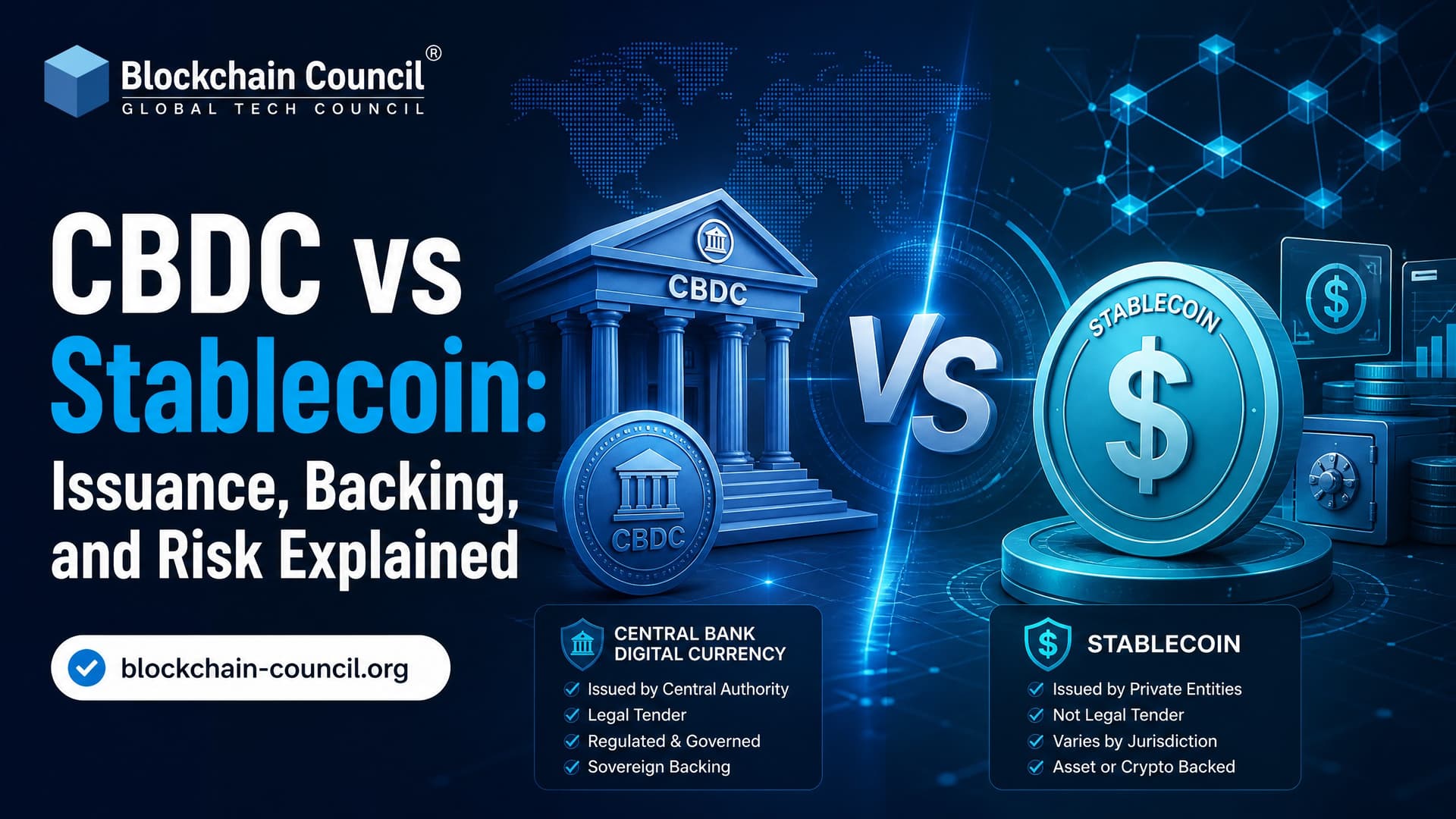
CBDC vs Stablecoin is not a debate about two versions of the same digital cash. A CBDC is central bank money in digital form. A stablecoin is usually a private token that tries to track a fiat currency, most often the US dollar, through reserves and redemption rules. That difference changes everything: legal status, user risk, compliance, and how each instrument fits into payments and Web3. Anyone trying to get past the surface-level comparison usually benefits from a structured Certified Central Bank Digital Currency (CBDC) Expert foundation before weighing CBDCs against private stablecoins in detail.
CBDC vs Stablecoin: The Basic Difference
A central bank digital currency, or CBDC, is a direct liability of a central bank. Think of it as digital sovereign money, closer to cash or central bank reserves than to a bank deposit. The Bank for International Settlements and the IMF have described CBDCs as public money that can be designed for retail users, wholesale settlement, or both.

A stablecoin is different. It is typically issued by a private company, bank, or licensed payment institution. It aims to hold a stable value against a reference asset, such as USD, EUR, HKD, or a basket of assets. The promise depends on reserves, governance, redemption rights, and regulation.
Short version: CBDC risk starts with public infrastructure design. Stablecoin risk starts with the issuer and its reserve assets. Because stablecoins sit squarely in the broader digital asset market, many professionals pair CBDC study with a Certified Digital Assets Expert background to cover both sides of this comparison properly.
How CBDCs Are Issued
Central bank liability
CBDCs are issued by central banks and sit on the central bank balance sheet. That is the cleanest line in the CBDC vs Stablecoin comparison. If you hold a CBDC, your claim is on the monetary authority, not on a private issuer.
Many CBDCs are expected to carry legal tender characteristics, although the exact status depends on domestic law. The Bahamas Sand Dollar, Jamaica Jam-Dex, and Nigeria eNaira are live examples of retail CBDCs. China's e-CNY remains the most advanced large-economy pilot, with extensive domestic testing and cross-border work through projects such as mBridge.
Retail and wholesale models
CBDC design usually falls into two categories:
Retail CBDC: Accessible to households and businesses for everyday payments, similar to digital cash.
Wholesale CBDC: Restricted to banks and regulated financial institutions for interbank settlement, securities settlement, and financial market infrastructure.
The Swiss National Bank's Project Helvetia is a good wholesale example because it tests settlement of tokenized assets on the SIX Digital Exchange. Brazil's DREX is another case to watch, since it is being built around tokenized financial services rather than simple consumer payments.
Two-tier distribution is becoming the default
Most central banks do not want to run customer service desks for millions of wallet users. So many designs use a two-tier model. The central bank issues the CBDC, while banks and payment service providers handle wallets, onboarding, compliance checks, and user support.
This matters for developers. A retail CBDC wallet may look like a normal payment app, but the underlying compliance, privacy, and settlement rules are not the same as a public blockchain token transfer.
How Stablecoins Are Issued
Private issuer, reserve-backed token
Stablecoins are usually private liabilities. The issuer accepts fiat or eligible assets, mints tokens, manages reserves, and promises redemption at par. If the token is pegged to 1 US dollar, users expect to redeem one token for one dollar, minus any disclosed fees or timing rules.
Under the EU Markets in Crypto-Assets Regulation, known as MiCA, stablecoins split into categories such as e-money tokens and asset-referenced tokens. MiCA's stablecoin provisions have applied since mid-2024 and set reserve, disclosure, governance, and anti-money-laundering requirements. In the United States, the GENIUS Act created a federal framework for payment stablecoins, with full reserve requirements backed by assets such as cash and short-term US Treasuries.
Reserve quality is the real product
Do not judge a stablecoin only by its logo or exchange listings. Judge it by reserves and redemption.
Are reserves held in cash, short-term government securities, bank deposits, or money market funds?
Are reserves segregated from the issuer's corporate assets?
How often are reserve attestations published?
Can ordinary users redeem directly, or only approved institutions?
What happens during a banking holiday or market stress?
That last question is not theoretical. A stablecoin can be fully backed on paper and still face liquidity pressure if users rush to redeem at the same time. Regulators in the EU, Hong Kong, Japan, Singapore, the United Arab Emirates, the United Kingdom, and the United States have all moved toward stricter stablecoin-specific rules for exactly this reason.
A developer detail that bites beginners
If you build with stablecoins, read the token contract before writing payment logic. USDC on Ethereum uses 6 decimals, not 18. I have seen test payments fail because a developer used parseEther('10') for a USDC transfer instead of parseUnits('10', 6). The contract did not care about the business intent. It only saw the wrong integer amount.
That sort of mistake does not exist in the same way with most CBDC pilots, because developers usually work through permissioned APIs, regulated intermediaries, or controlled sandbox environments rather than public ERC-20 contracts.
Risk Comparison: CBDC vs Stablecoin
Issuer credit risk
CBDCs largely remove issuer credit risk for users because the issuer is the central bank. A stablecoin keeps issuer risk in the picture. Even with strong regulation, users depend on the issuer's solvency, internal controls, reserve custody, and redemption process.
To be blunt, a stablecoin is only as safe as its weakest operational link. That might be reserve custody, governance, banking access, sanctions screening, or smart contract controls.
Bank funding and run risk
CBDCs create a different concern. They may pull deposits away from commercial banks. If users can move money instantly from bank deposits into central bank money during a panic, the speed of a bank run could increase. IMF and central bank research often points to holding limits, non-interest-bearing CBDCs, tiered remuneration, and phased conversion as possible safeguards.
Stablecoins can also face runs. If holders doubt the peg, they may redeem or sell quickly. Large redemptions can force the issuer to liquidate reserve assets, which may affect Treasury markets, bank deposits, or money market funds if the stablecoin is large enough.
Operational and cyber risk
CBDCs would become critical national payment infrastructure. An outage, data leak, or cyberattack could dent public trust in money itself. That is why central banks have shifted from broad experimentation toward questions about resilience, redundancy, incident response, and privacy.
Stablecoins face cyber risk too, but in a different stack. Think compromised issuer keys, faulty smart contracts, bridge hacks, exchange failures, wallet phishing, and oracle issues in DeFi. Public blockchains add transparency, but transparency is not the same as safety. Engineers working across both stacks often round out this security foundation with a broader Tech Certification, since key management, incident response, and secure infrastructure practice apply to CBDC and stablecoin systems alike.
Privacy and surveillance concerns
Retail CBDCs raise hard privacy questions. Who sees transaction data: the central bank, wallet providers, merchants, law enforcement, or analytics vendors? Good CBDC design has to balance privacy with anti-money-laundering obligations.
Stablecoins also create traceable transaction records on public chains. That can help compliance teams and investigators, but it also exposes user behavior if addresses are linked to real identities. Privacy is not automatic in either model.
Regulatory Direction From 2025 to 2030
The global direction is clear. CBDCs are moving slowly into build phases, while stablecoins are being pulled into payment regulation.
CBDCs: The Atlantic Council has reported that more than 130 countries and currency unions are researching CBDCs, with dozens in pilot stages. The European Central Bank's digital euro project moved from investigation into preparation, and its technical build work is expected to shape a possible issuance decision later this decade. The Bank of England continues digital pound design work without a final launch decision.
Stablecoins: MiCA, the GENIUS Act, Hong Kong's Stablecoins Ordinance, Japan's Payment Services Act amendments, and Singapore's framework all point to one result. Serious issuers will need licensing, high-quality reserves, audits, AML controls, and clear redemption rights.
Expect coexistence, not one winner. Wholesale CBDCs may handle institutional settlement. Regulated stablecoins may serve crypto markets, Web3 applications, remittances, and tokenized commerce. Tokenized deposits may sit somewhere between them.
Use Cases: Where Each Makes Sense
CBDC use cases
Public digital cash: Retail payments backed directly by the state.
Financial inclusion: Access for people underserved by bank branches, especially in island or rural economies.
Wholesale settlement: Central bank settlement for tokenized securities and interbank transfers.
Cross-border experiments: Multi-central-bank platforms such as mBridge that test faster international settlement.
Stablecoin use cases
Crypto trading: A stable settlement asset across exchanges and DeFi protocols.
Programmable payments: On-chain settlement for subscriptions, escrow, payroll, and business workflows.
Remittances: Faster transfer rails where local regulation and liquidity support safe conversion.
Tokenized finance: Cash-like collateral for on-chain bonds, funds, and institutional settlement.
My view: if you need state-backed final settlement, look at CBDC and central bank money models. If you need composability with smart contracts today, regulated stablecoins are more practical. But do not treat unregulated or algorithmic stablecoins as cash equivalents. That lesson was learned the expensive way in crypto markets.
What Professionals Should Learn Next
For finance teams, the key skill is risk classification. Ask whether the instrument is a sovereign liability, a bank liability, a payment institution liability, or a smart contract claim. For developers, learn token standards, wallet security, compliance hooks, and settlement finality. For enterprises, map digital currency use cases to jurisdiction, licensing, treasury policy, and operational controls before running pilots.
If you want a structured path, consider Blockchain Council's Certified Blockchain Expert™ for digital asset fundamentals, Certified Blockchain Developer™ for smart contract and blockchain implementation, Certified Cryptocurrency Expert™ for crypto market infrastructure, and Certified DeFi Expert™ if stablecoins will be used in decentralized finance workflows. Start by comparing one live stablecoin contract, one CBDC policy paper, and one regulatory framework such as MiCA. You will grasp the CBDC vs Stablecoin difference faster than by reading definitions alone. And if part of your job involves explaining that difference to clients or leadership, a Marketing Certification can help you turn a genuinely technical distinction into a case that lands with a non-specialist audience.
FAQs
1. What is the difference between a CBDC and a stablecoin?
A central bank digital currency (CBDC) is digital money issued by a central bank and denominated in the country's official unit of account.
A stablecoin is generally a privately issued digital token designed to maintain a stable value relative to a reference asset, most commonly a national currency such as the U.S. dollar.
The essential distinction is:
CBDC → liability of a central bank
Stablecoin → liability or obligation associated with a private issuer or arrangement, depending on its legal structure
Both can represent “digital dollars” or similar units on a screen, but the legal and financial machinery underneath them is quite different.
2. Who issues a CBDC?
A CBDC is issued by a central bank.
Examples of institutions that could issue CBDCs include:
Federal Reserve
European Central Bank and Eurosystem
Bank of England
Reserve Bank of India
People's Bank of China
CBDC issuance therefore forms part of the sovereign monetary system.
3. Who issues stablecoins?
Stablecoins are generally issued by private organizations.
Depending on the arrangement, the issuer may be:
A regulated financial institution
A specialized stablecoin company
A fintech company
Another legally structured private entity
The issuer typically creates tokens in exchange for eligible funds or reserve assets and redeems them according to the stablecoin's rules.
4. What backs a CBDC?
A CBDC does not need a separate pool of assets backing each digital unit in the way a reserve-backed stablecoin does.
CBDC itself is a direct liability of the central bank, just as central bank money represents a claim within the sovereign monetary framework.
Its value rests on the issuing monetary authority and legal framework rather than a private reserve portfolio.
5. What backs a stablecoin?
Reserve-backed stablecoins may be backed by assets such as:
Cash
Bank deposits
Short-term government securities
Repurchase agreements
Other permitted liquid assets
The exact reserve composition varies by stablecoin and regulatory regime.
For users, reserve quality, custody, liquidity, transparency, and redemption rights are therefore crucial.
6. How does a fiat-backed stablecoin maintain its value?
Suppose a stablecoin targets:
1 token = $1
A reserve-backed issuer may accept $1 and issue one token.
Conceptually:
User provides $1 → Issuer creates 1 stablecoin
When redeemed:
1 stablecoin → Issuer returns $1 → Token is retired
Reliable redemption around par helps anchor the market price near $1.
7. Can a stablecoin lose its peg?
Yes.
A stablecoin can trade above or below its target value because of:
Concerns about reserves
Redemption difficulties
Liquidity shortages
Market stress
Banking problems
Operational failures
Regulatory developments
Loss of confidence
The severity of this risk depends heavily on the stablecoin's design and backing.
8. Can a CBDC lose its peg?
A domestic CBDC normally is the sovereign currency unit, rather than an asset attempting to track it.
For example, one digital unit of a hypothetical dollar CBDC would be one dollar in digital central bank money.
Its purchasing power could still decline through inflation or exchange-rate depreciation, but that is different from a stablecoin breaking a one-to-one redemption peg.
9. What is the biggest risk difference?
The central distinction is issuer and counterparty risk.
With CBDC, the holder has central bank money.
With a privately issued stablecoin, users depend on the legal and operational structure supporting the token, including potentially:
Issuer solvency
Reserve quality
Custodian safety
Redemption mechanisms
Operational continuity
Regulation can reduce these risks, but it does not turn a privately issued token into a central-bank liability.
10. Are all stablecoins backed by cash?
No.
Stablecoin designs have included:
Fiat/reserve-backed stablecoins
Supported by reserve assets.
Crypto-collateralized stablecoins
Supported by cryptocurrency or tokenized collateral.
Algorithmic arrangements
Attempt to stabilize value using economic mechanisms rather than full conventional reserves.
These structures can have radically different risk profiles despite sharing the charmingly reassuring word “stable.”
11. What is reserve risk?
Reserve risk is the possibility that assets supporting a stablecoin may not be sufficiently safe, liquid, or available to satisfy redemptions.
Questions include:
What assets are held?
Where are they held?
Who owns them legally?
Are they liquid during stress?
Are reserves independently verified?
What happens if a custodian fails?
Reserve composition matters particularly when many holders attempt to redeem simultaneously.
12. What is redemption risk?
Redemption risk concerns whether users can exchange stablecoins for the referenced currency at the promised value and within expected timeframes.
Potential problems include:
Redemption fees
Minimum redemption amounts
Delays
Eligibility restrictions
Banking interruptions
Issuer distress
A stablecoin trading at $1 during calm markets does not by itself prove that large-scale redemption will work smoothly during a crisis.
13. How do CBDCs and stablecoins differ in settlement?
CBDC transactions can potentially provide settlement in central bank money.
Stablecoin transactions transfer a private digital instrument.
Even if stablecoin transfers settle rapidly on a blockchain, the underlying asset remains different from central bank money.
This distinction matters for settlement risk, especially in large financial transactions.
14. Do CBDCs require blockchain?
No.
CBDCs can use:
Centralized databases
Distributed databases
DLT
Permissioned blockchains
Hybrid systems
Stablecoins are more commonly implemented as tokens on blockchain networks, although their economic design is separate from the blockchain itself.
15. Which offers faster payments?
Either can potentially support near-real-time transfers.
Stablecoins already demonstrate rapid transfers across various blockchain networks, although actual speed, cost, and finality depend on the network.
CBDCs could be engineered for high-speed domestic retail or wholesale payments.
Speed is therefore not inherent to the label CBDC or stablecoin. Infrastructure determines it.
16. How do they compare for cross-border payments?
Stablecoins can enable transfers across blockchain networks without relying on every stage of traditional correspondent banking.
CBDCs could potentially improve cross-border payments through interoperable systems linking central banks and regulated intermediaries.
Both approaches face challenges involving:
Foreign-exchange conversion
AML/CFT requirements
Sanctions
Identity
Regulatory differences
Liquidity
Interoperability
Legal finality
Moving digital tokens across borders is technically easier than getting several jurisdictions to agree on the rules. Humans have preserved their comparative advantage.
17. How do CBDCs and stablecoins affect commercial banks?
Both could potentially compete with bank deposits.
If users hold more money in CBDCs or stablecoins, banks could experience deposit outflows.
That could affect:
Bank funding
Lending capacity
Funding costs
Liquidity management
CBDC designers may use holding limits or remuneration structures to mitigate these effects, while stablecoin regulation may impose reserve and operational requirements.
18. Which provides better privacy?
Neither automatically provides greater privacy.
CBDC privacy depends on:
Architecture
Identity requirements
Data minimization
Intermediary roles
Legal access
Transaction monitoring
Stablecoin privacy depends on:
Blockchain transparency
Wallet identification
Issuer records
Exchange records
Analytics capabilities
Regulatory requirements
A pseudonymous blockchain address should not be casually confused with anonymity.
19. How do CBDCs and stablecoins compare?
Feature | CBDC | Stablecoin |
|---|---|---|
Issuer | Central bank | Private issuer/arrangement |
Monetary liability | Central bank | Private arrangement |
Value | Sovereign currency itself | Targets reference value |
Separate reserve backing | Generally not required | Usually important for reserve-backed models |
Redemption risk | Different structure as central bank money | Depends on issuer and redemption rights |
Reserve risk | Not analogous to private reserve backing | Potentially significant |
Blockchain required | No | Common, but design-dependent |
Credit/counterparty risk | Central-bank exposure | Private-sector risks |
Cross-border potential | High with interoperability | High on compatible networks |
Programmability | Technically possible | Commonly available |
Regulation | Public monetary framework | Private financial regulation |
20. Which is safer: CBDC or stablecoin?
From a credit-risk perspective, CBDC would generally represent the lower-risk monetary claim because it is a liability of the central bank.
A stablecoin introduces risks associated with its issuer, reserves, custodians, redemption structure, technology, and applicable regulation.
That does not mean CBDCs are risk-free. They can involve:
Cybersecurity risk
Operational outages
Privacy concerns
Financial-stability effects
Technology failures
Policy and governance risks
The risks are simply different.
21. Can CBDCs and stablecoins coexist?
Yes.
A future monetary system could contain:
Central Bank Money
Cash + CBDC + central-bank reserves
alongside:
Commercial Bank Money
Bank deposits
and:
Regulated Private Digital Money
Stablecoins or tokenized deposits
Stablecoins could serve specialized payment, trading, or cross-border use cases while CBDCs provide a sovereign digital settlement asset.
22. What should finance professionals examine when evaluating a stablecoin?
Important questions include:
Who is the legal issuer?
What assets back the token?
Who holds the reserves?
Are reserves segregated?
What redemption rights exist?
How liquid are the reserves?
What disclosures or attestations are available?
What happens if the issuer or custodian fails?
Which regulator and legal regime apply?
The logo and the word “stable” are, regrettably, not sufficient due diligence.
23. What should finance professionals examine when evaluating a CBDC?
Important questions include:
Retail or wholesale design
Direct or intermediated distribution
Account or token representation
Privacy model
Offline capability
Holding limits
Remuneration
Interoperability
Cybersecurity
Settlement finality
Commercial-bank implications
Cross-border compatibility
CBDCs from different jurisdictions can differ substantially despite sharing the same label.
24. What is the easiest way to understand CBDC versus stablecoin?
Think about the issuer and the promise behind the digital unit.
CBDC
Central Bank → Issues Digital Currency → User holds central bank money
Stablecoin
User provides funds/assets → Private issuer holds reserves → Stablecoin is issued → User relies on redemption arrangement
The key distinction is therefore not simply government technology versus blockchain technology.
It is:
CBDC = sovereign digital central bank money
Stablecoin = privately issued digital money or token designed to maintain a reference value
Both could play roles in future payment systems, but their backing, legal status, counterparty risk, redemption mechanisms, governance, and financial-stability implications are fundamentally different.
Related Articles
View All
Digital Assets
CBDC Governance Explained: Standards, Oversight, and Stakeholder Roles
CBDC governance defines how digital central bank money is issued, supervised, secured, and operated across central banks, banks, PSPs, regulators, and users.

Digital Assets
CBDC vs Commercial Bank Money: Legal Tender, Risk, and User Experience
Compare CBDC vs commercial bank money across legal tender status, credit risk, privacy, adoption data, and real user experience in live pilots.

Digital Assets
CBDC Skills Every Professional Needs: Blockchain, Payments, Compliance, and Risk
CBDC skills now require blockchain architecture, payment systems knowledge, AML/CFT compliance, privacy design, cybersecurity, and risk management expertise.
Trending Articles
AWS Career Roadmap
A step-by-step guide to building a successful career in Amazon Web Services cloud computing.
What is AWS? A Beginner's Guide to Cloud Computing
Everything you need to know about Amazon Web Services, cloud computing fundamentals, and career opportunities.
Claude AI Tools for Productivity
Discover Claude AI tools for productivity to streamline tasks, manage workflows, and improve efficiency.