

CBDC vs Bitcoin: Control, Supply, and Privacy Compared
 Suyash Raizada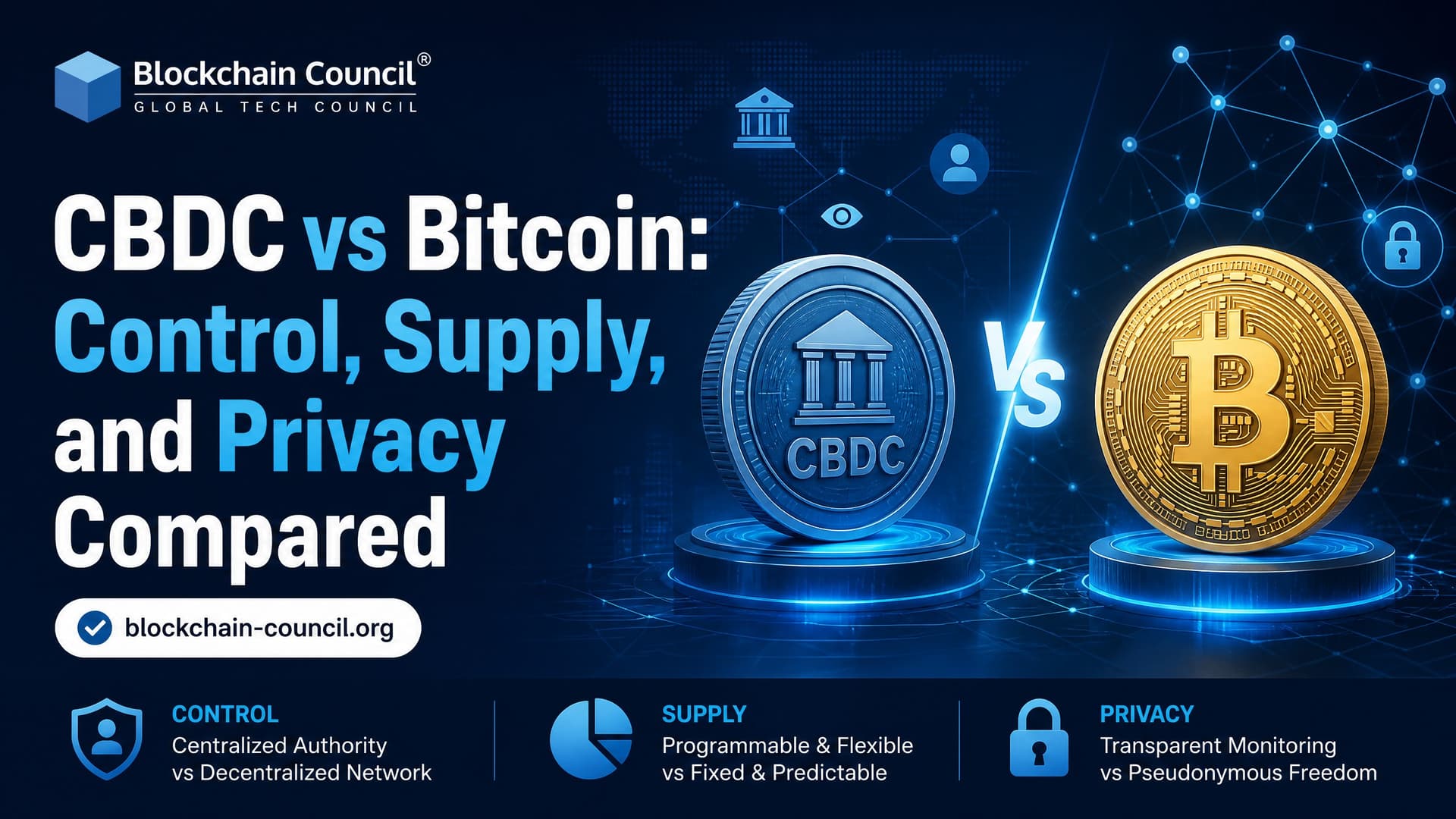
CBDC vs Bitcoin is not a debate between two versions of the same technology. A central bank digital currency is state-issued digital fiat. Bitcoin is a non-state monetary network with rules enforced by software, miners, and nodes. That single difference changes everything: who can change the money supply, who can block payments, and who can see transaction data. Professionals who want to compare the two systems with real technical depth, rather than headline arguments, are increasingly formalizing that knowledge through a program such as the Certified Central Bank Digital Currency (CBDC) Expert designation.
If you work in payments, compliance, treasury, Web3 development, or digital asset strategy, this distinction matters. CBDCs extend the existing fiat system into digital form. Bitcoin sits outside that system by design.

What Is a CBDC?
A central bank digital currency, or CBDC, is a digital form of national currency issued by a central bank. It is generally designed to be a direct liability of the central bank, similar to cash, but represented in digital form.
CBDCs may be used by the public for everyday payments, known as retail CBDCs, or by financial institutions for settlement, known as wholesale CBDCs. The Bahamas Sand Dollar, Jamaica JAM-DEX, and Nigeria eNaira are live examples of retail CBDCs. According to the Atlantic Council CBDC Tracker and BIS survey work, most central banks are now studying, testing, or piloting CBDCs in some form.
The key point: a CBDC is still fiat money. Its value, legal status, issuance, and rules come from the state.
What Is Bitcoin?
Bitcoin is a decentralized cryptocurrency launched in 2009. It has no central issuer, no central bank, and no monetary policy committee. Its supply rules are written into the protocol and enforced by thousands of independently operated nodes. Since Bitcoin sits inside the wider category of digital assets rather than fiat money, professionals comparing it against CBDCs often round out their knowledge with a Certified Digital Assets Expert credential, which covers custody, valuation, and classification questions that a pure CBDC course does not focus on.
Bitcoin has a maximum supply of 21 million coins. New bitcoin is issued through mining, and the block subsidy halves every 210,000 blocks, roughly every four years. That is not a policy target. It is protocol behavior.
A practical detail developers learn quickly: if you broadcast a Bitcoin transaction that spends an output already used, Bitcoin Core rejects it with errors such as bad-txns-inputs-missingorspent. There is no customer support desk to reverse your mistake. The network accepts valid transactions and rejects invalid ones. That is the point.
CBDC vs Bitcoin: Control
Who issues the money?
A CBDC is issued by a central bank. It is backed by the authority of the state and may have legal tender status, depending on national law. It sits inside the regulatory perimeter, including AML, KYC, sanctions compliance, reporting rules, and tax obligations.
Bitcoin is issued according to protocol rules. No government or company creates bitcoin on demand. Some countries have recognized Bitcoin in specific legal ways. El Salvador adopted it as legal tender in 2021, then rolled back much of that mandate in early 2025 under an IMF agreement. Globally, it is still not treated like sovereign money.
Who can change the rules?
CBDC rules can be changed by lawmakers, regulators, and central banks. If the policy goal changes, the system can be updated. Transaction limits, wallet tiers, identity requirements, offline limits, and compliance checks can all be designed into the payment layer.
Bitcoin changes are much harder. Developers can propose updates, but nodes decide what software to run. Miners cannot simply rewrite the 21 million supply cap and force everyone else to accept it. Users would reject invalid blocks. This makes Bitcoin slower to change, but also harder to capture.
Censorship and reversibility
CBDCs can support payment blocking, balance freezing, transaction reversal, or spending restrictions if the design allows it. That is useful for law enforcement and sanctions compliance. It is also where civil liberty concerns begin.
Bitcoin is built for censorship resistance. If you hold your own private keys, no central operator can freeze your on-chain balance. Custodial exchanges can still block withdrawals or close accounts, but that is a custody issue, not a base protocol feature.
To be blunt, CBDCs fit regulated payment systems better. Bitcoin fits users who prioritize self-custody and resistance to centralized control.
CBDC vs Bitcoin: Supply
CBDC supply follows fiat monetary policy
CBDC supply is discretionary. A central bank can expand or contract the money supply as part of wider monetary policy. A CBDC would normally be fungible with cash and bank money, so it would not have an independent scarcity model.
This flexibility is useful during financial stress. Central banks can respond to liquidity shortages, inflation, recession, or payment system disruptions. BIS and IMF research frames CBDCs as tools that may improve payment efficiency while preserving monetary sovereignty.
The trade-off is obvious. Users must trust the central bank and political system to manage supply responsibly.
Bitcoin supply is fixed by code
Bitcoin has an algorithmic issuance schedule. The supply cap is 21 million BTC, and issuance declines over time through halvings. No central authority can expand the supply because unemployment rises, banks need liquidity, or markets panic.
This is why Bitcoin supporters call it scarce digital money. The criticism is just as clear: fixed supply contributes to volatility and makes Bitcoin weak as a stable unit of account today. Central bank researchers, including Deutsche Bundesbank analysts, have repeatedly pointed to Bitcoin price volatility as a barrier to everyday currency use. Understanding both systems well enough to explain the trade-off accurately is as much a systems-literacy question as a finance one, and analysts working across both worlds often add a general Tech Certification so they can follow protocol-level and infrastructure arguments without relying entirely on secondhand summaries.
So the choice is not simple. CBDCs offer policy flexibility. Bitcoin offers monetary predictability.
CBDC vs Bitcoin: Privacy
CBDC privacy is policy dependent
CBDCs can be designed with different privacy models. Some may be account-based, where identity verification is central. Others may use token-based or tiered approaches, where small payments receive more privacy than large transfers.
Still, full anonymity is unlikely. Central banks must meet AML and counter-terrorist financing requirements. European data protection authorities have warned that CBDCs need privacy-by-design, data minimization, and clear legal limits on transaction data access.
The concern is not imaginary. A CBDC system could give public authorities or authorized intermediaries detailed visibility into balances, spending patterns, counterparties, and locations. With programmability, it could also restrict where or when money is spent.
Bitcoin is public but pseudonymous
Bitcoin is not anonymous. Every on-chain transaction is visible forever. Anyone can inspect addresses, amounts, transaction hashes, and timing.
But Bitcoin addresses are not automatically tied to legal identity. The risk comes when address data meets off-chain data, such as exchange KYC records, reused addresses, IP logs, or merchant invoices. If you reuse one address for payroll, donations, and exchange withdrawals, you have probably built your own surveillance file.
This is the privacy paradox: CBDCs may hide less from the issuer, while Bitcoin hides less from the public ledger. Bitcoin avoids a single central observer, but careless use can still expose you.
Programmability: Useful Feature or Control Risk?
CBDC programmability can support legitimate use cases. Governments could distribute targeted benefits, set transaction limits for fraud prevention, or enable offline payments with spending caps. Wholesale CBDCs could improve settlement across banks and reduce counterparty risk in cross-border payment experiments, as seen in BIS projects such as Project Mariana and Project Sela.
But programmable money can also become conditional money. Expiry dates, sector limits, geographic rules, or automatic tax collection may be efficient on paper, yet uncomfortable in practice.
Bitcoin has programmability too, but it is limited and user-driven. Bitcoin Script supports multisignature wallets, time locks, and payment conditions. It does not let a central bank impose negative interest rates or block a category of purchases across the whole network.
CBDC vs Bitcoin Comparison Table
Dimension | CBDC | Bitcoin |
|---|---|---|
Issuer | Central bank | Protocol-based issuance |
Legal status | Can be legal tender | Usually not legal tender |
Supply | Discretionary, linked to fiat policy | Fixed cap of 21 million BTC |
Governance | Centralized through public authorities | Distributed among nodes, miners, developers, and users |
Privacy | Usually identity-linked or tiered | Public ledger with pseudonymous addresses |
Censorship | Freezing, blocking, or reversal may be possible | No central protocol-level freeze function |
Best fit | Regulated national payments and settlement | Self-custody, open transfer, scarcity-focused holding |
Real-World Use Cases
Where CBDCs make sense
Retail payments where a country wants a digital public money option
Financial inclusion programs with low-cost wallets
Wholesale settlement between banks
Cross-border payment experiments between central banks
Government disbursements with audit trails
Where Bitcoin makes sense
Self-custody of a scarce digital asset
Cross-border transfers without a central payment operator
Long-term value storage for users who accept volatility
Payments in environments where banking access is limited
Portfolio exposure through regulated products where available
Bitcoin is the wrong tool if you need price stability in local currency terms. A CBDC is the wrong tool if your priority is independence from state control.
What Professionals Should Learn Next
If you work in digital assets, do not treat CBDCs and Bitcoin as competitors on one feature checklist. They answer different design questions.
For compliance and policy roles: study AML, wallet tiering, transaction monitoring, and privacy governance.
For developers: understand custody, key management, Bitcoin transaction structure, and identity layers in regulated payment systems.
For enterprise leaders: compare settlement finality, operational risk, data exposure, and regulatory dependency before choosing a payment architecture.
If you want structured training rather than headline-level comparisons, this topic maps well onto Blockchain Council certifications such as the Certified Blockchain Expert, Certified Bitcoin Expert, and Certified Cryptocurrency Expert programs.
Final Takeaway
CBDC vs Bitcoin comes down to control, supply, and privacy. A CBDC is digital fiat controlled by a central bank, with supply managed through monetary policy and privacy shaped by regulation. Bitcoin is decentralized, capped at 21 million coins, and pseudonymous rather than centrally monitored. Explaining that distinction clearly to customers, regulators, or the public is its own skill, which is why some digital asset teams pair this kind of technical comparison work with a general Marketing Certification focused on communicating complex financial products honestly rather than with slogans.
Your next step: run a Bitcoin wallet on testnet or regtest, read one central bank CBDC design paper, and map who can freeze funds, change supply, and view transaction data in each system. That exercise will teach you more than any slogan.
FAQs
1. What is the main difference between a CBDC and Bitcoin?
A central bank digital currency (CBDC) is digital sovereign money issued by a central bank. Bitcoin (BTC) is a decentralized digital asset whose issuance and transaction rules are enforced by an open network rather than a central bank.
The simplest distinction is:
CBDC → centrally issued sovereign money
Bitcoin → decentralized, protocol-based digital asset
Both are digital, which is roughly where the easy comparison ends.
2. Who controls a CBDC?
A CBDC is issued and governed within a country's official monetary system.
Depending on its design, the central bank can determine matters such as:
Issuance
Monetary characteristics
Distribution architecture
Participation rules
Holding limits
Technical standards
Settlement rules
Private banks and payment service providers may still operate customer-facing services.
3. Who controls Bitcoin?
Bitcoin has no central bank or single monetary issuer.
Its operation depends on a distributed ecosystem including:
Nodes
Miners
Wallet users
Developers
Exchanges and service providers
The protocol's rules can evolve through software changes and network adoption, but no central authority can simply issue additional bitcoin by administrative decision.
4. How is CBDC supply determined?
CBDC supply would be managed as part of the central bank's monetary framework.
CBDC could be created or redeemed as users convert between forms of money such as:
Bank deposits ↔ CBDC
The exact mechanism would depend on the country's monetary and CBDC architecture.
CBDC therefore would not ordinarily have a predetermined permanent maximum supply.
5. How is Bitcoin's supply determined?
Bitcoin's issuance is governed by its protocol.
New bitcoin is issued through mining rewards, with the issuance rate periodically reduced through halving events.
Bitcoin's protocol specifies a maximum supply approaching:
21 million BTC
This scarcity model differs fundamentally from central-bank-managed currency supply.
6. What is Bitcoin mining?
Bitcoin mining is the process through which miners use computing resources to participate in proof-of-work consensus.
Miners compete to add valid blocks of transactions to the blockchain.
Successful miners can receive:
Newly issued bitcoin
Transaction fees
Mining contributes to network security while also providing Bitcoin's issuance mechanism.
7. Would a CBDC require mining?
Generally, no.
A CBDC has an identifiable central issuer, so it does not need Bitcoin-style proof-of-work mining to establish monetary issuance or network consensus.
Even a CBDC using distributed ledger technology would more likely employ permissioned validation mechanisms.
Making banks mine blocks to process supermarket payments would be an unusually expensive way to rediscover centralized monetary authority.
8. Is Bitcoin legal tender?
Its legal status varies by jurisdiction and can change over time.
Bitcoin is generally treated as a digital or crypto asset rather than conventional sovereign currency in many jurisdictions, although some countries have given it special legal status.
A CBDC, by contrast, would be an official form of central bank money, although whether a particular CBDC receives formal legal-tender status depends on the jurisdiction's law.
9. What backs a CBDC?
A CBDC is a liability of the issuing central bank.
It does not require a separate reserve portfolio backing every CBDC unit in the manner of a privately issued reserve-backed stablecoin.
Its monetary status derives from the central bank and sovereign monetary framework.
10. What backs Bitcoin?
Bitcoin is not a claim on a central bank, commercial bank, company, or reserve pool.
Its market value emerges from factors including:
Scarcity
Demand
Network adoption
Utility
Market liquidity
Investor expectations
There is no institution promising to redeem one bitcoin for a fixed amount of sovereign currency.
11. Which has more stable purchasing value?
A CBDC would be denominated directly in its national currency.
For example:
1 digital dollar = 1 dollar
Its purchasing power could still change because of inflation or exchange-rate movements.
Bitcoin's market price relative to currencies such as dollars or euros can fluctuate substantially, making it considerably more volatile.
12. How does privacy differ?
Neither system should simply be described as “anonymous.”
Bitcoin is generally pseudonymous. Transactions are recorded on a public blockchain, while addresses do not inherently display a person's legal name.
However, blockchain analysis and information from exchanges or other services can sometimes link addresses to real-world identities.
CBDC privacy would depend on its specific architecture and legal framework.
13. Could a CBDC provide cash-like privacy?
Potentially, particularly for certain low-value payments, but this depends entirely on policy and technical design.
Possible mechanisms include:
Data minimization
Intermediated identity
Tiered identification
Pseudonymous transaction identifiers
Privacy-enhancing cryptography
Offline payments
CBDCs would also generally need to operate within applicable financial-crime and legal requirements.
14. Is Bitcoin completely anonymous?
No.
Bitcoin's blockchain provides a publicly visible transaction history.
Anyone can inspect:
Addresses
Transaction amounts
Transaction relationships
Transaction times
Although addresses are pseudonymous, sophisticated analytics can sometimes infer relationships between addresses and entities.
Public does not necessarily mean identified, but pseudonymous does not mean invisible either.
15. Can CBDC transactions be reversed?
Potentially, depending on system rules and applicable law.
A CBDC architecture could include mechanisms for dealing with:
Fraud
Court orders
Operational errors
Unauthorized transactions
Legally required freezes
Whether completed transactions can technically or legally be reversed would depend on the design.
16. Can Bitcoin transactions be reversed?
Confirmed Bitcoin transactions generally cannot be unilaterally reversed by a bank or central authority.
A recipient can voluntarily return funds, but there is no standard chargeback mechanism comparable to conventional consumer payment systems.
This provides strong settlement properties but makes mistakes and theft considerably less forgiving.
17. How do transaction systems differ?
A CBDC could use:
Centralized databases
Distributed databases
Permissioned DLT
Hybrid infrastructure
Bitcoin uses a:
Public blockchain + proof-of-work consensus
CBDC therefore does not mean “government Bitcoin.” That phrase sacrifices most of the architecture for conversational convenience.
18. Which system processes more transactions?
CBDCs could be designed for national retail-payment volumes using high-performance centralized or permissioned infrastructure.
Bitcoin's base layer intentionally prioritizes properties such as decentralization and security rather than maximizing raw transaction throughput.
Additional systems and payment layers can improve Bitcoin transaction capacity, but architecture and trust assumptions differ.
19. What happens if the internet is unavailable?
Bitcoin transactions normally require eventual network connectivity to propagate and settle on the blockchain.
CBDCs could potentially include specialized offline-payment functionality using secure devices, cards, or hardware.
Offline CBDC might allow limited device-to-device payments followed by later synchronization.
Neither digital system automatically reproduces physical cash's offline properties.
20. Can Bitcoin be frozen?
Bitcoin at the protocol level does not have a central administrator who can simply freeze an address.
However, centralized exchanges, custodians, and regulated service providers can restrict access to assets they control and may comply with legal orders.
Users who control their own private keys operate under a different custody model.
21. Can CBDC holdings be frozen?
Potentially, under legally authorized circumstances.
Depending on the architecture, authorities or regulated intermediaries might be able to enforce:
Court orders
Sanctions
Fraud restrictions
AML measures
Other legally mandated controls
The scope of these capabilities would be an important governance and civil-liberties question in any CBDC design.
22. Could CBDCs be programmable?
Technically, CBDC systems could support programmable payments or conditional transaction logic.
Potential examples include:
Automated settlement
Escrow
Delivery versus payment
Conditional government payments
However, it is important to distinguish:
Programmable payments → instructions governing when a payment occurs
from:
Programmable money → restrictions embedded in how money itself can be spent
The second raises substantially greater policy concerns.
23. Is Bitcoin programmable?
Bitcoin supports programmable transaction conditions through its scripting system.
More complex applications can also be built through additional protocols and layers.
However, no central issuer can ordinarily impose a new spending restriction on every bitcoin simply through a monetary-policy decision.
That is a significant difference in governance.
24. How do CBDC and Bitcoin compare directly?
Feature | CBDC | Bitcoin |
|---|---|---|
Issuer | Central bank | No central issuer |
Monetary control | Centralized | Protocol/network governance |
Supply | Policy-managed | Capped near 21 million BTC |
Liability | Central bank | No issuer liability |
Unit of account | Sovereign currency | BTC |
Price stability | Same nominal unit as domestic currency | Market-driven and volatile |
Blockchain required | No | Yes |
Network access | Usually permissioned infrastructure | Permissionless |
Mining required | No | Proof-of-work mining |
Transaction visibility | Design-dependent | Public ledger |
Identity | Design-dependent, likely regulated | Pseudonymous protocol addresses |
Offline capability | Potentially designed in | Limited without eventual connectivity |
Monetary policy | Integrated with central banking | Predetermined issuance rules |
25. Which is more decentralized?
Bitcoin is substantially more decentralized in monetary issuance and transaction validation.
CBDCs deliberately retain central-bank authority because their purpose is to provide a digital form of sovereign central bank money.
A distributed CBDC ledger does not change that fundamental distinction.
Distributed infrastructure ≠ decentralized monetary governance.
26. Which offers better privacy?
There is no universal answer.
Bitcoin provides pseudonymous participation at the protocol level but records transactions publicly.
A CBDC could hide transaction information from the public while allowing varying degrees of access to intermediaries or authorities.
So privacy should be evaluated across several dimensions:
Public visibility
Identity requirements
Institutional visibility
Data retention
Legal access
Transaction traceability
Calling either system simply “private” misses most of the interesting questions.
27. Which is safer?
That depends on the risk being considered.
A CBDC would minimize conventional issuer credit risk because it represents a central-bank liability, but users could face cybersecurity, privacy, operational, or account-access risks.
Bitcoin removes reliance on a central monetary issuer but introduces:
Price volatility
Private-key risk
Custody risk
Transaction irreversibility
Exchange and service-provider risks
Different architectures remove different intermediaries and, with impressive consistency, introduce different problems.
28. Could CBDCs replace Bitcoin?
CBDCs and Bitcoin solve substantially different problems.
CBDCs are intended to provide digital sovereign money.
Bitcoin provides a scarce, permissionless digital asset and payment network independent of central-bank issuance.
A CBDC could reduce demand for some crypto payment use cases, but it would not reproduce Bitcoin's fixed supply, permissionless participation, or decentralized issuance.
29. Could Bitcoin replace CBDCs?
Bitcoin could continue functioning as a digital asset and payment system, but replacing sovereign currency involves more than transferring digital value.
National monetary systems support:
Taxation
Government payments
Monetary policy
Banking systems
Credit markets
Financial stability frameworks
Legal obligations
A CBDC is designed to fit within those institutions rather than replace them.
30. What is the easiest way to understand CBDC versus Bitcoin?
Think about who controls the monetary system.
CBDC
Central Bank → Issues currency → Defines monetary framework → Regulated infrastructure → Users
Bitcoin
Protocol rules → Distributed miners and nodes → Permissionless network → Users
The central contrast is therefore:
CBDC = digital sovereign money built around institutional trust
Bitcoin = decentralized digital scarcity built around cryptographic verification and network consensus
CBDCs prioritize characteristics such as stable denomination, central-bank backing, regulatory integration, and national payment infrastructure.
Bitcoin prioritizes characteristics such as fixed long-run supply, permissionless access, censorship resistance, and independence from central-bank monetary issuance.
Neither should be understood merely as “digital money.” The real difference is the system of trust, control, supply, privacy, governance, and risk underneath the digits.
Related Articles
View All
Digital Assets
CBDC vs Bitcoin: Key Differences in Purpose, Control, and Monetary Design
CBDCs are state-issued digital fiat. Bitcoin is decentralized scarce money. This guide compares CBDC vs Bitcoin by purpose, control, policy, and design.

Digital Assets
Token-Based CBDC vs Account-Based CBDC: Which Design Protects Privacy Better?
Token-based CBDC usually protects privacy better than account-based CBDC, but real protection depends on identity linkage, data rules, and governance.

Digital Assets
CBDC vs Ethereum: Central Bank Money and Decentralized Platforms Compared
CBDC vs Ethereum explained through governance, programmability, privacy, performance, use cases, and the future of digital money infrastructure.
Trending Articles
AWS Career Roadmap
A step-by-step guide to building a successful career in Amazon Web Services cloud computing.
What is AWS? A Beginner's Guide to Cloud Computing
Everything you need to know about Amazon Web Services, cloud computing fundamentals, and career opportunities.
Claude AI Tools for Productivity
Discover Claude AI tools for productivity to streamline tasks, manage workflows, and improve efficiency.