

CBDC Privacy Explained: What Data Could Governments and Banks See?
 Suyash Raizada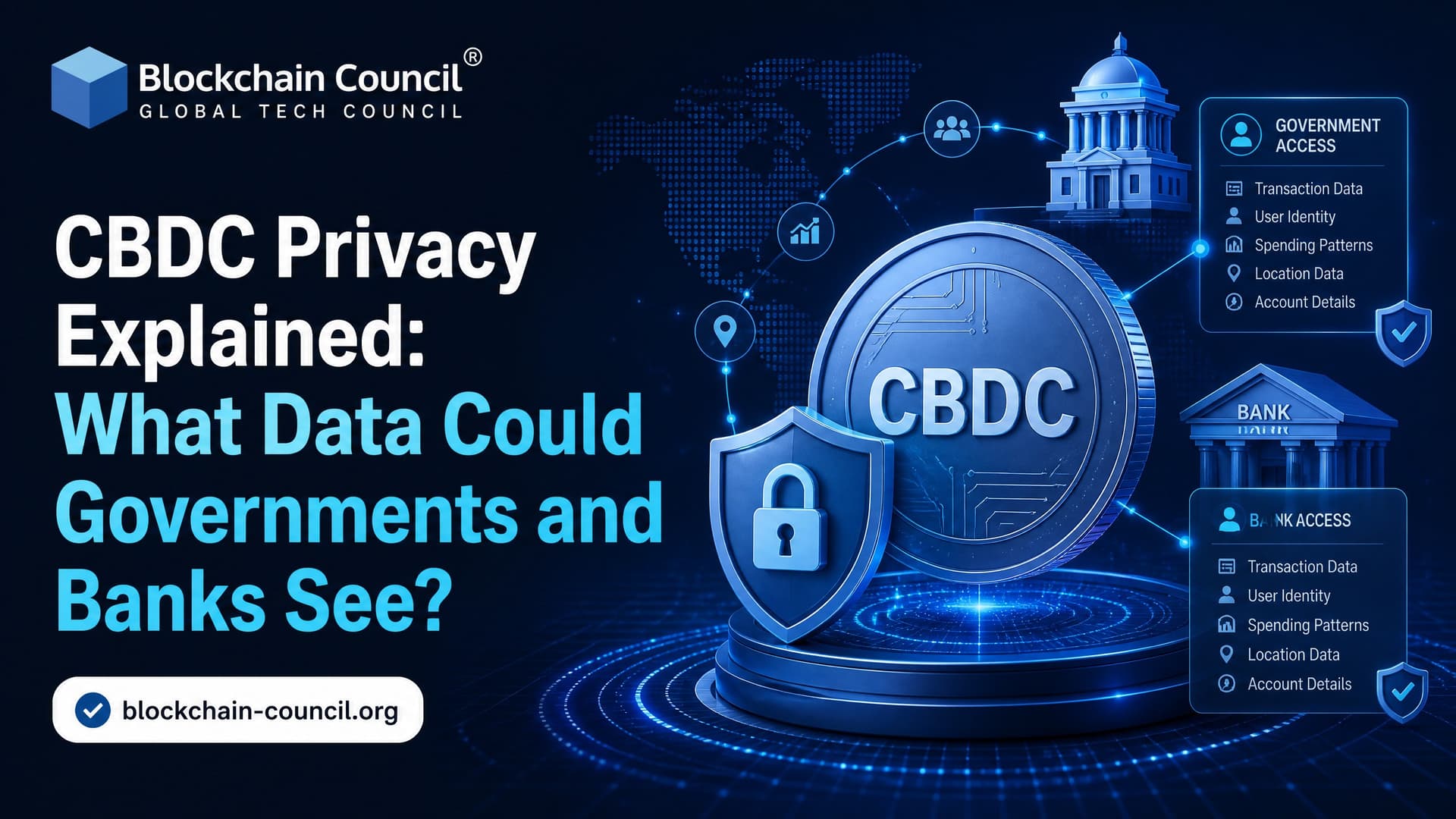
CBDC privacy is not a yes-or-no question. A central bank digital currency can be designed so the central bank sees very little personal data, or it can be built so governments and banks can inspect identity, balances, transaction history, device logs, and behavioral patterns. The difference sits in architecture, law, and operational discipline. If you want the broader design and policy context behind these trade-offs, the Certified Central Bank Digital Currency (CBDC) Expert program is a reasonable place to build that foundation.
If you work in compliance, digital assets, banking, payments, or blockchain architecture, remember this: CBDCs create machine-readable payment data by default. Cash does not. The real debate is about who can read that data, when they can read it, and whether re-identification is technically and legally controlled.

Why CBDC Architecture Decides the Privacy Outcome
A CBDC is not one fixed technology. Central banks are studying several models, and each model changes what data is visible.
Account-based CBDC
In an account-based CBDC, users hold accounts or wallets tied to identity. If the central bank directly manages those accounts, it may collect personal information such as name, address, phone number, account ID, wallet ID, balance, and linked banking details. Legal research on retail CBDCs has noted that direct account management requires collecting user information and account balances.
This model is simple to supervise. It is also the riskiest for privacy if strict limits are missing.
Token-based CBDC
A token-based CBDC can work more like digital cash. The system verifies the validity of the token rather than always checking the full identity of the payer. Some designs allow low-value offline payments with less identity exposure.
Do not assume token-based means anonymous. Tokens can still be traceable. They can carry identifiers, use controlled wallets, or require reporting when values cross a threshold.
One-tier vs two-tier models
In a one-tier model, the central bank deals directly with users. That gives it wider access to identity and transaction data.
In a two-tier model, commercial banks, wallet providers, or payment firms handle customer relationships. The central bank may run settlement infrastructure and see pseudonymous or aggregated data. The IMF and OECD have both discussed CBDC models where personal data sits mainly with regulated intermediaries, while the central bank receives limited data.
Here is the catch. If intermediaries must report detailed data to public authorities, indirect access can start to look a lot like direct access.
What Data Could Governments and Central Banks See?
Since this data question touches the same wallet, custody, and tokenization issues that come up across digital assets more broadly, it is worth pairing this reading with a Certified Digital Assets Expert credential to build that wider context.
The answer depends on the CBDC design, but the possible data set is broad.
Identity and wallet data
An account-based CBDC may expose or store:
Full name and residential address
Phone number and email address
National ID or tax identifier
Profession or employment data
Wallet ID, account ID, or payment address
CBDC balance and account status
Linked bank account information
The U.S. Federal Reserve has warned that a general-purpose CBDC would likely involve sensitive personally identifiable information and financial transaction data. That is a serious security target. One breach could do more damage than a normal card database leak, because the data may connect identity, payments, devices, and public-sector infrastructure.
Transaction-level payment data
CBDC systems can record payment data at scale. Depending on access rules, a central bank or government agency could see:
Payer and payee identifiers
Transaction amount
Date and exact time
Merchant name or merchant category
Location or point-of-sale data
Payment channel, such as mobile app, card, or offline device
Status information, including failed, reversed, or flagged transactions
This is where CBDC privacy differs sharply from cash. A cash payment for medicine, a political donation, or a bus fare leaves no central payment trail. A digital payment can.
In payment-system threat reviews, the detail that often surprises teams is not the main ledger field. It is the operational log. Even when the transaction ledger uses pseudonymous IDs, app telemetry may still capture device model, IP address, failed authentication attempts, SIM change events, and app version. Those logs are useful for fraud prevention. They are also sensitive personal data once you combine them with transaction history.
Behavioral and inferred data
Payment data is intimate. It can suggest where you worship, which clinic you visit, what political groups you support, whether you travel often, and who you financially support.
European data protection authorities have warned that concentrating payment data in a central bank database could create systemic surveillance risk. The European Data Protection Supervisor has also cautioned against designs that map every citizen to a single identifier across the payment system.
Privacy advocates, including Big Brother Watch and policy researchers at the Cato Institute, argue that CBDCs could enable financial surveillance if governments receive broad default access rather than targeted access under legal process.
Compliance and regulatory data
CBDCs will not sit outside anti-money laundering, counter-terrorist financing, sanctions, and tax rules. So some monitoring is almost certain.
Authorities may seek access to:
Large transactions
Suspicious transaction patterns
Wallets linked to sanctioned entities
Cross-border transfer records
Tax-relevant payment flows
This is not automatically improper. AML controls are part of regulated finance. The policy question is whether CBDC systems collect everything first and ask questions later, or whether they use data minimization and targeted disclosure.
Device, network, and security metadata
Information security work on CBDCs at the Bank for International Settlements stresses that privacy has to cover more than payment contents. Metadata matters too.
CBDC infrastructure may collect:
Device identifiers
IP addresses
Geolocation signals
Authentication logs
Wallet recovery events
App version and operating system data
Network and session information
To be blunt, metadata alone can be enough to identify you. A pseudonymous wallet that always logs in from the same phone, home network, and work location is not very pseudonymous.
What Could Banks and Payment Providers See?
In most two-tier CBDC proposals, banks and payment service providers stay close to the customer. On a day-to-day basis they may see more than the central bank does.
Commercial intermediaries could hold:
KYC profiles
Transaction histories
Wallet onboarding records
Fraud scores
Risk flags
Credit and affordability indicators
Customer service records
This looks familiar because banks already hold rich payment data today. CBDCs may tighten the connection between that private-sector data and public payment infrastructure.
A weak design could let banks or wallet providers use CBDC transaction data for credit scoring, advertising, cross-selling, or customer profiling. European regulators have specifically warned against repurposing payment data for unrelated uses. Purpose limitation is not a legal nicety here. It is core to the privacy model.
Can CBDCs Be Private?
Yes, but only with hard design choices. Policy promises are not enough.
Strong CBDC privacy usually needs a mix of technical and legal controls:
Data minimization: collect only what is needed for payment, security, and compliance.
Pseudonymization: separate identity data from transaction processing where possible.
Tiered wallets: allow higher privacy for low-value payments and stronger checks for high-value or cross-border transfers.
Offline payments: support limited cash-like payments without real-time central visibility.
Selective disclosure: prove compliance facts without exposing full transaction details.
Role-based access: operators, banks, regulators, and law enforcement each see only what their role requires.
Legal gateways: require court orders, statutory authority, or clear supervisory mandates for re-identification.
Bank of Canada research has discussed cryptographic options for privacy-preserving compliance. The OECD has highlighted CBDC models where private wallet providers manage personal data while central banks receive pseudonymous records. The World Economic Forum has also discussed need-to-know access models for different actors in CBDC systems. Engineers implementing pseudonymization, selective disclosure, and role-based access at this level often reinforce their fundamentals with a general Tech Certification, since the underlying systems and cryptography knowledge applies well beyond any single CBDC design.
The strongest designs do not depend on trust alone. They make unnecessary access technically difficult, auditable, and legally risky.
Digital Euro Privacy and the Direction of Policy
The digital euro debate is one of the clearest examples of CBDC privacy becoming a design requirement rather than an afterthought. European institutions have discussed offline payments, limited data collection, and purpose limitation. Data protection bodies have pushed hard against centralizing all citizen payment data in one database.
That direction matters globally. Other jurisdictions are watching how Europe balances AML requirements, central bank money, commercial bank roles, and fundamental rights. If a major CBDC launches with meaningful offline privacy and strict data separation, it raises the bar for later projects.
Practical Takeaways for Professionals and Enterprises
If you are assessing CBDC privacy risk, ask specific questions. Vague assurances such as "privacy will be protected" are not enough.
Who holds identity data? Central bank, commercial bank, wallet provider, or a government identity agency?
Who sees transaction data by default? Check whether the central bank receives full, pseudonymous, aggregated, or no retail-level records.
Can users make low-value private payments? Look for offline or tiered wallet features.
What triggers re-identification? An AML alert, court order, tax request, sanctions screening, or administrative access?
Can data be used for other purposes? Credit scoring and marketing should be explicitly restricted.
How long is data retained? Retention periods are a privacy control, not an archive setting.
Who audits access? Every privileged data query should leave a trace.
For blockchain and digital asset professionals, this is also a useful learning path. CBDCs sit at the crossroads of token design, identity, cryptography, compliance, and cybersecurity. Blockchain Council programs such as Certified Blockchain Expert™, Certified Cryptocurrency Expert™, and Certified Blockchain Developer™ are worth exploring if you want to understand how digital money systems are built and assessed.
Final View: CBDC Privacy Depends on Constraints, Not Branding
A CBDC can be privacy-preserving. It can also become the most detailed financial surveillance infrastructure a country has ever deployed. The label tells you almost nothing. The architecture tells you more. The law tells you the rest.
If you are evaluating a CBDC proposal, start with the data map: identity, transactions, metadata, access rights, retention, and re-identification rules. Then test whether the system still protects ordinary low-value payments from routine tracking. That is the practical benchmark. Start there before you accept any privacy claim. And if part of your job is explaining these privacy trade-offs to the public or to policymakers, a Marketing Certification is worth adding to the mix, since public trust in a CBDC depends as much on clear, honest communication as it does on the technical safeguards themselves.
FAQs
1. What is CBDC privacy?
CBDC privacy refers to how personal and transaction information is collected, stored, shared, and accessed when people use a Central Bank Digital Currency. Depending on the design, information could be handled by commercial banks, payment providers, the central bank, or other authorized institutions. Privacy therefore depends on technical architecture, data-protection laws, identity requirements, and governance. A CBDC being digital does not automatically mean the government can see every transaction, nor does it automatically guarantee cash-like anonymity.
2. Can governments see every CBDC transaction?
Not necessarily. Government visibility would depend on how a particular CBDC is designed and regulated. In an intermediated system, commercial banks or payment providers might manage customer identities while the central bank receives limited or pseudonymized transaction information. Authorities could potentially obtain more detailed information under legally defined circumstances. A privacy-focused architecture can deliberately prevent the central bank from maintaining a convenient, searchable diary of everyone's daily purchases.
3. Can central banks see what people buy with CBDCs?
Whether a central bank can see purchase details depends on what transaction data the system collects and which parties can access it. A CBDC transaction may include an amount, wallet identifiers, timestamp, and potentially merchant information, but this does not mean all information must be visible to the central bank. Data-minimization and separation techniques can limit visibility. Laws can further restrict access and define circumstances in which identifiable transaction information may be obtained.
4. What information could a CBDC transaction contain?
A CBDC transaction could potentially contain wallet identifiers, payment amounts, timestamps, transaction references, merchant or counterparty information, authentication records, and technical metadata. Separately, wallet providers may hold names, identification documents, contact details, and KYC information. The precise dataset depends on the CBDC architecture. Privacy-by-design aims to ensure each participant receives only the information necessary to perform its function rather than distributing the entire dataset to everyone involved.
5. Can commercial banks see CBDC transactions?
Commercial banks could potentially see certain CBDC transactions if they act as wallet providers, intermediaries, or compliance service providers. Their visibility would depend on the operating model and applicable regulations. Banks may need sufficient information to perform KYC, AML monitoring, sanctions screening, fraud prevention, and customer support. A well-designed framework can limit access to necessary information and prevent intermediaries from using CBDC transaction data for unrelated purposes without appropriate legal authority or user consent.
6. Will CBDC wallets require personal identification?
Many retail CBDC models could require identity verification, particularly for wallets with higher balances or transaction limits. However, tiered KYC could allow lower-value wallets to operate with simplified identification requirements where regulations permit. Identity verification does not necessarily require exposing someone's identity to every merchant or counterparty. A system can verify a person during onboarding while using pseudonymous credentials or identifiers during ordinary transactions.
7. Can CBDCs be anonymous like physical cash?
Providing complete cash-like anonymity is difficult because digital payment systems need to address fraud, double spending, AML requirements, and cybersecurity. However, CBDCs could potentially provide stronger privacy for low-value or offline payments. Some designs may use tiered privacy, pseudonymous identifiers, or privacy-enhancing cryptography. Policymakers therefore need to distinguish complete anonymity from financial privacy. A transaction can remain appropriately private without becoming permanently invisible under every legally authorized circumstance.
8. Can CBDC transactions be tracked?
CBDC transactions may generate digital records, meaning some level of traceability can be technically possible. Who can track those transactions is the more important question. Access could be limited to regulated intermediaries or made available to authorities only under defined legal procedures. Privacy-enhancing technologies can also reduce linkability between transactions and identities. Traceability should therefore not be confused with unrestricted surveillance, although poor governance could certainly turn one into the other.
9. Could governments use CBDCs for financial surveillance?
A poorly designed CBDC could create surveillance concerns if government agencies had broad access to centralized, identifiable transaction records. This is why privacy safeguards need to be built into both technology and law. Data minimization, separation of identity and transaction information, independent oversight, access logs, judicial authorization, and strict purpose limitations can reduce surveillance risks. Privacy should ideally depend on enforceable restrictions rather than assurances that authorities simply have no intention of looking.
10. Could banks use CBDC transaction data for advertising?
Whether banks or payment providers could use CBDC information for advertising would depend on applicable privacy laws, CBDC regulations, contractual terms, and consent requirements. Policymakers could explicitly restrict secondary commercial use of CBDC transaction data. Purpose limitation is particularly important because information collected for payments, security, or AML compliance should not automatically become marketing material. Users may reasonably object to buying something with sovereign digital money and receiving a targeted advertisement about it thirty seconds later.
11. How does KYC affect CBDC privacy?
KYC connects a wallet or financial relationship to a verified individual or organization. However, identity information does not necessarily need to accompany every transaction. CBDC architectures can separate KYC records from transaction processing and reveal identity only when legally required. Tiered KYC can also apply different verification requirements according to wallet functionality, transaction limits, or risk. This can help balance privacy, financial inclusion, and financial-crime compliance.
12. Can law enforcement access CBDC transaction records?
Law-enforcement access would depend on national law and the CBDC's governance framework. Authorities may be able to obtain relevant transaction information through warrants, court orders, statutory powers, or other legally authorized processes, depending on jurisdiction. CBDC legislation should clearly establish access standards, oversight, recordkeeping, and safeguards against misuse. The mere technical ability to retrieve information should not automatically establish unlimited legal authority to do so.
13. How can privacy-by-design protect CBDC users?
Privacy-by-design incorporates privacy protections into the CBDC architecture from the beginning. Techniques can include data minimization, separation of identity and payment information, encryption, pseudonymous identifiers, restricted data retention, and role-based access controls. Privacy impact assessments can identify risks before deployment. Building these protections early is generally more effective than constructing a gigantic centralized transaction database and later developing the sudden realization that perhaps access controls would have been useful.
14. Can zero-knowledge proofs improve CBDC privacy?
Zero-knowledge proofs could potentially allow users or intermediaries to prove that certain conditions are satisfied without revealing all underlying information. For example, a system might verify that a user meets a regulatory requirement without disclosing unrelated personal details. Such technologies can support selective disclosure and data minimization. Their practical use depends on performance, scalability, security, regulatory acceptance, and how they integrate with the broader CBDC infrastructure.
15. Are offline CBDC payments more private?
Offline payments could potentially provide stronger privacy because transactions may occur directly between devices without immediately contacting central infrastructure. However, the privacy level depends on what information devices store and what is transmitted when they reconnect. Offline CBDCs also need controls against double spending, fraud, and device manipulation. Transaction and holding limits may therefore apply. Offline functionality can provide more cash-like characteristics without necessarily reproducing complete cash anonymity.
16. How long could banks or governments store CBDC transaction data?
Retention periods would depend on national data-protection, financial-recordkeeping, AML, tax, and CBDC-specific laws. Some information may need to be retained for regulatory purposes, while other data could potentially be deleted or anonymized sooner. A privacy-oriented framework should define clear retention schedules rather than keeping information indefinitely because storage happens to be cheap. The longer sensitive financial data exists, the longer it remains available for breaches, misuse, or unauthorized access.
17. What happens if a CBDC transaction database is hacked?
A breach could expose sensitive financial or identity information if the system stores identifiable transaction data centrally. CBDC architectures should therefore minimize unnecessary data concentration and use encryption, segmentation, strong authentication, access controls, monitoring, and incident-response procedures. Separating identity records from payment information can also reduce the value of compromised datasets. Cybersecurity and privacy are closely connected because data that is never unnecessarily collected cannot later be stolen from a database.
18. How does CBDC privacy compare with cryptocurrency privacy?
CBDCs and cryptocurrencies have very different privacy models. Public blockchains can expose transaction histories while users operate through pseudonymous addresses. CBDCs may keep transaction records private from the public but make certain information available to regulated intermediaries under defined rules. Privacy-focused cryptocurrencies may conceal substantially more transaction information. The meaningful comparison therefore concerns who can access the data and under what conditions rather than simply asking which system is “more private.”
19. How can CBDCs balance privacy with AML compliance?
CBDCs can use risk-based controls, tiered KYC, selective disclosure, pseudonymous credentials, and privacy-enhancing technologies to reduce unnecessary data exposure while supporting legitimate financial-crime controls. Lower-value transactions could potentially receive greater privacy, while higher-risk activities undergo stronger verification or monitoring. The goal is proportionality. Effective AML does not inherently require every institution in a payment chain to receive complete information about every ordinary transaction.
20. What should users know about CBDC privacy before adoption?
Users should understand what information a CBDC collects, who stores it, who can access it, how long it is retained, and under what circumstances it can be disclosed. They should also examine wallet-provider privacy rules, recovery procedures, identity requirements, and protections against unauthorized access. Ultimately, CBDC privacy will depend less on the phrase “digital currency” and more on specific technical and legal choices. The crucial questions are who can see what, why they can see it, and what prevents that access from being abused.
Related Articles
View All
Digital Assets
CBDC Consultant Career Guide: Advising Banks and Governments
Learn how to become a CBDC consultant, including required skills, client work, CBDC market trends, career paths, and certification options.

Digital Assets
CBDC Governance Explained: Standards, Oversight, and Stakeholder Roles
CBDC governance defines how digital central bank money is issued, supervised, secured, and operated across central banks, banks, PSPs, regulators, and users.

Digital Assets
CBDC for Remittances: How Digital Currency Could Lower Cross-Border Costs
CBDC for remittances could cut cross-border costs by reducing intermediaries, FX spreads, settlement delays, and cash handling, if systems interoperate.
Trending Articles
How Blockchain Secures AI Data
Understand how blockchain technology is being applied to protect the integrity and security of AI training data.
What is AWS? A Beginner's Guide to Cloud Computing
Everything you need to know about Amazon Web Services, cloud computing fundamentals, and career opportunities.

Can DeFi 2.0 Bridge the Gap Between Traditional and Decentralized Finance?
The next generation of DeFi protocols aims to connect traditional banking with decentralized finance ecosystems.