

CBDC Benefits and Disadvantages: A Balanced Guide for Decision-Makers
 Suyash Raizada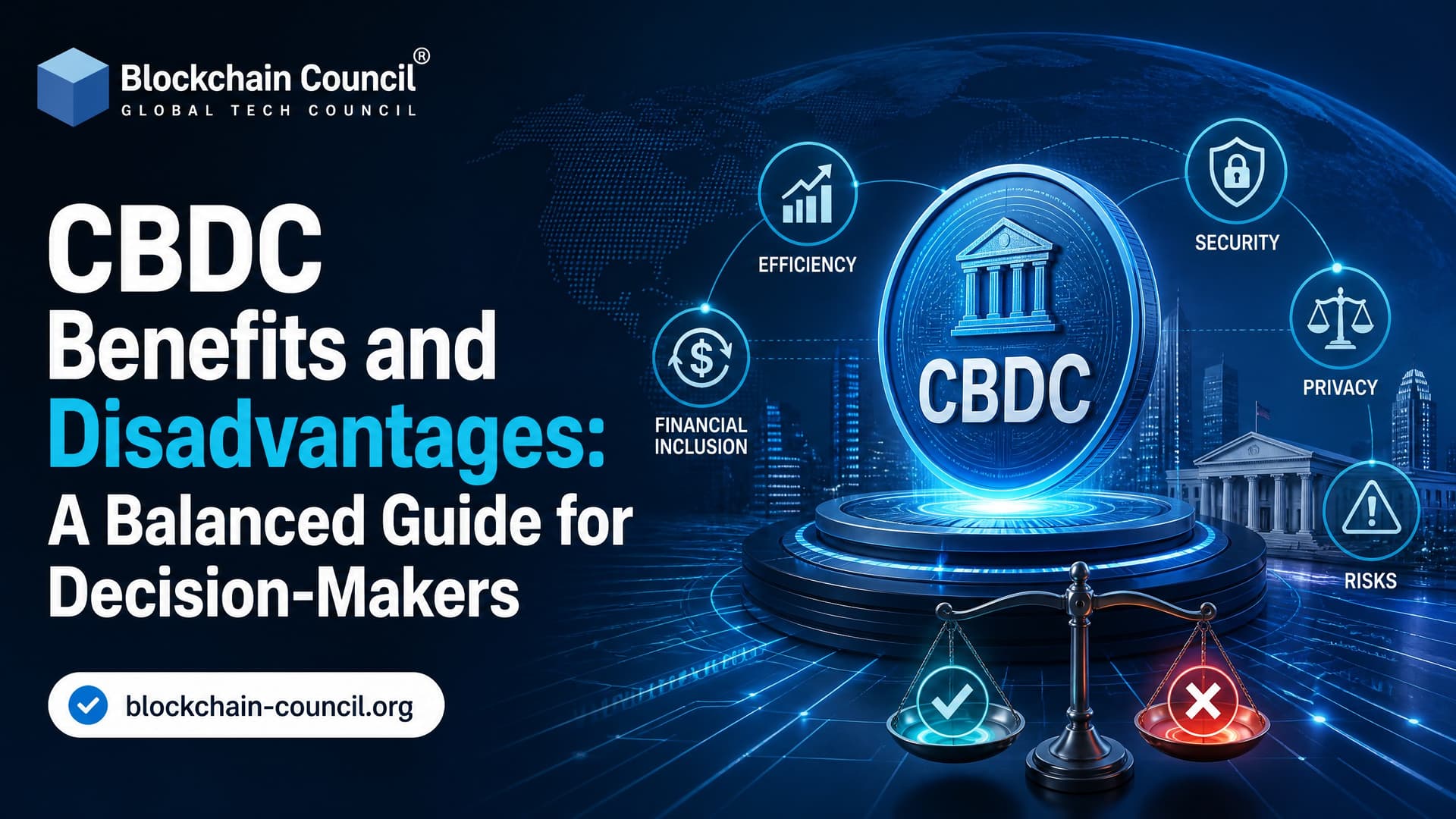
CBDC benefits and disadvantages should be assessed as an infrastructure decision, not a technology experiment. A central bank digital currency can improve payment speed, financial inclusion, and monetary sovereignty. It can also create new risks around privacy, bank funding, cybersecurity, and state control over payments. Anyone weighing that trade-off in a structured way often starts with a Certified Central Bank Digital Currency (CBDC) Expert credential, which frames the benefits and risks covered in this piece within a formal design and policy context.
The real question for policy leaders, financial institutions, and enterprise teams is not whether CBDCs are good or bad in the abstract. The better question is this: which design solves a real public problem without creating a larger one?

What Is a CBDC?
A central bank digital currency is digital money issued as a direct liability of a central bank. That makes it different from a bank deposit, which is a liability of a commercial bank, and different from a stablecoin, which is issued by a private entity.
Most CBDC discussions separate two models:
Retail CBDC: Used by households and businesses for everyday payments.
Wholesale CBDC: Used by banks and financial institutions for settlement, securities transactions, and high value payments.
This split matters more than it looks. Retail CBDCs touch consumers, merchants, privacy rules, and bank deposits. Wholesale CBDCs are narrower and often easier to justify, because they target settlement inefficiencies in financial markets rather than replacing household deposits. Professionals evaluating where a CBDC fits among stablecoins, tokenized deposits, and other forms of digital money often complement this with a Certified Digital Assets Expert credential, since the retail-versus-wholesale question rarely gets decided in isolation from the rest of the digital asset landscape.
Current State of CBDCs in 2025
CBDCs have moved well beyond white papers. According to the Atlantic Council CBDC Tracker and central bank updates, a handful of countries had fully launched CBDCs by early 2025, while dozens more were in pilot or advanced testing stages. The Bank for International Settlements has coordinated multi-jurisdiction wholesale CBDC experiments, with cumulative transaction volumes across pilot initiatives running into the tens of billions of dollars.
Major institutions remain cautious. The US Federal Reserve has stated that any US CBDC would require clear legal authority and broad public support. The European Central Bank is studying the digital euro with close attention to privacy, intermediated distribution, and holding limits. The World Bank and IMF have published technical guidance for countries evaluating CBDCs, especially in emerging markets.
That caution is justified. Payment systems are boring until they break.
CBDC Benefits for Governments, Banks, and Enterprises
1. Faster and cheaper payments
One of the clearest CBDC benefits is payment efficiency. Domestic retail CBDCs can cut dependence on layered card networks and legacy clearing systems. Wholesale CBDCs can shrink settlement time from T+2 cycles to near real time in some securities and interbank use cases.
Cross border pilots are the more interesting story. BIS-linked experiments have shown that shared CBDC platforms can reduce settlement friction, improve transparency, and lower transaction costs when central banks agree on common rules. Some studies estimate meaningful cross border cost reductions in realistic scenarios, with the highest savings only in ideal conditions.
A practical warning: instant settlement is not automatically cheaper. In real payment operations, netting saves liquidity. If you remove netting without adding liquidity-saving mechanisms, banks may need to hold more intraday liquidity. Anyone who has mapped ISO 20022 pacs.008 and pacs.009 flows into a settlement engine knows the problem is not just the token. Queue management, cut-off times, reversals, and reconciliation still matter.
2. Financial inclusion
CBDCs can support inclusion when they are paired with simple wallets, low fees, and accessible identity options. In countries where mobile phone access is wider than bank branch coverage, a well designed retail CBDC can give people a safer way to receive wages, remittances, subsidies, or disaster payments.
The World Economic Forum has stressed that inclusion depends on digital identity, mobile access, and user trust. A CBDC that demands an expensive smartphone, constant internet, or complex onboarding will not reach the most excluded users. It will just add another app for people who already have banks.
India's e-rupee pilots and Caribbean CBDC deployments show why governments care. CBDC wallets can support faster public transfers, including subsidies and emergency relief, without requiring physical bank branches to be fully operational.
3. Monetary sovereignty
Central banks worry about the declining use of cash and the rise of private payment platforms, foreign stablecoins, and closed digital ecosystems. A CBDC can preserve access to public money in digital form.
The BIS describes central bank money as important because it provides settlement finality, liquidity, and public trust. For emerging markets, a domestic CBDC may also reduce reliance on foreign digital currencies, but only if it is useful, stable, and widely accepted.
That last condition is the one people skip. Nobody uses a CBDC because a policy document says they should. Merchants must accept it. Wallets must work. Disputes must be handled. Fees must make sense.
4. Better fiscal delivery
CBDCs can help governments send payments quickly and with clearer audit trails. Social benefits, tax refunds, emergency support, and targeted subsidies can reach recipients through CBDC wallets.
Programmability comes up a lot here. A payment could be released only to eligible users, used within a set time window, or restricted to certain categories. That can reduce leakage in public programs.
But this is where the debate gets uncomfortable. Conditional money can help during a crisis. It can also become a tool for excessive control. Decision makers need legal limits before launching programmable features, not after.
5. Auditability and anti-fraud controls
CBDCs can improve auditability and reduce fragmentation in compliance reporting. Well designed systems can help detect fraud, money laundering, corruption in subsidy programs, and suspicious payment patterns.
For enterprises in regulated sectors, CBDC rails could simplify certain settlement and reporting workflows. Professionals studying tokenization, smart contracts, or regulated digital assets may want to connect this topic with Blockchain Council programs such as the Certified Blockchain Expert™, Certified Blockchain Developer™, and Certified Smart Contract Developer™.
CBDC Disadvantages and Risks
1. Bank disintermediation
The biggest financial stability risk is deposit migration. If people can hold unlimited central bank money in a wallet, they may pull funds out of commercial banks, especially during stress. That weakens bank funding and reduces the ability of banks to lend.
This is why many central banks prefer intermediated CBDC models. Banks and payment service providers manage customer relationships, while the central bank runs the core settlement layer. Holding limits and tiered remuneration are common design tools too.
There is a trade-off. Strict limits reduce run risk, but they also make the CBDC less useful for businesses and higher income households. A CBDC with a tiny balance cap may work for small payments but not for payroll, trade, or emergency disbursement at scale.
2. Privacy and surveillance concerns
Privacy is not a side feature. It is central to CBDC legitimacy.
A CBDC can be designed with full identity, tiered identity, pseudonymous low value payments, or privacy-preserving controls. Each option affects anti-money-laundering obligations, user trust, and law enforcement access.
The World Economic Forum and BIS have both flagged privacy as a major governance issue. The risk is not only technical hacking. It is also lawful but excessive access to citizens' transaction data. If people believe every purchase is visible to the state, adoption will suffer.
A reasonable approach is tiered privacy: stronger privacy for low value transactions, stricter checks for larger or suspicious transfers, clear audit trails for government access, and independent oversight.
3. Cybersecurity and operational resilience
A CBDC is critical national infrastructure. A major outage or breach would damage confidence in public money itself.
Risks include software bugs, wallet compromise, insider threats, denial of service attacks, cryptographic failures, and telecom outages. Offline CBDC functionality sounds simple until you test double-spend controls, device key storage, and delayed synchronization. In offline payment pilots, reconciliation logic is usually where the hard problems appear.
Central banks need incident response plans, independent security audits, hardware security modules, disaster recovery, and fallback payment options. If the CBDC becomes the backup for private payment networks, it also needs its own backup.
4. Technical complexity and cost
CBDCs must integrate with banks, payment processors, mobile wallets, merchant systems, legal frameworks, data protection rules, and cross border standards. That is expensive.
Projected savings depend on adoption. If merchants do not accept the CBDC, users do not keep balances, and banks build parallel systems only for compliance, the project turns into costly infrastructure with little real usage.
Interoperability is also hard. Domestic CBDCs need to work with existing real time payment systems. Cross border CBDCs need shared messaging, foreign exchange arrangements, compliance rules, and settlement finality across legal systems. Engineers building this layer of the stack often reach for a general Tech Certification to strengthen the conventional software, integration, and infrastructure skills that sit alongside the blockchain-specific work.
5. Governance and concentration of power
CBDCs can expand the role of public authorities in payment flows. That may help resilience and policy delivery, but it raises hard questions about control.
Who can freeze funds? Who can see transaction data? Can a programmable CBDC restrict spending? Can emergency powers override normal privacy protections?
These are legal and constitutional questions as much as technical ones. A credible CBDC framework should define data access, liability, user rights, programmability limits, and independent review.
6. International monetary spillovers
CBDCs could reshape cross border payments and currency competition. A widely accessible foreign CBDC may become attractive in countries with weak currencies or unstable banking systems. That can increase currency substitution and complicate domestic monetary policy.
This is why the BIS, IMF, World Bank, and regional central bank groups keep pushing coordination. Without shared standards, CBDCs could fragment global payments instead of improving them.
Retail CBDC vs Wholesale CBDC: Which Is More Practical?
For most advanced economies, wholesale CBDC has the clearer near-term business case. It targets settlement risk, securities markets, interbank payments, and cross border corridors without directly replacing household bank deposits.
Retail CBDC is more politically sensitive. It can help inclusion and public payment access, but it touches privacy, commercial banking, consumer protection, and social trust. If a country already has low cost instant payments, high banking access, and strong competition, a retail CBDC may not be worth the disruption.
For emerging markets, the case is often stronger when the goals are specific: cut cash handling costs, improve subsidy delivery, support disaster payments, or widen access to digital money.
A CBDC Decision Checklist
Before committing to a CBDC, decision makers should answer six questions:
What problem are you solving? Be specific: inclusion, settlement, resilience, cross border payments, or monetary sovereignty.
Why can existing systems not solve it? Compare a CBDC against instant payment rails, open banking, digital identity upgrades, and stablecoin regulation.
What model reduces risk? Consider intermediated distribution, holding limits, tiered remuneration, and privacy tiers.
How will privacy be protected? Define data minimization, legal access rules, audit mechanisms, and user rights.
Can the system survive failure? Test outages, cyber incidents, offline use, dispute handling, and recovery.
Who must be involved? Include banks, fintechs, merchants, civil society, cybersecurity teams, and legal experts early.
What Professionals Should Learn Next
CBDCs sit at the intersection of digital assets, payment systems, regulation, cybersecurity, and smart contract design. If you work in banking, public policy, fintech, or enterprise blockchain, build a working understanding of tokenized money, settlement finality, wallet architecture, and governance controls.
A practical next step is to study CBDCs alongside stablecoins, tokenized deposits, and blockchain based settlement. Blockchain Council's Certified Blockchain Expert™, Certified Blockchain Developer™, Certified Cryptocurrency Expert™, and Certified Blockchain Architect™ can serve as useful learning paths for professionals who need to evaluate digital asset infrastructure with both technical and policy awareness.
Do not start from the assumption that a CBDC is inevitable. Start with the payment problem, the legal constraints, the privacy expectation, and the operational risk. If the CBDC still makes sense after that analysis, it is worth piloting carefully. And since even a well designed CBDC still needs merchants, banks, and the public to actually adopt it, teams working on rollout communication and stakeholder buy-in often turn to a Marketing Certification to help build the trust and understanding that no amount of technical design can create on its own.
FAQs
1. What are the main benefits and disadvantages of CBDCs?
Central Bank Digital Currencies (CBDCs) could provide faster payments, lower transaction costs, improved financial inclusion, greater payment-system resilience, and more efficient government or cross-border transactions. However, they can also introduce privacy concerns, cybersecurity risks, implementation costs, operational complexity, and potential disruption to commercial banks. The balance depends heavily on each CBDC's architecture and policy objectives. Decision-makers should therefore compare specific CBDC designs rather than treating “CBDC” as one standardized product.
2. What are the biggest benefits of a CBDC?
Potential CBDC benefits include access to digital central bank money, faster settlement, improved payment efficiency, greater competition in payments, and stronger financial inclusion. CBDCs could also support government disbursements, offline transactions, cross-border payments, and settlement of tokenized financial assets. For institutions, wholesale CBDCs may reduce certain settlement risks and reconciliation requirements. Whether these benefits materialize depends on adoption, interoperability, regulation, technology, and how effectively the CBDC addresses weaknesses in existing payment infrastructure.
3. What are the main disadvantages of CBDCs?
Major CBDC disadvantages include privacy concerns, cybersecurity threats, digital exclusion, implementation costs, operational risks, and possible disruption to bank funding. Poorly designed CBDCs could also create excessive dependence on centralized digital infrastructure or introduce complicated identity requirements. Cross-border use adds further legal and regulatory challenges. A CBDC can solve some existing payment problems while creating entirely new ones, because apparently financial infrastructure prefers conservation of complexity over its actual elimination.
4. How can CBDCs improve payment efficiency?
CBDCs could provide digital settlement using central bank money and potentially reduce processing layers between participants. Domestic transactions may settle quickly, while interoperable CBDCs could improve certain cross-border payments. Faster settlement can reduce reconciliation work and provide recipients with earlier access to funds. However, CBDCs must compete with increasingly efficient instant-payment systems. Where existing payment infrastructure already provides low-cost, real-time transactions, the incremental efficiency benefits of a retail CBDC may be smaller.
5. Can CBDCs reduce transaction and payment costs?
CBDCs could reduce some costs by simplifying payment chains, automating reconciliation, and increasing competition among payment providers. Cross-border transactions may offer significant opportunities because they can involve correspondent banks, foreign-exchange charges, and multiple intermediaries. However, CBDCs also create development, integration, cybersecurity, compliance, maintenance, and support costs. Decision-makers should therefore assess total system costs rather than assuming digital infrastructure is automatically inexpensive merely because nobody has to print it.
6. How can CBDCs improve financial inclusion?
CBDCs could provide low-cost digital payment access to people underserved by conventional banking. Features such as simplified wallets, low fees, offline payments, and support for basic devices may help expand access. Government transfers could also introduce underserved populations to digital financial services. However, CBDCs could worsen exclusion if they require smartphones, reliable connectivity, extensive documentation, or high digital literacy. Financial inclusion therefore depends on deliberate product and policy design rather than digitization alone.
7. What are the privacy disadvantages of CBDCs?
Digital transactions can generate detailed information about users' financial activities, creating concerns about surveillance, profiling, unauthorized data access, and misuse. CBDC privacy depends on decisions about what information is collected, where it is stored, and who can access it. Data minimization, privacy-enhancing technologies, institutional separation, and strong legal protections can reduce risks. Decision-makers must balance privacy with legitimate requirements for fraud prevention, AML compliance, and law enforcement.
8. Can CBDCs offer the same privacy as physical cash?
Replicating cash-level anonymity in a digital system can be difficult because digital transactions often create records and CBDCs generally need to comply with financial-crime regulations. Some designs may provide stronger privacy for low-value transactions through tiered identification or privacy-enhancing technologies. Offline payments may also provide cash-like characteristics. However, complete anonymity may conflict with AML and other legal obligations. Policymakers therefore need to define clearly what “privacy” means within a particular CBDC architecture.
9. What cybersecurity risks do CBDCs create?
CBDCs could become attractive targets for cybercriminals and state-sponsored attackers because they form part of critical national financial infrastructure. Threats include wallet compromise, phishing, malware, credential theft, denial-of-service attacks, insider threats, API vulnerabilities, and attacks against intermediaries. Strong encryption, authentication, key management, monitoring, incident response, redundancy, and recovery systems are essential. Security must cover the entire ecosystem because protecting the central ledger while leaving wallets vulnerable would be an impressively incomplete achievement.
10. How could CBDCs affect commercial banks?
Retail CBDCs could affect banks if consumers transfer substantial deposits into central bank digital money. Reduced deposits could increase bank funding costs or influence credit provision. During periods of financial stress, rapid digital transfers into CBDCs could potentially accelerate deposit outflows. Central banks can address these risks through holding limits, tiered remuneration, intermediary-based models, or other design mechanisms. CBDCs may also create opportunities for banks to provide wallets, payment services, custody, and digital-asset infrastructure.
11. Could CBDCs increase the risk of digital bank runs?
Potentially. If consumers can quickly move bank deposits into a highly trusted CBDC during periods of uncertainty, deposit outflows could occur more rapidly than through traditional channels. This risk depends on CBDC design, transaction limits, remuneration, and financial conditions. Central banks may impose holding limits or other safeguards to reduce large-scale movements. Policymakers must balance easy access to central bank money against the possibility that convenience becomes particularly problematic precisely when confidence in banks declines.
12. What are the benefits of CBDCs for businesses?
Businesses could benefit from faster settlement, improved cash-flow visibility, lower reconciliation costs, automated payments, and potentially more efficient cross-border transactions. CBDCs might integrate with invoices, procurement systems, supply chains, and tokenized assets. Wholesale CBDCs could also improve institutional settlement. The business case will depend on integration costs and whether CBDCs outperform existing banking and payment solutions. Companies are unlikely to redesign treasury infrastructure merely for the privilege of participating in monetary innovation.
13. What are the benefits of CBDCs for governments?
Governments could use CBDCs for welfare payments, pensions, emergency assistance, tax refunds, procurement, and other public-sector transactions. Faster digital distribution may reduce administrative delays and improve reconciliation. CBDCs could also support financial inclusion and payment-system resilience. However, government use raises significant privacy and accessibility concerns. Strong legal safeguards, transparent governance, cybersecurity, and alternative access methods are important to ensure efficiency gains do not come at the expense of citizen rights.
14. What are the benefits and risks of CBDCs for cross-border payments?
CBDCs could reduce settlement times, intermediary costs, and payment uncertainty in cross-border transactions, particularly through interoperable or multi-CBDC platforms. They may also support payment-versus-payment in foreign exchange. Challenges include legal differences, sanctions, AML requirements, foreign-exchange liquidity, data governance, and monetary sovereignty. Cross-border CBDCs therefore require institutional cooperation in addition to technical integration. International finance remains annoyingly unwilling to become simple merely because the ledger has become digital.
15. Can CBDCs improve monetary policy?
CBDCs could potentially provide central banks with additional payment-system data and, depending on design, new mechanisms affecting monetary transmission. An interest-bearing CBDC could theoretically influence monetary conditions more directly, although such designs involve significant financial-stability and policy considerations. CBDCs should not be assumed to improve monetary policy automatically. Any use of transaction data or programmable features would also raise privacy, governance, legal, and public-trust questions requiring careful evaluation.
16. What are the disadvantages of programmable CBDCs?
Programmable payment infrastructure can automate transactions when specified conditions are met, potentially improving efficiency. However, restrictions embedded directly into money could raise concerns about personal autonomy, privacy, discrimination, system errors, and excessive control over spending. Decision-makers should distinguish programmable payments from programmable money. Smart contracts and payment applications can often provide automation without changing the fundamental characteristics of the currency itself, potentially reducing some governance and civil-liberty concerns.
17. What are the costs of implementing a CBDC?
CBDC implementation can involve substantial costs for research, technology development, cybersecurity, digital identity, wallet infrastructure, integration, testing, compliance, consumer support, and public education. Ongoing expenses include system maintenance, security monitoring, upgrades, fraud management, and operational resilience. Banks and merchants may also face integration costs. Decision-makers should compare these expenses with measurable improvements in payment efficiency, inclusion, resilience, or settlement rather than treating technological modernization as an economic benefit by definition.
18. What are the advantages and disadvantages of CBDCs compared with stablecoins?
CBDCs provide a direct claim on the central bank and therefore differ fundamentally from privately issued stablecoins, which depend on issuer governance, reserves, and redemption arrangements. Stablecoins may offer faster private-sector innovation and integration with digital-asset markets. CBDCs may provide stronger public-money characteristics but can involve slower policy and implementation processes. A future financial system could include both, provided stablecoins operate within appropriate regulatory frameworks and interoperability standards.
19. How should decision-makers evaluate whether a CBDC is worthwhile?
Decision-makers should begin with clearly defined problems rather than with a predetermined technological solution. Evaluation criteria can include payment costs, settlement speed, financial inclusion, resilience, privacy, cybersecurity, financial stability, interoperability, adoption potential, and implementation expense. CBDCs should also be compared with alternatives such as instant-payment systems, regulatory reforms, tokenized deposits, and upgrades to existing infrastructure. A pilot that demonstrates limited benefits can be valuable evidence that another solution is preferable.
20. Do the benefits of CBDCs outweigh the disadvantages?
There is no universal answer. CBDCs may provide substantial value where existing payment systems are expensive, inaccessible, slow, or insufficiently resilient. Wholesale CBDCs may also offer advantages for tokenized markets and institutional settlement. In countries with highly efficient digital payments, the benefits of a retail CBDC may be less obvious. The appropriate decision depends on measurable public value, costs, risks, and available alternatives. The sensible question is therefore not whether CBDCs are inherently good or bad, but whether a particular CBDC design solves important problems better than the alternatives.
Related Articles
View All
Digital Assets
CBDC Consultant Career Guide: Advising Banks and Governments
Learn how to become a CBDC consultant, including required skills, client work, CBDC market trends, career paths, and certification options.

Digital Assets
CBDC Compliance Professional Guide: KYC, AML, Privacy, and Regulation
A practical CBDC compliance guide covering KYC tiers, AML/CFT monitoring, privacy controls, FATF guidance, offline CBDCs, and regulatory trends.

Digital Assets
Is CBDC Certification Worth It? Benefits for Finance and Blockchain Careers
CBDC certification can strengthen finance, fintech, policy, and blockchain careers by proving practical knowledge of central bank digital currency design.
Trending Articles
The Role of Blockchain in Ethical AI Development
How blockchain technology is being used to promote transparency and accountability in artificial intelligence systems.
What is AWS? A Beginner's Guide to Cloud Computing
Everything you need to know about Amazon Web Services, cloud computing fundamentals, and career opportunities.
Claude AI Tools for Productivity
Discover Claude AI tools for productivity to streamline tasks, manage workflows, and improve efficiency.