

DeFi Lending and Borrowing: Overcollateralization, Liquidations, and Interest Rate Models

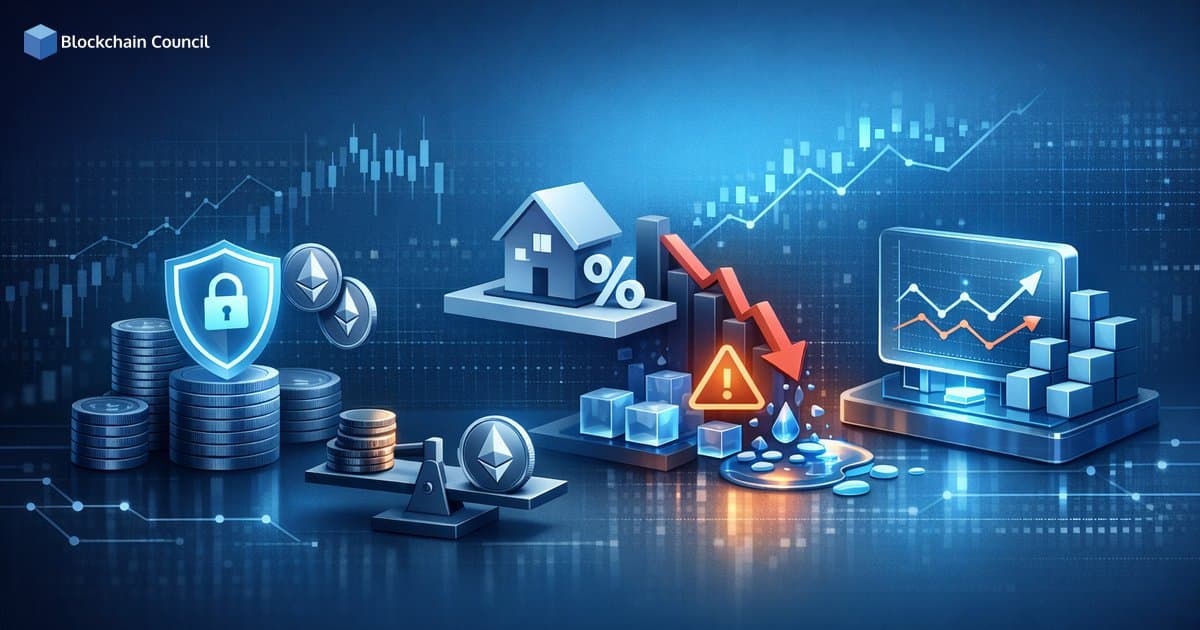
DeFi lending and borrowing has grown from a niche use case into one of the most important market structures in decentralized finance. Modern lending protocols combine three mechanisms to keep pools solvent without traditional underwriting: overcollateralization, automated liquidations, and utilization-based interest rate models. Understanding how these pieces interact is essential for developers designing money markets, risk teams evaluating exposure, and users managing leverage safely.
The largest protocols follow a pool-based architecture where liquidity providers deposit assets into shared pools, borrowers post collateral to draw loans, and smart contracts enforce rules around loan-to-value (LTV), liquidation thresholds, and dynamic interest rates. Research and industry analyses consistently show that activity and earnings concentrate in a small set of assets such as USDC, USDT, ETH, and wrapped or staked derivatives, even when protocols list many more tokens. This concentration shapes liquidity depth, liquidation dynamics, and governance priorities.

Current State of DeFi Lending and Borrowing Markets
Lending protocols remain among the top categories by total value locked across major chains and Layer 2 networks. Beyond established names like Aave, Compound, and MakerDAO, newer money markets and liquid staking token (LST) driven lending have expanded capital efficiency and composability across ecosystems.
Most large protocols share a similar core design:
Suppliers deposit assets and receive interest-bearing tokens representing their claim on the pool.
Borrowers lock collateral and borrow from the same pool.
Smart contracts enforce overcollateralization, calculate interest via utilization-based curves, and trigger liquidations when risk limits are breached.
This model replaces identity and credit scoring with enforceable on-chain collateral and automated risk controls. The tradeoff is clear: strong solvency mechanisms, but limited access for users without substantial crypto collateral.
Overcollateralization: What It Is and Why It Exists
Overcollateralization means a borrower deposits collateral worth more than the value of the loan. DeFi protocols generally cannot rely on legal enforcement, wage garnishment, or identity-based collections. If a borrower can walk away, the protocol can only seize what is already escrowed in the smart contract. Overcollateralization is therefore the primary lender protection mechanism.
Common Ranges and a Simple Example
Protocol documentation typically describes collateralization requirements in the 150% to 300% range, depending on asset volatility and liquidity. A simple scenario illustrates the logic:
A user deposits ETH worth 1,000 USD.
They borrow 650 USD of a stablecoin.
The extra buffer absorbs ETH price drops before the position becomes liquidatable.
Key Parameters
DeFi lending and borrowing risk is largely expressed through a small set of parameters:
Collateralization ratio: collateral value divided by borrowed value.
Loan-to-value (LTV): borrowed value divided by collateral value.
Collateral factor (max LTV): maximum LTV allowed at origination (for example, 0.70).
Liquidation threshold: the LTV at which liquidation becomes possible, often set higher than max LTV.
Liquidation bonus: discount given to liquidators, effectively paid from the borrower's equity.
Example configuration:
Collateral factor: 75%
Liquidation threshold: 80%
Liquidation bonus: 5% to 10%
The borrower can open a loan up to 75% LTV. If collateral value falls and LTV rises above 80%, liquidators can repay debt and seize collateral at a discount, pushing the position back toward safety.
Static vs. Adaptive Collateral Design
Historically, major protocols have calibrated collateral factors and liquidation thresholds using historical volatility, asset liquidity, and governance risk tolerance. Research on adaptive DeFi borrow-lending architectures argues that fixed, offline parameter choices become inefficient when volatility regimes change. A proposed approach separates decision-making into two layers:
Low-frequency planning to periodically recalibrate overcollateralization and liquidation parameters based on observed market behavior.
High-frequency control to adjust interest rates more rapidly as utilization and external conditions shift.
This direction reflects a broader industry trend toward data-driven parameter management rather than static, one-size-fits-all risk limits.
Recursive Leverage: A Hidden Amplifier
One advanced behavior observed in large money markets is recursive leverage. Users loop deposits and borrows - depositing staked ETH, borrowing stablecoins, swapping into more correlated collateral, and repeating the cycle. While each step may satisfy overcollateralization rules individually, the overall chain can become fragile. Even small adverse price moves can trigger cascading liquidations across the loop, increasing systemic stress during market downturns.
Liquidations: Mechanics, Incentives, and Costs
Liquidations are the enforcement layer of DeFi lending and borrowing. They protect pool solvency by forcibly reducing risky positions once LTV exceeds the liquidation threshold.
How Liquidation Flows Typically Work
Price updates arrive through on-chain oracles.
Eligibility is triggered when LTV crosses the liquidation threshold.
Liquidators repay part or all of the borrower's debt.
Collateral seizure occurs at a discount equal to the liquidation bonus.
Position health improves because debt is reduced, though the borrower loses collateral in the process.
Newer designs aim to reduce reliance on external liquidators. Some mechanisms allow the protocol to temporarily absorb risk and then dispose of collateral more gradually, reducing race conditions, improving price discovery, and smoothing market impact.
Liquidator Incentives and Failure Modes
Liquidations require economically motivated actors. The liquidation bonus must cover:
Gas and execution costs
Oracle latency risk and price movement between trigger and execution
Market liquidity risk when selling seized collateral
If incentives are too low, or collateral is illiquid, liquidations can lag during fast crashes. In extreme moves, collateral value can fall below outstanding debt before liquidators act, creating bad debt. Protocols therefore balance user experience against the need for robust liquidation profitability across different position sizes and market conditions.
What Empirical Research Shows About Liquidation Events
Empirical research across major protocols shows that liquidations cluster in waves during market stress, typically around sharp price declines and oracle updates. Central bank analyses of major lending deployments have reported that borrower losses during peak liquidation events can reach 10% to 30% of liquidated value when accounting for liquidation penalties and the opportunity cost of being forced out before a price rebound.
Two conclusions stand out:
Protocols often remain solvent because liquidations and overcollateralization perform their intended function.
Borrowers bear tail risk, particularly those running high leverage or recursive strategies.
Interest Rate Models: Utilization as the Control Variable
Interest rate models coordinate liquidity supply and borrowing demand. Most DeFi lending and borrowing protocols use utilization-based curves tied to the pool utilization ratio:
U = total borrowed / total supplied
Why Utilization-Based Rates Work
When utilization is low, borrow rates tend to be low to encourage demand.
As utilization rises, borrow rates increase to slow demand and attract more supply.
Near 100% utilization, rates can spike sharply to prevent liquidity exhaustion and preserve withdrawal capacity for suppliers.
One important nuance for lenders: in many designs, suppliers effectively earn yield only on the utilized portion of liquidity. Idle liquidity generates no interest, so realized supply APY depends on both the interest curve and actual utilization levels.
Typical Interest Rate Curve Parameters
Many protocols implement piecewise rate models with the following components:
Base rate: the minimum borrow rate at very low utilization.
Slope below kink: a gradual increase until a target utilization level is reached.
Kink (optimal utilization): often set between 70% and 90%.
Slope above kink: a steep increase designed to discourage over-utilization.
Conceptual example:
Base rate: 1%
0% to 80% utilization: rates rise toward 8% to 10%
80% to 100% utilization: rates can jump to 20% to 50% or higher
Limitations of Static Rate Curves and the Case for Adaptive Models
Research on adaptive money markets highlights several shortcomings of static curves:
External misalignment: on-chain lending rates can drift from reference yields such as staking returns or centralized funding rates.
Demand shocks: utilization can move to extremes rapidly, creating sudden rate spikes and unstable borrowing conditions.
Risk regime changes: volatility shifts can alter liquidation risk, but interest curves and collateral limits often remain unchanged until governance intervenes.
Adaptive designs propose frequent interest rate updates based on utilization and external market signals, paired with slower recalibration of collateral and liquidation parameters. For developers and risk professionals, this represents a key frontier: integrating risk sensing, control theory, and governance constraints into protocol design.
Governance: The Often Overlooked Factor Behind Risk Parameters
Loan-to-value limits, liquidation thresholds, and liquidation bonuses are not purely technical choices. They are governance decisions shaped by competing incentives. Economic modeling suggests that under certain assumptions, higher liquidation thresholds can benefit both borrowers and suppliers by increasing leverage capacity and demand. In practice, protocols often choose more conservative thresholds due to oracle uncertainty, tail volatility, and risk aversion among token holders.
Governance composition also matters. Borrower-heavy token distributions may push for higher capital efficiency, while supplier-heavy governance typically favors larger safety buffers.
Practical Use Cases That Drive Borrow Demand
DeFi lending and borrowing is frequently used for market strategies rather than consumption credit:
Margin-style leverage: borrow stablecoins against ETH to acquire more ETH exposure.
Leveraged yield: borrow to amplify yield from LSTs or liquidity positions, sometimes via recursive loops.
Treasury management: DAOs borrow stablecoins against core holdings to fund operations without selling assets.
Stablecoin liquidity provisioning: market participants supply stablecoins to earn yield and support on-chain liquidity.
Cross-chain expansion introduces additional risks, including wrapped asset dependencies and bridge security assumptions, which can affect collateral reliability during periods of stress.
Conclusion: Thinking Clearly About DeFi Lending and Borrowing Risk
DeFi lending and borrowing functions because it replaces credit assessment with strict collateral rules and automated enforcement. Overcollateralization protects lenders, liquidations preserve solvency, and utilization-based interest rate models coordinate liquidity. The cost is that borrowers face real downside, particularly during stressed markets where liquidations cluster and losses can be substantial.
For professionals building or using these systems, the most important analytical habits are:
Model LTV sensitivity to collateral price moves and volatility shifts.
Understand liquidation mechanics, including oracle dependencies and liquidator incentives.
Track utilization and rate curve behavior to anticipate borrowing cost changes.
Evaluate governance and parameter-setting processes as part of overall protocol risk assessment.
Professionals seeking structured, job-aligned skills in DeFi risk and protocol design can explore Blockchain Council's Certified DeFi Expert, Certified Blockchain Expert, and Certified Smart Contract Developer programs as relevant next steps.
Related Articles
View All
DeFi
DeFi Lending
DeFi lending allows users to lend and borrow digital assets through blockchain-based protocols without traditional financial intermediaries. This comprehensive guide explains how DeFi lending works, interest rates, collateral, smart contracts, major benefits, risks, and key concepts beginners should understand.

DeFi
The Future of DeFi Regulation: Compliance Challenges, KYC/AML Trends, and What Builders Should Prepare For
Explore the future of DeFi regulation, emerging KYC/AML and sanctions trends, and the compliance architecture builders need to prepare for enforcement and growth.

DeFi
Can DeFi 2.0 Bridge the Gap Between Traditional and Decentralized Finance?
The short answer is yes—at least partly. DeFi 2.0, the second generation of decentralized finance protocols, is designed to fix the flaws of DeFi 1.0 and make it easier for institutions to step in. By adding better incentives, improved security, and real-world asset tokenization, DeFi 2.0 is…
Trending Articles
The Role of Blockchain in Ethical AI Development
How blockchain technology is being used to promote transparency and accountability in artificial intelligence systems.
How Blockchain Secures AI Data
Understand how blockchain technology is being applied to protect the integrity and security of AI training data.
How to Install Claude Code
Learn how to install Claude Code on macOS, Linux, and Windows using the native installer, plus verification, authentication, and troubleshooting tips.