

Data Scientist vs Data Analyst vs Machine Learning Engineer: Key Differences Explained
 Suyash Raizada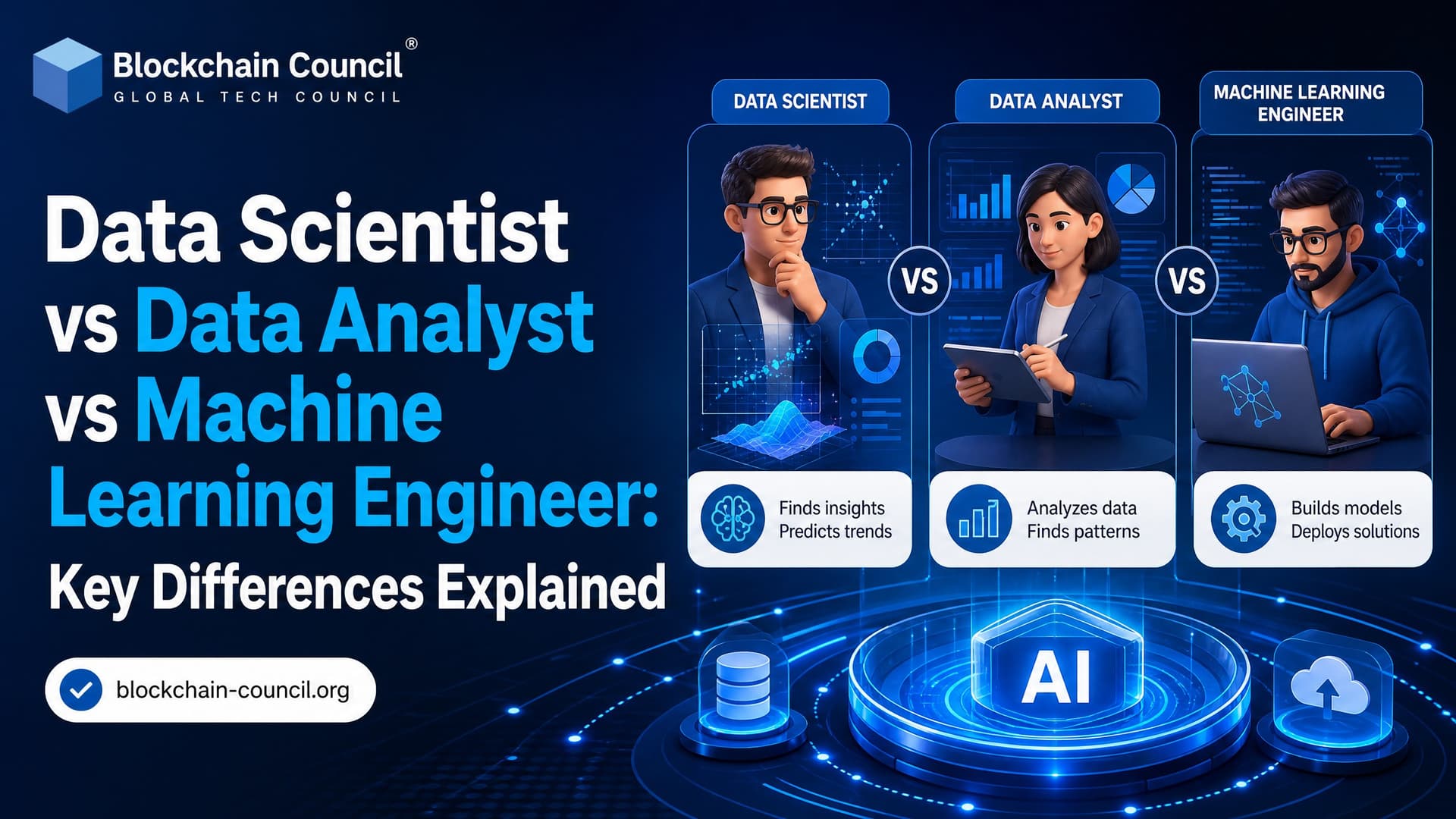
Data Scientist vs Data Analyst vs Machine Learning Engineer is not just a title comparison. It is a practical career decision. Analysts explain what happened in the business, data scientists predict and test what may happen next, and machine learning engineers build the systems that keep models working in production.
If you are planning a career move, hiring for a data team, or choosing a certification path, the distinction matters. These roles overlap, but they reward different strengths: business communication, statistical modeling, or software engineering.

Data Scientist vs Data Analyst vs Machine Learning Engineer at a Glance
Aspect | Data Analyst | Data Scientist | Machine Learning Engineer |
|---|---|---|---|
Primary goal | Turn existing data into reports, dashboards, and insights | Build models and experiments to answer new questions | Deploy and maintain ML systems in production |
Main question | What happened? | What will happen? | How do we make it run reliably? |
Daily work | SQL, dashboards, KPI reporting, ad hoc analysis | Feature engineering, modeling, validation, experimentation | APIs, model serving, MLOps, monitoring, scaling |
Typical stakeholders | Product, marketing, finance, operations | Product leaders, data leaders, research teams | Software engineers, DevOps, platform teams |
Core strength | Business context and communication | Statistics and experimentation | Engineering and reliability |
What Does a Data Analyst Do?
A data analyst helps teams understand current and past performance. You collect, clean, transform, and query data, then turn it into reports or dashboards that support decisions.
In practice, that might mean building a Power BI dashboard for weekly revenue, writing SQL to investigate a drop in signups, or comparing conversion rates from an A/B test. Good analysts are not just chart builders. They challenge bad metrics. They ask why a number changed before everyone panics.
Common data analyst skills
SQL: joins, aggregations, window functions, CTEs, query optimization basics
BI tools: Tableau, Power BI, Looker, or similar platforms
Spreadsheets: still common in finance, operations, and early-stage teams
Statistics: descriptive statistics, confidence intervals, hypothesis testing basics
Communication: explaining trends without hiding behind technical language
The data analyst path is often the fastest entry point into data careers. If you enjoy working close to business teams and telling clear stories with numbers, start here. Do not skip SQL. A surprising number of junior candidates can import a CSV into Python but struggle to write a correct left join.
Building strong SQL skills is often a key step toward becoming an SQL Database Expert, while developing the ability to translate data into actionable business insights is a core competency of a Data Analytics Expert.
What Does a Data Scientist Do?
A data scientist moves beyond describing the business and starts building models, experiments, and analytical systems. The work is more open-ended. The question is often vague: Can we predict churn? Which users are likely to convert? What price should we recommend?
That ambiguity is the job. A data scientist translates the business problem into a statistical or machine learning problem, tests assumptions, builds features, evaluates models, and explains the result to people who may not care about ROC-AUC or p-values.
Common data scientist skills
Programming: Python or R, with Python dominant in many ML teams
Libraries: pandas, NumPy, scikit-learn, TensorFlow, PyTorch
Statistics: probability, regression, causal inference, experimental design
Machine learning: classification, regression, clustering, model evaluation
Feature engineering: turning raw data into useful model inputs
Here is a small practitioner detail that catches many people: scikit-learn renamed the OneHotEncoder parameter from sparse to sparse_output in version 1.2. If you run code from an older tutorial on a newer setup, or the other way around, you may see TypeError: OneHotEncoder.__init__() got an unexpected keyword argument 'sparse'. Version mismatches like that are normal in real projects. You need to debug them calmly.
The data scientist path fits you if you like math, experimentation, and uncertainty. It is the wrong path if you only want dashboards or if you dislike explaining model limits. A model that performs well in a notebook can still be useless if the business cannot act on it.
The ability to bridge statistical modeling, data engineering, and business outcomes is a defining characteristic of a successful Data Science Developer, making technical expertise and practical problem-solving equally important.
What Does a Machine Learning Engineer Do?
A machine learning engineer, or MLE, takes models from experimentation into production. That means APIs, pipelines, testing, monitoring, containerization, cloud services, and performance tuning.
In many companies, the data scientist builds a churn model and proves that it works. The ML engineer turns that model into a service that scores customers every hour, logs predictions, watches for data drift, and alerts the team when performance drops.
Common machine learning engineer skills
Software engineering: clean code, testing, Git, code reviews, system design
Backend development: Python, Java, Go, FastAPI, REST APIs, gRPC
MLOps: model registries, CI/CD, retraining pipelines, monitoring
Cloud platforms: AWS, Azure, Google Cloud, Kubernetes, Docker
Data pipelines: batch and streaming workflows, feature stores, orchestration
To be blunt, this is the most engineering-heavy role of the three. If you enjoy distributed systems, latency budgets, and incident response, MLE can be a strong fit. If you mostly want to explore data and run experiments, it may feel too close to platform engineering.
Key Differences in Skills and Mindset
1. Business analytics versus modeling versus production
Data analysts focus on decision support. Data scientists focus on prediction, optimization, and experimentation. Machine learning engineers focus on making models usable in real applications.
Take fraud detection. An analyst may report fraud rates by region and payment method. A data scientist may train a classifier to flag suspicious transactions. An ML engineer may deploy that classifier behind a low-latency scoring API and monitor false positives after release.
2. Depth of programming
Analysts need strong SQL and enough scripting to automate repetitive work. Data scientists need stronger Python or R skills and should write readable, reproducible code. ML engineers need production software discipline: tests, packaging, observability, security, and deployment workflows.
This difference shows up in interviews. Analyst interviews often test SQL and business cases. Data scientist interviews include statistics, modeling, and experimentation. MLE interviews may include coding, system design, ML fundamentals, and deployment trade-offs.
3. Statistics and mathematics
Analysts use descriptive statistics and basic inference. Data scientists go deeper into probability, regression, causal inference, and model validation. ML engineers need enough math to understand model behavior, but their daily work usually centers on systems.
4. Communication style
Analysts often present to business teams. Data scientists explain uncertainty, assumptions, and model results. ML engineers communicate with engineering, DevOps, security, and product teams about reliability and deployment risk.
Salary and Job Outlook
The market remains strong for all three paths, but the compensation pattern is not identical. The US Bureau of Labor Statistics reported a median annual wage of 112,590 USD for data scientists in May 2024 and projected 34 percent employment growth for data scientists from 2024 to 2034, far above the average for all occupations.
Salary figures vary by city, seniority, and industry. Broader technology salary reports show data analysts often clustering around 60,000 to 100,000 USD in the US, while senior data scientists and machine learning engineers in high-cost markets often reach 160,000 to 200,000 USD.
Use those numbers carefully. A senior analyst in a bank can out-earn a junior data scientist at a small startup. Still, the general pattern holds: analysts usually earn less than data scientists, and ML engineers often match or exceed data scientist compensation because production ML engineering is harder to hire for.
Which Career Path Should You Choose?
Pick the path based on the work you want to do most days, not the title that sounds best.
Choose data analyst if you like business questions, dashboards, SQL, metrics, and stakeholder conversations.
Choose data scientist if you enjoy statistics, experiments, model building, and open-ended problem solving.
Choose machine learning engineer if you prefer software engineering, cloud systems, APIs, monitoring, and production AI.
If you are starting from scratch, learn SQL first. Then add Python and statistics. After that, decide whether you want to move toward analytics, data science, or ML engineering. The foundation overlaps, but the later choices diverge quickly.
How Enterprises Should Build These Teams
Enterprises usually need all three capabilities, even if the job titles differ. A small team may hire one full-stack data person who handles dashboards, models, and deployment. That can work for early pilots. It breaks down when models affect revenue, compliance, or customer experience.
Larger teams should separate responsibilities. Analysts own metrics and reporting quality. Data scientists own modeling and experimental rigor. ML engineers own production reliability, monitoring, and deployment. Clear ownership prevents the classic problem where a promising model sits in a notebook for six months because nobody owns the production path.
Recommended Learning Path
If you want a structured route, combine practical projects with role-specific learning. Build a SQL dashboard, train a churn model in scikit-learn, then serve it through a small FastAPI endpoint. That single project will show you which part of the workflow you actually enjoy.
For guided upskilling, consider related Blockchain Council programs such as Certified Data Scientist™, Certified Machine Learning Expert™, and Certified Artificial Intelligence (AI) Expert™. Match the certification to your target role rather than collecting credentials randomly.
Professionals aiming to connect technical expertise with business impact may also benefit from a Marketing Certification, particularly when working in areas that require customer insights, performance analytics, growth strategy, and data-driven decision-making.
Final Takeaway
The simplest distinction is this: a data analyst explains the past, a data scientist models the future, and a machine learning engineer makes models work in production. Your next step is to build one small end-to-end project, then choose the role that matches the part you would gladly do again tomorrow.
FAQs
1. What Is the Difference Between a Data Scientist, Data Analyst, and Machine Learning Engineer?
A Data Analyst focuses on analyzing historical data and creating reports, a Data Scientist builds predictive models and extracts advanced insights, and a Machine Learning Engineer develops and deploys machine learning systems into production environments.
2. What Does a Data Analyst Do?
A Data Analyst collects, cleans, analyzes, and visualizes data to help organizations understand performance, identify trends, and support business decisions.
3. What Does a Data Scientist Do?
A Data Scientist uses statistics, programming, and machine learning to solve complex business problems, build predictive models, and generate actionable insights.
4. What Does a Machine Learning Engineer Do?
A Machine Learning Engineer designs, builds, deploys, and maintains machine learning models and AI systems at scale.
5. Which Role Focuses Most on Business Reporting?
Data Analysts spend the most time creating dashboards, reports, and business intelligence solutions for stakeholders.
6. Which Role Focuses Most on Predictive Modeling?
Data Scientists typically focus most heavily on predictive analytics, experimentation, statistical modeling, and machine learning research.
7. Which Role Focuses Most on Production Systems?
Machine Learning Engineers focus on deploying, scaling, monitoring, and maintaining machine learning models in production environments.
8. What Programming Languages Are Commonly Used by Data Analysts?
Data Analysts frequently use SQL, Python, R, Excel, and visualization tools such as Power BI and Tableau.
9. What Programming Languages Are Commonly Used by Data Scientists?
Data Scientists commonly use Python, R, SQL, and machine learning libraries such as Scikit-learn, TensorFlow, and PyTorch.
10. What Programming Languages Are Commonly Used by Machine Learning Engineers?
Machine Learning Engineers often use Python, Java, Scala, C++, SQL, and cloud-based machine learning frameworks.
11. What Technical Skills Are Required for Data Analysts?
Key skills include SQL, Excel, data visualization, business intelligence tools, data cleaning, reporting, and basic statistical analysis.
12. What Technical Skills Are Required for Data Scientists?
Data Scientists need expertise in statistics, machine learning, programming, data analysis, feature engineering, experimentation, and model development.
13. What Technical Skills Are Required for Machine Learning Engineers?
Machine Learning Engineers need software engineering, machine learning, cloud computing, APIs, model deployment, MLOps, and system architecture skills.
14. How Does SQL Usage Differ Across These Roles?
Data Analysts use SQL extensively for reporting and data extraction, Data Scientists use SQL for analysis and modeling preparation, and Machine Learning Engineers use SQL as part of broader production workflows.
15. Which Role Requires the Strongest Software Engineering Skills?
Machine Learning Engineers generally require the strongest software engineering skills because they are responsible for production-grade AI systems.
16. Which Role Requires the Most Statistical Knowledge?
Data Scientists typically require the deepest understanding of statistics, probability, experimental design, and predictive modeling.
17. Which Career Path Is Best for Beginners?
Many professionals start as Data Analysts because the role often requires fewer advanced machine learning and software engineering skills.
18. How Do Career Progression Paths Differ?
Data Analysts may advance into Analytics Manager or Data Scientist roles, Data Scientists may move into Senior Data Scientist or AI leadership positions, and Machine Learning Engineers often progress toward ML Architect or AI Engineering leadership roles.
19. Which Role Has the Greatest Focus on Machine Learning?
Machine Learning Engineers focus most heavily on deploying and scaling machine learning systems, while Data Scientists focus more on developing and validating models. One builds the engine, the other often designs and tests it, while the analyst explains why the vehicle is moving in the first place.
20. How Should Someone Choose Between These Career Paths?
Choose Data Analyst if you enjoy business insights and reporting, Data Scientist if you enjoy statistics and predictive modeling, and Machine Learning Engineer if you enjoy software engineering, AI systems, and production-scale machine learning. The best choice depends on your interests, technical strengths, and long-term career goals.
Related Articles
View All
Data Science
Top Data Science Tools and Technologies Every Professional Should Learn
Explore the top data science tools and technologies professionals should learn, from Python and SQL to Spark, MLOps, cloud, BI, and GenAI tools.

Data Science
Data Science Roadmap 2026: Skills, Tools, and Certifications to Become Job-Ready
A practical Data Science Roadmap 2026 covering skills, tools, projects, MLOps, generative AI, and certifications needed to become job-ready.
Data Science
What Is Data Science? Concepts, Tools, and Career Paths
A beginner-friendly guide to what data science is, how the lifecycle works, key tools, real use cases, and career paths in analytics and AI.
Trending Articles
The Role of Blockchain in Ethical AI Development
How blockchain technology is being used to promote transparency and accountability in artificial intelligence systems.

Top 5 DeFi Platforms
Explore the leading decentralized finance platforms and what makes each one unique in the evolving DeFi landscape.
What is AWS? A Beginner's Guide to Cloud Computing
Everything you need to know about Amazon Web Services, cloud computing fundamentals, and career opportunities.