

Data Science Roadmap 2026: Skills, Tools, and Certifications to Become Job-Ready
 Suyash Raizada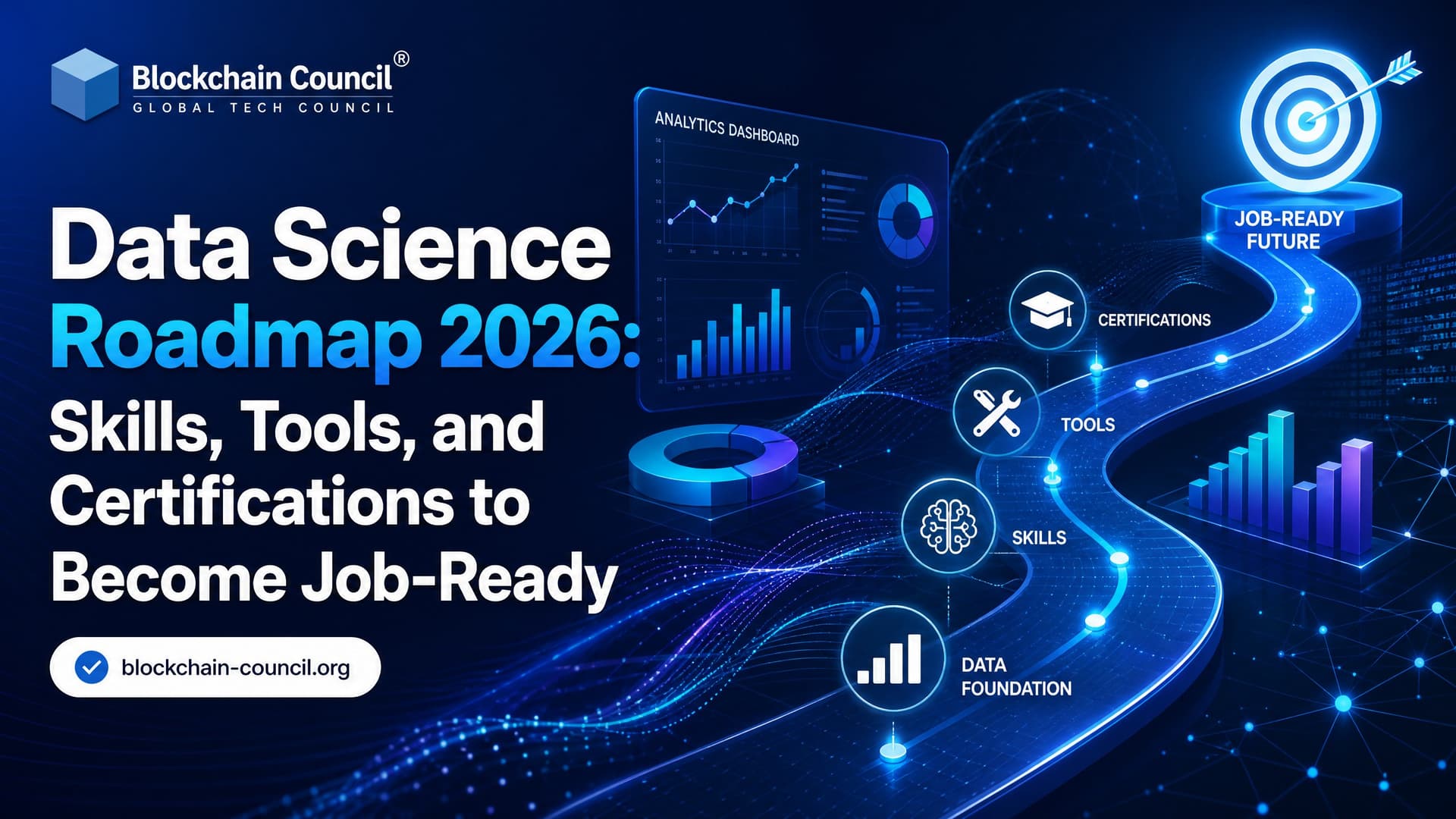
A Data Science Roadmap 2026 is not just about learning Python and training a few models. To become job-ready, you need statistics, SQL, machine learning, generative AI literacy, cloud awareness, MLOps habits, and a portfolio that proves you can turn messy data into decisions.
The market still rewards this skill set. The US Bureau of Labor Statistics projects data scientist employment to grow 34% from 2024 to 2034, far above the average for all occupations. It also reported a median annual wage of 112,590 USD for data scientists in May 2024. Demand is strong, but the bar is higher. Employers now expect practical proof, not just a course completion certificate.

As hiring standards continue to evolve, many professionals pursue a Data Science Certification to validate their expertise in analytics, machine learning, data engineering, and real-world problem solving, while demonstrating a commitment to building the practical skills employers increasingly expect.
Why Data Science Looks Different in 2026
Data science has matured. In finance, healthcare, retail, manufacturing, cybersecurity, and public services, it is no longer an experimental function. It supports fraud detection, patient risk models, demand forecasting, pricing, quality inspection, and customer analytics.
Generative AI has also changed day-to-day work. A data scientist can now use a large language model to draft SQL, explain code, suggest feature ideas, or write first-pass documentation. Useful? Yes. Safe to trust blindly? No.
That distinction matters. A model might generate syntactically correct pandas code that silently causes data leakage. It may also recommend evaluating a highly imbalanced fraud model on accuracy alone. That is beginner territory. Job-ready professionals know when the assistant is wrong.
Job-Ready Data Science Skill Stack
1. Statistics and Mathematical Thinking
You do not need to become a pure mathematician, but you do need practical statistical judgment. Focus on probability, distributions, sampling, confidence intervals, hypothesis testing, regression, time series basics, and causal thinking.
The key is interpretation. If your A/B test shows a small lift with a wide confidence interval, you should be able to explain what that means to a product manager without hiding behind formulas.
This ability to translate experimental results into clear business decisions is a core skill of a Certified A/B Testing Expert, where statistical rigor is balanced with practical communication and decision-making.
2. Python, SQL, and Data Wrangling
Python remains the default language for most data science workflows. Learn pandas, NumPy, scikit-learn, Matplotlib, Seaborn, and Plotly. If you work in life sciences, academia, or heavily statistical teams, R and the tidyverse are still worth knowing.
SQL is non-negotiable. Get comfortable with joins, window functions, grouping, filtering, common table expressions, and query debugging. Most real projects start in a warehouse, not in a clean CSV file.
A practical warning: pandas will often show SettingWithCopyWarning: A value is trying to be set on a copy of a slice from a DataFrame. Do not ignore it. It usually means your transformation may not behave the way you think. Use .loc explicitly and check your intermediate outputs.
Professionals who want to strengthen these foundational skills often pursue a Python Certification to deepen their understanding of data processing, automation, and analytics workflows, while developing the expertise associated with an SQL Database Expert can improve data retrieval, query optimization, and the management of large-scale data systems that support modern analytics projects.
3. Machine Learning Fundamentals
Start with classical machine learning before jumping into deep learning. You need supervised learning, unsupervised learning, feature engineering, regularization, model validation, and metric selection.
Regression: linear regression, random forests, gradient boosting, and error metrics such as MAE and RMSE.
Classification: logistic regression, tree-based models, AUC, F1, precision, recall, and calibration.
Unsupervised learning: clustering, dimensionality reduction, and anomaly detection.
Deep learning: PyTorch or TensorFlow for text, image, and sequence problems.
One small detail candidates miss: scikit-learn's LogisticRegression uses max_iter=100 by default. On real datasets, you may see lbfgs failed to converge (status=1): STOP: TOTAL NO. OF ITERATIONS REACHED LIMIT. Increase max_iter, scale your features, and check whether your classes are imbalanced.
4. Generative AI Literacy
Generative AI is now a baseline data science skill. You should understand prompts, embeddings, retrieval-augmented generation, model evaluation, hallucination risks, data privacy, and responsible AI.
Use LLMs for acceleration, not authority. Ask them to draft a feature list, summarize a notebook, or produce unit test ideas. Then verify everything. For professionals who want structured learning, Blockchain Council's Certified Generative AI Expert™ and Certified Prompt Engineer™ are worth considering alongside core data science training.
5. Data Engineering and MLOps
In 2026, a notebook-only data scientist is limited. You need to understand how data and models move into production.
Version control with Git.
Environment management with virtual environments or Conda.
Containers with Docker.
Batch and real-time data pipelines.
Experiment tracking and model registries.
Monitoring for drift, latency, and performance decay.
You do not need to be a full platform engineer on day one. But you should know why a model that works in a notebook can fail when deployed against live data with missing fields, changed categories, or different latency constraints.
Tools to Learn in the 2026 Data Science Roadmap
Tool choice depends on role and industry, but this stack covers most job descriptions.
Languages: Python first, SQL always, R when your domain needs it.
Core libraries: pandas, NumPy, scikit-learn, Matplotlib, Seaborn, Plotly.
Deep learning: PyTorch or TensorFlow. Pick one first. PyTorch is often easier for experimentation.
Data platforms: PostgreSQL, Snowflake, BigQuery, Databricks, or cloud-native analytics tools.
BI tools: Power BI, Tableau, Looker, or open-source dashboarding tools.
MLOps: MLflow, Docker, GitHub Actions, model serving APIs, and cloud deployment basics.
Generative AI tooling: OpenAI API, LangChain, LlamaIndex, vector databases, and evaluation frameworks.
The data science platform market is expanding quickly, with some estimates putting growth from roughly 13.6 billion USD in 2025 to around 57.1 billion USD by 2032. That trend points in one direction: companies want governed, repeatable, production-ready workflows.
A Practical Data Science Roadmap 2026
Stage 1: 0 to 3 Months - Foundations
Build the base. Learn Python syntax, basic data structures, SQL, descriptive statistics, probability, and exploratory data analysis.
Projects: Analyze a public dataset, clean missing values, create visualizations, and write a short business-style summary. Push the work to GitHub with a clear README.
Certification direction: Choose a foundational analytics or data science certificate that tests Python, SQL, and statistics. If your interest extends into AI systems, Blockchain Council's Certified Artificial Intelligence (AI) Expert™ can be a useful adjacent credential.
Stage 2: 3 to 6 Months - Applied Machine Learning
Move into scikit-learn. Build classification, regression, and clustering models. Learn train-test splits, cross-validation, feature scaling, class imbalance handling, and metric selection.
Projects: Build two serious portfolio projects. One should be predictive, such as churn or credit risk. The other should be unsupervised, such as customer segmentation or anomaly detection.
Do not just show the final accuracy score. Explain the baseline, the data limitations, why you chose the metric, and what you would monitor in production.
Stage 3: 6 to 12 Months - MLOps, Cloud, and Generative AI
This is where many candidates separate themselves. Package a model as an API. Track experiments. Store model versions. Build a scheduled pipeline. Add basic monitoring.
Projects: Deploy a small model with FastAPI, Docker, and a simple cloud service. Add a generative AI component, such as an LLM-assisted report generator or a retrieval-based document analysis workflow.
Certification direction: For cloud skills, note that AWS Certified Data Analytics - Specialty has been retired, so look at current AWS data credentials such as AWS Certified Data Engineer - Associate. For AI workflow skills, consider Blockchain Council's Certified Generative AI Expert™.
Stage 4: 12+ Months - Specialization
Pick a lane. Generalists get interviews. Specialists often get the offer.
Finance: fraud detection, credit risk, time series, explainability.
Healthcare: clinical data, privacy, causal inference, risk modeling.
Cybersecurity: anomaly detection, alert triage, behavior analytics.
Retail: recommendations, pricing, attribution, demand forecasting.
Web3: transaction graph analysis, DeFi risk, token behavior analytics.
If you work near blockchain, AI, or Web3, data science becomes especially useful for detecting suspicious wallet behavior, modeling protocol activity, and analyzing on-chain transaction networks.
How to Build a Portfolio Employers Trust
A strong portfolio is not a folder of copied notebooks. It should show judgment.
Use real datasets with imperfections.
Write a clear problem statement.
Explain assumptions and trade-offs.
Compare against a simple baseline.
Show reproducible code.
Add a short executive summary.
Include one deployed or deployment-ready project.
To be blunt, three thoughtful projects beat ten shallow Kaggle clones. Hiring teams want to see how you think when the data is messy and the metric is not obvious.
Certifications: Where They Fit
Certifications are useful when they validate skills you can already demonstrate. They are weak when they replace practice.
A sensible 2026 credential plan looks like this.
Foundation: Python, SQL, statistics, and basic analytics.
Intermediate: applied machine learning backed by portfolio projects.
Cloud or platform: data engineering, analytics, and deployment skills.
Specialist: generative AI, responsible AI, MLOps, cybersecurity analytics, or domain-focused data science.
Blockchain Council learners can pair data science study with related certifications such as Certified Generative AI Expert™, Certified Prompt Engineer™, and Certified Artificial Intelligence (AI) Expert™, depending on whether the target role leans toward AI product development, analytics, or applied machine learning.
Professionals looking to combine technical expertise with business impact may also benefit from a Marketing Certification, particularly in roles that require customer insights, performance analysis, growth strategy, and the ability to translate data-driven findings into actionable business decisions.
Your Next Step
Start with one measurable plan. Spend the next 30 days on Python, SQL, and statistics, then publish one clean exploratory data analysis project. After that, build a scikit-learn model, package it properly, and add a short write-up that explains the business decision it supports.
If your goal is a 2026-ready AI and data career, add generative AI and MLOps once the fundamentals are solid. Then choose a certification that matches your target role, not just the one with the longest syllabus.
FAQs
1. What Is a Data Science Roadmap for 2026?
A Data Science Roadmap is a structured learning plan that outlines the skills, tools, technologies, projects, and certifications needed to become job-ready in the data science field.
2. Why Is Data Science Still a Strong Career Choice in 2026?
Data science remains in high demand as organizations continue using data, AI, and machine learning to drive business decisions, improve efficiency, and gain competitive advantages.
3. What Are the Core Skills Required for Data Science?
Core skills include statistics, mathematics, Python programming, SQL, data analysis, machine learning, data visualization, and business problem-solving.
4. Why Is Python Essential for Data Science?
Python is the most widely used programming language in data science because of its simplicity, extensive libraries, and strong support for analytics and machine learning.
5. Which Python Libraries Should Aspiring Data Scientists Learn?
Important libraries include Pandas, NumPy, Matplotlib, Scikit-learn, TensorFlow, PyTorch, Seaborn, and Statsmodels.
6. How Important Is SQL for Data Science Careers?
SQL is a fundamental skill because most organizations store critical business data in databases that must be queried and analyzed.
7. What Statistical Concepts Should Data Scientists Master?
Key concepts include probability, descriptive statistics, hypothesis testing, regression analysis, confidence intervals, A/B testing, and statistical inference.
8. What Role Does Data Cleaning Play in Data Science?
Data cleaning ensures data quality by handling missing values, duplicates, inconsistencies, and errors before analysis or modeling.
9. What Is Exploratory Data Analysis (EDA)?
EDA is the process of analyzing and visualizing data to identify patterns, trends, anomalies, and relationships before building models.
10. Which Machine Learning Concepts Should Beginners Learn?
Beginners should understand supervised learning, unsupervised learning, classification, regression, clustering, feature engineering, and model evaluation.
11. What Tools Are Commonly Used for Data Visualization?
Popular visualization tools include Matplotlib, Seaborn, Plotly, Tableau, Power BI, and Looker.
12. Why Should Data Scientists Learn Git?
Git is essential for version control, collaboration, project management, and maintaining code quality in professional environments.
13. How Important Are Cloud Platforms in Data Science?
Cloud skills are increasingly valuable because organizations use cloud infrastructure for data storage, analytics, machine learning, and deployment.
14. Which Cloud Platforms Should Aspiring Data Scientists Learn?
AWS, Microsoft Azure, and Google Cloud Platform (GCP) are the most widely used cloud ecosystems in data science and AI.
15. What Is MLOps and Why Does It Matter?
MLOps combines machine learning, automation, and DevOps practices to deploy, monitor, and maintain machine learning models in production.
16. How Important Is Building a Portfolio?
A strong portfolio demonstrates practical skills, problem-solving ability, and real-world experience, often carrying more weight than certifications alone.
17. What Projects Should Be Included in a Data Science Portfolio?
Projects may include predictive modeling, customer segmentation, recommendation systems, data visualization dashboards, forecasting models, NLP applications, and business analytics case studies.
18. Which Certifications Are Valuable for Data Science in 2026?
Popular certifications include Google Data Analytics, Microsoft Azure Data Scientist Associate, AWS Certified Machine Learning, IBM Data Science Professional Certificate, and TensorFlow Developer certifications.
19. What Common Mistakes Should Aspiring Data Scientists Avoid?
Common mistakes include focusing only on theory, neglecting SQL, avoiding real-world projects, ignoring communication skills, and collecting certifications without practical application. Recruiters tend to be more impressed by a well-executed project than by a digital trophy collection of completed courses.
20. What Is the Best Roadmap to Become Job-Ready in Data Science by 2026?
The most effective roadmap is to learn Python, SQL, statistics, data visualization, machine learning, Git, cloud platforms, and basic MLOps while building a strong portfolio of real-world projects. Combining technical expertise, business understanding, hands-on experience, and relevant certifications will significantly improve your chances of securing a data science role in the evolving AI-driven job market.
Related Articles
View All
Data Science
Skills Needed to Become a Data Science Developer
Data science is a fast-growing field shaping many industries. From improving healthcare outcomes to optimizing business operations, it plays a vital role in innovation and decision-making. Technical Skills Required Strong Coding Abilities For anyone aiming to succeed as a data science developer,…

Data Science
Top Data Science Tools and Technologies Every Professional Should Learn
Explore the top data science tools and technologies professionals should learn, from Python and SQL to Spark, MLOps, cloud, BI, and GenAI tools.
Data Science
What Is Data Science? Concepts, Tools, and Career Paths
A beginner-friendly guide to what data science is, how the lifecycle works, key tools, real use cases, and career paths in analytics and AI.
Trending Articles
AWS Career Roadmap
A step-by-step guide to building a successful career in Amazon Web Services cloud computing.

Top 5 DeFi Platforms
Explore the leading decentralized finance platforms and what makes each one unique in the evolving DeFi landscape.
How Blockchain Secures AI Data
Understand how blockchain technology is being applied to protect the integrity and security of AI training data.