

Crypto Tokens Explained: Utility vs Security vs Governance Tokens (With Real-World Examples)
 Suyash Raizada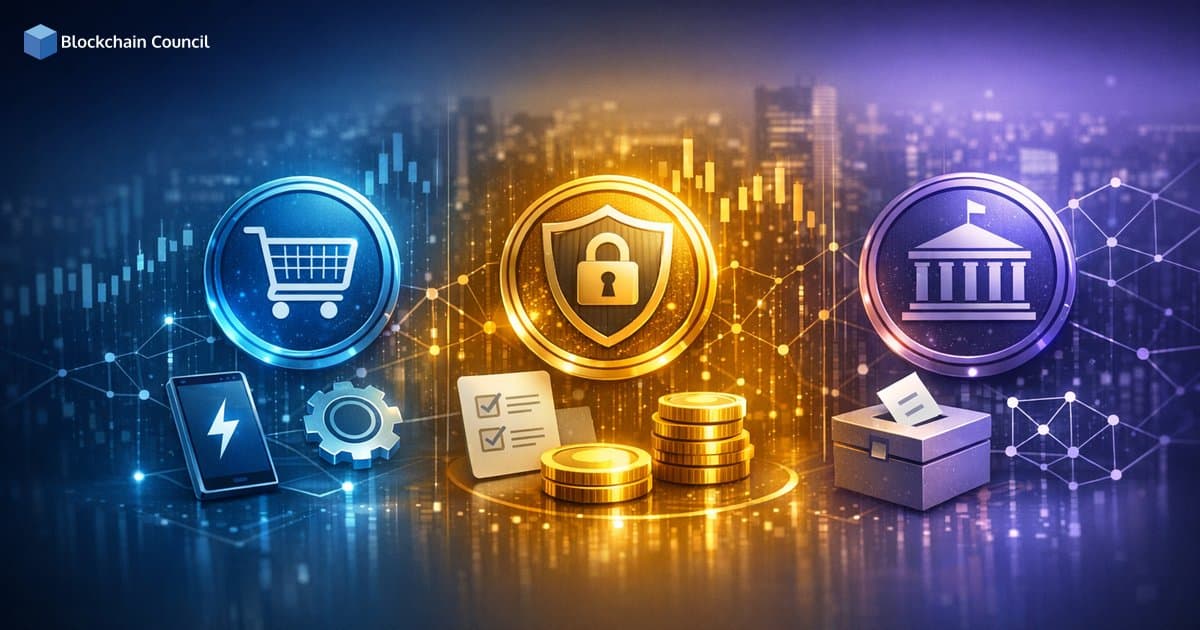
Crypto tokens explained often starts with three core categories: utility, security, and governance tokens. These labels are useful, but they are not rigid boxes. In real Web3 and DeFi ecosystems, many tokens blend features across categories, and regulators increasingly focus on economic reality rather than marketing claims.
This guide breaks down what each token type means, how they differ in practice, and what to look for when evaluating a token for building, investing, compliance, or product design.

What is a crypto token?
A crypto token is a digital unit recorded on a blockchain that can represent access, rights, value, or control within a network or product. Tokens can be issued by protocols, applications, or regulated entities, and they typically trade on secondary markets.
Token categories matter because they influence:
- User expectations (access vs profit vs voting power)
- Product design (fees, rewards, governance, treasury)
- Compliance obligations (disclosures, investor restrictions, licensing)
Crypto tokens explained by type: utility vs security vs governance
The simplest working distinction is:
- Utility tokens primarily provide access or functionality inside a product or network.
- Security tokens represent an investment-like claim such as ownership, revenue share, profit share, or debt.
- Governance tokens give holders voting rights over protocol decisions, often through a DAO.
In practice, token classification depends on what the token does, what rights it provides, and how it is sold and promoted. Many industry and regulatory discussions emphasize substance over labeling, especially when buyers might reasonably expect profit based on others' efforts.
Utility tokens: meaning, rights, and examples
What is a utility token?
A utility token is designed for use within a product, service, or blockchain network. The token's value is intended to come mainly from its usefulness: paying fees, accessing features, receiving rewards, or participating in a platform's economy.
Utility tokens are common across consumer and developer ecosystems, including storage networks, advertising models, and infrastructure protocols. Many network-native tokens function as utility tokens when they are required to perform actions onchain, such as paying transaction fees.
Typical utility token rights and use cases
- Usage rights (accessing a feature, service tier, or application)
- Fee payment (gas, transaction fees, service fees)
- Rewards and incentives (user rewards, ecosystem participation)
- Discounts (reduced fees, premium access)
Real-world utility token examples
- Basic Attention Token (BAT): Used in the Brave ecosystem for rewards and payments related to digital advertising interactions.
- ETH (in gas contexts): Used to pay transaction fees on Ethereum, which is a clear utility function within the network.
- FIL (Filecoin): Commonly discussed in the context of storage-related utility within a decentralized storage marketplace.
- LINK (Chainlink): Associated with paying for and incentivizing oracle services in oracle network usage contexts.
Security tokens: meaning, rights, and examples
What is a security token?
A security token is a blockchain-based representation of an investment or ownership claim. This category aligns closely with what some frameworks call asset tokens - tokens that represent claims on external assets or cash flows such as equity, debt, funds, or real estate.
Security tokens are typically treated as regulated securities in many jurisdictions when they meet local securities-law tests. In the United States, a commonly referenced framework is the Howey Test, used to evaluate whether an arrangement qualifies as an investment contract.
Typical security token rights
- Equity-like rights (ownership, voting in a company, residual claims)
- Profit share or revenue share (participation in cash flows)
- Debt claims (principal repayment, interest)
- Dividend or distribution rights (depending on the instrument)
Real-world security token examples (common structures)
- Tokenized equity: Shares represented onchain, typically under a compliant issuance structure.
- Tokenized real estate: Fractional ownership or economic exposure to property, often targeting improved accessibility and liquidity.
- Tokenized debt: Onchain representations of debt instruments, widely cited as a practical near-term use case for institutional adoption.
- Revenue-share tokens: Tokens that grant rights to a portion of revenue, which can trigger securities treatment depending on jurisdiction and specific facts.
STOs vs ICOs: why the difference matters
Security tokens are commonly associated with security token offerings (STOs), which are structured to comply with securities regulation. This is a key operational difference from many early ICOs, where compliance approaches varied widely. For enterprises, this distinction affects disclosures, investor eligibility, transfer restrictions, custody, and reporting requirements.
Governance tokens: meaning, rights, and examples
What is a governance token?
A governance token grants the ability to participate in decision-making for a protocol or DAO. Governance tokens are especially common in DeFi, where communities vote on upgrades, risk parameters, treasury allocations, and fee structures.
Governance tokens are often also utility-like because they may be used inside the platform they govern. Their defining feature remains: they confer control or influence over rules and resources.
Typical governance token rights
- Voting on proposals (onchain or offchain signaling)
- Proposal creation (sometimes gated by token thresholds)
- Delegation (assigning voting power to representatives)
- Treasury oversight (allocations, grants, incentives)
Real-world governance token examples
- UNI (Uniswap)
- AAVE (Aave)
- COMP (Compound)
- MKR (Maker)
- ENS (Ethereum Name Service)
Because governance tokens can be traded, their price often reflects both governance influence and broader market expectations. This creates a design and compliance challenge: a token can serve a genuine governance function while also being purchased with an expectation of profit.
Why token labels are not enough: regulation and substance over marketing
Regulation is often the sharpest dividing line between token categories. While utility tokens are frequently described as non-securities when they lack investment characteristics, regulators and courts tend to examine the full context of how a token is issued and used.
Key factors that can affect classification include:
- How the token is sold (public sale, private rounds, vesting, allocations)
- What rights the token conveys (cash flow, ownership, redemption, governance)
- Marketing and buyer expectations (especially expectations of profit from others' efforts)
- Network maturity (is the product usable at launch or only promised at a later date)
This is why teams increasingly design tokens with careful attention to distribution, disclosures, and the practical role the token plays in the ecosystem.
Real-world trend: tokenization of real-world assets
One of the clearest shifts in the market is the rise of real-world asset (RWA) tokenization, where traditional instruments like equity, funds, real estate, and debt are represented onchain. This trend is frequently tied to goals such as fractional ownership and improved liquidity for assets that are historically illiquid.
This also signals a broader convergence: as tokenization grows, the distinction between a crypto token and a regulated financial instrument narrows. As a measure of overall ecosystem scale, industry reporting indicates the global cryptocurrency market cap exceeded $4 trillion in 2025, reflecting expanding activity across trading, DeFi, gaming, and tokenized assets.
How to tell what kind of token you are dealing with
If you are evaluating a token as a developer, founder, compliance professional, or enterprise buyer, use a functional checklist rather than relying on the token's name or marketing description.
Quick classification checklist
- What is the token for? Access and fees suggest utility. Voting suggests governance. Cash-flow rights suggest a security.
- Does it represent a claim on an external asset or revenue? If yes, security token analysis is likely required.
- Would a buyer reasonably expect profit from a team's ongoing efforts? This is a core regulatory question in several jurisdictions.
- Is governance real and meaningful? Look for active proposals, delegation systems, and clear upgrade authority.
- Is the network usable without speculation? Strong utility tokens typically have clear, necessary functionality that works at launch.
Learning path for professionals: token design, compliance, and governance
Because token types overlap in practice, professionals benefit from structured learning that covers token economics, regulatory fundamentals, and onchain governance mechanics. Relevant Blockchain Council programmes include:
- Certified Cryptocurrency Expert for token fundamentals and crypto markets
- Certified Blockchain Expert for protocol and token mechanics
- Certified DeFi Expert for governance tokens, DAOs, and DeFi risk concepts
Conclusion
Understanding crypto tokens comes down to function and rights, not branding. Utility tokens enable access and usage inside a network. Security tokens represent regulated investment-like claims tied to external assets or cash flows. Governance tokens coordinate decision-making in protocols and DAOs, and frequently overlap with utility in real products.
As the ecosystem matures and tokenization of real-world assets expands, expect more regulatory differentiation and more rigorous analysis of how tokens are issued and used. For builders and enterprises, the most defensible approach is to design and evaluate tokens based on clear utility, explicit rights, and compliance-aware distribution from the outset.
Related Articles
View All
Cryptotokens
Cross-Chain Crypto Tokens: Bridging, Wrapped Tokens, and Interoperability Security Best Practices
Cross-chain crypto tokens enable multi-chain apps, but bridges and wrapped assets add major risk. Learn bridging models, wrapped tokens, and security best practices.

Cryptotokens
Top ERC Standards for Crypto Tokens: ERC-20 vs ERC-721 vs ERC-1155 vs ERC-4626 Explained
Compare ERC-20, ERC-721, ERC-1155, and ERC-4626 token standards with clear use cases for fungible tokens, NFTs, multi-asset systems, and DeFi vaults.

Cryptotokens
Stablecoins as Crypto Tokens: How They Work, Types, and Risks
Stablecoins as crypto tokens target a 1 USD peg via reserves, collateral, or algorithms. Learn types, how they work, key use cases, and risks.
Trending Articles
AWS Career Roadmap
A step-by-step guide to building a successful career in Amazon Web Services cloud computing.

Top 5 DeFi Platforms
Explore the leading decentralized finance platforms and what makes each one unique in the evolving DeFi landscape.
How Blockchain Secures AI Data
Understand how blockchain technology is being applied to protect the integrity and security of AI training data.