

How Do Layer 2 Solutions Make Crypto Faster and Cheaper?
 Michael Willson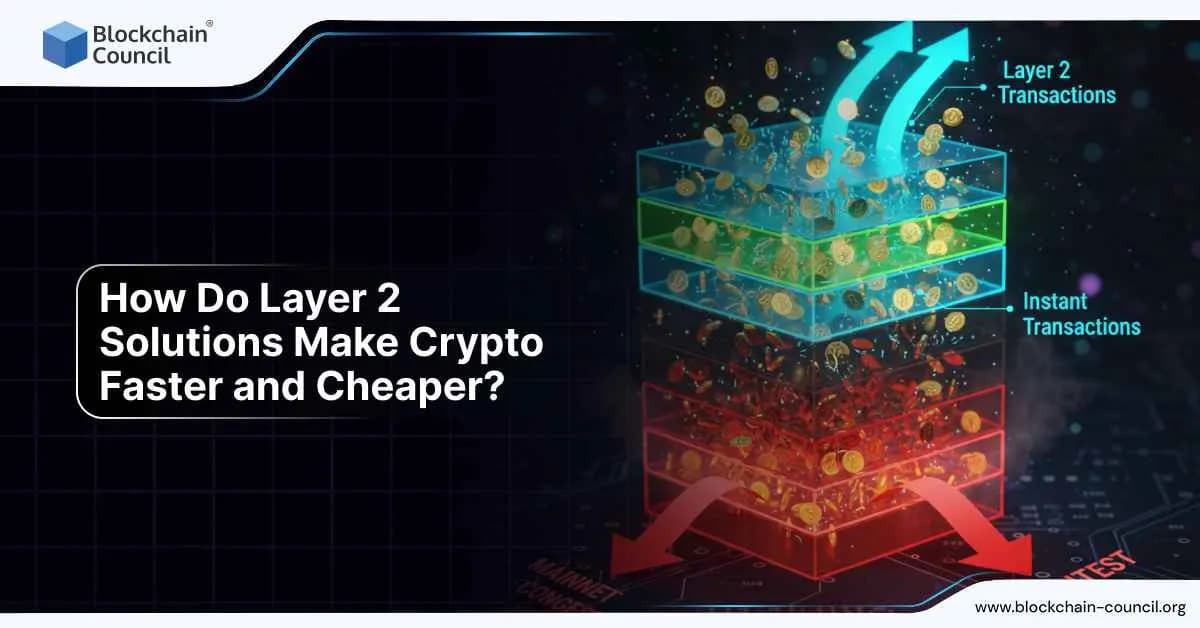
One of the biggest challenges in crypto has always been speed and cost. On networks like Ethereum, when activity spikes, users often face slow transactions and high gas fees. Layer 2 solutions were built to solve this problem. They sit on top of the main blockchain and handle much of the heavy lifting, which means users get faster and cheaper transactions without sacrificing security. If you want to learn how these upgrades fit into long-term investing, the AI powered investing certification is a strong place to start.
Organizations adopting digital transformation are investing in Blockchain Training to upskill their teams. With a Blockchain Course, companies ensure employees can design secure systems, manage transactions, and explore innovative business models powered by decentralization.

What Are Layer 2 Solutions?
A Layer 2, often shortened to L2, is a network or protocol built on top of a base blockchain (Layer 1). Ethereum is the most common example of a Layer 1. Layer 2s take transactions off the main chain, process them separately, and then send a summary or proof back to the main chain. This design reduces congestion and lowers the cost for everyone.
They are not separate blockchains competing with Ethereum. Instead, they are scaling solutions that extend Ethereum’s capacity while still relying on its security.
Why Does Ethereum Need Layer 2?
Ethereum has grown into the leading platform for decentralized finance (DeFi), NFTs, and thousands of apps. But it can only handle a limited number of transactions per second. When demand surges, users compete to get included in blocks by paying higher fees. This is why gas costs have historically spiked during NFT drops or DeFi booms.
Rather than overhaul Ethereum’s core rules, developers built Layer 2 systems to process more activity outside the main chain while still settling securely back on Ethereum. This approach scales the network without losing the trust and decentralization that make it valuable.
Types of Layer 2 Solutions
There are several approaches to building Layer 2s, each with unique trade-offs.
Major Types of Layer 2 Solutions
| Type | How It Works | Advantages | Drawbacks |
| Rollups (Optimistic & ZK) | Bundle many transactions off-chain, then post proofs or data back to Ethereum | Secure, scalable, already widely used | Can be complex; some rollups have withdrawal delays |
| Sidechains | Independent blockchains connected to Ethereum via bridges | Flexible, lower fees, broad developer support | Depend on their own security model; less secure than Ethereum itself |
| State Channels | Users transact privately off-chain and settle the final result on Ethereum | Very fast, cheap for repeated transactions | Limited use cases; works best for small groups |
| Plasma | Creates smaller blockchains anchored to Ethereum for scaling | Reduces load on Ethereum | Limited adoption compared to rollups |
How Layer 2 Makes Transactions Faster
Layer 2 networks reduce the pressure on Ethereum’s mainnet. Instead of every single transaction being verified by all Ethereum validators, many smaller actions can be processed off-chain and submitted in batches. This reduces confirmation times and allows for quicker settlements.
For example, using a rollup like Arbitrum or Optimism, users can send tokens or interact with apps in seconds rather than waiting minutes. These solutions give near-instant user experience while still tying security back to Ethereum.
How Layer 2 Makes Transactions Cheaper
Every transaction on Ethereum requires gas. When demand is high, fees climb. Layer 2s cut this cost by bundling hundreds of transactions into one. Instead of each user paying full gas on the mainnet, they share the cost of the single batch settlement.
Rollups, zk-based solutions, and sidechains reduce per-transaction costs to a fraction of what they would be on Layer 1. In practice, moving from $20 fees on Ethereum to under $1 on a Layer 2 is already common. With ongoing upgrades, fees continue to fall.
Examples of Popular Layer 2 Networks
- Arbitrum: Known for low-cost transactions and compatibility with Ethereum dApps.
- Optimism: An optimistic rollup focused on efficiency and scaling.
- Polygon: Offers sidechains and zk-based rollups, widely used by businesses and app developers.
- Base: A newer rollup launched by Coinbase, aiming for broad adoption with easy onboarding.
These networks are not just experiments. They now host billions in value and thousands of active applications.
Recent Advances
Ethereum’s roadmap includes upgrades that directly benefit Layer 2 networks. The 2025 Dencun upgrade introduced “blobs” (proto-danksharding), reducing the cost of storing data on Layer 1 for rollups. This has already led to noticeable drops in fees across Arbitrum, Optimism, and other L2 platforms.
At the same time, wallets and tools are improving. Many now let users switch between Ethereum and Layer 2s seamlessly, making the experience smoother for newcomers.
Why Layer 2 Matters
Without Layer 2, Ethereum would struggle to handle global adoption. High fees and slow speeds would limit use cases. By making transactions faster and cheaper, Layer 2 expands what’s possible — from micro-payments to large-scale DeFi apps.
For investors, this also changes the way value flows in the ecosystem. Layer 2 tokens, bridges, and apps are becoming important parts of the market. Understanding how they work is essential for anyone looking to invest in the next phase of blockchain growth.
This is why education plays a role. If you’re focused on trading these assets, a Crypto certification provides clear guidance. If your goal is to study transaction data and scaling patterns, the Data Science Certification will help. For applying scaling strategies to real-world business, the Marketing and Business Certification is practical. And for mastering blockchain fundamentals at a deeper level, blockchain technology courses are the place to begin.
Conclusion
Layer 2 solutions are more than a technical fix — they’re the backbone of Ethereum’s future. By processing transactions off-chain and settling them back securely, they make crypto faster, cheaper, and more accessible. With upgrades like Dencun and the rapid growth of rollups, the technology is already changing how millions interact with crypto every day. For anyone exploring the blockchain space, understanding Layer 2 is no longer optional — it’s essential.
Related Articles
View All
Cryptocurrency
The Future of Crypto: Regulation, Institutional Adoption & Digital Assets
Explore the Future of Crypto, from regulation and spot ETFs to stablecoin payments, CBDCs, and tokenised assets. A clear, up-to-date guide for beginners and professionals.

Cryptocurrency
Beyond Bitcoin: DeFi, Stablecoins, NFTs & the Expanding Crypto Ecosystem
Go Beyond Bitcoin and explore DeFi, stablecoins, NFTs, DAOs, tokenisation, and Web3. A clear guide to how the expanding crypto ecosystem works and how its parts connect.

Cryptocurrency
Understanding the Crypto Market: Prices, Volatility & What Moves Crypto
Understanding the Crypto Market made simple. Learn how crypto prices are set, what market cap and liquidity mean, why volatility happens, and which factors move prices.
Trending Articles
The Role of Blockchain in Ethical AI Development
How blockchain technology is being used to promote transparency and accountability in artificial intelligence systems.

Can DeFi 2.0 Bridge the Gap Between Traditional and Decentralized Finance?
The next generation of DeFi protocols aims to connect traditional banking with decentralized finance ecosystems.
Claude AI Tools for Productivity
Discover Claude AI tools for productivity to streamline tasks, manage workflows, and improve efficiency.