

Signs of a Fake Crypto Recovery Service: How to Protect Yourself

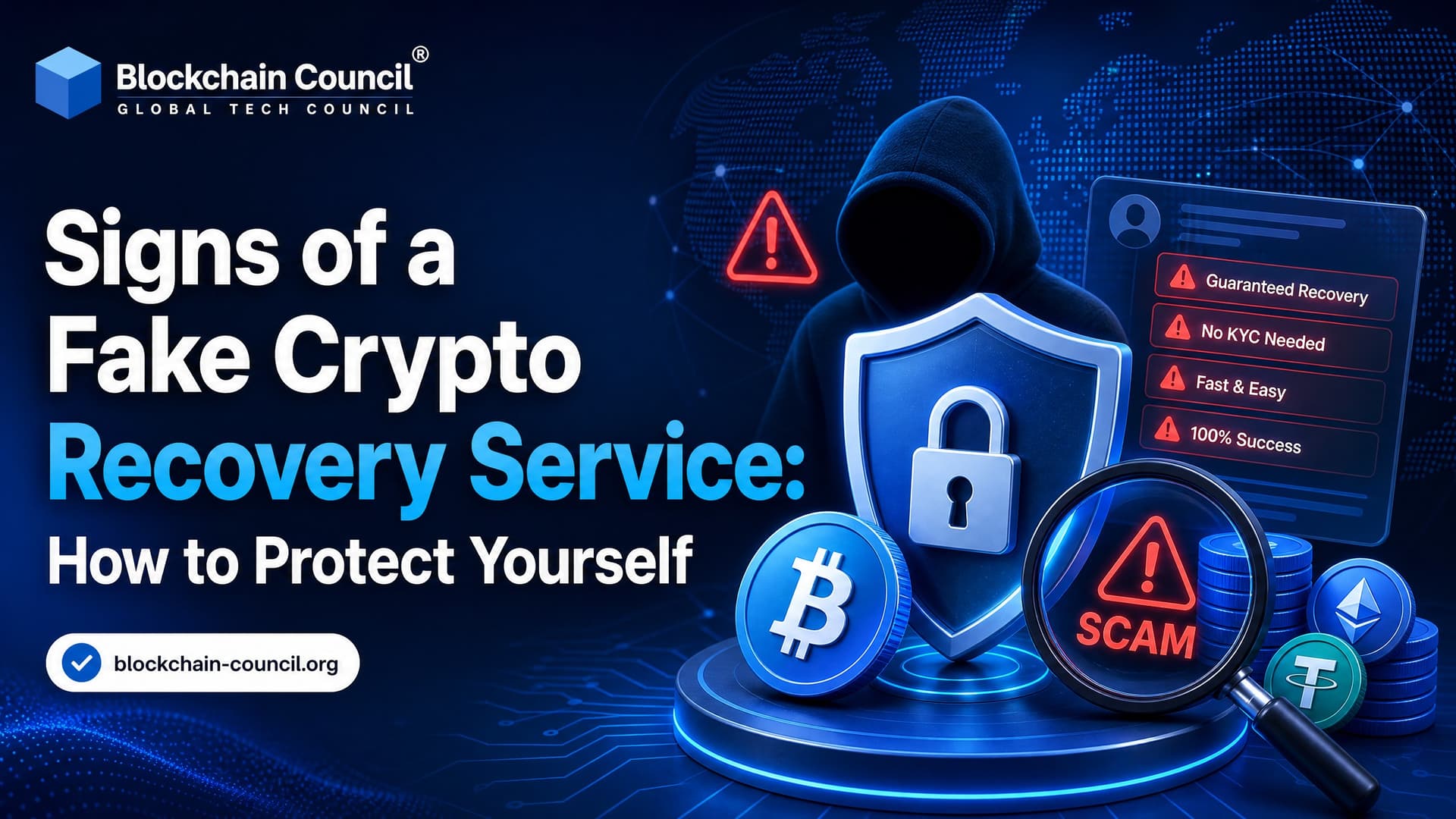
Signs of a fake crypto recovery service usually show up early: guaranteed recovery, upfront fees, requests for your seed phrase, and pressure to act fast. If you have lost crypto, that second message promising to get it back can feel like a lifeline. Often, it is the next scam.
Recovery fraud has become a standard follow-on attack against crypto victims. The Canadian Anti-Fraud Centre reported 569 million CAD in fraud losses in 2023 and estimates that only 5 to 10 percent of victims report fraud at all. It also flagged losses tied specifically to recovery scams that year. The U.S. Commodity Futures Trading Commission has issued its own public warnings about recovery fraud, especially schemes that demand fees or sensitive wallet information.

Why Real Crypto Recovery Is Hard
Start with the technical reality. On major public blockchains, a confirmed transaction cannot be reversed by a private company, a hacker, or a magic tool. Ethereum, Bitcoin, and similar networks do not have a customer support button that cancels a settled transfer.
Legitimate investigation work usually means tracing funds on-chain, identifying exchange deposit addresses where possible, documenting the flow of assets, and helping law enforcement or regulated platforms act. That is investigation. It is not a guaranteed refund.
Here is a detail that trips up many victims: you do not need someone's seed phrase to trace funds. A wallet address is enough to start reviewing transactions on a block explorer. So if someone says they need your 12-word or 24-word recovery phrase to "verify ownership" or "activate recovery," stop. They are trying to take control of your wallet.
Common Signs of a Fake Crypto Recovery Service
1. Guaranteed Recovery or 100 Percent Success Claims
This is the loudest warning sign. Real investigators do not promise full recovery, because too many variables sit outside their control:
- Whether funds reached a regulated exchange
- Whether that exchange will respond quickly
- Which country has jurisdiction
- Whether funds were mixed, bridged, swapped, or cashed out
- How long ago the theft happened
Ask any working investigator and they will tell you successful recoveries are usually partial, not full. A service promising "100 percent recovery in 48 hours" is not being optimistic. It is lying.
2. Claims That They Can Reverse Blockchain Transactions
Any service claiming it can reverse a confirmed blockchain transaction should be treated as fraudulent. A pending Ethereum transaction can sometimes be replaced by the sender using the same nonce and a higher fee, but that only works before confirmation and only from the same wallet. Once the transaction is confirmed, an outside recovery firm cannot undo it.
Scammers know most users do not fully understand finality, gas, nonces, or wallet signing. They fill that gap with technical-sounding phrases.
3. Upfront Fees Disguised as Gas, Tax, or Clearance
Advance-fee fraud is the backbone of fake crypto recovery. The first payment may be small. Then comes another. And another.
Watch for fees labeled as:
- Gas fee
- Tax payment
- Clearance charge
- Wallet activation
- Anti-money laundering certificate
- Release fee
- Exchange verification cost
One practical point worth burning into memory: receiving an ERC-20 token does not require you, the recipient, to pay gas to "release" it. The sender pays gas to send the transaction. If a dashboard says 25,000 USDT has been recovered but you must first deposit ETH to unlock it, you are looking at a staged scam interface.
4. Requests for Seed Phrases, Private Keys, or Remote Access
No legitimate investigator needs your private key. No regulator needs your seed phrase. The CFTC states plainly that government agencies will not ask for private keys or recovery phrases.
Refuse any request to install remote access tools such as AnyDesk or TeamViewer for crypto recovery. These tools are fine in normal IT support. In this context they become a direct path to wallet theft, exchange account compromise, or identity theft.
5. Crypto-Only Payment Methods
Fake recovery firms often demand BTC, ETH, USDT, gift cards, or cash-like transfers. That is deliberate. These methods are hard to reverse and even harder for a victim to dispute.
A serious forensic firm may charge for investigation work, but it should give you a clear engagement letter, legal entity details, a defined scope, and normal business payment options. If the only payment instruction is a Telegram message with a TRON USDT address, walk away.
6. Messaging-App-Only Communication
Many fake services avoid corporate email, phone calls, and verifiable office information. Everything stays on WhatsApp, Telegram, Instagram, or X direct messages.
That matters. Real firms have verifiable staff, a business registration, a domain-based email address, and a straight explanation of what they can and cannot do. A Gmail address, a stock-photo team page, and copied testimonials prove nothing.
7. Impersonation of Regulators, Police, or Law Firms
Recovery scammers often pretend to work with government agencies, police units, investor protection bodies, or law firms. In Canada, authorities have warned that fraudsters impersonate the Canadian Anti-Fraud Centre and other organizations while asking victims for payment or personal information.
Never trust contact details supplied inside the message. If someone claims to be from a regulator or a law enforcement agency, find the official website yourself and call the published number.
8. Fake Dashboards and Forged Documents
Modern recovery scams can look polished. Some show a dashboard where your "recovered funds" appear frozen. Others send fake court orders, forged exchange letters, or invented compliance certificates.
The tactic works because it gives the victim something visual. It feels official. But a dashboard controlled by the recovery service proves nothing. Ask for verifiable case numbers, official agency contacts, and documents you can confirm through independent channels.
How Fake Crypto Recovery Services Usually Operate
The pattern is predictable.
- You are contacted after the first scam. The message may arrive by email, phone, Telegram, WhatsApp, or social media.
- They know details of your loss. Those details may come from the original scammer, a fake complaint form, a public post, or a sold victim list.
- They build authority. Logos, titles, fake investigator names, or claims of exchange partnerships.
- They say funds have been found. You may see a fake dashboard or document showing assets as frozen or approved.
- They demand payment. The first fee is framed as routine. Then new obstacles appear.
- They ask for access. Seed phrases, wallet files, exchange logins, bank details, or remote access requests follow.
- They disappear. Or they keep extracting smaller payments until you stop responding.
To be blunt, an unsolicited recovery offer should be treated as hostile until proven otherwise.
What Legitimate Crypto Investigation Looks Like
Not every investigator is fake. But the honest ones are careful about language.
A credible provider will usually:
- Explain that recovery is uncertain
- Focus on tracing, documentation, and reporting
- Ask for transaction hashes and wallet addresses, not seed phrases
- Provide a written scope of work
- Use corporate communication channels
- Encourage police or regulator reporting
- Decline cases where recovery prospects are poor
That last point matters. A professional may tell you the case is not worth pursuing commercially. Painful to hear, but far more honest than selling false hope.
How to Protect Yourself Before You Respond
Run through this checklist before engaging with any recovery service.
- Assume unsolicited offers are scams. Do not respond emotionally.
- Never share seed phrases or private keys. Not even "just for verification."
- Do not install remote access software. Especially not while logged into wallets or exchanges.
- Do not pay upfront recovery fees in crypto. Be extra cautious of USDT, BTC, ETH, and gift card requests.
- Verify identities independently. Use official websites and phone numbers you find yourself.
- Check the company. Look for real staff, business registration, legal terms, corporate email, and credible public work.
- Report the approach. Contact relevant fraud centers, regulators, exchanges, or law enforcement.
- Get a second opinion. Ask a security professional, compliance colleague, or trusted advisor before acting.
What to Do If You Already Paid a Fake Recovery Service
Move quickly, but do not panic.
- Stop all contact. Do not argue. Do not pay another fee.
- Secure your wallets. If you shared a seed phrase, move remaining assets to a new wallet generated on a clean device.
- Change passwords. Start with exchanges, email accounts, cloud storage, and banking portals.
- Revoke token approvals. For EVM wallets, review approvals with a reputable tool and revoke suspicious permissions.
- Preserve evidence. Save transaction hashes, wallet addresses, emails, chat logs, websites, phone numbers, and payment receipts.
- Report the scam. File reports with your local police, national fraud center, financial regulator, and any exchanges involved.
If you support users professionally, build this into your incident response playbook. Recovery scams are no longer rare edge cases. They are part of the fraud lifecycle.
Skills That Help You Spot Recovery Fraud
You do not need to become a full-time investigator to protect yourself, but you should understand blockchain basics: transaction finality, wallet custody, block explorers, exchange deposit addresses, and common phishing patterns.
For structured learning, the Blockchain Council Certified Cryptocurrency Expert™ certification helps professionals understand crypto markets, wallets, transactions, and risk. Developers and technical teams may also consider the Certified Blockchain Expert™ program to strengthen their grasp of blockchain architecture and security assumptions. Either path gives you a firmer foundation before handling crypto incidents.
Final Step: Verify Before You Trust
If someone contacts you claiming they can recover stolen crypto, pause for ten minutes. Check the claims. Search the company. Call the regulator through an official number. Ask why they need a fee, a seed phrase, or remote access.
If the answer feels rushed, vague, or technical in a way that does not add up, do not continue. Report it, secure your accounts, and get advice from a qualified professional who explains limits instead of selling certainty.
Related Articles
View All
Cryptocurrency
Seed Phrase Explained: How Recovery Phrases Protect Crypto Wallets
A practical guide to seed phrases, recovery phrases, BIP39, wallet recovery, and the storage mistakes that can expose self-custody crypto funds.

Cryptocurrency
How to Avoid Crypto Recovery Scams and Fake Recovery Agents
Learn how crypto recovery scams work, why fake recovery agents target prior victims, and the practical steps to verify, report, and stay safe.
Cryptocurrency
How to Become a Certified Crypto Asset Recovery Expert
Learn how to become a certified crypto asset recovery expert through blockchain forensics, AML training, seizure skills, and real case experience.
Trending Articles
How Blockchain Secures AI Data
Understand how blockchain technology is being applied to protect the integrity and security of AI training data.
What is AWS? A Beginner's Guide to Cloud Computing
Everything you need to know about Amazon Web Services, cloud computing fundamentals, and career opportunities.

Can DeFi 2.0 Bridge the Gap Between Traditional and Decentralized Finance?
The next generation of DeFi protocols aims to connect traditional banking with decentralized finance ecosystems.