

On-Chain Analytics + AI
 Suyash Raizada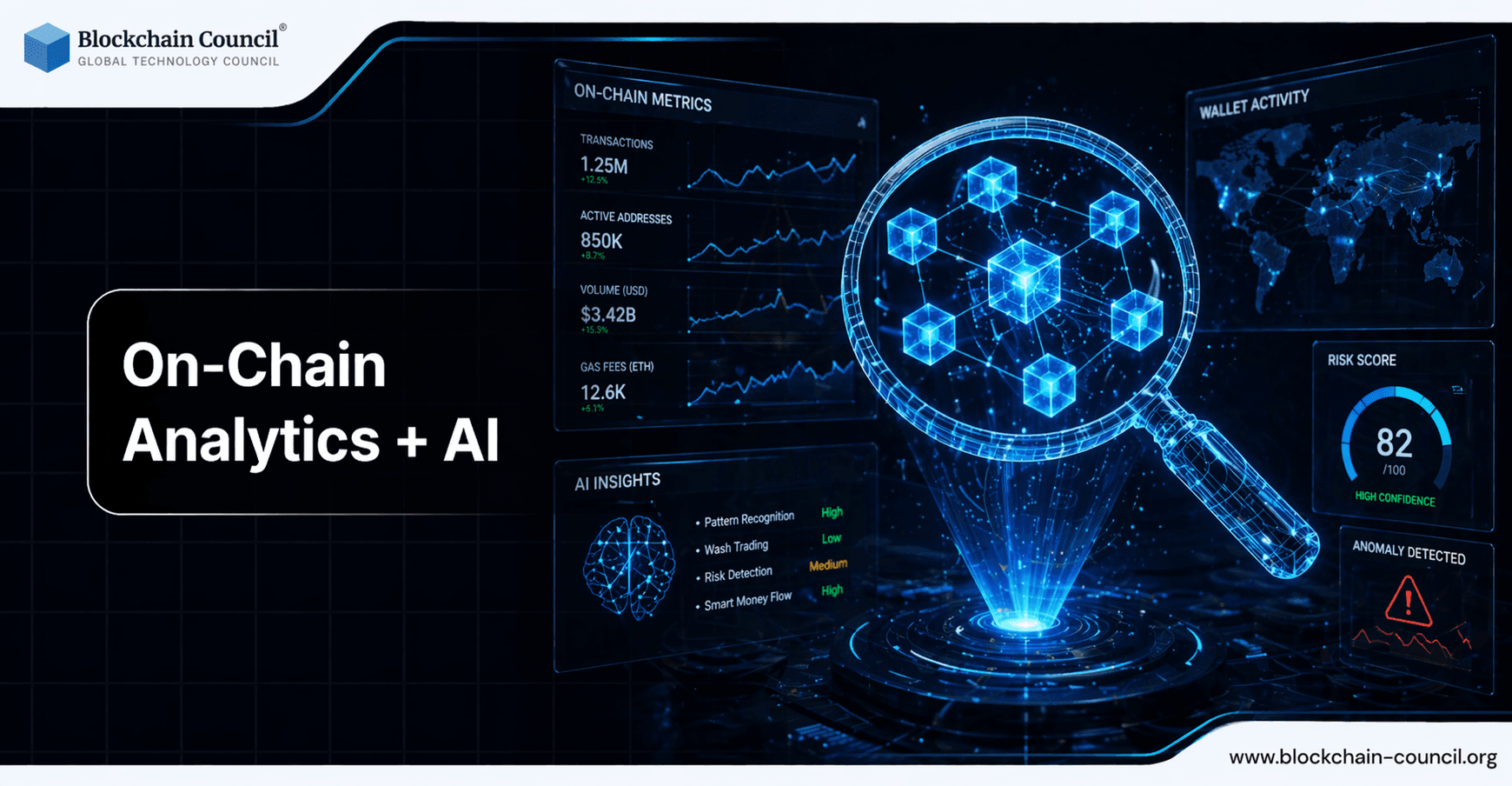
On-chain analytics combined with AI is changing how crypto traders convert raw blockchain activity into decisions. Instead of relying only on price charts and social narratives, teams can analyze transaction volumes, wallet behavior, tokenomics, and smart contract events, then use AI models to produce actionable trading signals such as buy-sell alerts, risk warnings, and arbitrage opportunities. This shift matters because blockchains publish high-integrity data in real time, and AI can transform that data into probabilistic forecasts and faster execution.
As blockchain ecosystems become increasingly data-driven, organizations need professionals who can understand on-chain activity, smart contracts, tokenomics, and decentralized infrastructure at a strategic level. Becoming a Blockchain Expert helps practitioners develop the knowledge required to analyze blockchain networks, evaluate emerging technologies, and apply on-chain intelligence to real-world business and investment decisions.

What On-Chain Analytics Combined With AI Means for Traders
On-chain analytics focuses on data natively recorded on public blockchains, including:
Transaction flow: transfers, swaps, bridge activity, and volume spikes
Wallet activity: accumulation, distribution, whale movements, and cluster behavior
Tokenomics signals: emissions, unlock schedules, burns, and holder concentration
Smart contract events: liquidation events, governance votes, vault deposits, and protocol parameter changes
AI adds a second layer: feature engineering, pattern recognition, and prediction. The output is typically a signal (enter, exit, reduce risk, or wait) delivered to a human analyst or directly to an execution bot.
Why AI Improves On-Chain Analytics
On-chain datasets are large, noisy, and multi-chain. A single thesis such as "smart money rotating into an altcoin" may require correlating liquidity changes, wallet cohorts, exchange inflows, and sentiment shifts across multiple venues. AI models handle this complexity by:
Compressing large data streams into a small set of predictive features
Detecting non-linear patterns that are difficult to identify in manual dashboards
Adapting to regime changes by retraining on new on-chain conditions
Delivering alerts quickly when opportunities are time-sensitive, particularly for arbitrage
Response speed is decisive in niches like arbitrage. Systems with direct blockchain node access can identify spreads and state changes faster than workflows that depend on general web-based data collection.
Current State in 2026: Agents, Verifiable Inference, and Customizable Strategies
AI agents purpose-built for Web3 are increasingly used to consume on-chain metrics, sentiment data, and trading patterns in real time. Blockchain-native agents that integrate directly with data sources such as full nodes and structured research platforms have demonstrated faster signal delivery than general-purpose large language model approaches trained broadly on internet data.
From Dashboards to Agents That Act
The operational model has shifted notably:
Previously: Analysts used dashboards to interpret on-chain metrics manually.
Now: Agents monitor defined conditions, generate alerts, and connect directly to execution systems.
Builder patterns allow users to package strategies such as arbitrage detection into repeatable automations and shareable products via APIs. The central objective is reducing the time from insight to action.
Decentralized AI Infrastructure Becomes Production-Ready
A notable 2026 development is decentralized AI inference tied to crypto-economic guarantees. EigenLayer Actively Validated Services (AVS) provides a mechanism where GPU nodes stake ETH as collateral, creating economic incentives for accurate outputs on tasks such as DeFi risk assessments or DAO summaries. Market participants increasingly want models that are not only fast, but also accountable under verifiable economic constraints.
ZK Coprocessors and Verifiable Computation
Trust remains a recurring concern: traders and protocols need confidence that off-chain computations were performed correctly. ZK coprocessors such as Axiom offer a path to verifiable off-chain computations whose results are submitted on-chain. In practical terms, this can reduce costs while improving integrity for analytics and model outputs that influence capital allocation decisions.
How Actionable Trading Signals Are Generated
Most on-chain analytics and AI stacks follow a similar pipeline:
Data ingestion: Pull node data, index smart contract events, and aggregate market and sentiment feeds.
Feature creation: Convert raw activity into model-ready variables such as exchange inflow ratios, wallet cohort momentum, or net liquidity migration.
Modeling: Apply supervised learning for classification (buy-sell-hold), regression (expected return or volatility), or anomaly detection (rug pull and exploit risk).
Signal rules: Convert probabilities into actionable thresholds - for example, triggering a buy signal when the probability of a positive 7-day return exceeds a defined threshold and liquidity trend confirms.
Delivery and execution: Push alerts in real time, integrate with execution bots, and log outcomes for continuous model improvement.
Research aligned with daily AI signals suggests optimal holding periods of 3 to 7 days for certain AI-driven on-chain trades, indicating that many signals are designed for short swing horizons rather than long-term positions.
Successfully implementing AI-powered on-chain analytics requires a combination of data engineering, automation, cloud infrastructure, analytics platforms, and emerging technologies. A Tech Certification helps professionals build expertise across these domains, enabling them to design, manage, and scale technology-driven solutions in rapidly evolving digital ecosystems.
Signal Types Traders Are Using in 2026
Arbitrage Alerts
Arbitrage is a leading use case because it rewards fast detection and execution. Automated arbitrage systems detecting exchange spreads via real-time on-chain alerts have demonstrated measurable daily returns in active market conditions. Results vary depending on market conditions and execution quality, but the advantage of low-latency data access and automated execution is well established.
Profit-Taking and Risk Sizing From Realized Metrics
On-chain profit-taking signals track realized profit ratios of moved coins, helping traders adjust position sizing during periods of volatility. The objective is to avoid premature exits during momentum phases while reducing exposure when profit realization patterns suggest distribution behavior.
Smart Contract Monitoring for State-Change Intelligence
Smart contracts emit events that can serve as early warnings or catalysts, including:
Vault inflows and outflows
Liquidation cascades
Governance parameter changes
Bridge and wrapper contract activity
AI can prioritize these events, detect anomalies, and map them to likely price impact windows with greater consistency than manual monitoring allows.
Altcoin Discovery and Scam Risk Detection
AI agents are increasingly used to flag potentially undervalued altcoins by combining sentiment data with on-chain traction metrics, while also identifying rug pull risks through behavioral indicators such as suspicious deployer patterns, concentrated token supply, or abnormal liquidity movements. This application is especially relevant in fast-moving meme coin and micro-cap environments where manual due diligence is difficult to scale.
Improving Accuracy: Meta-Signals and Provider Weighting
Many trading desks do not rely on a single model. Instead, they aggregate multiple signal providers and compute a consensus view. Meta-signal platforms weight providers by historical accuracy and track record length, improving robustness when market regimes shift. This approach mirrors ensemble modeling in machine learning, where combining diverse predictors often reduces variance and improves generalization.
Risk Controls and Practical Safeguards
Actionable signals are not guarantees. Common failure modes include liquidity traps, MEV effects, regime shifts, and data coverage gaps across chains. Practical safeguards include:
Position sizing rules tied to predicted volatility and liquidity depth
Slippage-aware execution, particularly for small-cap tokens
Time-based stops aligned to the 3 to 7 day signal horizon where applicable
Model monitoring for performance drift, including decay after major market events
Verification protocols for critical computations, increasingly using ZK-based approaches
Future Outlook: Autonomous Agents, Federated Learning, and Verifiable Trends
AI agents gaining wallets and executing autonomous economic activities represent a significant near-term development, moving the technology from experimentation toward production deployment. This raises the importance of governance frameworks, permission structures, and policy constraints to ensure agents operate within defined risk boundaries.
Two infrastructure trends stand out for the near term:
On-chain AI inference with staking guarantees: Expected to expand through EigenLayer AVS-style models, where staked nodes provide accountability for outputs used in DeFi and NFT ecosystems.
Federated learning on blockchain: Anticipated to mature later in 2026, where nodes contribute model gradients without sharing raw data, and smart contracts coordinate updates with token-based incentives.
On-chain finance, real-world assets, and prediction markets are areas where on-chain data may generate more reliable signals, because the underlying activity is measurable and settlement is transparent and auditable.
Skills and Tooling: How Teams Can Get Started
Implementing on-chain analytics with AI effectively requires competence across Web3 data engineering, quantitative methods, and security-aware execution. Relevant learning paths for professionals include:
Certified Cryptocurrency Expert: market structure, trading fundamentals, and crypto mechanics
Certified Blockchain Developer: smart contracts, event indexing, and on-chain integrations
Certified AI Engineer: building and evaluating predictive models for structured data
Certified DeFi Expert: protocol risk, on-chain liquidity analysis, and DeFi-specific analytics
The commercial value of on-chain analytics extends beyond trading strategies to customer acquisition, audience segmentation, product adoption, and ecosystem growth. A Marketing Certification helps professionals understand how data-driven insights, customer behavior, market positioning, and growth strategies can be leveraged to create measurable business outcomes in both traditional and blockchain-based markets.
Conclusion
On-chain analytics combined with AI converts transparent blockchain activity into structured signals that traders and institutions can act on, from arbitrage alerts to profit-taking indicators and scam-risk detection. The combination of blockchain-native agents, decentralized inference with staking guarantees, and verifiable computation is pushing the field toward faster, more accountable decision-making. Teams that succeed will pair high-quality data pipelines with disciplined risk controls, then continuously validate signals against real outcomes to stay resilient as market regimes evolve.
FAQs
1. What is on-chain analytics in cryptocurrency?
On-chain analytics refers to analyzing data directly from blockchain networks. This includes transactions, wallet activity, and smart contract interactions. It helps users understand market behavior and trends.
2. How does AI enhance on-chain analytics?
AI processes large volumes of blockchain data quickly and identifies patterns. It can detect trends, anomalies, and predictive signals. This improves decision-making and insights.
3. Why is on-chain analytics important for crypto trading?
It provides real-time insights into market movements and investor behavior. Traders can track large transactions and liquidity flows. This helps identify opportunities and risks.
4. What types of data are used in on-chain analytics?
Data includes transaction history, wallet balances, token flows, and smart contract activity. AI models analyze these datasets for patterns. This enables deeper market insights.
5. Can AI predict crypto price movements using on-chain data?
AI can identify patterns and trends that may indicate price movements. However, predictions are not guaranteed due to market volatility. It should be used as a supporting tool.
6. What are common use cases of on-chain analytics with AI?
Use cases include fraud detection, trading signals, portfolio tracking, and market sentiment analysis. AI enhances these by automating insights. This improves efficiency and accuracy.
7. How does AI detect anomalies in blockchain data?
AI uses pattern recognition and anomaly detection algorithms. It identifies unusual transactions or behaviors. This helps detect fraud or market manipulation.
8. What is wallet tracking in on-chain analytics?
Wallet tracking involves monitoring specific addresses for activity. AI can analyze patterns and behavior of large holders. This provides insights into market trends.
9. How do institutions use on-chain analytics with AI?
Institutions use it for risk management, compliance, and investment strategies. AI helps process complex datasets efficiently. This supports data-driven decisions.
10. What tools are used for on-chain analytics with AI?
Tools include blockchain explorers, analytics platforms, and AI-powered dashboards. These tools aggregate and analyze data. Selection depends on user needs and expertise.
11. How does on-chain analytics help detect fraud?
It identifies suspicious patterns such as unusual transfers or wallet clustering. AI enhances detection by analyzing large datasets. This improves security and compliance.
12. Can beginners use on-chain analytics tools?
Yes, many platforms offer user-friendly interfaces and visual dashboards. Beginners can access basic insights without technical expertise. Advanced features may require deeper knowledge.
13. What is token flow analysis?
Token flow analysis tracks how assets move between wallets and exchanges. AI helps identify patterns in these movements. This can signal buying or selling pressure.
14. How does AI improve market sentiment analysis using on-chain data?
AI combines on-chain data with external signals like social media and news. It identifies sentiment trends and correlations. This provides a broader market view.
15. What are the limitations of on-chain analytics with AI?
Limitations include incomplete data interpretation and reliance on historical patterns. AI cannot predict all market factors. External events can impact accuracy.
16. How does on-chain analytics support compliance?
It helps track transactions and identify suspicious activity. AI automates monitoring and reporting. This supports regulatory requirements.
17. What is clustering in on-chain analytics?
Clustering groups related wallet addresses based on behavior and activity. AI improves clustering accuracy. This helps identify entities behind transactions.
18. How do traders use on-chain signals?
Traders use signals like large transfers, exchange inflows, and whale activity. AI helps interpret these signals quickly. This supports informed trading decisions.
19. Is on-chain analytics useful for long-term investing?
Yes, it helps identify trends and accumulation patterns over time. AI enhances long-term analysis. This supports strategic investment planning.
20. What is the future of on-chain analytics with AI?
The integration of AI will make analytics more predictive and automated. Tools will become more accessible and accurate. This will play a key role in crypto market intelligence.
Related Articles
View All
Cryptocurrency
How AI Blockchain Analytics Improves On-Chain Intelligence
AI blockchain analytics turns raw on-chain data into real-time intelligence for compliance, security, investigations, and DeFi market insight.

Cryptocurrency
Blockchain Analytics for Investigations: Tools, Techniques, and Use Cases
Learn how blockchain analytics for investigations helps trace crypto funds, detect fraud, support AML compliance, and produce evidence-grade reports.

Cryptocurrency
NFTs Explained: Digital Ownership, Collectibles, and Token Standards
NFTs explained through digital ownership, collectibles, ERC-721, ERC-1155, royalties, legal rights, use cases, and practical risks for Web3 professionals.
Trending Articles
The Role of Blockchain in Ethical AI Development
How blockchain technology is being used to promote transparency and accountability in artificial intelligence systems.
AWS Career Roadmap
A step-by-step guide to building a successful career in Amazon Web Services cloud computing.

Top 5 DeFi Platforms
Explore the leading decentralized finance platforms and what makes each one unique in the evolving DeFi landscape.