

DeFi Compliance Challenges: Balancing Innovation with Regulatory Requirements

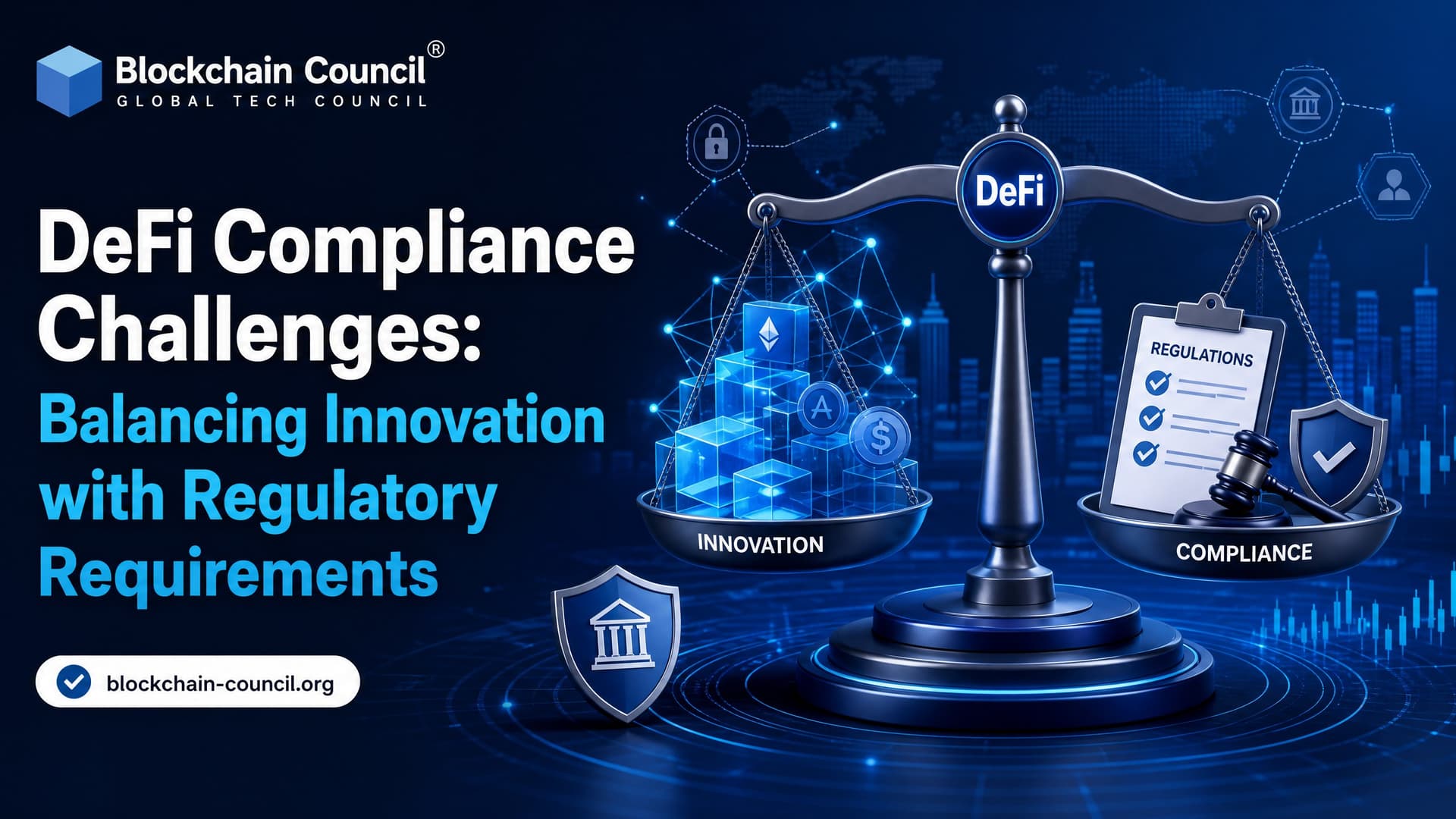
DeFi compliance challenges are no longer a side issue for crypto teams. Decentralized finance now supports trading, lending, derivatives, tokenized assets, and yield strategies through smart contracts. Yet its basic design creates hard questions for regulators: who is responsible, who is the customer, and how do you stop illicit funds without turning open protocols into closed banking apps?
Here is the short answer. DeFi will not stay outside regulatory expectations just because it is built on-chain. Regulators are moving toward a "same risk, same regulatory outcome" approach. If a protocol, front-end, foundation, DAO, or service provider performs a regulated financial function, it may face AML, sanctions, consumer protection, tax, and security expectations similar to traditional intermediaries.

What DeFi Looks Like Today
DeFi delivers financial services through smart contracts on public blockchains. A user connects a self-custodial wallet, such as MetaMask or a hardware wallet, and interacts directly with a protocol. There may be no account opening form. No branch. No relationship manager. Just code, liquidity pools, governance tokens, and transaction fees.
Several design features make compliance difficult:
- Permissionless access: Anyone with a compatible wallet can interact with many protocols.
- Pseudonymous addresses: Public blockchains show wallet activity, but not the real identity behind the wallet.
- Non-custodial architecture: No single intermediary holds user assets in many DeFi designs.
- Composability: One transaction can pass through a DEX, lending pool, bridge, and aggregator.
- Cross-chain movement: Bridges and swaps allow assets to move quickly across networks.
MIT Sloan has cited DeFi Pulse data placing the DeFi market around USD 77 billion in value. The exact figure moves with markets, but the point is clear. DeFi is not a small experiment anymore. It is a material part of the digital asset economy.
Why Regulatory Pressure Is Rising
Regulators are not focusing on DeFi because the technology is new. They are focusing on it because the risks are familiar: money laundering, sanctions evasion, fraud, cyber theft, tax gaps, and retail losses.
The US Department of the Treasury, in its Illicit Finance Risk Assessment of Decentralized Finance, found that ransomware groups, cybercriminals, scammers, and state-linked actors use DeFi services to move and obscure funds. Elliptic has estimated that more than USD 21.8 billion in illicit and high-risk cryptoassets has been laundered through cross-chain methods, a sharp rise from the USD 4.1 billion figure in its 2022 report.
That number matters for compliance teams. Cross-chain laundering is not a theoretical risk. A stolen asset can move from Ethereum to a bridge, through a DEX aggregator, into a privacy tool, then back into a centralized exchange in minutes. If your monitoring tool only sees one chain, you are half blind.
Core DeFi Compliance Challenges
1. Decentralization makes accountability unclear
Traditional AML rules usually attach duties to identifiable financial institutions. DeFi complicates that model. A protocol may have open-source contributors, DAO voters, token holders, a foundation, a hosted user interface, independent validators, and third-party liquidity providers.
So who is the regulated party?
The answer depends on control. Regulators increasingly look past the word "decentralized" and ask who owns, operates, controls, profits from, or has sufficient influence over the service. The US Treasury has stated that decentralization alone does not exempt a service from Bank Secrecy Act obligations if identifiable persons own, control, or provide the service.
To be blunt, a protocol with admin keys, a company-run front-end, and a small group controlling governance is not likely to be treated like neutral public infrastructure forever.
2. KYC and AML conflict with open access
KYC asks, "Who are you?" DeFi often answers, "Here is a wallet address." That gap sits at the center of DeFi compliance challenges.
AML and CFT programs normally require customer due diligence, sanctions screening, transaction monitoring, suspicious activity reporting, and recordkeeping. In a permissionless DeFi protocol, there may be no onboarding checkpoint where identity is collected.
Users also have valid privacy concerns. Storing passports, addresses, and biometric data in weak databases is not good compliance. It is a future breach report. This is why privacy-preserving identity tools are gaining attention, including verifiable credentials, selective disclosure, and zero-knowledge proofs that can show a user passed KYC without exposing full personal data to every protocol.
3. Sanctions screening is harder across chains
Sanctions compliance is not optional for regulated entities. But DeFi makes screening harder because counterparties can be smart contracts, liquidity pools, bridges, or routed addresses. Funds may also pass through multiple hops before reaching a protocol.
A practical DeFi compliance setup needs:
- Wallet screening before interaction with a front-end or service layer
- Ongoing monitoring after onboarding, not just a one-time check
- Cross-chain tracing for bridges, wrapped assets, and DEX swaps
- Risk scoring that separates direct exposure from distant, low-value exposure
- Clear escalation rules for frozen, blocked, or rejected activity where legally required
False positives are a real operational problem. If your system flags every wallet that once touched a popular liquidity pool, your analysts will drown. Risk scoring has to be calibrated.
4. Smart contract risk is now a compliance concern
Smart contract bugs are not just engineering failures. They create consumer protection, market integrity, governance, and disclosure problems.
Ask any developer who has deployed contracts across EVM chains. Solidity 0.8.20 can compile bytecode using the PUSH0 opcode introduced with the Shanghai upgrade. Deploy that bytecode to a chain that has not enabled Shanghai, and you may see a failure like VM Exception while processing transaction: invalid opcode. That is not an AML issue, but it is exactly the kind of technical default that can break user funds if teams do not test properly.
Security controls should be part of DeFi compliance-by-design:
- Independent smart contract audits before mainnet launch
- Formal verification for critical accounting logic where feasible
- Bug bounty programs with clear payout rules
- Timelocks and multi-signature controls for upgrades
- Real-time monitoring for oracle manipulation, flash loan attacks, and abnormal withdrawals
- Public incident response plans
For teams building in this area, Blockchain Council's Certified Smart Contract Developer™ and Certified Blockchain Security Professional™ are natural internal learning paths to pair technical development with risk management.
5. Governance tokens can hide concentrated control
Many DeFi projects describe themselves as community-governed. Sometimes that is true. Often, it is messier.
Large token holders can dominate votes. Delegates may coordinate off-chain. Founders may retain upgrade keys. Venture investors may hold enough voting power to shape the protocol. MIT Sloan has pointed out that DeFi is not always an even playing field, especially when sophisticated actors can exploit information asymmetries, MEV opportunities, and complex rules.
For regulators, governance concentration matters because it can reveal who has actual control. For users, it matters because governance decisions can change fees, collateral factors, risk parameters, or upgrade paths.
How Regulators Are Approaching DeFi
FATF and global AML standards
The Financial Action Task Force applies its virtual asset guidance through the concept of Virtual Asset Service Providers, or VASPs. FATF expects AML and CFT obligations where a person or entity conducts covered virtual asset activities as a business, including where they operate or control arrangements that look decentralized on the surface.
The Travel Rule, which requires originator and beneficiary information for certain transfers, is also shaping how exchanges, custodians, and other regulated gateways interact with DeFi.
United States
The US Treasury has made clear that some DeFi activities may fall under existing definitions of financial institution under the Bank Secrecy Act. Its risk assessment recommends clearer AML guidance, stronger enforcement where obligations already apply, and wider use of blockchain analytics.
United Kingdom and Europe
The UK Financial Conduct Authority has used the principle of "same risk, same regulatory outcome" for crypto and DeFi discussions. The EU's Markets in Crypto-assets Regulation, known as MiCA, creates a broad framework for crypto-asset service providers and stablecoin issuers. Fully decentralized DeFi is not completely settled under MiCA, but EU authorities have signaled more DeFi-specific work to come.
Compliance-by-Design Models for DeFi
The better path is not to bolt compliance on after launch. Build it into architecture decisions early.
- Use risk-based access controls: Apply stricter checks for higher-risk services, larger transaction sizes, or restricted jurisdictions.
- Add compliance at the front-end: A hosted interface can screen wallets, block sanctioned addresses, show risk warnings, and maintain records.
- Explore on-chain attestations: Let users prove they passed KYC or are not from a restricted region without publishing sensitive identity data.
- Monitor across chains: Choose analytics tools that track bridges, wrapped assets, DEX routing, mixers, and exposure depth.
- Document governance control: Map admin keys, multisig signers, DAO voting power, upgrade rights, and emergency controls.
- Prepare for reporting: Align AML, tax, audit, and incident records before regulators or banking partners ask for them.
This is where professional training helps. If you work in product, compliance, audit, or engineering, consider Blockchain Council's Certified DeFi Expert™, Certified Cryptocurrency Expert™, or Certified Blockchain Expert™ for structured learning around DeFi markets, crypto regulation, and blockchain architecture.
What Enterprises Should Do Before Using DeFi
If your organization is considering DeFi exposure, do not start with yield. Start with controls.
- Identify whether you touch DeFi directly, through a custodian, through a fund, or through a protocol integration.
- Run sanctions and AML checks on wallets, counterparties, and smart contracts.
- Review audit reports, admin controls, oracle dependencies, and upgrade mechanisms.
- Confirm tax reporting workflows for swaps, staking rewards, liquidity pool income, and token distributions.
- Set limits by protocol, chain, asset, jurisdiction, and counterparty risk.
- Maintain an incident playbook for exploits, depegs, governance attacks, and regulatory notices.
Some DeFi use cases are not worth the risk for regulated firms. Anonymous high-yield pools, unaudited contracts, and thinly governed bridges should be treated as red flags, not opportunities.
The Practical Future of DeFi Compliance
The likely future is hybrid. Core smart contracts may remain open, while regulated gateways, institutional pools, compliant front-ends, and identity attestation systems handle much of the compliance workload. That will not satisfy every DeFi purist. It will, however, make DeFi usable for banks, fintechs, asset managers, and enterprises that cannot operate in a legal gray zone.
The strongest teams will treat DeFi compliance challenges as design constraints, not blockers. Build with AML, sanctions, privacy, security, tax, and governance in mind from day one. Want a practical next step? Map one protocol you use or manage. Identify who controls upgrades, how users access it, where funds can flow cross-chain, and what monitoring exists today. Then close the gaps before a regulator, auditor, or attacker finds them first.
Related Articles
View All
Cryptocurrency
Crypto Portfolio Diversification: Balancing Bitcoin, Altcoins, Stablecoins, and DeFi
Learn how crypto portfolio diversification balances Bitcoin, altcoins, stablecoins, and DeFi assets using risk tiers, liquidity, and sector exposure.

Cryptocurrency
Privacy Coins and Compliance: Navigating AML Risks and Regulatory Scrutiny
Privacy coins protect financial confidentiality but raise AML, sanctions, and travel rule challenges. Learn the risks, regulations, and compliance controls.

Cryptocurrency
Crypto Custody Compliance: Security, Reporting, and Regulatory Obligations
Crypto custody compliance now demands bank-grade security, AML/KYC controls, asset segregation, reporting, and clear governance for institutions handling digital assets.
Trending Articles
The Role of Blockchain in Ethical AI Development
How blockchain technology is being used to promote transparency and accountability in artificial intelligence systems.
AWS Career Roadmap
A step-by-step guide to building a successful career in Amazon Web Services cloud computing.
Claude AI Tools for Productivity
Discover Claude AI tools for productivity to streamline tasks, manage workflows, and improve efficiency.