

Custodial vs Non-Custodial Wallets: Ownership, Control, and Risk

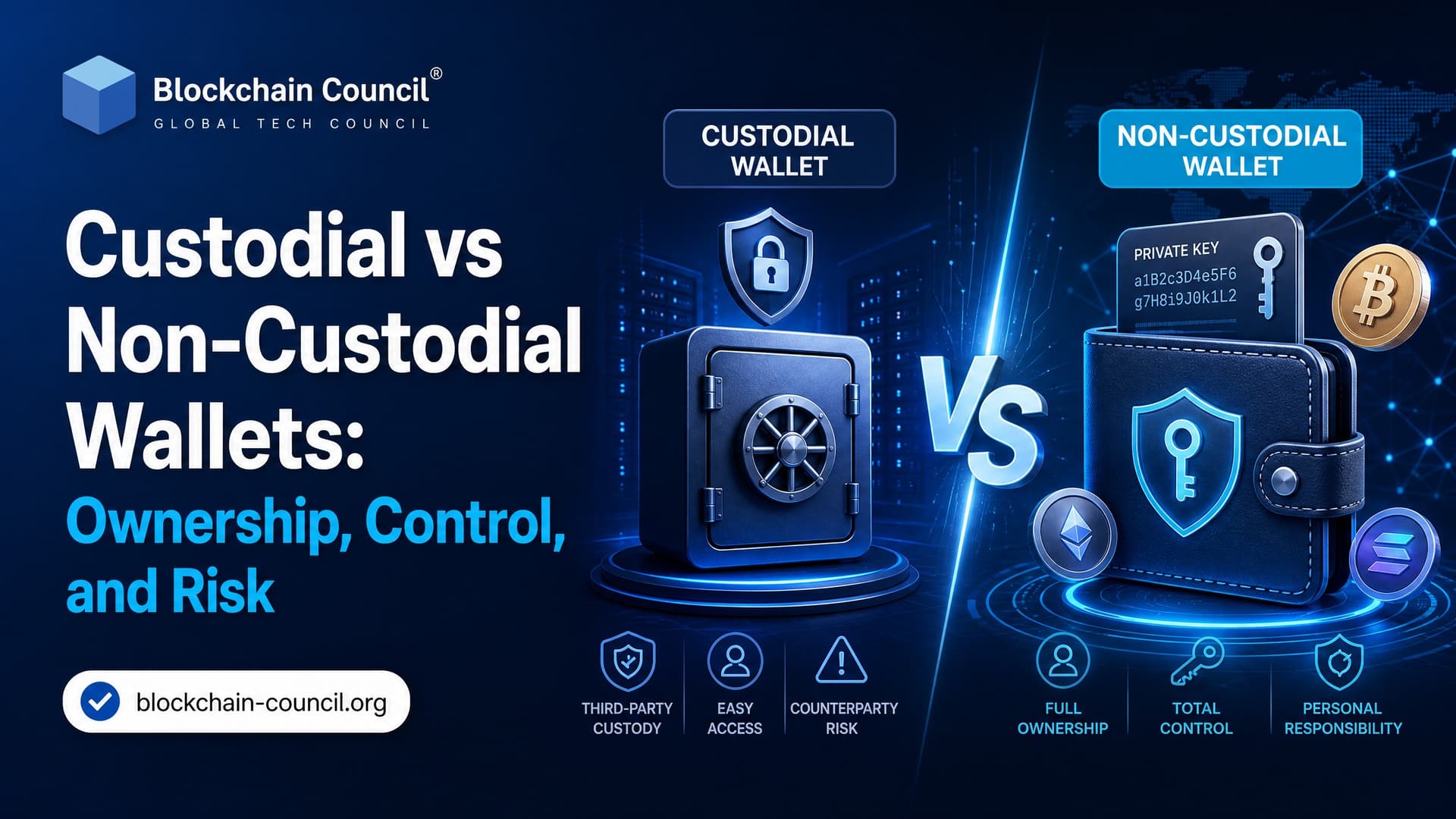
Custodial vs non-custodial wallets come down to one hard question: who controls the private keys? If a provider controls them, you are using custody. If you control them, you are using self-custody. That single design choice decides how much control you have, how recovery works, what privacy you can expect, and where the biggest risk sits.
This is not a minor user-interface choice. It affects legal ownership, day-to-day security, DeFi access, compliance, and incident response. The trade-off is simple to state: in a custodial model, risk sits mainly with the provider. In a non-custodial model, risk sits mainly with you.

What Is a Custodial Wallet?
A custodial wallet is a wallet where a third party, usually an exchange, fintech app, or qualified custodian, holds and manages the private keys for you. You log in with an email, password, passkey, or two-factor authentication. The provider signs blockchain transactions behind the scenes.
Think of it like online banking for crypto. Your account may show 0.5 ETH, but technically you do not control the Ethereum address holding those assets. You have a claim against the provider. If the provider freezes withdrawals, suffers an outage, or enters insolvency proceedings, your access can be interrupted even if Ethereum itself is producing blocks normally.
Why People Use Custodial Wallets
- Simple onboarding: You can create an account without learning seed phrases or gas fees first.
- Account recovery: Password resets and support tickets exist. That matters for beginners.
- Fiat ramps: Many custodial services connect directly to bank cards, bank transfers, and trading pairs.
- Compliance support: KYC, AML screening, tax reports, and transaction histories are often built in.
- Institutional controls: Professional custodians may offer policy approvals, audit trails, and segregation of duties.
The trade-off is dependency. To be blunt, if you cannot withdraw, your crypto is only useful inside that provider's system.
What Is a Non-Custodial Wallet?
A non-custodial wallet, also called a self-custody wallet or Web3 wallet, gives you control of the private keys. Wallets such as MetaMask, Rabby, Trust Wallet, Ledger Live with a hardware device, and many smart-contract wallets act as interfaces. They help you create keys, sign transactions, and connect to networks. They do not hold the assets for you.
The assets live on-chain. The wallet helps you prove control. On Ethereum mainnet, chain ID 1, your wallet signs a transaction that the network validates. If you send an ERC-20 token, interact with an ERC-721 NFT contract, or approve a DeFi protocol, your private key or signer authorizes that action.
Why People Use Non-Custodial Wallets
- Direct control: No exchange approval is needed to move funds.
- DeFi and Web3 access: You can connect to decentralized exchanges, lending protocols, DAOs, NFT markets, and on-chain games.
- More privacy by default: Most self-custody wallets do not require KYC to create an address.
- Censorship resistance: A wallet provider cannot normally stop you from signing with keys you hold.
- Hardware security options: Dedicated signers can keep keys off your laptop or phone.
But there is no magic safety net. Lose the seed phrase and the funds may be gone. Sign the wrong transaction and the result may be final. I have seen new users approve a malicious ERC-20 spender because the wallet screen looked harmless. The token did not leave immediately. Ten minutes later, the approved contract drained the balance. That is self-custody risk in one painful example.
Ownership: IOU vs On-Chain Control
The phrase not your keys, not your coins is overused, but the legal and technical point is real.
Custodial Wallets: Contractual Ownership
With custodial wallets, ownership and control are separated. The provider controls the private keys. You usually hold a contractual or beneficial claim to a balance shown in your account. Depending on jurisdiction and the provider's legal structure, client assets may be treated differently in bankruptcy or enforcement actions.
This is why regulated custodians are expected to maintain strict controls: cold storage policies, multi-person approvals, account segregation, audit processes, and incident procedures. Serious custody design is a risk-management issue, not a product checkbox.
Non-Custodial Wallets: Direct Control
With non-custodial wallets, the private key or seed phrase is the root of control. The wallet company generally cannot recover your funds, reverse a transaction, or reset your access. That is the point.
This direct control is powerful for DeFi users and blockchain-native businesses. A DAO treasury, for example, may use a smart-contract wallet with multiple signers rather than leaving assets on a centralized exchange. For professionals building this kind of system, Blockchain Council's Certified Blockchain Expert™ and Certified Blockchain Developer™ help connect wallet architecture with broader blockchain design.
Risk Comparison: Where the Failure Happens
Neither wallet type is automatically safer. The failure mode changes.
Custodial Wallet Risks
- Counterparty risk: You depend on the provider's solvency, governance, and honesty.
- Platform hacks: Centralized pools of funds attract attackers because one breach can expose many users.
- Withdrawal freezes: Maintenance, liquidity issues, sanctions screening, or legal orders can block access.
- Privacy loss: KYC and transaction monitoring are standard in regulated services.
- Policy limits: You may be unable to interact with certain tokens, networks, or dApps.
Non-Custodial Wallet Risks
- Seed phrase loss: If your recovery phrase is lost and no backup exists, recovery is usually impossible.
- Phishing: Fake wallet pop-ups, cloned dApps, and malicious approvals remain common attack paths.
- Device compromise: Malware can replace addresses, capture clipboard data, or trick you into signing.
- User error: Sending assets to the wrong chain or contract can be unrecoverable.
- Gas mistakes: On Ethereum, beginners often hit errors such as insufficient funds for gas * price + value because they hold a token but no ETH for gas under EIP-1559 fee mechanics.
That last one sounds small. It is not. A wallet can show a healthy USDC balance, yet you still cannot move it on Ethereum without ETH to pay network fees. This is one of the first operational details certification candidates and new DeFi users tend to miss.
Custodial vs Non-Custodial Wallets for Different Users
Beginners
If you are buying your first small amount of crypto, a reputable custodial exchange can be reasonable. You get recovery, fiat access, and a cleaner learning curve. Do not store more than you are prepared to lose to platform risk. Move slowly.
Active DeFi and NFT Users
Use a non-custodial wallet. Custodial accounts are poor tools for DeFi because you need direct signing, dApp connections, token approvals, and network switching. Pair a browser wallet with a hardware signer once balances become meaningful. Also learn how to revoke token approvals and read transaction simulations.
Enterprises and Funds
Do not copy retail habits. Institutions usually need written custody policies, approval workflows, insurance review, accounting controls, and audit logs. A regulated custodian may be right for treasury storage. A multi-signature or smart-contract wallet may be better for protocol operations. Often, the correct answer is both.
Developers
For product builders, the choice affects regulation and architecture. If your app holds customer keys, you may be creating a custodial service with licensing duties. If your app is only a non-custodial interface, the compliance profile can be different, though not risk-free. Teams building wallet products should study key generation, signing flows, secure storage, and threat modeling. Blockchain Council's Certified Cryptocurrency Expert™ gives readers structured coverage of crypto markets, wallets, and risk.
Hybrid Wallets, MPC, and Account Abstraction
The market is moving toward mixed models. Multi-party computation, or MPC, can split signing authority across parties so no single machine holds the complete private key. Smart-contract wallets can add spending limits, recovery guardians, role-based permissions, and batched transactions.
Account abstraction on Ethereum, associated with ERC-4337, pushes this further by allowing wallet behavior to be programmed. That can mean social recovery, session keys for games, or policy-based approvals. Useful? Yes. A cure for bad security habits? No. If recovery guardians are weak or signing prompts are ignored, losses still happen.
Hardware wallets also remain important. A dedicated signer reduces exposure to malware on your daily computer. It does not protect you from approving a malicious transaction you failed to read. Security is process plus tooling, not tooling alone.
How to Choose the Right Wallet Model
Use this quick decision guide:
- Choose custodial if you need simple recovery, fiat access, regulated reporting, or institutional custody controls.
- Choose non-custodial if you need direct ownership, DeFi access, NFT activity, DAO participation, or censorship resistance.
- Choose hybrid or multi-signature if you manage team funds, protocol treasuries, or enterprise workflows.
- Avoid self-custody for large balances until you have tested backup recovery with a small amount first.
- Avoid leaving large idle balances on exchanges unless you have assessed the provider's custody, audit, and legal protections.
Before moving serious funds, do a dry run. Create the wallet. Back it up. Send a small amount. Restore it on a second device or compatible wallet. Then send it back. This boring test catches mistakes before they become expensive.
Practical Next Step
If you want convenience, start with a reputable custodial platform and learn the basics. If you want real on-chain control, set up a non-custodial wallet with a hardware signer and practice with small transactions. For a structured path, pair hands-on wallet practice with Blockchain Council's Certified Cryptocurrency Expert™ or Certified Blockchain Expert™ so you understand not just how wallets work, but where ownership, control, and risk actually sit.
Related Articles
View All
Cryptocurrency
How Cryptocurrency Actually Works: Wallets, Transactions & Mining
Learn How Cryptocurrency Actually Works, from wallets and keys to transaction verification, mining, staking, gas fees, confirmations, and the security mistakes to avoid.

Cryptocurrency
NFTs Explained: Digital Ownership, Collectibles, and Token Standards
NFTs explained through digital ownership, collectibles, ERC-721, ERC-1155, royalties, legal rights, use cases, and practical risks for Web3 professionals.
Cryptocurrency
Crypto Options Trading: Calls, Puts, and Risk Management
Learn how crypto options trading works through calls, puts, Greeks, hedging strategies, and practical risk management rules for volatile markets.
Trending Articles
The Role of Blockchain in Ethical AI Development
How blockchain technology is being used to promote transparency and accountability in artificial intelligence systems.
AWS Career Roadmap
A step-by-step guide to building a successful career in Amazon Web Services cloud computing.
Claude AI Tools for Productivity
Discover Claude AI tools for productivity to streamline tasks, manage workflows, and improve efficiency.