

Free Claude: Is Claude Fable Free or a Real Product?


Free Claude is real, but Claude Fable is not an official Anthropic product name. If you are asking whether you can use Claude to write fables, short stories, moral tales, or classroom-style narratives without paying, the answer is yes, within the daily limits of Claude.ai's free tier. If you mean a separate tool called Claude Fable, there is no credible evidence that Anthropic offers one.
That distinction matters. A free account on Claude.ai is different from Claude Pro, Claude API access, and community-built tools that copy a Claude-like workflow while routing requests to other models. The user experience can look similar. The costs, privacy terms, reliability, and model quality are not the same.

What Does Free Claude Mean?
Free Claude usually refers to the no-cost web access available through Claude.ai. The free tier and Pro tier are clearly different products, and free users get a limited number of prompts per day before they hit a cap.
So the short version is simple:
- Yes, Claude has a free web tier.
- Yes, that tier has usage limits.
- No, free access is not meant for heavy production work.
- Paid Pro and API options exist for higher-volume use.
Anthropic does not always publish a fixed, permanent free quota that applies to every user forever. Limits can vary by demand, region, model availability, account age, and product changes. Treat the free tier as a useful starting point, not as guaranteed infrastructure.
Is There an Official Claude Fable Product?
No. There is no official Anthropic product called Claude Fable in any public source. The word Fable is best read as a use case: asking Claude to write a fable, parable, children's story, myth, or lesson-based narrative.
This is a common point of confusion because people search for AI tools by task. You may see queries like "Claude poem," "Claude resume," "Claude fable," or "Claude coding." These usually describe what the user wants Claude to do, not a standalone Anthropic product.
Can You Write Fables With Free Claude?
Yes. Free Claude can generate fables as long as you stay inside your daily message limits. For light creative writing, that is often enough. A short fable may only take one or two prompts if you know what to ask.
For example, you can ask:
Write a 600-word fable for 10-year-old readers about a clever crow and an impatient fox. The moral should be about checking facts before acting. Use simple language, no rhyming, and end with a one-sentence moral.
That prompt usually works better than "write a fable" because it sets audience, length, characters, theme, style, and ending. Small prompt details change output quality more than beginners expect. Ask for "a fable for children" and you may get something generic. Specify the moral and reading age, and the structure improves quickly.
Where Free Claude Works Well
Free Claude is useful when your work is occasional, exploratory, or low risk. It is not the right choice when you need guaranteed uptime, predictable throughput, or contractual data controls.
Good Uses for Free Claude
- Creative writing: Draft fables, dialogue, story outlines, classroom examples, and short moral tales.
- Learning: Ask for plain-language explanations of AI, blockchain, Web3, cybersecurity, or software concepts.
- Editing: Improve tone, remove repetition, simplify dense paragraphs, or create alternative versions.
- Light coding help: Debug small snippets, review error messages, or ask for an explanation of a function.
- Brainstorming: Generate titles, lesson ideas, quiz questions, or article outlines.
Where Free Claude Is the Wrong Choice
- Production customer support: Daily caps and outages can interrupt service.
- Large document processing: Long files can consume your allowance quickly.
- Team workflows: Shared professional usage usually needs admin controls and predictable access.
- Regulated data: Review Anthropic's current data policies and your own compliance requirements before pasting sensitive content.
- High-volume coding: Serious software teams usually move to paid plans, API access, or a controlled internal setup.
To be blunt, free AI tools are best treated like a good notebook, not like a production database. Useful every day. Not something you build a critical business process around without a fallback.
Free Claude vs Claude Pro vs API Access
The free Claude tier is the entry point. Claude Pro is for users who need more access through the web product. API access is for developers and organizations building Claude into software systems.
Here is the practical difference:
- Free Claude: Best for personal use, learning, short writing tasks, and trying the assistant before paying.
- Claude Pro: Better for frequent users who want higher limits and more dependable access through Claude.ai.
- Claude API: Best for applications, automation, backend services, internal tools, and controlled deployments.
If you are only writing one fable a day, Free Claude is probably fine. If you are generating hundreds of story variations for an educational app, use the API or another production-grade model pipeline. The free tier is not designed for that workload.
What About "Free Claude Code" and Community Tools?
There is another layer to the Free Claude conversation: community projects that imitate Claude-style workflows while using different back-end models.
Some tutorials describe a "free Claude Code" setup where a local proxy runs at localhost:8082 and redirects requests from a Claude Code-style interface to other providers or local models. Examples discussed in the developer community include routing through OpenRouter or running local inference with Ollama.
That can reduce cost. It can also create confusion.
If the back end is not Anthropic's model, you are not really using Claude. You are using a Claude-like interface. The model may answer differently, follow instructions differently, handle safety differently, and store data under different terms. For coding, that may be acceptable. For sensitive enterprise work, it needs review.
A Practical Warning for Developers
If you experiment with proxy-based AI tooling, keep secrets out of your repository. I still see developers paste provider keys directly into config files, then push them to GitHub by accident. Use environment variables, add .env to .gitignore, and rotate keys immediately if they leak. Cheap experiments become expensive fast when a public key starts serving someone else's traffic.
Reliability: Free Does Not Mean Always Available
Claude is generally available, but outages happen. Incidents have hit Claude.ai, the API, and Claude Code at the same time, affecting both free and Pro users. Free users have also seen quota-tracking issues, where the system behaved as if prompts had already been used.
Third-party monitoring sources such as StatusGator, Pulsetic, and Downdetector track Claude.ai and the Anthropic API, and they show that short incidents do occur. Anthropic also maintains its own Claude status page for live and historical service information.
If you rely on Free Claude, plan around two constraints:
- Usage limits: You may hit the daily cap during long sessions.
- Service interruptions: Login, quota tracking, API availability, or model access may fail temporarily.
For casual writing, this is an inconvenience. For business operations, it is a design risk.
How to Get Better Fables From Free Claude
If your main interest is fable-style writing, use structured prompts. Claude tends to respond well when you define constraints clearly.
Use This Prompt Structure
- Audience: "For readers aged 8 to 10."
- Length: "Around 500 words."
- Characters: "A tired turtle and a proud eagle."
- Conflict: "They disagree about speed versus patience."
- Moral: "Careful work beats rushed work."
- Style: "Simple, warm, no slang."
- Revision request: "Make the ending less obvious and add one funny moment."
Do not spend ten prompts fixing a vague first draft. Spend one prompt making the assignment precise. That saves your free quota.
Learning AI Beyond Free Tools
Free Claude is a good place to practice prompt writing, but professionals need broader AI literacy: model behavior, privacy, evaluation, automation, and governance. If you want a structured path, consider Blockchain Council programs such as the Certified Generative AI Expert™, Certified AI Expert™, or Certified Prompt Engineer™ as next steps.
For developers working with AI systems, pair prompt practice with API fundamentals, model evaluation, and basic security controls. If you also work in Web3, AI agents, or decentralized apps, connect this learning with Blockchain Council programs around blockchain and Web3 development.
Final Answer: Is Claude Fable Free?
Free Claude is available, but Claude Fable is not a separate official product. You can use the free Claude.ai tier to write fables and other narrative content until you hit your daily usage limit. For heavier writing, team workflows, coding assistance, or production systems, expect to use Claude Pro, API access, or a carefully reviewed alternative model setup.
Your next step: create a free Claude.ai account, test three fable prompts with clear constraints, and track how quickly you hit the daily limit. If you are using AI professionally, build your prompt and model-evaluation skills through a structured certification such as the Certified Prompt Engineer™ or Certified Generative AI Expert™.
Related Articles
View All
Claude Ai
How to Use Claude Fable 5.1 for Free
Find out whether Claude Fable 5.1 is available for free, which Claude plans provide access, and what users need to know before trying Anthropic’s latest AI model.

Claude Ai
How to Use Fable 5 for Free: Claude Access Options Explained
Learn how to use Fable 5 for free through Claude plan promotions, Claude Code, and GitLab Duo trials, plus limits, pricing, and smart test cases.
Claude Ai
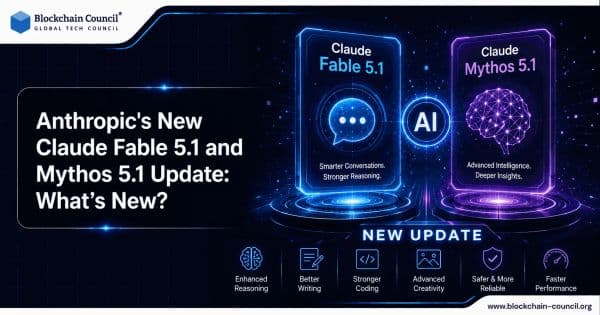
Anthropic's New Claude Fable 5.1 and Mythos 5.1 Update: What's New?
Anthropic’s Claude Fable 5.1 and Mythos 5.1 update brings stronger coding, long-running agentic workflows, research, vision, and knowledge-work capabilities. Fable 5.1 is generally available and introduces cheaper cache reads, potentially reducing typical workload costs by about 25% and highly agentic workloads by up to 45%. Mythos 5.1 uses the same underlying model but offers expanded cybersecurity and biology capabilities to vetted organizations through trusted-access programs.
Trending Articles

Top 5 DeFi Platforms
Explore the leading decentralized finance platforms and what makes each one unique in the evolving DeFi landscape.
What is AWS? A Beginner's Guide to Cloud Computing
Everything you need to know about Amazon Web Services, cloud computing fundamentals, and career opportunities.
Blockchain in Supply Chain Provenance Tracking
Supply chains are under pressure to prove not just efficiency, but also authenticity, sustainability, and fairness. Customers want to know if their coffee really is fair trade, if the diamonds are con