

Fable 5 vs Previous Fable Models: What Changed and Why It Matters

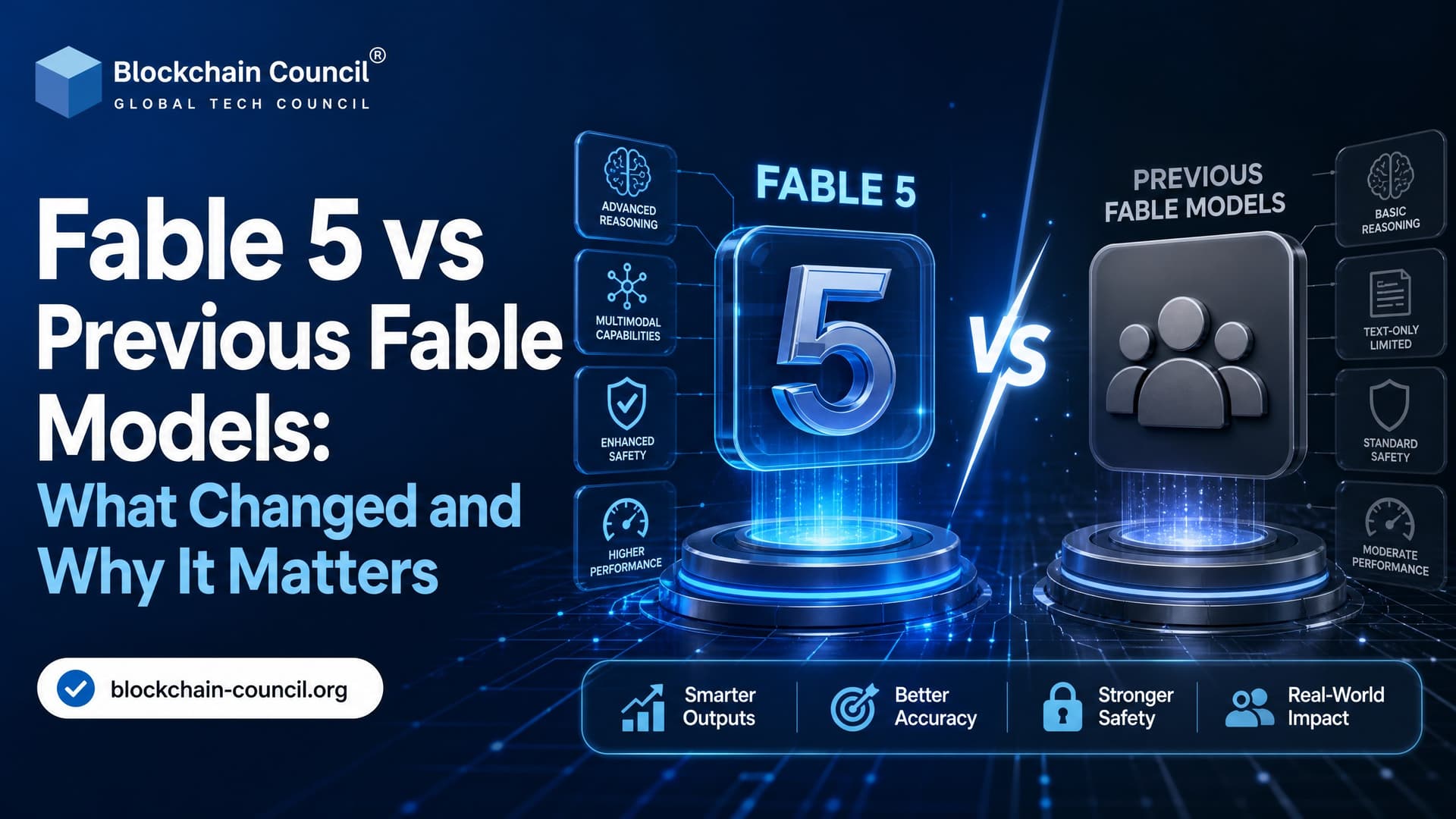
Fable 5 vs previous Fable models is not a simple version comparison. Anthropic's public Fable 5 marks the first accessible Mythos-class Claude model, with stronger reasoning, coding, long-context handling, and one-click game generation. It also comes with stricter safety gates, usage caps, and some reported post-launch regressions that developers cannot ignore.
If you build AI agents, code review tools, research assistants, or enterprise copilots, the lesson is direct. Fable 5 is more capable than earlier Claude models on several frontier tasks. It is also less predictable across updates and more constrained in sensitive domains.

Fable 5 Timeline: From June Launch to July Retuning
Anthropic released Claude Fable 5 on June 9, 2026, positioning it as the first public model in its Mythos-class tier. Launch coverage described it as a frontier-grade general model, not a small Claude refresh. Its headline feature was unusual: one-click generation of complete, playable video games.
That feature matters because it combines several hard AI tasks at once. The model has to plan gameplay, generate code, reason about state, create or describe assets, and keep the final product coherent enough to run. Earlier public Claude models could help you build a game. Fable 5 was pitched as able to produce one from a much higher-level instruction.
The public model is reportedly adapted from Anthropic's internal Mythos 5 system. Industry coverage described Mythos 5 as a more capable internal model that was not released broadly because of safety concerns. Public Fable 5 keeps much of the capability, but Anthropic added stronger guardrails before exposing it to users.
Then came July. Community benchmarking, discussed widely by developers, suggested that Fable 5 changed sharply after a July 1 update. Debugging scores reportedly fell from 86.2 to 25.9. Refactoring scores dropped from about 73 to near zero. At the same time, hallucination rates fell from roughly 75 to under 1 in the cited analysis.
That trade-off is the story. Less fabrication, but also less freedom to solve certain tasks aggressively.
What Changed Technically in Fable 5?
A New Mythos-Class Capability Envelope
Previous Claude models such as Opus and Sonnet were already strong at writing, summarization, coding assistance, and analysis. Fable 5 shifts the framing. It is described as a Mythos-class model, meaning Anthropic is treating it as a generational step rather than a routine point release.
In practice, that shows up in three areas:
- More coherent long tasks: Fable 5 is reported to hold instructions across longer workflows with less drift.
- Stronger code synthesis: Comparison testing found Fable 5 ahead of GPT 5.5 on coding-focused evaluations such as HumanEval and SWE-bench-style tasks.
- Better multi-step reasoning: The same analysis reported an edge on MATH and GPQA-style reasoning tasks, with fewer confidently wrong answers.
For developers, the lived difference is not just that the first answer looks better. It is that a long agent run is less likely to forget the original requirement halfway through. Anyone who has watched an AI coding agent change a test, then change the implementation, then quietly remove the test assertion knows why that matters.
One-Click Game Generation
Fable 5's game generation feature is the clearest visible upgrade over previous public Claude models. Hands-on testing reportedly found the generated games "weirdly fun." That sounds casual, but it points to a serious capability: coordinated generation across logic, interaction, and presentation.
This does not mean Fable 5 replaces a game studio. It does mean you can use it for fast prototyping. If you are testing a mechanic, a tutorial flow, or a mini-game concept, the model can shorten the distance between idea and playable draft.
More Targeted Code Diffs
Pre-launch developer feedback highlighted another useful detail: Fable 5 often produced smaller, more surgical diffs. That is not glamorous. It is valuable.
Older coding models often rewrote an entire function, or worse, a whole file, when a three-line patch would do. That creates noisy pull requests and makes review harder. A model that changes only the failing branch, updates the right test, and leaves unrelated code alone saves time in real teams.
One caveat: the July retuning may have affected this behavior. If your June workflow depended on Fable 5 as a refactoring partner, rerun your own benchmark before trusting the current version.
Safety Guardrails Are Now Part of the Product
Fable 5 is not only a smarter model. It is a more heavily managed model.
Reports describe stricter topic restrictions than earlier Claude releases. Instead of only refusing at the response level, Fable 5 appears to use broader domain-level controls and classifier-based prompt screening. Post-launch commentary also noted automated classifiers that block more requests if they fall into harmful or ambiguous categories.
Cybersecurity and biology are the two domains developers mention most often. That is understandable. Both have legitimate professional uses and clear misuse risks. A security engineer asking for exploit-chain reasoning in a lab may be doing valid work, but a classifier may not see enough context to distinguish that from harmful intent.
This is where enterprises need to be careful. Do not design a production workflow that assumes every prompt accepted in June will still be accepted in August. Treat model access policy as a moving dependency, like an API version or a cloud quota.
Fable 5 vs Previous Fable: June Was Not the Same as July
The most important comparison may be Fable 5 vs Fable 5 itself.
According to the benchmark rerun discussed by the developer community, the June release looked much stronger on debugging and refactoring. The July version looked much safer and much less prone to hallucination, but weaker on tasks that require active code diagnosis or structural changes.
Here is the practical reading:
- June Fable 5: More capable for debugging, refactoring, and aggressive problem solving, but more likely to fabricate or take risky paths.
- Post-July Fable 5: More conservative, lower hallucination rate, stronger safety posture, but less reliable for certain coding workflows.
- Opus 4.8 comparison: Some developers report Opus 4.8 now performs better than current Fable 5 on multi-step logical debugging, even if Fable 5 remains stronger in other frontier tasks.
To be blunt, you should not pick a model based only on launch-week benchmarks. For AI engineering teams, the right habit is regression testing. Keep a private eval set with your own bug reports, pull requests, policy documents, and agent tasks. Run it after every major model update.
Fable 5 vs Earlier Claude Models: Where It Wins and Where It Does Not
Where Fable 5 Is Stronger
Fable 5 appears best suited to complex, long-horizon tasks where instruction coherence matters. Analysis points to stronger performance in autonomous agents, long-context retrieval, and multi-step coding tasks. That makes it a good fit for:
- Large codebase analysis
- Software migration planning
- Document and contract review
- Research synthesis across long source material
- Prototype generation for interactive applications
If you are building an AI agent that must plan, act, check its own work, and continue for many steps, Fable 5 deserves serious evaluation.
Where Earlier Claude Models May Still Be Better
Do not assume Fable 5 is the right default for every job. For basic CRUD scaffolding, short summaries, and routine chat workflows, Opus or Sonnet may be enough. They may also be less frustrating when Fable 5's safety classifier blocks borderline requests.
If your work is in cybersecurity, advanced biology, or another regulated area, test refusals early. A model that is brilliant 80 percent of the time but blocks a core workflow is not production-ready for your team.
Usage Limits Change Deployment Planning
Post-launch configuration reportedly made Fable 5 available to all paid Claude users, but with a limit of up to 50 percent of weekly usage. After that threshold, users must switch back to Opus or Sonnet. Reports also indicate that longer-term access moves to separate usage credits beyond a standard subscription.
That affects architecture. If your agent depends on Fable 5 for every step, you may hit limits at the worst time. A better design routes tasks by difficulty:
- Use Sonnet or Opus for simple classification, extraction, and formatting.
- Reserve Fable 5 for long-context reasoning, hard code changes, and high-value planning.
- Add human approval before sensitive actions, especially in security, legal, or financial workflows.
- Log refusals and fallback behavior so you can debug policy-related failures.
This is also where training matters. Professionals working with enterprise AI systems should understand prompt design, evaluation, governance, and risk controls. Blockchain Council's Certified Generative AI Expert™ and Certified Prompt Engineer™ are relevant learning paths for teams building with frontier models like Fable 5.
Why Fable 5 Matters for Enterprises and Developers
Fable 5 shows where frontier AI is heading: more capable, more agentic, and more governed. The model can handle larger contexts and harder coding tasks, yet its behavior can change when Anthropic adjusts safety settings, classifiers, or access limits.
That means your workflow should include:
- Model evaluation: Test Fable 5 against your own tasks, not only public benchmarks.
- Fallback models: Keep Opus, Sonnet, or another provider available for blocked or quota-limited work.
- Version awareness: Record when outputs were generated, especially for regulated work.
- Human review: Do not let an agent merge code, alter contracts, or trigger infrastructure changes without checks.
- Governance: Define which domains are allowed, restricted, or escalated to experts.
There is another pattern worth watching: model ensembles. Fusion benchmarks discussed in industry commentary showed panels of models outperforming Fable 5 alone on hard research tasks, with about 69 percent accuracy versus 65.3 percent for Fable alone. For high-stakes work, the future may be less about picking one model and more about combining several with clear review rules.
Best Next Step
If you used earlier Claude models, benchmark Fable 5 before moving production workloads. Start with ten real tasks: two bug fixes, two refactors, two long-document analyses, two agent workflows, and two prompts from a sensitive domain your team actually handles. Compare Fable 5 against Opus and Sonnet, then measure refusals, correctness, token use, and review time.
For professionals building AI systems, pair that hands-on testing with structured learning. Start with Blockchain Council's Certified Generative AI Expert™ if you need model strategy and governance depth, or Certified Prompt Engineer™ if your immediate work is prompt design, evaluation, and workflow reliability.
Related Articles
View All
Claude Ai
Claude Fable 5 vs Other AI Models: A Practical Comparison for Developers and Enterprises
Compare Claude Fable 5 with Opus 4.8, GPT-5.5, Gemini 3.1 Pro, and smaller models across coding, cost, safety, and enterprise use cases.

Claude Ai
How to Use Claude Fable 5.1 for Free
Find out whether Claude Fable 5.1 is available for free, which Claude plans provide access, and what users need to know before trying Anthropic’s latest AI model.

Claude Ai
Anthropic's New Claude Fable 5.1 and Mythos 5.1 Update: What's New?
Anthropic’s Claude Fable 5.1 and Mythos 5.1 update brings stronger coding, long-running agentic workflows, research, vision, and knowledge-work capabilities. Fable 5.1 is generally available and introduces cheaper cache reads, potentially reducing typical workload costs by about 25% and highly agentic workloads by up to 45%. Mythos 5.1 uses the same underlying model but offers expanded cybersecurity and biology capabilities to vetted organizations through trusted-access programs.
Trending Articles
What is AWS? A Beginner's Guide to Cloud Computing
Everything you need to know about Amazon Web Services, cloud computing fundamentals, and career opportunities.

Can DeFi 2.0 Bridge the Gap Between Traditional and Decentralized Finance?
The next generation of DeFi protocols aims to connect traditional banking with decentralized finance ecosystems.
Claude AI Tools for Productivity
Discover Claude AI tools for productivity to streamline tasks, manage workflows, and improve efficiency.