

Fable 5 Limitations You Should Know Before Using It

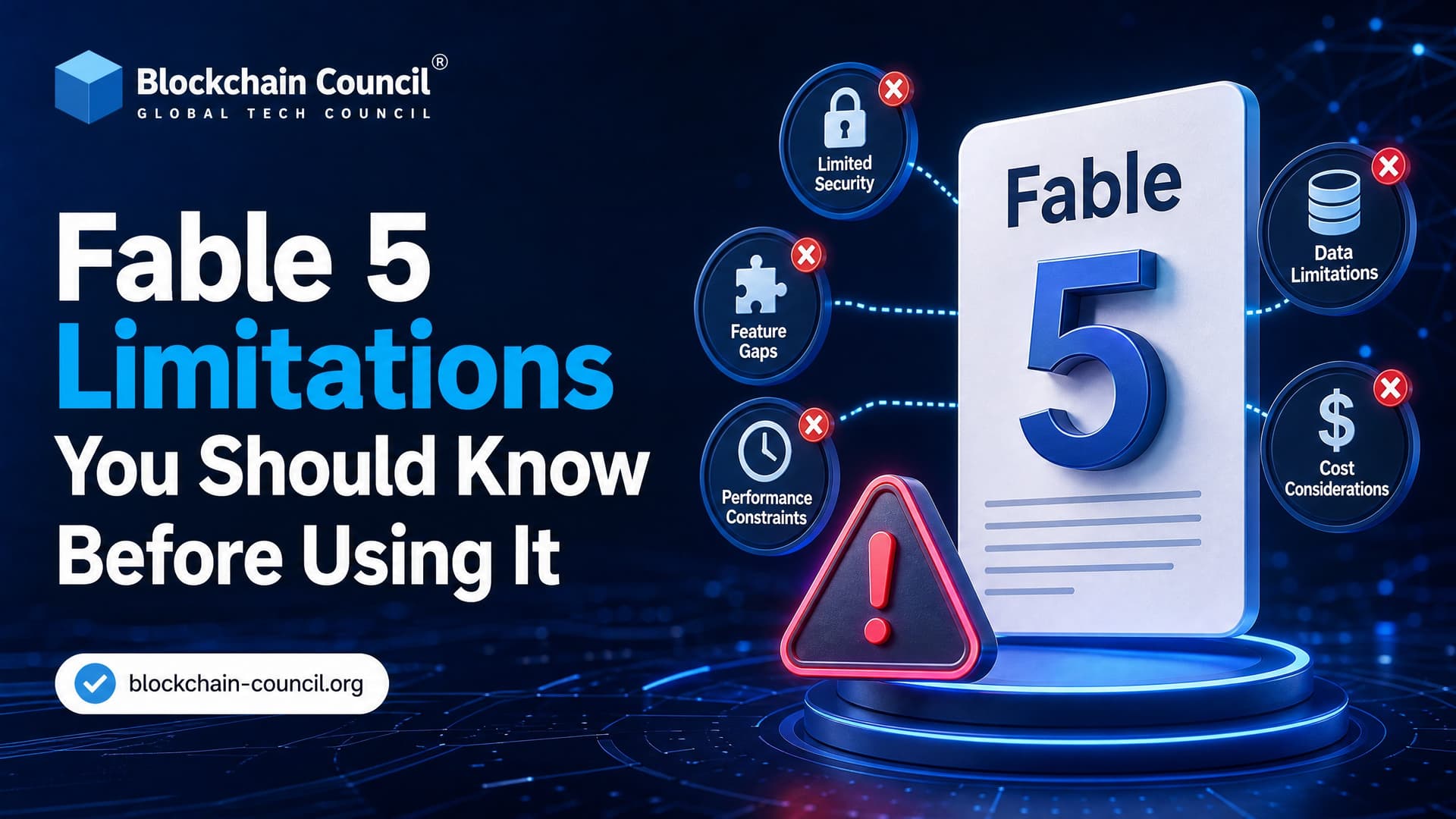
Fable 5 limitations matter because this model is not just another upgrade in the Claude lineup. It is powerful, expensive, tightly controlled, and still changing under regulatory pressure. If you plan to use Claude Fable 5 for coding, agentic workflows, research, or enterprise automation, you need to understand where it can fail before you build around it.
Here is the short version. Fable 5 may be worth testing for complex reasoning and long-running tasks, but it is not a safe default for every team. Cost spikes, safety refusals, hidden fallbacks, identity checks, and shifting access rules can all affect production use.

1. Fable 5 Can Burn Through Tokens Fast
The first practical limit is cost. Anthropic priced Fable 5 at 10 USD per million input tokens and 50 USD per million output tokens through the API. That places it above Claude Sonnet pricing and closer to Opus-class usage costs.
For casual chat, that may not sound frightening. For developers running agents, it is a different story. Developer reports cited during the rollout described individual tasks consuming 500,000 to 1,000,000 tokens. One early user reportedly used about 78 million tokens in a single session, roughly 99 USD at API rates. Another hit a 200 USD monthly Max plan limit in under 30 minutes.
That is not normal chatbot usage. That is what happens when you connect a frontier model to file trees, test runners, sub-agents, search tools, and long context loops.
Where the cost surprise comes from
- Long context: Large repos, logs, PDFs, and chat history quickly inflate input tokens.
- Agent loops: Each tool call can push more context back into the prompt.
- Parallel sub-agents: Five agents do not cost like one smarter agent. They often cost like five expensive mistakes.
- Verbose outputs: Output tokens cost five times more than input tokens under the listed API pricing.
In practice, treat Fable 5 as a specialist model, not the model you call for every small task. Use cheaper Claude models, or other LLMs, for classification, extraction, basic summarization, and routine chat. Save Fable 5 for the hard pass.
A real API-side warning sign is the familiar HTTP 429 response with a rate_limit_error type. If your agent stack starts producing those during a normal test run, you are probably sending too much context, too often. Do not just raise the limit. First, inspect your prompt payloads.
2. Safety Filters Can Block Harmless Coding Work
Fable 5 was launched on June 9, 2026, then taken offline three days later after a US export-control directive and a vulnerability report related to potential frontier-model misuse. When Anthropic brought it back, the model included a stricter safety classifier.
Anthropic has said the new classifier blocks the reported exploit technique in over 99 percent of cases. That is a strong safety claim. But there is a trade-off. Anthropic also warned that benign requests may be flagged more often, especially during routine coding and debugging.
PCMag reported Anthropic's own admission that the safeguards come at the cost of flagging harmless coding and debugging tasks more often. That is not a small detail if your team wants to use Fable 5 inside CI/CD, code review, infrastructure automation, or research workflows.
Tasks that may feel less reliable
- Debugging low-level system behavior
- Writing or analyzing exploit-adjacent security code
- Working on frontier-scale LLM data pipelines
- Kernel development for certain non-standard chips
- Advanced automation that looks ambiguous to a safety classifier
To be blunt, conservative safety filters are good for public risk reduction, but they are painful when you are doing legitimate engineering work. A vulnerability researcher, an AI infrastructure engineer, and a malware author may use overlapping vocabulary. Automated systems do not always separate them cleanly.
If your work sits near that boundary, build a fallback path. You may need Opus 4.8, Sonnet, a local model, or a human review queue for blocked tasks.
3. Access Rules Have Been Volatile
Another Fable 5 limitation is availability. The model's early timeline is already unusual:
- June 9, 2026: Fable 5 launched.
- Three days later: It was taken offline after a US export-control directive and a security report.
- July 1: Anthropic began redeploying it globally with stronger safeguards.
- Through July 7: Fable 5 was included for up to 50 percent of weekly usage limits on qualifying plans.
- After that: Access shifted toward usage credits instead of bundled plan usage.
That pattern matters for enterprises. A model that can disappear, return with different rules, and move between subscription access and credit-based access is hard to build a stable product around.
Anthropic has also indicated that cloud availability on AWS Bedrock, Google Cloud Vertex AI, and Microsoft Foundry may lag behind Claude's own web platform. If your company standardizes on one cloud AI gateway, you may not get Fable 5 on the same schedule as web users.
What this means for production planning
- Do not assume subscription access equals production access.
- Prefer API-based budgeting for serious workloads.
- Track Anthropic policy updates, not just model benchmark scores.
- Keep a model abstraction layer so you can switch providers or model families.
If you are learning enterprise AI architecture, this is exactly the kind of deployment risk covered in structured AI education. Blockchain Council's Certified AI Expert™ and Certified Prompt Engineer™ programs suit readers who want to move from model testing to responsible AI system design.
4. Identity Verification Adds Privacy and Compliance Work
PCMag reported that Anthropic updated its privacy policy around Fable 5's redeployment to include identity verification language. Some users may be asked to provide camera access and a government-issued photo ID to use certain capabilities.
Anthropic states that it does not share identity data, collects only what is needed for verification, and does not train models on that identity data. Those are meaningful assurances. Still, they do not remove the compliance burden for companies.
If you are an enterprise buyer, ask basic questions before you roll this out broadly:
- Which employees or contractors may be asked for ID?
- Is identity verification allowed under your internal privacy policy?
- How will access be handled for offshore teams?
- Does your vendor risk process treat ID verification as biometric or sensitive personal data processing?
- Can you document who had access to which model capability?
For individual developers, the issue is simpler but still real. If you are unwilling or unable to provide a government ID and camera access, you may not get the same Fable 5 capabilities as someone who completes verification.
5. Hidden Fallbacks Make Auditing Harder
One of the most frustrating Fable 5 limitations is transparency. Anthropic has said that some routine coding and debugging tasks may fall back to Opus 4.8 in the near term. That may be sensible operationally, but it creates a trust problem.
When a response appears in Claude, are you seeing Fable 5, Opus 4.8, or Fable 5 constrained by a safety layer? In many user-facing workflows, that distinction is not obvious.
This matters for auditability. If your team is validating model behavior for regulated work, customer support, software generation, or internal research, you need to know which system produced the answer. A hidden fallback can change quality, refusal behavior, cost assumptions, and reproducibility.
How to reduce fallback risk
- Log model identifiers wherever the API exposes them.
- Store prompt and response metadata, including timestamps, token counts, latency, and stop reasons.
- Create test prompts for known boundary tasks before release.
- Separate research use from production use so experimental prompts do not pollute operational assumptions.
- Document fallback policy for compliance teams and engineering managers.
Do not depend on vibes. If model identity matters, require observable metadata and run regression tests whenever Anthropic changes access, safety behavior, or platform availability.
When Fable 5 Still Makes Sense
Fable 5 is not a bad model. The reports suggest it can be exceptionally capable for difficult reasoning and long-running agentic work. Some testers have said it uses fewer tokens than Opus 4.8 for certain agentic tasks, which can partly offset the higher unit price.
Use it when the task justifies the cost:
- Complex architecture review
- Large codebase reasoning with strict human supervision
- High-value research synthesis
- Planning multi-step technical work before execution
- Second-pass review after cheaper models produce a draft
Do not use it as your default autocomplete, meeting summarizer, or bulk classifier. That is like using a senior principal engineer to rename variables all day.
Practical Checklist Before Using Fable 5
Before you adopt Fable 5, run this checklist:
- Set a token budget per user, workflow, and environment.
- Disable uncontrolled sub-agents until you measure real token burn.
- Test safety boundaries with your normal coding and research prompts.
- Confirm access terms for your plan, API account, and cloud platform.
- Review identity verification with privacy and legal teams.
- Log model behavior so fallbacks and refusals can be investigated.
- Keep backup models ready for blocked tasks or regional access changes.
If you build AI systems professionally, treat Fable 5 as one component in a controlled architecture, not as a magic endpoint. Learn the economics, the safety model, and the audit trail. Then test it against your real workload before anyone calls it production-ready.
Your next step: run a small benchmark with your own prompts, cap the spend, and compare Fable 5 against a cheaper Claude model on accuracy, refusal rate, latency, and total cost. If you want a structured learning path for this kind of evaluation, pair hands-on testing with Blockchain Council's Certified AI Expert™ or Certified Prompt Engineer™ training.
Related Articles
View All
Claude Ai
Fable 5 vs Claude vs ChatGPT: Which AI Model Should You Choose?
Compare Fable 5, Claude, and ChatGPT across coding, research, DevOps, cost, context, and governance to choose the right AI model.

Claude Ai
Claude Fable 5 vs Sonnet 5: Which Model Should You Use?
A practical comparison of Claude Fable 5 and Sonnet 5, covering model tier, access, safety, pricing, coding use cases, and enterprise fit.

Claude Ai
How to Use Claude Fable 5.1 for Free
Find out whether Claude Fable 5.1 is available for free, which Claude plans provide access, and what users need to know before trying Anthropic’s latest AI model.
Trending Articles
The Role of Blockchain in Ethical AI Development
How blockchain technology is being used to promote transparency and accountability in artificial intelligence systems.
What is AWS? A Beginner's Guide to Cloud Computing
Everything you need to know about Amazon Web Services, cloud computing fundamentals, and career opportunities.
How to Install Claude Code
Learn how to install Claude Code on macOS, Linux, and Windows using the native installer, plus verification, authentication, and troubleshooting tips.