

Core Foundations of Claude
 Suyash Raizada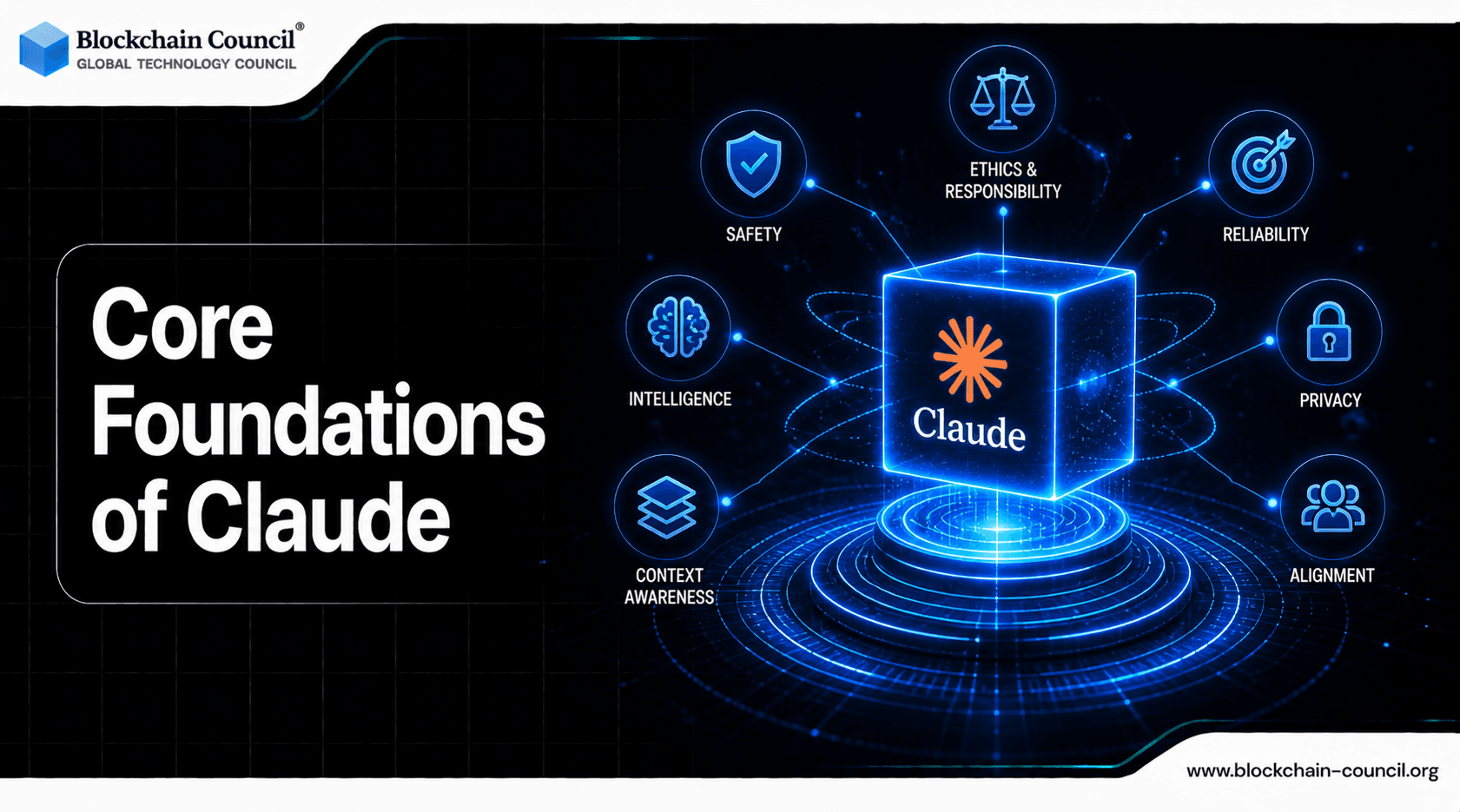
Claude AI
Artificial Intelligence is evolving rapidly-but not all AI systems are built the same way. As tools like ChatGPT, Gemini, and others dominate conversations, a powerful alternative is quietly redefining how AI should behave: Claude AI.
If you’ve ever wondered:

Why some AI models feel more “human”
How safety and ethics are built into AI
Which AI skills are future-proof
Then understanding the core foundations of Claude is essential.
In this guide, you’ll learn everything-from Anthropic’s vision to Claude’s model evolution, its unique safety framework, and how you can build a career around it.
What is Anthropic? The Company Behind Claude
Anthropic is an AI research company founded by former OpenAI researchers with a clear mission: build reliable, interpretable, and steerable AI systems.
Key Goals of Anthropic
Prioritize AI safety and alignment
Create systems that follow human values
Reduce harmful or biased outputs
Make AI trustworthy for real-world use
Unlike many AI companies focused purely on performance, Anthropic emphasizes responsible intelligence-and that’s where Claude stands out.
What is Claude AI? Models, Philosophy & Purpose
Claude is a family of large language models (LLMs) designed to be:
Helpful
Honest
Harmless
This philosophy is central to everything Claude does.
Core Philosophy
Claude is not just built to answer questions-it’s built to:
Understand context deeply
Avoid harmful or misleading responses
Provide structured, thoughtful outputs
Key Capabilities
Content writing and editing
Code generation and debugging
Research summarization
Business automation
Conversational AI
Claude models are especially known for:
Long context understanding
Better reasoning
Safer responses
What is Constitutional AI? Claude’s Safety Framework
One of the most important foundations of Claude is Constitutional AI.
What is Constitutional AI?
It’s a training method where AI follows a set of predefined ethical principles (“constitution”) instead of relying only on human feedback.
How It Works
AI generates responses
It evaluates its own output using ethical guidelines
It improves responses based on those principles
Why It Matters
Reduces bias
Improves safety
Enables self-correction
Makes AI more scalable
Example
If asked a sensitive question, Claude:
Avoids harmful answers
Provides balanced perspectives
Suggests safe alternatives
This makes Claude particularly useful for:
Businesses
Education
Content creation
Claude vs Traditional LLMs: What Makes It Different?
Let’s compare Claude with traditional AI models.
1. Safety First Approach
Claude: Built with Constitutional AI
Traditional LLMs: Rely heavily on human moderation
2. Better Context Handling
Claude can process very long documents
Ideal for research, legal, and business use
3. More Natural Responses
Less robotic
More structured
Easier to understand
4. Reduced Hallucination
More cautious with uncertain information
Provides safer outputs
5. Business-Friendly Design
Claude is widely used in:
Customer support automation
Content workflows
Internal knowledge systems
Evolution of Claude: From Claude 1 to Claude 4
Claude has evolved rapidly over time. Let’s break it down.
Claude 1
Initial release
Focus on safety and usability
Basic reasoning capabilities
Claude 2
Improved performance
Longer context window
Better coding and writing
Claude 3
A major leap forward with three model types:
Higher accuracy
Faster processing
Advanced reasoning
Claude 4 (Latest Generation)
Claude 4 represents a next-level AI system:
Superior reasoning
Near-human comprehension
Enterprise-grade capabilities
Enhanced multimodal abilities
It’s designed for:
Professionals
Developers
Businesses
Claude Model Types Explained: Opus, Sonnet & Haiku
Claude offers different models based on use cases.
1. Opus (Most Powerful)
Best for:
Complex reasoning
Research tasks
Advanced coding
Features
Highest intelligence
Deep analysis
Best accuracy
2. Sonnet (Balanced Model)
Best for:
Daily tasks
Content creation
Business workflows
Features
Good speed + intelligence balance
Cost-efficient
Highly versatile
3. Haiku (Fastest Model)
Best for:
Quick responses
Chatbots
Automation
Features
Lightweight
Ultra-fast
Budget-friendly
AI Learning Path: Why Claude Skills Matter
AI is no longer optional-it’s a career multiplier.
Step-by-Step Learning Roadmap
Step 1: Understand AI Basics
What are LLMs
How prompting works
Step 2: Learn Claude Prompting
Structured prompts
Business use cases
Automation workflows
Step 3: Apply in Real Projects
Content generation
AI tools for clients
Workflow automation
Step 4: Monetize Skills
Freelancing
Consulting
AI services
Certified Claude AI Expert Program (Soft Introduction)
If you want to go beyond theory, a structured learning path helps.
A Certified Claude AI Expert Program typically focuses on:
What You Learn
Advanced prompting techniques
Claude for business automation
Content systems using AI
Real-world use cases
Why It Matters
Build job-ready skills
Get certification credibility
Learn income-generating applications
Instead of just learning AI, you learn how to use it practically.
Top Tech Certifications to Combine with Claude Skills
To maximize your AI career, combine Claude expertise with tech skills.
Recommended Certifications
Python Certification
Automation + AI scripting
Node.js Certification
Backend AI integrations
AWS / Google Cloud Certification
Deploy AI applications
Data Analytics Certification
Work with AI-generated insights
Automation Tools (Zapier, Make)
Build AI workflows
Business Certifications That Complement AI Skills
AI + Business = High-income skill stack.
Must-Have Certifications
1. Digital Marketing Certification
SEO
Paid ads
Funnels
2. Social Media Marketing
Content strategy
Growth systems
3. Performance Marketing
ROI-driven campaigns
4. Freelancing Certification
Client acquisition
Pricing strategies
5. Entrepreneurship Programs
Build AI-powered businesses
Monetization Opportunities with Claude AI Skills
Once you understand Claude, multiple income streams open up.
1. Freelancing
AI content writing
Prompt engineering
Automation setup
2. AI Agency
Offer AI services to businesses
Build recurring revenue
3. Personal Brand
Teach AI
Create content
Sell digital products
4. Remote Jobs
AI specialist
Automation expert
Content strategist
Conclusion: Why Claude is the Future of AI
Claude is not just another AI tool-it represents a shift toward safer, smarter, and more human-aligned AI.
If you’re serious about:
Future-proof skills
High-income opportunities
Staying ahead in tech
Then learning Claude is a smart move.
Start small, stay consistent, and gradually build expertise. With the right learning path and certifications, you can turn AI into a powerful career asset.
FAQs
1. What is Claude AI?
Claude is an advanced AI assistant developed by Anthropic, designed for natural language understanding, reasoning, and content generation. It focuses on producing safe, helpful, and context-aware outputs. Claude is widely used across industries for tasks like writing, coding, and analysis. Its design emphasizes reliability and alignment with human intent.
2. How does Claude AI work?
Claude is built on large language model (LLM) architecture that processes and predicts language patterns. It is trained on vast datasets to understand context, meaning, and relationships in text. By analyzing input prompts, it generates relevant responses. Its strength lies in handling complex, multi-step reasoning tasks.
3. What makes Claude different from other AI models?
Claude stands out for its strong contextual understanding and safety-focused design. It can process long documents more effectively than many models. Its responses are generally more structured and thoughtful. This makes it suitable for professional and enterprise use.
4. What is the main purpose of Claude AI?
The primary purpose of Claude is to assist users in completing tasks efficiently. It helps with writing, research, coding, and decision-making. Businesses use it to automate workflows and improve productivity. It acts as a collaborative tool rather than just a chatbot.
5. What are the core features of Claude?
Claude offers features like text generation, summarization, reasoning, and document analysis. It can handle long context inputs and maintain coherence. It also supports multi-step problem solving. These features make it versatile across different domains.
6. What is meant by “context” in Claude?
Context refers to the information Claude uses to generate responses. This includes the user’s prompt and any additional data provided. Claude is known for its ability to handle large context windows. This improves accuracy and relevance.
7. What is a large language model (LLM)?
A large language model is an AI system trained to understand and generate human language. Claude is an example of an LLM. It uses deep learning techniques to process text. These models power modern AI tools.
8. How is Claude trained?
Claude is trained using large datasets and reinforcement learning techniques. It learns patterns, language structure, and reasoning abilities. Safety and alignment are key parts of its training process. This ensures more reliable outputs.
9. What is AI alignment in Claude?
AI alignment ensures that the model’s behavior matches human values and expectations. Claude is specifically designed with alignment principles. This reduces harmful or misleading outputs. It makes the AI safer to use.
10. Can Claude understand complex queries?
Yes, Claude can understand complex, multi-layered questions. It can break down problems and provide structured answers. This makes it useful for research and analysis. Its reasoning ability is a major strength.
11. What types of tasks can Claude perform?
Claude can perform tasks like writing, coding, summarizing, translating, and analyzing data. It is also useful for brainstorming and planning. Its flexibility allows it to adapt to many use cases. This makes it valuable across industries.
12. Is Claude suitable for beginners?
Yes, Claude is user-friendly and accessible to beginners. It requires simple text prompts to operate. Users do not need technical knowledge to start. This makes it widely adoptable.
13. How accurate is Claude AI?
Claude is generally accurate but depends on the quality of input prompts. Clear instructions lead to better outputs. Like all AI systems, it can make errors. Users should verify important information.
14. What is a prompt in Claude?
A prompt is the instruction or question given to Claude. It guides how the AI responds. Well-structured prompts improve output quality. Prompt design is a key skill.
15. Does Claude learn from user interactions?
Claude does not learn in real time from individual conversations. Its training happens in controlled environments. However, it uses context within a session to improve responses. This ensures continuity.
16. What are the limitations of Claude?
Claude may produce incorrect or outdated information at times. It depends heavily on input clarity. It also lacks real-time awareness unless integrated with tools. Understanding its limits is important.
17. Is Claude safe to use?
Claude is designed with safety and ethical guidelines in mind. It avoids harmful or inappropriate responses. However, users should still apply judgment. Responsible use is essential.
18. How does Claude handle long documents?
Claude can process large amounts of text efficiently. It can summarize, analyze, and extract insights from long documents. This makes it useful for research and business tasks. Its long-context ability is a key advantage.
19. Can Claude replace human work?
Claude enhances productivity but does not replace human expertise. It supports tasks but requires oversight. Human creativity and decision-making remain essential. It acts as an assistant, not a replacement.
20. Why is Claude important in AI today?
Claude represents a shift toward more reliable and aligned AI systems. It combines strong performance with safety features. Its use is expanding across industries. It plays a significant role in the future of AI.
Related Articles
View All
Claude Ai
How to Use Claude Fable 5.1 for Free
Find out whether Claude Fable 5.1 is available for free, which Claude plans provide access, and what users need to know before trying Anthropic’s latest AI model.

Claude Ai
Anthropic's New Claude Fable 5.1 and Mythos 5.1 Update: What's New?
Anthropic’s Claude Fable 5.1 and Mythos 5.1 update brings stronger coding, long-running agentic workflows, research, vision, and knowledge-work capabilities. Fable 5.1 is generally available and introduces cheaper cache reads, potentially reducing typical workload costs by about 25% and highly agentic workloads by up to 45%. Mythos 5.1 uses the same underlying model but offers expanded cybersecurity and biology capabilities to vetted organizations through trusted-access programs.

Claude Ai
Fable 5 vs Claude vs ChatGPT: Which AI Model Should You Choose?
Compare Fable 5, Claude, and ChatGPT across coding, research, DevOps, cost, context, and governance to choose the right AI model.
Trending Articles

Top 5 DeFi Platforms
Explore the leading decentralized finance platforms and what makes each one unique in the evolving DeFi landscape.
How Blockchain Secures AI Data
Understand how blockchain technology is being applied to protect the integrity and security of AI training data.
Blockchain in Supply Chain Provenance Tracking
Supply chains are under pressure to prove not just efficiency, but also authenticity, sustainability, and fairness. Customers want to know if their coffee really is fair trade, if the diamonds are con