

Claude Fable 5 Vs Claude Opus 4.8
 Suyash Raizada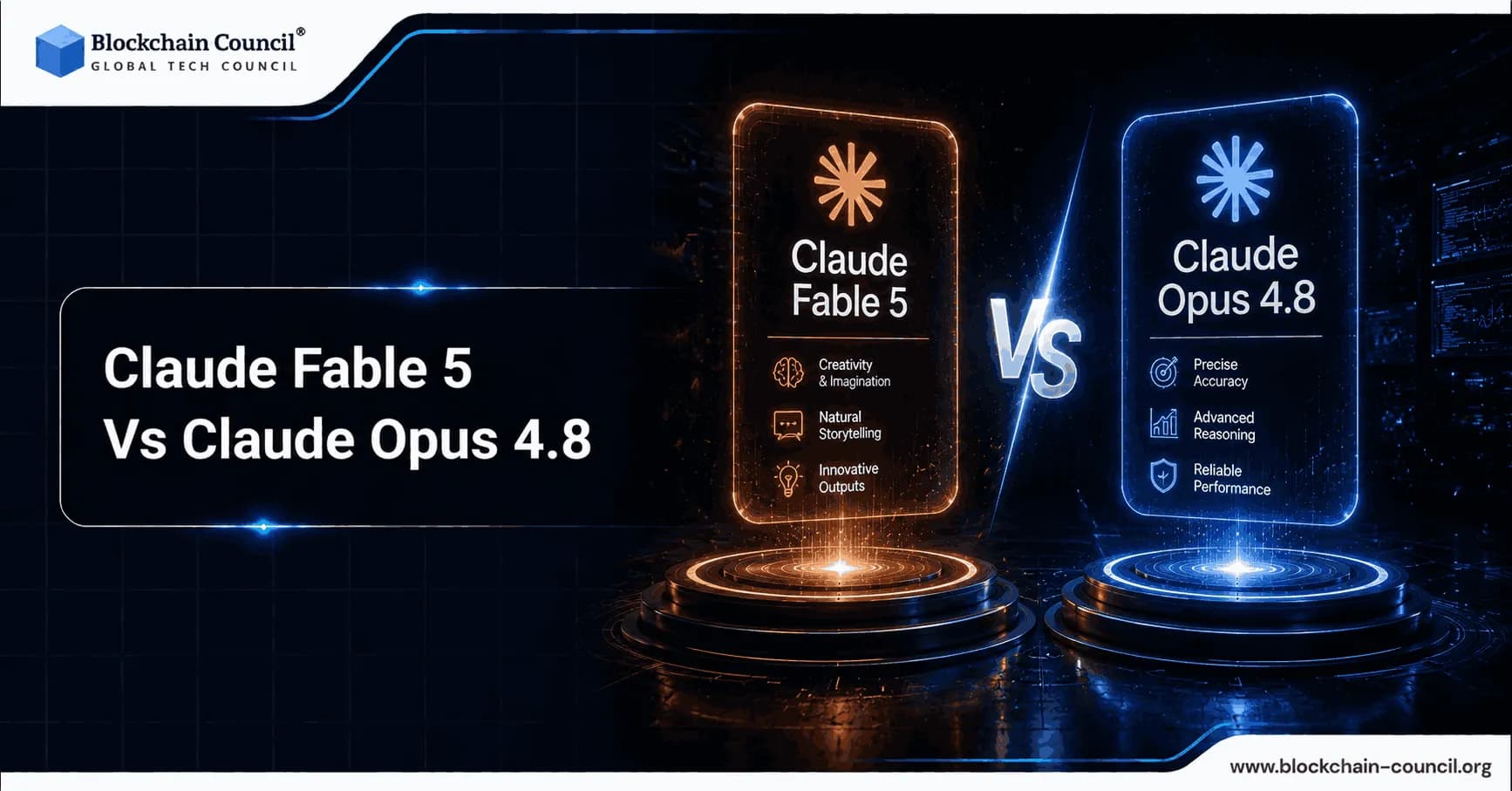
Introduction: A New Era of AI Capability
On June 9, 2026, Anthropic launched two of the most significant AI models in its history: Claude Fable 5 and Claude Mythos 5. Together, they mark the arrival of a new class of AI capability Mythos-class that sits above the Opus class in both performance and complexity. For developers, enterprises, and AI professionals evaluating their model choices, the most practically important question is clear: how does Claude Fable 5 vs Claude Opus 4.8 compare across the dimensions that matter most?
Claude Opus 4.8 is not being retired. In fact, it plays a central role in Fable 5's deployment architecture serving as the fallback model when Fable 5's safety classifiers detect sensitive queries. Therefore, understanding the relationship between these two models requires more than a capability benchmark comparison. It requires understanding how they work together, where each excels, and which one is the right choice for different types of tasks and users.

This article provides a comprehensive, research-backed comparison of Claude Fable 5 vs Claude Opus 4.8 covering architecture, benchmarks, specific capability domains, pricing, safeguards, availability, and professional development pathways for those building expertise with these models.
Model Overview: Understanding What Each Model Is
Claude Fable 5: Mythos-Class Capability for General Use
Claude Fable 5 is Anthropic's most capable model ever made generally available. It is a Mythos-class model the tier above Opus that has been equipped with safety classifiers enabling its release to the public. The name "Fable" comes from the Latin fabula, meaning "that which is told," and is linguistically related to the Greek mythos reflecting that Fable 5 and Mythos 5 share the same underlying model, distinguished only by their safeguard configurations.
Fable 5 is available through Claude.ai, the Claude API, and all subscription tiers. When Fable 5's classifiers detect queries related to cybersecurity, biology and chemistry, or distillation, those queries automatically fall back to Claude Opus 4.8 and users are informed when this occurs. Anthropic reports that more than 95% of Fable 5 sessions involve no fallback whatsoever. Consequently, for the vast majority of real-world use cases, Fable 5 operates at full Mythos-class performance.
Claude Opus 4.8: Anthropic's Premium Benchmark
Claude Opus 4.8 was Anthropic's most capable generally available model before the launch of Fable 5. It remains a highly capable model strong enough that Anthropic selected it specifically as the fallback for Fable 5's safeguard triggers. Furthermore, Opus 4.8 continues to serve as the primary model for many enterprise deployments and API integrations that are optimized for its specific performance characteristics.
In the context of Claude Fable 5 vs Claude Opus 4.8, Opus 4.8 is not a model being left behind. It is a proven, trusted model that serves a dual role: as a powerful standalone model and as the safety-ensured fallback that allows Fable 5 to be deployed responsibly at scale. Therefore, both models remain commercially and technically relevant albeit at different capability tiers.
Capability Benchmarks: How Fable 5 and Opus 4.8 Compare
Software Engineering
In the domain of software engineering, the Claude Fable 5 vs Claude Opus 4.8 gap is among the largest of any capability area. On Cognition's FrontierCode evaluation which tests whether models can pass difficult coding tasks while meeting the standards of high-quality production codebases, Fable 5 scores highest among all frontier models, even at medium effort levels. Furthermore, Fable 5 is more token-efficient than Opus 4.8 on coding tasks, completing them in fewer tokens while maintaining or exceeding output quality.
Real-world evidence reinforces the benchmark data. During early testing, one company reported that Fable 5 compressed months of engineering work into days performing a codebase-wide migration in a single day across a fifty-million-line codebase that would have required a full team more than two months to complete manually. Additionally, Fable 5 is the highest-scoring model on FrontierBench, an independent frontier coding evaluation, excelling specifically at long-horizon reasoning and generalization to unfamiliar tools out of the box.
Knowledge Work and Analytical Reasoning
On Hebbia's Finance Benchmark for senior-level reasoning which tests document-based reasoning, chart and table interpretation, and complex problem solving Fable 5 scores higher than any other tested model, including Opus 4.8. Moreover, a trading analytics organization reported that Fable 5 aced their trading-analysis evaluations nearly across the board, covering factual lookup, conceptual reasoning, root-cause analysis, and expected-value analysis.
Furthermore, an analytics organization reported that Fable 5 was the first model to break ninety percent on their core analytics benchmark of complex, long-running analytical tasks, a ten-point jump over Opus 4.8. On the hardest questions in that benchmark, Fable 5 showed strong judgment and attention to nuance that Opus 4.8 did not consistently achieve. Therefore, for demanding knowledge work at senior professional grade, Claude Fable 5 vs Claude Opus 4.8 represents a meaningful and measurable performance gap.
Vision Capabilities
Claude Fable 5 is the new state-of-the-art model for vision-based tasks, a capability domain where Opus 4.8 was previously competitive but not leading. Fable 5 can extract precise numbers from detailed scientific figures, rebuild web application source code from screenshots alone, and complete complex vision-based tasks with minimal scaffolding. Furthermore, where previous Claude models including Opus 4.8 required complex helper harnesses to play Pokémon FireRed, Fable 5 completed the game with a minimal, vision-only harness using only raw game screenshots.
Memory and Long-Context Performance
Fable 5 maintains focus across millions of tokens in long-running tasks and improves its outputs using its own persistent notes. When tested on the deck-building game Slay the Spire, giving Fable 5 access to persistent file-based memory improved its performance three times more than the equivalent memory access improved Opus 4.8's performance. Additionally, Fable 5 reached the game's final act three times more often than Opus 4.8. Consequently, for long-horizon tasks requiring sustained reasoning and adaptive memory, Fable 5's advantage over Opus 4.8 is substantial.
Autonomous Operation
One of the defining dimensions of Claude Fable 5 vs Claude Opus 4.8 is autonomous task completion. Fable 5 can work autonomously for longer than any previous Claude model including Opus 4.8. It handles complex, multi-step agentic tasks with a level of reliability and self-correction that opens a class of long-horizon problems previously out of reach. Furthermore, at the highest effort levels, Fable 5 reflects on and validates its own work, a capability that makes highly autonomous operations viable in ways that Opus 4.8 cannot fully match.
Building Claude Expertise: Professional Credentials for the Fable Era
The launch of Claude Fable 5 represents a significant step forward in what AI models can accomplish. Consequently, developers, engineers, and AI professionals who develop deep expertise in Claude's capabilities including Fable 5's advanced reasoning, vision, coding, and agentic features are positioning themselves at the forefront of a rapidly evolving professional landscape. Furthermore, structured, credentialed expertise in Claude specifically is becoming increasingly valuable as organizations expand their Claude-based deployments.
Understanding the technical depth of Claude Fable 5 vs Claude Opus 4.8 including how to prompt each model effectively, how safeguard fallbacks work, when to choose each model for specific use cases, and how to build reliable agentic workflows with Fable 5 requires both hands-on experience and structured knowledge of Claude's architecture and design principles.
For professionals seeking to develop verified, comprehensive expertise in Claude specifically, a Claude AI Expert certification from Blockchain Council provides a structured, globally recognized pathway to develop and demonstrate mastery of Claude covering its capabilities, deployment patterns, prompt engineering best practices, and the architectural decisions that distinguish models like Fable 5 and Opus 4.8 directly applicable for developers and AI professionals building production systems on Claude.
Safeguards and Safety Architecture: The Key Structural Difference
How Fable 5's Safety Classifiers Work
The most structurally significant dimension of Claude Fable 5 vs Claude Opus 4.8 is the presence of safety classifiers on Fable 5. These are separate AI systems that detect potential misuse including jailbreak attempts and route those queries to Opus 4.8 instead of allowing Fable 5 to respond. The classifiers cover three specific domains: cybersecurity, biology and chemistry, and distillation of Claude's capabilities for training competing models.
Anthropic tuned these classifiers conservatively, prioritizing safety even at the cost of occasional false positives on benign requests. However, the company's early data shows that fallback triggers occur in fewer than five percent of Fable 5 sessions. Furthermore, when a fallback does occur, users receive a response from Opus 4.8 a highly capable model rather than an outright refusal. Therefore, the user experience degradation from a fallback is significantly lower than a simple refusal would produce.
Cybersecurity Classifier
Mythos-class models including Fable 5 excel at discovering and exploiting software vulnerabilities, a capability that could provide meaningful assistance to malicious actors attempting cyberattacks. Fable 5's cybersecurity classifier covers both exploitation and offensive cyber tasks in a broader sense. External testing by one partner found that Fable 5's safeguards against harmful cyber queries were the most robust of any model tested with zero compliance on harmful single-turn requests related to cyberattack planning, exploit development, or defense evasion, regardless of which jailbreak techniques were applied.
Biology and Chemistry Classifier
Mythos-class models have demonstrated capabilities in complex biological reasoning that extend beyond conventional AI benchmarks. Fable 5's biology and chemistry classifier currently casts a broad net catching most requests in these domains and routing them to Opus 4.8. Anthropic has explicitly acknowledged that this breadth creates false positives on legitimate research queries. However, the company plans to narrow the classifier as safeguards mature. Furthermore, a trusted access program for biomedical researchers will soon provide access to Fable 5 with these particular safeguards lifted.
Data Retention Policy for Mythos-Class Models
A significant policy difference introduced alongside Fable 5 is a new thirty-day data retention requirement for all traffic on Mythos-class models including Fable 5. This applies across both first-party and third-party surfaces. Anthropic will not use this data for model training or non-safety purposes. The data is used exclusively to defend against complex and novel attacks and to identify and reduce false positives. Consequently, enterprise customers deploying Fable 5 should incorporate this policy into their data governance and compliance frameworks.
Pricing, Availability, and Access
Pricing
In the Claude Fable 5 vs Claude Opus 4.8 pricing comparison, Fable 5 and Opus 4.8 share identical token pricing: ten US dollars per million input tokens and fifty US dollars per million output tokens. This represents less than half the price of Claude Mythos Preview making Fable 5's Mythos-class capability significantly more accessible than its predecessor. Therefore, developers and enterprises can access Fable 5's substantially superior capabilities at no additional cost compared to Opus 4.8 on a per-token basis.
API Access
Developers access Fable 5 through the Claude API using the model string "claude-fable-5." The model is fully available on the Claude API and consumption-based Enterprise plans from launch day. Furthermore, it is available on Pro, Max, Team, and seat-based Enterprise subscription plans at no extra cost through June 22, 2026 after which usage credits will be required on those plans until sufficient capacity allows Fable 5 to be restored as a standard subscription model.
Subscription Plans
Anthropic has structured Fable 5's subscription rollout to manage high demand while maximizing access. From launch through June 22, all paid subscription tiers include Fable 5 at no extra cost. After June 22, usage credits will be required. Anthropic has committed to communicating changes ahead of time and to restoring Fable 5 as a standard subscription model as capacity allows. Consequently, users who want guaranteed access throughout this transition period should monitor official Anthropic communications and plan their usage credit budgets accordingly.
AI Expertise in the Fable 5 Era: Why Formal Credentials Matter
The capability leap represented by Claude Fable 5 vs Claude Opus 4.8 makes structured AI expertise more valuable, not less. As models become more capable of autonomous operation, long-horizon reasoning, and complex multi-step tasks, the knowledge required to deploy them effectively and safely becomes deeper and more specialized. Furthermore, organizations adopting Fable 5 for agentic workflows, knowledge work, or software engineering need professionals who understand not just how to use AI tools but how to govern, evaluate, and optimize them.
Consequently, the market for credentialed AI professionals is growing at precisely the moment when AI capabilities are advancing most rapidly. Professionals who invest in structured AI knowledge now are positioning themselves to lead in an environment where intuitive familiarity with AI tools is no longer sufficient differentiation.
An AI Certification from Blockchain Council provides a comprehensive, globally recognized credential covering the full scope of artificial intelligence from foundational machine learning concepts through to enterprise deployment, governance, and model evaluation. Consequently, professionals with this credential are equipped to assess the Claude Fable 5 vs Claude Opus 4.8 trade-offs analytically, design AI systems that use each model appropriately for different task types, and advise organizations on strategic AI model selection and deployment.
Use Case Guidance: When to Choose Fable 5 vs Opus 4.8
Choose Fable 5 For
Complex, long-horizon software engineering tasks particularly codebase-wide migrations, refactoring, and production-grade code generation where Fable 5's performance advantage over Opus 4.8 is among the largest measured. Furthermore, choose Fable 5 for vision-intensive tasks including document analysis, screenshot-based development, and scientific figure interpretation. Senior-level knowledge work, financial analysis, and analytical tasks at the frontier of model performance also favor Fable 5 strongly.
Additionally, choose Fable 5 for agentic workflows requiring sustained autonomous operation across many steps, tasks involving persistent memory and long-context reasoning, and any work where the model's ability to reflect on and validate its own outputs is important. Consequently, for organizations pushing the boundaries of what AI can accomplish autonomously, Fable 5 is the clear choice.
Choose Opus 4.8 For
Tasks that fall within Fable 5's classifier domains particularly cybersecurity research, vulnerability analysis, penetration testing, and advanced biology or chemistry work will route to Opus 4.8 as a fallback. Therefore, professionals working primarily in these domains may find it more efficient to use Opus 4.8 directly. Furthermore, applications that require predictable response patterns without classifier-triggered fallbacks may prefer Opus 4.8 for consistency.
Additionally, Opus 4.8 remains the right choice for organizations with data governance requirements incompatible with Fable 5's thirty-day data retention policy. Consequently, regulated industries with strict data retention limitations should evaluate whether Fable 5's policy constraints are compatible with their compliance frameworks before migrating workflows from Opus 4.8.
The Hybrid Approach
Many sophisticated deployments will use both models strategically. Fable 5 handles the vast majority of tasks at Mythos-class performance, while Opus 4.8 manages the specialized domains where Fable 5's classifiers apply. This hybrid approach which Anthropic has essentially built into Fable 5's fallback architecture represents the optimal strategy for most enterprise environments. Therefore, organizations need not make an either-or choice between Claude Fable 5 vs Claude Opus 4.8 but can benefit from both models operating within a coordinated system.
Technology Professionals and the Model Selection Decision
The Claude Fable 5 vs Claude Opus 4.8 decision is not purely a capability question. It is also a systems architecture question, a compliance question, and a cost optimization question. Technology professionals including platform engineers, DevOps teams, and enterprise architects who understand how to evaluate AI models across these multiple dimensions add significant value to organizations navigating the transition to Fable 5 and the broader agentic AI landscape.
Furthermore, integrating Fable 5 into existing AI infrastructure requires understanding how safeguard fallbacks interact with application logic, how the thirty-day data retention policy affects compliance frameworks, and how to design systems that use each model's strengths appropriately. Consequently, technology professionals with structured expertise in AI platforms and enterprise systems are better equipped to lead these integrations effectively.
For technology professionals seeking recognized credentials that validate expertise in enterprise AI systems, cloud platforms, and digital infrastructure, a Tech Certification from Global Tech Council provides a structured pathway to develop and demonstrate the platform expertise that AI model integration and governance decisions require supporting career advancement in enterprise architecture, AI platform engineering, and technology consulting roles where Claude Fable 5 vs Claude Opus 4.8 evaluations are part of the daily work.
Life Sciences and Scientific Research: Where Mythos 5 Leads
The scientific research capabilities of the Mythos-class represent one of the most consequential aspects of the Claude Fable 5 vs Claude Opus 4.8 comparison. Mythos 5, the same underlying model as Fable 5 with cyber safeguards lifted, demonstrated drug design acceleration of approximately ten times compared to conventional approaches. In one evaluation, Mythos 5 matched or beat skilled human protein design operators, autonomously executing all tasks normally completed by a scientist: choosing binding sites, selecting and running protein design tools, and recovering from failures along the way.
Furthermore, Mythos 5 conducted novel genomics research in over a week of largely autonomous work assembling single-cell data for millions of cells across 138 animal species and training a custom machine learning model that outperformed a recently published model from the journal Science, despite being one hundred times smaller. Additionally, Mythos 5 is Anthropic's first model to consistently produce novel, compelling scientific hypotheses with scientists preferring its molecular biology hypotheses approximately eighty percent of the time in blinded comparisons against Opus-class models.
Consequently, for life sciences researchers and organizations, the gap between Fable 5 and Opus 4.8 in research capability is potentially transformative. Anthropic has announced a trusted access program for biomedical researchers that will provide access to Fable 5 with biology and chemistry safeguards lifted enabling these capabilities for legitimate research at a level that Opus 4.8 cannot match.
Strategic Implications of Fable 5 for Business and Marketing
The arrival of Claude Fable 5 vs Claude Opus 4.8 as a strategic choice for organizations extends beyond technical teams to business leaders, product managers, and marketing professionals. Fable 5's capabilities in knowledge work, analytical reasoning, vision, and autonomous operation open new possibilities for content creation, market research, competitive analysis, customer communication, and strategic planning at a level of autonomy and quality that Opus 4.8 could not reliably achieve.
Furthermore, organizations that adopt Fable 5 strategically integrating it thoughtfully into marketing workflows, product development processes, and customer engagement strategies will gain operational advantages over competitors still operating with earlier-generation AI capabilities. Consequently, business and marketing professionals who understand both the capabilities and limitations of Fable 5 are better positioned to design AI-augmented strategies that deliver measurable competitive advantage.
For business leaders and marketing professionals building strategic knowledge of how AI capabilities reshape business operations, competitive positioning, and customer engagement, a Marketing Certification from Universal Business Council provides structured expertise in the intersection of technology and business strategy equipping professionals to navigate the strategic implications of the Claude Fable 5 vs Claude Opus 4.8 transition and design AI-augmented business strategies that create lasting organizational value.
Conclusion: A Clear Capability Leap With Thoughtful Safeguards
The Claude Fable 5 vs Claude Opus 4.8 comparison reveals a relationship that is more nuanced than a simple generational upgrade. Fable 5 is genuinely more capable than Opus 4.8 across virtually every tested benchmark with particularly large gaps in software engineering, long-horizon autonomous operation, vision, and frontier knowledge work. Furthermore, Fable 5 offers these Mythos-class capabilities at identical per-token pricing to Opus 4.8, making the capability upgrade economically straightforward for most use cases.
At the same time, Fable 5's safety classifiers create a deliberate architecture in which Opus 4.8 remains essential serving as both a standalone model for classifier-triggered domains and as the fallback that makes Fable 5's general availability responsible and sustainable. Consequently, both models remain important components of the Anthropic ecosystem, and understanding how to use them together represents genuine professional value.
Therefore, for developers evaluating API model choices, enterprises planning AI strategy, researchers selecting tools for complex scientific work, and AI professionals building expertise in Anthropic's model ecosystem the arrival of Claude Fable 5 vs Claude Opus 4.8 as a real capability decision marks a defining moment in the maturation of practical AI deployment. The future is agentic, long-horizon, and Mythos-class. Fable 5 is its first chapter.
Frequently Asked Questions (FAQs)
1. What is Claude Fable 5 and when was it released?
Claude Fable 5 is Anthropic's most capable model ever made generally available. It is a Mythos-class model the tier above Opus with safety classifiers enabling public release. It was announced and launched on June 9, 2026, alongside Claude Mythos 5.
2. What is the relationship between Claude Fable 5 and Claude Mythos 5?
Fable 5 and Mythos 5 share the same underlying model. The difference is their safeguard configuration: Fable 5 has safety classifiers active for cybersecurity, biology/chemistry, and distillation domains, while Mythos 5 has those classifiers lifted for authorized users in trusted access programs.
3. How does Claude Fable 5 compare to Claude Opus 4.8 in coding performance?
Fable 5 scores highest among frontier models on Cognition's FrontierCode evaluation and on FrontierBench. Real-world testing showed it compressing months of engineering into days completing codebase-wide migrations in a single day that would take a full team over two months manually. Furthermore, it is more token-efficient than Opus 4.8 on coding tasks.
4. What happens when Claude Fable 5's safety classifiers trigger?
When Fable 5's classifiers detect a query related to cybersecurity, biology/chemistry, or distillation, the request is automatically handled by Claude Opus 4.8 instead. Users are informed whenever this fallback occurs. Anthropic reports that fallback triggers occur in fewer than five percent of Fable 5 sessions.
5. What is the pricing for Claude Fable 5 vs Claude Opus 4.8?
Both models are priced identically at ten US dollars per million input tokens and fifty US dollars per million output tokens. This represents less than half the price of Claude Mythos Preview making Fable 5's Mythos-class capability substantially more accessible.
6. Is Claude Opus 4.8 being discontinued after Fable 5's launch?
No. Claude Opus 4.8 is not being discontinued. It continues as both a standalone model and the designated fallback for Fable 5's safety classifier triggers. Consequently, Opus 4.8 remains a core component of the Anthropic model ecosystem and an essential part of Fable 5's deployment architecture.
7. How much better is Fable 5 than Opus 4.8 on analytical and finance tasks?
Fable 5 scores highest on Hebbia's Finance Benchmark for senior-level reasoning. One analytics organization reported it was the first model to break ninety percent on their complex analytics benchmark, a ten-point improvement over Opus 4.8. A trading analytics firm reported Fable 5 aced their evaluations nearly across the board.
8. Can Claude Fable 5 be used for cybersecurity research?
Fable 5's cybersecurity classifier routes most cybersecurity queries to Opus 4.8 as a fallback. For authorized cybersecurity organizations participating in Project Glasswing, Claude Mythos 5 which has cyber safeguards lifted provides the full Mythos-class cybersecurity capability. A broader trusted access program for cybersecurity organizations is planned.
9. What is the data retention policy for Claude Fable 5?
Anthropic requires thirty-day data retention for all traffic on Mythos-class models including Fable 5, on both first-party and third-party surfaces. The data is used exclusively for safety purposes defending against novel attacks and reducing false positives and will not be used for model training or other non-safety purposes.
10. How does Fable 5 perform on vision tasks compared to Opus 4.8?
Fable 5 is the new state-of-the-art model for vision tasks. It can extract precise data from scientific figures, rebuild web app source code from screenshots, and complete vision-based tasks with minimal scaffolding. Where Opus 4.8 required complex helper harnesses for tasks like Pokémon FireRed, Fable 5 completed the same game with a vision-only harness.
11. What is Claude Fable 5's performance on long-context tasks?
Fable 5 maintains focus across millions of tokens and improves outputs using persistent notes. In testing with the game Slay the Spire, file-based memory improved Fable 5's performance three times more than it improved Opus 4.8's and Fable 5 reached the final act three times more often than Opus 4.8.
12. How is Claude Fable 5 available on subscription plans?
Through June 22, 2026, Fable 5 is included on Pro, Max, Team, and seat-based Enterprise plans at no extra cost. After June 22, usage credits will be required on those plans. Anthropic has committed to restoring Fable 5 as a standard subscription model as capacity allows and will communicate changes ahead of time.
13. What is Project Glasswing and how does it relate to Fable 5?
Project Glasswing is Anthropic's program for deploying Mythos-class AI capabilities to trusted cybersecurity organizations and critical infrastructure providers. Claude Mythos 5 the version of Fable 5 with cyber safeguards lifted is deployed through Project Glasswing as an upgrade to Claude Mythos Preview.
14. What biology and chemistry tasks trigger Fable 5's classifiers?
Fable 5 currently routes most biology and chemistry-related requests to Opus 4.8 as a fallback. Anthropic has acknowledged this is broader than ideal and plans to narrow the classifier as safeguards mature. A trusted access program for biomedical researchers will provide access to Fable 5 with these safeguards lifted for legitimate research use.
15. What is the distillation classifier in Claude Fable 5?
The distillation classifier detects large-scale attempts to extract Claude's capabilities through systematic querying for the purpose of training competing AI models. When detected, these requests fall back to Opus 4.8. This protects against the proliferation of Fable 5's capabilities in forms that could be released without appropriate safeguards.
16. How does Claude Fable 5 perform on scientific research tasks?
Mythos 5 the same underlying model accelerated drug design by approximately ten times in internal testing, autonomously executed protein design tasks matching skilled human operators, conducted novel genomics research over a week of autonomous work, and consistently produced novel, compelling scientific hypotheses preferred over Opus-class outputs about eighty percent of the time in blinded comparisons.
17. What model string do developers use to access Claude Fable 5 via API?
Developers access Claude Fable 5 through the Claude API using the model string "claude-fable-5." The model is fully available on the Claude API and consumption-based Enterprise plans from launch day, June 9, 2026.
18. How does Fable 5 handle autonomous multi-step agentic tasks vs Opus 4.8?
Fable 5 can work autonomously for longer than any previous Claude model. It handles complex multi-step agentic tasks with greater reliability, self-correction, and reflection than Opus 4.8. At the highest effort levels, Fable 5 validates its own work making highly autonomous operations viable for a wider range of complex tasks than Opus 4.8 could support.
19. Is Claude Fable 5 safe for jailbreak resistance?
Fable 5's safeguards were tested through extensive internal red-teaming and an external bug bounty program that produced no universal jailbreaks in over one thousand hours of testing. External red-teaming organizations also failed to find universal jailbreaks on long-form agentic tasks. One partner found Fable 5's safeguards against harmful cyber queries were the most robust of any model tested.
20. For most everyday use cases, is Claude Fable 5 or Claude Opus 4.8 the better choice?
For the vast majority of everyday use cases coding, writing, analysis, research, vision, and general assistance Claude Fable 5 is the better choice. Fable 5's Mythos-class capabilities exceed Opus 4.8 across nearly all benchmarks, and at identical pricing, there is no cost reason to choose Opus 4.8 for general tasks. Opus 4.8 remains the choice for cybersecurity, advanced biology/chemistry, and compliance-constrained environments.
Related Articles
View All
Claude Ai
How to Use Claude Fable 5.1 for Free
Find out whether Claude Fable 5.1 is available for free, which Claude plans provide access, and what users need to know before trying Anthropic’s latest AI model.
Claude Ai
Anthropic's New Claude Fable 5.1 and Mythos 5.1 Update: What's New?
Anthropic’s Claude Fable 5.1 and Mythos 5.1 update brings stronger coding, long-running agentic workflows, research, vision, and knowledge-work capabilities. Fable 5.1 is generally available and introduces cheaper cache reads, potentially reducing typical workload costs by about 25% and highly agentic workloads by up to 45%. Mythos 5.1 uses the same underlying model but offers expanded cybersecurity and biology capabilities to vetted organizations through trusted-access programs.

Claude Ai
Fable 5 vs Claude vs ChatGPT: Which AI Model Should You Choose?
Compare Fable 5, Claude, and ChatGPT across coding, research, DevOps, cost, context, and governance to choose the right AI model.
Trending Articles
The Role of Blockchain in Ethical AI Development
How blockchain technology is being used to promote transparency and accountability in artificial intelligence systems.

Top 5 DeFi Platforms
Explore the leading decentralized finance platforms and what makes each one unique in the evolving DeFi landscape.
How Blockchain Secures AI Data
Understand how blockchain technology is being applied to protect the integrity and security of AI training data.