

Claude Fable 5.2 vs Claude Mythos 5.2: Key Differences, Features, Capabilities and Use Cases
 Suyash Raizada
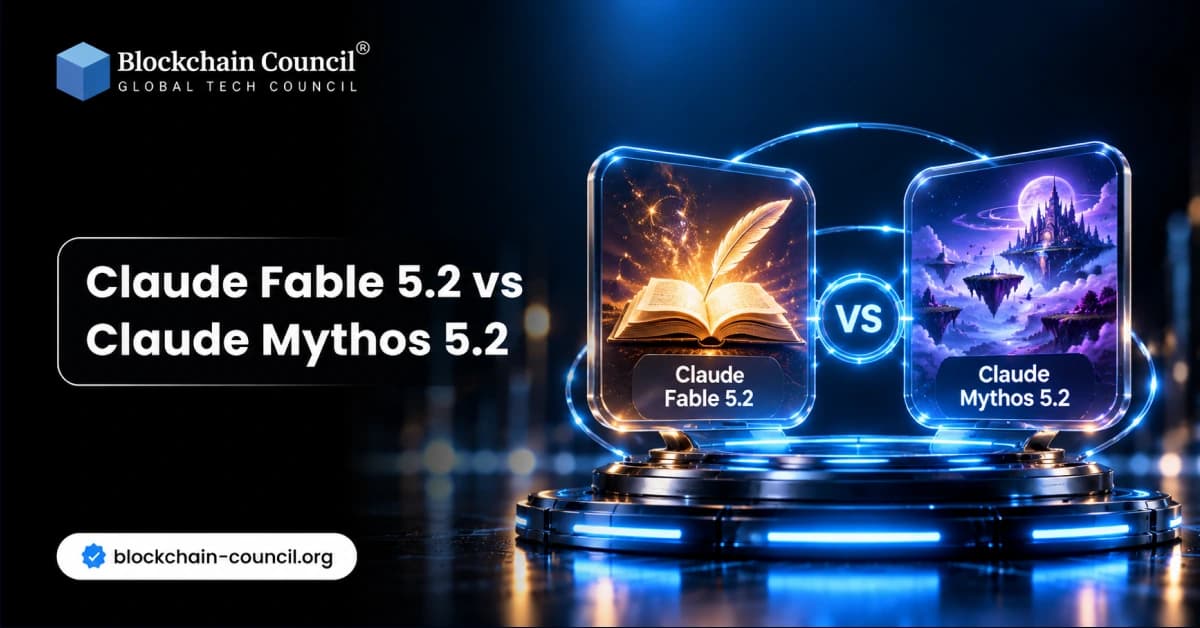
Artificial intelligence is moving beyond traditional chatbots and basic content-generation tools. The latest generation of AI models is increasingly capable of handling complex technical challenges, performing advanced reasoning, supporting software engineering and contributing to scientific research.
On November 9, 2026, Anthropic introduced Claude Fable 5.2 and Claude Mythos 5.2, two advanced AI models designed to tackle demanding technical and knowledge-intensive tasks. The announcement highlights improvements in coding, reasoning, vision, scientific research and engineering, making these models an important development in the evolving AI landscape.

Although both models share the same underlying foundation, their safeguards and intended availability differ. Understanding these distinctions is important for developers, AI professionals, cybersecurity specialists and businesses exploring advanced AI technologies.
In this article, we explore Claude Fable 5.2 vs Claude Mythos 5.2, their features, capabilities, differences, applications and potential impact on the future of artificial intelligence.
Professionals interested in building practical knowledge of Claude's capabilities can explore the Certified Claude AI Expert program to develop their understanding of Claude AI and its applications.
What Are Claude Fable 5.2 and Claude Mythos 5.2?
Claude Fable 5.2 and Claude Mythos 5.2 are advanced artificial intelligence models developed by Anthropic.
These models are designed to address complex technical problems that require more than simple question-and-answer interactions. Their capabilities include advanced software engineering, mathematical reasoning, scientific research, engineering workflows and sophisticated AI-assisted problem-solving.
One of the most important details about these models is that they share the same underlying model. However, Anthropic applies different safeguards depending on the intended deployment.
Claude Fable 5.2 includes stronger cybersecurity and biology safeguards, allowing broader availability.
Claude Mythos 5.2 is designed for vetted organisations working on specialised cybersecurity and biomedical research applications, where access to advanced capabilities requires additional verification.
This distinction demonstrates how AI companies are increasingly balancing advanced model capabilities with responsible deployment and risk management.
Professionals who want to build broader knowledge of artificial intelligence can also explore the Certified Artificial Intelligence (AI) Expert program to strengthen their understanding of AI concepts and practical applications.
Key Features of Claude Fable 5.2 and Claude Mythos 5.2
The latest models introduce several developments that could influence how organisations use artificial intelligence.
1. Advanced AI Reasoning
Advanced reasoning is an important capability of modern AI systems.
Claude Fable 5.2 and Mythos 5.2 are designed to work through complicated technical challenges, analyse multiple pieces of information and verify their outputs.
Instead of simply generating an immediate response, these models can approach problems through iterative processes involving planning, analysis and verification.
This can be useful in:
Complex mathematical problem-solving.
Technical research and analysis.
Software architecture planning.
Data interpretation.
Scientific experimentation.
Business intelligence and financial analysis.
For professionals working with AI, understanding how reasoning models operate is becoming an increasingly valuable skill.
2. Agentic AI and Multi-Agent Coordination
One of the most interesting developments is the ability of Claude Fable 5.2 to coordinate multiple AI agents.
An AI agent can perform specific tasks using instructions, tools, context and feedback. Multiple agents can work together, with one agent coordinating activities while others handle individual responsibilities.
For example, an enterprise software development project could involve:
One AI agent analysing project requirements.
Another reviewing the existing codebase.
A third identifying potential errors.
Another performing testing.
A coordinating agent reviewing the results.
This approach can help organisations build more sophisticated AI workflows.
Claude Fable 5.2 has demonstrated the ability to coordinate hundreds or even more than a thousand subagents in Anthropic's testing.
This makes multi-agent coordination an important area to watch as autonomous AI systems continue to evolve.
3. Advanced AI Coding and Software Engineering
Software development is one of the major application areas highlighted in Anthropic's announcement.
Claude Fable 5.2 is designed to work on ambitious software engineering tasks, including projects involving multiple repositories and large codebases.
Its capabilities include:
Analysing complex software architecture.
Identifying potential coding problems.
Debugging and troubleshooting.
Supporting software migrations.
Reviewing and testing code.
Improving existing development workflows.
An important development is its ability to work on larger, less clearly defined engineering problems while testing and verifying its own work.
For software developers, this represents a shift from using AI only for code suggestions towards using AI as an engineering assistant capable of handling broader development tasks.
4. Scientific Research and Mathematical Problem-Solving
Another important application is scientific research.
Anthropic reported that the models contributed to several challenging research and engineering tasks during prerelease testing.
These included work involving physics, mathematical proofs and the design of electronic devices.
One particularly notable example was the formalisation of a proof of Fermat's Last Theorem in approximately 30 hours.
AI-assisted scientific research could help researchers:
Analyse complex mathematical problems.
Explore alternative research approaches.
Formalise mathematical proofs.
Develop computational models.
Evaluate experimental results.
Improve research workflows.
However, AI-generated scientific outputs still require appropriate verification and expert oversight.
5. AI Vision and Engineering Applications
Claude Fable 5.2 and Mythos 5.2 also demonstrate improvements in vision-related capabilities.
This is particularly relevant for applications involving technical documents, images, engineering designs and visual information.
Potential applications include:
Analysing technical diagrams.
Interpreting engineering documentation.
Understanding complex visual information.
Supporting hardware design.
Creating simulations.
Assisting with robotics-related workflows.
These developments illustrate how modern AI systems are expanding beyond text-based applications into more complex digital and physical environments.
Claude Fable 5.2 vs Claude Mythos 5.2: Key Differences
Although both models share the same underlying foundation, their deployment approaches are different.
Comparison | Claude Fable 5.2 | Claude Mythos 5.2 |
|---|---|---|
Underlying model | Shared foundation | Shared foundation |
Cybersecurity safeguards | Strong safeguards | Different access controls |
Biology safeguards | Strong safeguards | Specialised access |
General availability | Broader availability | Vetted organisations |
Primary positioning | Advanced technical work | Specialised high-capability research |
Coding and reasoning | Advanced | Advanced |
Enterprise applications | Yes | Eligible organisations |
The most important distinction is not that these are two completely different model architectures. Rather, Anthropic uses different safeguards and access policies for the same underlying model.
Organisations working in sensitive cybersecurity and biomedical research areas can apply through Anthropic's relevant verification programmes for Mythos access.
Claude Fable 5.2 vs Claude Mythos 5.2 vs Other AI Models
The release of these models also raises an important question: how do they fit into the wider AI ecosystem?
The AI industry includes several major model families, each targeting different applications.
AI model family | Main application areas |
|---|---|
Claude Fable 5.2 | Advanced technical work, coding and research |
Claude Mythos 5.2 | Specialised cybersecurity and biomedical research |
GPT models | Reasoning, productivity, coding and multimodal AI |
Gemini models | Multimodal AI, research and productivity |
Open-source LLMs | Custom AI development and deployment |
A meaningful comparison should consider independent benchmark results, reasoning accuracy, coding performance, latency, pricing, safety and real-world performance.
It would be inaccurate to declare one model the overall winner without comparable testing across the same tasks.
For businesses, selecting an AI model should depend on the complexity of the task, security requirements, integration capabilities and total operating costs.
How Can Businesses Use Claude Fable 5.2?
Advanced AI models can support several business functions.
Enterprise Automation
Businesses can explore multi-agent workflows to automate repetitive activities, coordinate processes and improve operational efficiency.
Software Development
Development teams can use advanced AI assistance for code analysis, debugging, software migration and technical documentation.
Financial Analysis
AI can support quantitative research, financial modelling, forecasting and the analysis of complex datasets.
Research and Development
Research teams can explore AI-assisted mathematical analysis, scientific experimentation and technical problem-solving.
Engineering and Product Design
AI-assisted workflows can support hardware development, simulations, visual analysis and engineering documentation.
However, businesses should evaluate accuracy, security, privacy and operational reliability before deploying these capabilities in production environments.
Technology professionals seeking to expand their skills in emerging tools and digital technologies can explore relevant Tech Certification programs.
AI Safety, Governance and Responsible Deployment
As AI models become more capable, responsible deployment becomes increasingly important.
The release of Claude Fable 5.2 and Claude Mythos 5.2 highlights the importance of safeguards designed to reduce potential misuse.
Anthropic describes several safety measures, including:
Cybersecurity safeguards.
Biology-related safeguards.
Alignment evaluations.
Behavioural monitoring.
Protection against model distillation attacks.
Additional controls for sensitive applications.
For organisations adopting advanced AI, technical capabilities alone are not enough.
They also need to understand AI governance, risk management, data privacy, model evaluation and responsible AI implementation.
These considerations are becoming essential for AI professionals, technology leaders and enterprise decision-makers.
Availability and Pricing of Claude Fable 5.2 and Claude Mythos 5.2
According to Anthropic's November 9, 2026 announcement, the two models have different access arrangements.
Claude Fable 5.2
Claude Fable 5.2 is available through Anthropic's supported platforms, including Claude, Claude Code and the Claude Platform, alongside supported cloud services.
The announced standard API pricing is:
Input: $8 per million tokens.
Output: $40 per million tokens.
Claude Mythos 5.2
Claude Mythos 5.2 is available to vetted cybersecurity and life sciences organisations through Anthropic's verification programmes.
Its announced standard pricing starts at:
Input: $8 per million tokens.
Output: $40 per million tokens.
Both models also support an optional fast mode, with higher pricing.
Availability and eligibility may vary depending on the platform and access programme.
What Do Claude Fable 5.2 and Mythos 5.2 Mean for the Future of AI?
The latest developments demonstrate that artificial intelligence is progressing towards systems that can manage complex tasks, coordinate multiple agents and support specialised technical workflows.
Several trends are likely to influence the next phase of AI adoption.
1. Autonomous AI Workflows: AI agents will increasingly coordinate tasks and work across multiple applications.
2. AI-Assisted Software Engineering: Developers will use AI for more than code generation, including architecture, testing and debugging.
3. Scientific Research: Advanced AI systems may help researchers explore complex scientific and mathematical challenges.
4. Enterprise AI Adoption: Organisations will increasingly integrate AI into business operations, decision-making and productivity workflows.
5. AI Governance: Security, accountability, transparency and responsible AI deployment will become increasingly important.
For professionals, this creates an opportunity to develop expertise in advanced AI models, agentic systems, AI governance and practical AI implementation.
How to Develop Expertise in Claude AI and Advanced Artificial Intelligence
Understanding advanced AI models requires more than knowing how to write effective prompts.
Professionals need to understand AI fundamentals, large language models, model capabilities, agentic AI, workflow automation, responsible AI and real-world implementation.
Structured learning can help individuals build these capabilities and understand how emerging AI technologies can be applied across industries.
Professionals interested in developing specialised knowledge can explore the Claude AI Expert certification by Blockchain Council to strengthen their understanding of Claude AI and its practical applications.
For additional learning opportunities, explore Global Tech Council for technology certifications and Universal Business Council for business and marketing certifications.
Frequently Asked Questions (FAQs)
1. What is Claude Fable 5.2?
Claude Fable 5.2 is an advanced AI model developed by Anthropic for complex technical work, including software engineering, scientific research, advanced reasoning and multi-agent coordination.
2. What is Claude Mythos 5.2?
Claude Mythos 5.2 is an advanced model sharing the same underlying foundation as Fable 5.2, with different safeguards and restricted access for vetted cybersecurity and biomedical research organisations.
3. What is the difference between Claude Fable 5.2 and Mythos 5.2?
The primary difference is their safeguards and availability. Fable 5.2 has strong cybersecurity and biology safeguards and is more broadly available, whereas Mythos 5.2 is accessible to vetted organisations for specialised applications.
4. Can Claude Fable 5.2 perform autonomous coding tasks?
Yes. It is designed to handle complex software engineering tasks, analyse codebases, coordinate subagents and test its work.
5. Is Claude Fable 5.2 an Agentic AI model?
It supports agentic capabilities, including long-running tasks, tool use, planning and coordination of multiple subagents.
6. Is Claude Mythos 5.2 publicly available?
No. Access is restricted to vetted organisations through Anthropic's cybersecurity and life sciences verification programmes.
7. Can Claude Fable 5.2 help with scientific research?
Yes. Its reported capabilities include mathematical reasoning, physics-related computations, research analysis and engineering applications.
8. How much does Claude Fable 5.2 cost?
Anthropic announced standard API pricing of $8 per million input tokens and $40 per million output tokens, with a separately priced fast mode.
9. How are Claude Fable 5.2 and Mythos 5.2 relevant to enterprise AI?
They demonstrate how advanced AI models can support software engineering, research, financial analysis, workflow automation and complex enterprise tasks.
10. How can professionals learn Claude AI?
Professionals can explore structured AI education, practical AI applications, large language models and specialised programmes such as the Claude AI Expert certification by Blockchain Council.
Conclusion
Claude Fable 5.2 and Claude Mythos 5.2 represent an important development in advanced artificial intelligence. Their capabilities in software engineering, reasoning, scientific research and multi-agent coordination demonstrate how AI systems are evolving beyond conventional conversational applications.
For businesses, developers and technology professionals, understanding these developments can help identify new opportunities for automation, innovation and productivity.
As AI capabilities continue to advance, developing practical knowledge of AI models, agentic systems and responsible AI implementation will become increasingly valuable.
Professionals interested in the business and promotional side of technology can also explore Marketing Certification programs to broaden their understanding of marketing practices.
Stay informed. Keep learning. Build expertise in emerging AI technologies with Blockchain Council.
Related Articles
View All
Claude Ai
Claude Sonnet 5 Explained: Key Features, Capabilities, and Use Cases
Claude Sonnet 5 brings 1M-token context, adaptive reasoning, stronger agent workflows, and enterprise safety controls for coding and knowledge work.

Claude Ai
Claude Prompt vs Claude Looping: Key Differences, Use Cases, and Best Practices
Learn the practical difference between Claude prompting and Claude looping, including when to use each, key risks, agent workflows, and best practices.

Claude Ai
Claude Fable vs Other LLMs: Features, Performance, and Use Cases Compared
Compare Claude Fable 5 with GPT, Gemini, Llama, and DeepSeek across context, coding, reasoning, cost, safety, and enterprise use cases.
Trending Articles
The Role of Blockchain in Ethical AI Development
How blockchain technology is being used to promote transparency and accountability in artificial intelligence systems.
Top 5 DeFi Platforms
Explore the leading decentralized finance platforms and what makes each one unique in the evolving DeFi landscape.
What is AWS? A Beginner's Guide to Cloud Computing
Everything you need to know about Amazon Web Services, cloud computing fundamentals, and career opportunities.