

Claude AI for Research and Assignments
 Suyash Raizada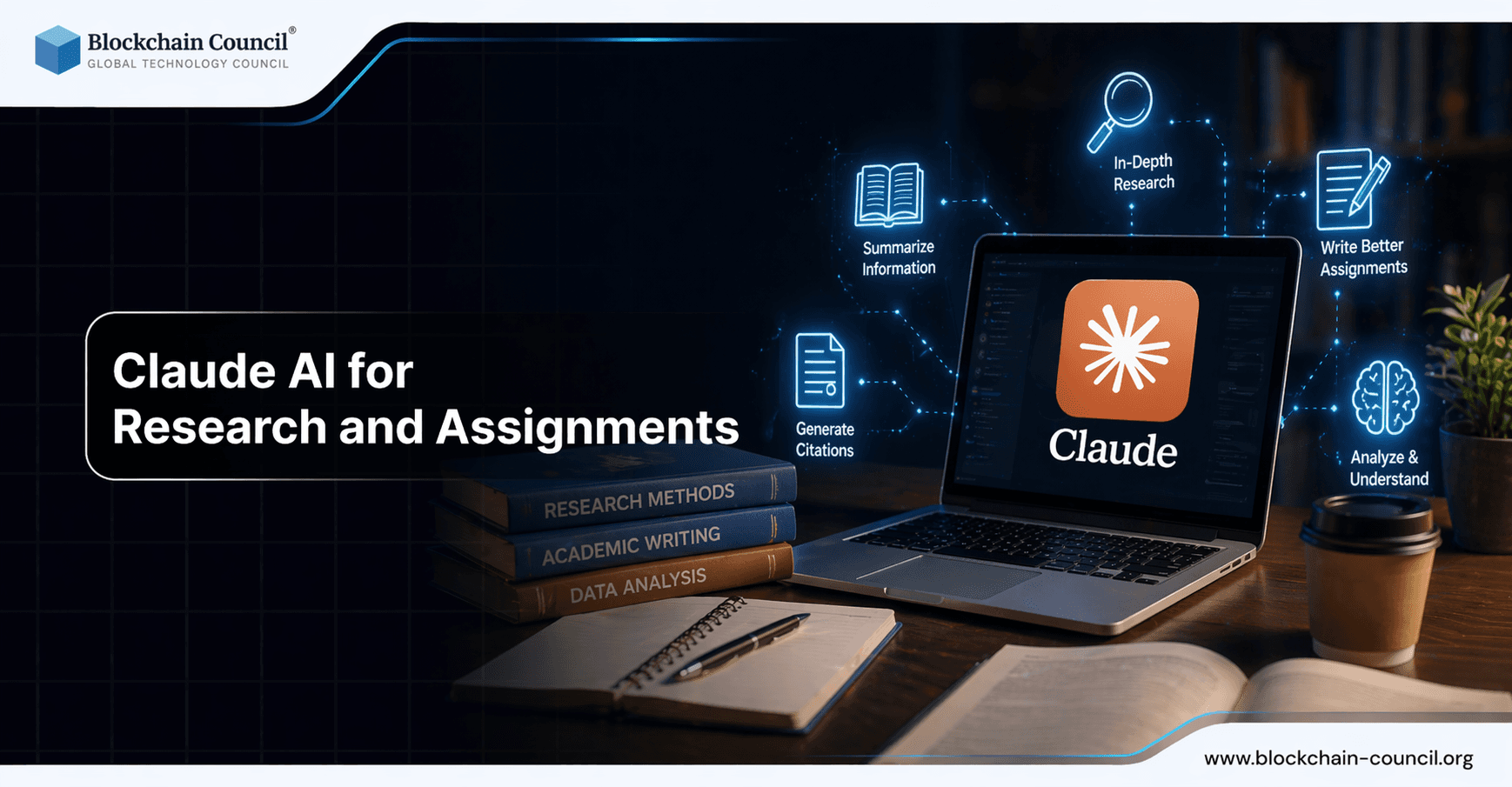
Claude AI for research and assignments has become a practical choice for students, analysts, and enterprise teams who need structured thinking, reliable source handling, and clear argumentation. Built by Anthropic, Claude is designed for multi-step reasoning and long-form work, making it well-suited to producing outlines, managing citations, and developing defensible claims across complex topics. As of 2026, Claude is widely deployed in professional environments, with strong adoption in large organizations and growing use for research-driven workflows. Applying Claude AI for Research and Assignments helps students and professionals gather insights, structure content, and improve clarity. Claude simplifies complex topics and enhances productivity. However, proper guidance is needed for accurate results. The Claude Code Certification helps you build these skills.
Why Claude AI Works Well for Research and Assignments
Research and academic writing tend to produce poor results when AI is used with generic, search-style prompts. Claude stands out because it is optimized for sustained reasoning, iterative drafting, and working across large bodies of text. With 1M+ token context support available in advanced configurations, Claude can hold long threads, notes, and draft sections in view simultaneously, which helps maintain consistency in definitions, assumptions, and argument logic throughout a document.

Claude is also increasingly used in enterprise contexts where reliability and governance matter. Reported enterprise adoption includes a significant share of Fortune 100 usage and high-volume professional API traffic, reflecting its fit for demanding work such as strategy, analysis, and documentation.
Enhance academic research and structured assignments using AI by mastering intelligent systems through an AI Course, improving analytical capabilities via a machine learning course, and presenting insights effectively with a Digital marketing course.
Building Strong Outlines with Claude AI
A good outline is a reasoning artifact, not just a list of headings. Claude AI for research and assignments is effective at transforming a rough brief into a coherent structure because it can:
Decompose the task into research questions, scope, assumptions, and deliverables
Propose section logic that matches common academic formats such as IMRAD, literature review, policy memo, or technical report
Track constraints like word count, rubric criteria, and required sources
Practical workflow: Ask Claude to produce two or three outline variants (argument-led, evidence-led, and methodology-led), then select one and request a paragraph-level plan specifying what each section must establish.
Outline Prompt Pattern
Input: topic + audience + required sections + evaluation criteria + any must-use sources.
Output to request:
Thesis candidates and what evidence would validate each
Section-by-section goals, meaning what each section must establish
Data needs such as tables, metrics, definitions, and counterarguments
Citation Handling: RAG, Context Windows, and Accuracy Controls
Citations are where many AI-assisted drafts break down, typically through hallucinated sources or mismatched quotes. Claude improves research reliability through Retrieval Augmented Generation (RAG), which grounds responses in a provided knowledge base or approved document set. Hybrid RAG approaches with contextual retrieval and caching have been reported to increase recall accuracy on specialized corpora significantly, which matters when you are citing internal reports, journal PDFs, or policy documents.
To use Claude responsibly for citations, treat it as a drafting and formatting assistant, then verify every source against your original materials. A reliable citation workflow looks like this:
Provide an approved corpus (PDFs, links, excerpts, or notes) and instruct Claude to cite only from it.
Require quote-plus-location (page, section, or paragraph identifiers) for any direct quote.
Choose a style guide (APA, MLA, Chicago, IEEE) and request formatted references.
Run a citation audit: ask Claude to list every claim that needs a citation and flag any that are missing one.
For professional environments, Claude's enterprise-oriented controls and integrations help ensure that sensitive material remains governed, which is important for regulated research and corporate assignments.
Structured Argument Building: From Thesis to Counterarguments
Claude is frequently described by practitioners as a model that reasons through a problem before responding, and that quality shows up clearly in argument construction. For research and assignments, it translates into clearer chains of reasoning, better separation of evidence from interpretation, and more consistent handling of counterclaims.
Use Claude to build arguments in layers:
Thesis options: generate three thesis statements with different levels of strength and scope.
Claim map: list primary claims, supporting claims, and what evidence is required for each.
Counterargument set: identify the strongest opposing points rather than weak or obvious objections.
Rebuttal strategy: specify whether the rebuttal is evidentiary (new data), definitional (clarified terms), or contextual (limits and trade-offs).
This layered approach is also effective in data-heavy writing such as financial reports, analytics memos, and technical papers where reasoning must remain consistent across multiple sections.
Real-World Workflows: From Academic Writing to Enterprise Research
Claude's adoption trends reflect its usefulness in professional research contexts. Users report significant time savings on complex tasks, with multi-hour work condensed into minutes through guided AI assistance. Claude Code, which supports code review and automation, has seen large-scale daily adoption, and it can help research teams automate data cleaning, statistical checks, and reproducible analysis steps that feed into cited reports.
Examples of how these capabilities translate into assignment-ready outputs include:
Iterative outlining across long conversations without losing context
Dataset summarization and insight extraction for analytics-heavy assignments
Governed drafting for teams that require admin controls and secure integrations
Best Practices and Skill Building
To get consistent results from Claude AI for research and assignments, focus on method rather than prompts alone:
Separate phases: treat outlining, evidence gathering, drafting, and revision as distinct sessions.
Force transparency: request that Claude surface its assumptions, uncertainties, and any information gaps.
Use checklists: ask Claude to validate rubric alignment and argument completeness before finalizing.
Keep an audit trail: maintain a source log and revision notes to support academic integrity.
Accelerate research workflows, summarization, and citation generation by combining expertise from an Agentic AI Course, automating tasks with a Python Course, and enhancing communication through an AI powered marketing course.
Conclusion
Claude AI for research and assignments is most effective when used as a reasoning partner. It helps design outlines that reflect sound academic logic, produces drafts grounded in approved sources through RAG, and builds arguments that anticipate counterclaims. With larger context windows, agent-style tooling, and enterprise-grade integrations becoming standard, Claude is increasingly capable of supporting end-to-end research pipelines, from evidence organization to final, well-cited writing. The key is to pair its speed with a disciplined verification workflow so that outlines, citations, and arguments remain accurate and defensible.
FAQs
1. What is Claude AI for research and assignments?
Claude AI is an AI assistant that helps with research, writing, and organizing academic work. It can summarize information and generate structured responses. This improves efficiency in completing assignments.
2. How can Claude AI help with academic research?
Claude AI can gather and summarize information on specific topics. It helps identify key points and organize findings. This speeds up the research process.
3. Can Claude AI write assignments for students?
Claude AI can assist in drafting assignments and structuring content. However, students should review and edit the work. Understanding the material is still essential.
4. How does Claude AI improve research efficiency?
Claude AI reduces time spent searching and organizing information. It provides quick summaries and insights. This allows users to focus on analysis.
5. Can Claude AI summarize academic papers?
Yes, Claude AI can summarize long research papers into key ideas. It highlights important findings and conclusions. This helps users understand complex material quickly.
6. How accurate is Claude AI for research tasks?
Claude AI is generally reliable but may not always provide fully accurate or updated information. Verification is important. Users should cross-check sources.
7. Can Claude AI help with essay writing?
Claude AI can generate outlines, drafts, and suggestions for essays. It improves structure and clarity. Final editing should be done by the user.
8. How does Claude AI assist with citations?
Claude AI can suggest citation formats and references. However, users should verify sources and formatting. Accuracy is critical in academic work.
9. Can Claude AI help with plagiarism-free writing?
Claude AI generates original text, but users must ensure proper citation of sources. Plagiarism checks are still recommended. Ethical use is important.
10. What subjects can Claude AI support for assignments?
Claude AI can assist with a wide range of subjects, including science, business, and humanities. It adapts to different topics. Depth depends on the input provided.
11. How does Claude AI help with note-taking?
Claude AI can summarize lectures and organize notes. It highlights key concepts. This improves study efficiency.
12. Can Claude AI assist with research planning?
Claude AI can help outline research topics and create study plans. It organizes tasks and timelines. This supports structured research work.
13. What are the limitations of Claude AI in academic work?
Limitations include potential inaccuracies and lack of deep subject expertise. It may miss context or nuance. Human review is necessary.
14. How can students get better results from Claude AI?
Providing clear instructions and context improves output quality. Iterating on responses helps refine results. Consistent use enhances effectiveness.
15. Can Claude AI help with critical thinking?
Claude AI can present multiple perspectives and explanations. It supports analysis but does not replace independent thinking. Users must engage actively.
16. Is Claude AI suitable for group assignments?
Yes, Claude AI can help generate ideas, summaries, and shared content. It supports collaboration. Teams should still review outputs together.
17. How does Claude AI support revision and editing?
Claude AI can review text and suggest improvements in clarity and structure. It helps refine assignments. This improves overall quality.
18. Can Claude AI assist with exam preparation?
Claude AI can summarize topics and generate practice questions. It helps with revision strategies. This supports better exam readiness.
19. What are ethical considerations when using Claude AI for assignments?
Students should use Claude AI as a support tool, not a replacement for learning. Proper citation and originality are important. Academic integrity must be maintained.
20. What is the future of AI in research and assignments?
AI tools like Claude will become more integrated into education. They will support faster and more personalized learning. Responsible use will remain critical.
Related Articles
View All
Claude Ai
Best Claude Fable Alternatives: Top LLMs for Coding, Automation, Research, and AI Agents
Compare the best Claude Fable alternatives for coding, automation, research, AI agents, IDE workflows, and self-hosted enterprise deployments.

Claude Ai
Claude Fable vs Perplexity AI: Which LLM Delivers Better Research and Real-Time Answers?
Claude Fable is stronger for reasoning and writing, while Perplexity AI leads in real-time, cited research. Learn which tool fits each workflow.

Claude Ai
How to Use Claude Fable 5.1 for Free
Find out whether Claude Fable 5.1 is available for free, which Claude plans provide access, and what users need to know before trying Anthropic’s latest AI model.
Trending Articles
AWS Career Roadmap
A step-by-step guide to building a successful career in Amazon Web Services cloud computing.

Top 5 DeFi Platforms
Explore the leading decentralized finance platforms and what makes each one unique in the evolving DeFi landscape.
How Blockchain Secures AI Data
Understand how blockchain technology is being applied to protect the integrity and security of AI training data.