

Claude AI for Career Guidance
 Suyash Raizada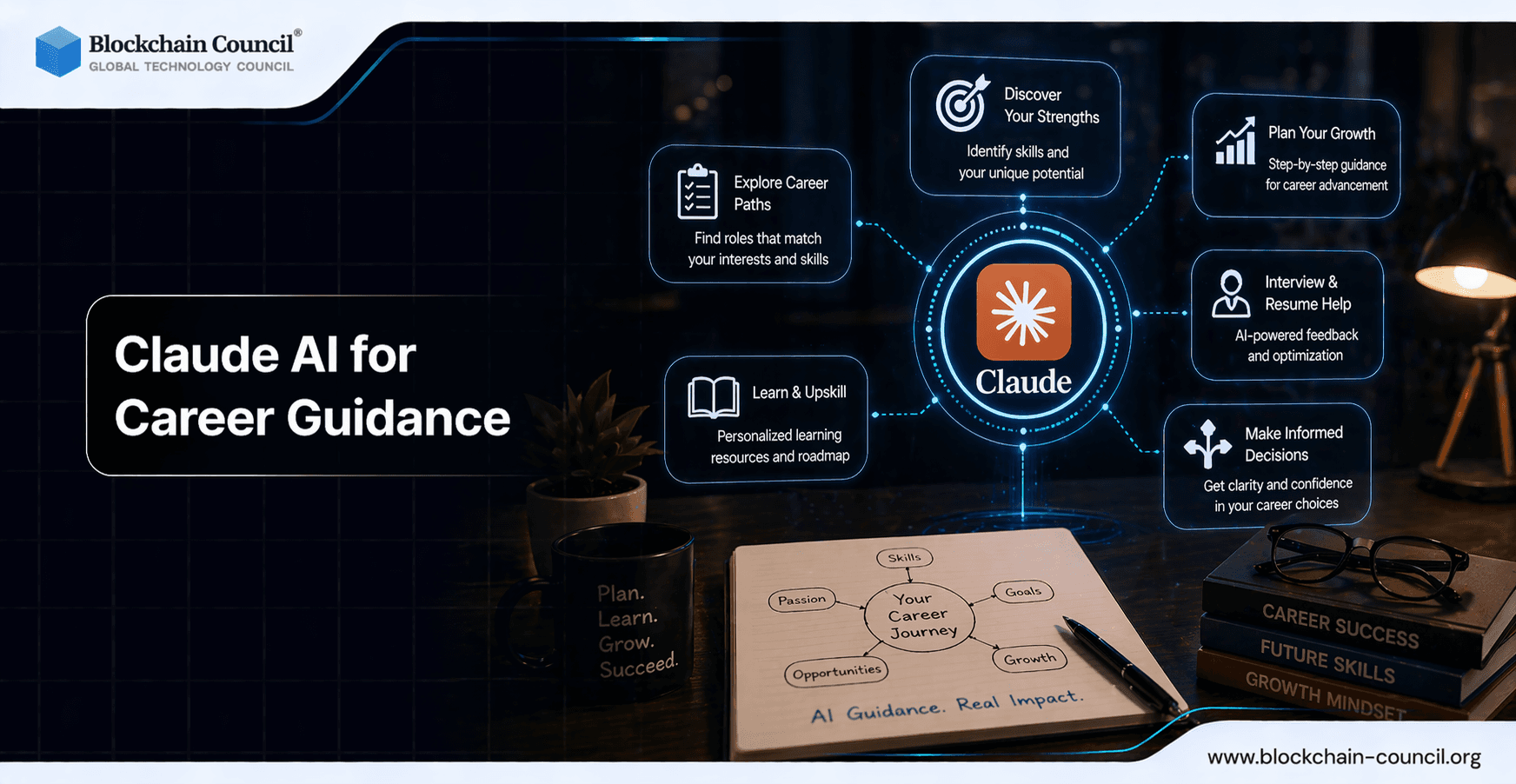
Claude AI for career guidance is becoming a practical workflow for professionals who want clearer role direction, faster skill-gap diagnosis, and a portfolio plan that maps directly to hiring signals. By early 2026, Claude had matured into an enterprise-grade platform with long-context capabilities, Retrieval Augmented Generation (RAG), and agentic behaviors that support multi-step planning. This matters because career decisions rarely fit into one prompt - they require structured inputs, iteration, and evidence. Applying Claude AI for Career Guidance allows individuals to explore career paths, improve skills, and plan growth strategies. Claude can provide personalized recommendations. However, actionable insights require structured interaction. The Claude Code Certification helps you make the most of these capabilities.
Why Claude AI Works for Career Guidance
Career planning is a reasoning-heavy task: you compare roles, translate experience into competencies, and decide which projects prove readiness. Claude is widely recognized for step-by-step reasoning and producing deliberate, structured outputs - qualities that support nuanced tasks like role fit analysis and skill gap mapping.

Adoption data also signals workplace relevance. Claude is used broadly in enterprise environments, including a significant share of Fortune 100 organizations, and usage trends show increasing application to professional work. That makes Claude-based workflows valuable for aligning career materials with how hiring teams actually evaluate candidates.
Use AI-driven insights to plan and accelerate your career path by mastering intelligent systems through an AI Course, building practical skills via a Python Course, and positioning yourself effectively with a Digital Marketing course.
Workflow 1: Role Fit Analysis with Structured Prompting
Start by treating Claude like a knowledgeable coworker. Instead of asking a vague question like "What job should I do?", provide structured context and ask for a repeatable rubric.
Inputs to Provide
Your inventory: responsibilities, tools, domains, measurable outcomes, and constraints (location, salary range, available learning time).
Target roles: 3 to 5 job descriptions or role summaries - for example, product analyst, ML engineer, or security analyst.
Evidence: links or text snippets from your resume, performance reviews, or project documentation.
Prompt Pattern
"Act as a career analyst. Build a role-fit scorecard for each target role using: core skills, adjacent skills, proof I already have, missing proof, and a 30-60-90 day plan. Ask me up to 10 clarifying questions first."
Claude can then produce a matrix that separates "skills you have" from "proof you can show." That distinction is important because hiring decisions typically reward demonstrable outcomes more than self-reported capability.
Workflow 2: Skill Gap Identification Using a Competency Audit
Skill gaps are easiest to address when they are specific and testable. Claude can turn vague goals into a competency checklist with measurable proficiency levels.
How to Run a Gap Audit
Extract skills from job posts: paste 3 to 10 postings for the same role and ask Claude to normalize them into a single competency framework.
Map your evidence: ask Claude to tag each competency as "proven," "partially proven," or "unproven" based on your resume or work samples.
Prioritize by impact: request a ranking by frequency in job posts and likelihood of appearing in interviews.
Because Claude supports long context, you can keep multiple job descriptions, your resume, and project notes in a single workspace, reducing the fragmentation that often derails career planning efforts.
Workflow 3: Portfolio Plans That Hiring Managers Recognize
A portfolio plan should not simply be "build three projects." It should be a sequence of artifacts that match real workflows: documentation, metrics, demos, and tradeoff decisions. Advanced users run ongoing co-working sessions where Claude maintains continuity across weeks, which is well suited to portfolio building.
Portfolio Plan Outputs to Request
Project briefs tied to target roles (problem statement, target users, constraints, success metrics).
Deliverables: README, architecture diagram, test plan, security notes, and a short case study.
Weekly sprint plan with estimated hours and dependencies.
Portfolio narrative: how each project proves a specific competency.
A practical tactic is to ask Claude to generate a single source-of-truth document - such as a roadmap file - that lists your gap skills, the project that addresses each skill, and the evidence you plan to publish. This reduces the risk of building impressive but irrelevant work.
Use RAG and Agentic Workflows Responsibly
RAG can reduce errors by grounding Claude's guidance in your actual documents: job posts, internal project notes, performance feedback, and learning resources. Agentic capabilities can further help by automating repetitive planning steps, such as generating role-specific resume bullets or tracking a portfolio checklist across multiple projects.
However, effective AI collaboration requires discipline. For career guidance, that means applying a few key practices:
Surface assumptions: ask Claude to list its uncertainties and identify what evidence would change its recommendation.
Separate advice from facts: require citations back to your supplied materials for any claims about your experience.
Run red-team checks: ask Claude to critique its own plan from the perspective of a skeptical recruiter.
Training and Credentialing: Making AI Collaboration a Career Advantage
As AI tools become standard in professional settings, the differentiator shifts from simply using a chatbot to orchestrating reliable, repeatable workflows. Structured programs such as Anthropic Academy's role-based tracks and the Claude Certified Architect pathway reflect a broader push to professionalize agentic loops, context management, and tool-based collaboration.
Leverage AI tools for skill gap analysis and career recommendations by combining expertise from an Agentic AI Course, strengthening technical knowledge via a machine learning course, and enhancing personal branding with an AI powered marketing course.
Conclusion: A Repeatable System, Not a One-Time Answer
Claude AI for career guidance is most effective when treated as an ongoing planning partner. Define target roles, audit skill gaps against concrete evidence, and build a portfolio plan that produces recruiter-friendly artifacts. With enterprise adoption rising and agentic workflows expanding, professionals who engage Claude through structured prompting, grounded context, and disciplined iteration will be better positioned to navigate role transitions and increasing workplace automation.
FAQs
1. What is Claude AI for Career Guidance?
Claude AI for Career Guidance provides personalized career advice. It helps users choose suitable paths.
2. How does Claude AI for Career Guidance work?
Claude AI for Career Guidance analyzes skills and goals. It suggests career options.
3. Why is Claude AI for Career Guidance important?
Claude AI for Career Guidance helps make informed decisions. It supports career growth.
4. Can Claude AI for Career Guidance help students?
Yes, Claude AI for Career Guidance helps students explore opportunities. It provides direction.
5. Can Claude AI for Career Guidance suggest skills?
Claude AI for Career Guidance recommends skill development. It aligns with industry needs.
6. Is Claude AI for Career Guidance accurate?
Claude AI for Career Guidance provides reliable suggestions. Users should validate advice.
7. Can Claude AI for Career Guidance help with resumes?
Yes, Claude AI for Career Guidance improves resumes. It suggests better formats.
8. Can Claude AI for Career Guidance support job search?
Claude AI for Career Guidance helps identify job roles. It improves job readiness.
9. What are benefits of Claude AI for Career Guidance?
Claude AI for Career Guidance provides clarity and direction. It enhances decision-making.
10. Can Claude AI for Career Guidance be used by professionals?
Yes, Claude AI for Career Guidance supports career transitions. It helps professionals grow.
11. Does Claude AI for Career Guidance require data input?
Claude AI for Career Guidance works better with detailed input. It improves recommendations.
12. Can Claude AI for Career Guidance reduce confusion?
Yes, Claude AI for Career Guidance simplifies choices. It provides structured advice.
13. What industries use Claude AI for Career Guidance?
Claude AI for Career Guidance is used in education and HR. It supports workforce planning.
14. Can Claude AI for Career Guidance improve planning?
Yes, Claude AI for Career Guidance helps long-term planning. It aligns goals.
15. Is Claude AI for Career Guidance beginner-friendly?
Claude AI for Career Guidance is easy to use. It suits all experience levels.
16. Can Claude AI for Career Guidance be customized?
Yes, Claude AI for Career Guidance adapts to user goals. It provides tailored advice.
17. What are challenges in Claude AI for Career Guidance?
Claude AI for Career Guidance may lack personal context. Human input improves results.
18. Can Claude AI for Career Guidance improve confidence?
Yes, Claude AI for Career Guidance builds confidence. It provides clarity.
19. How to start Claude AI for Career Guidance?
Start Claude AI for Career Guidance by inputting skills and goals. Explore suggestions.
20. What is the future of Claude AI for Career Guidance?
Claude AI for Career Guidance will evolve with AI. It will offer more personalized insights.
Related Articles
View All
Claude Ai
How to Use Claude Fable 5.1 for Free
Find out whether Claude Fable 5.1 is available for free, which Claude plans provide access, and what users need to know before trying Anthropic’s latest AI model.
Claude Ai
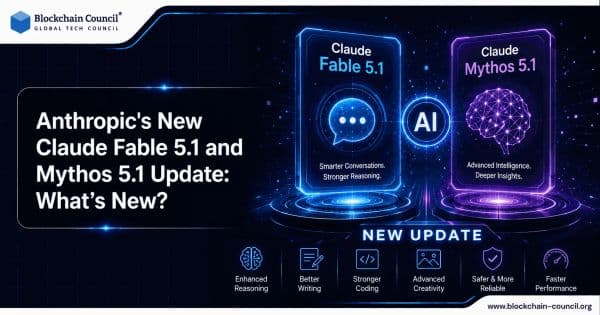
Anthropic's New Claude Fable 5.1 and Mythos 5.1 Update: What's New?
Anthropic’s Claude Fable 5.1 and Mythos 5.1 update brings stronger coding, long-running agentic workflows, research, vision, and knowledge-work capabilities. Fable 5.1 is generally available and introduces cheaper cache reads, potentially reducing typical workload costs by about 25% and highly agentic workloads by up to 45%. Mythos 5.1 uses the same underlying model but offers expanded cybersecurity and biology capabilities to vetted organizations through trusted-access programs.

Claude Ai
Fable 5 vs Claude vs ChatGPT: Which AI Model Should You Choose?
Compare Fable 5, Claude, and ChatGPT across coding, research, DevOps, cost, context, and governance to choose the right AI model.
Trending Articles
The Role of Blockchain in Ethical AI Development
How blockchain technology is being used to promote transparency and accountability in artificial intelligence systems.

Top 5 DeFi Platforms
Explore the leading decentralized finance platforms and what makes each one unique in the evolving DeFi landscape.
What is AWS? A Beginner's Guide to Cloud Computing
Everything you need to know about Amazon Web Services, cloud computing fundamentals, and career opportunities.