

Claude Agent SDK

Artificial intelligence is evolving from passive tools into active systems capable of making decisions, executing tasks, and interacting with complex environments. One of the most important developments in this space is the emergence of agent based architectures, supported by tools such as the Claude Agent SDK.
The Claude Agent SDK enables developers to build intelligent AI agents that can reason, act, and integrate with external systems. These agents go beyond simple prompt response models and operate as dynamic entities capable of handling workflows, automation, and decision making processes.

For professionals aiming to master this evolving domain, structured programs like the Claude Code Certification and the AI expert certification provide essential knowledge in AI systems, development frameworks, and intelligent automation.
What is Claude Agent SDK
Claude Agent SDK is a development toolkit that allows programmers to create AI agents powered by Claude models. These agents can perform tasks, interact with APIs, and operate within defined workflows.
Core Capabilities
Autonomous decision making
Task execution
Integration with external tools
Context aware reasoning
Unlike traditional AI systems, agents built with this SDK are designed to act rather than simply respond.
What is an AI Agent
Before diving deeper, it helps to understand what an AI agent is.
Definition
An AI agent is a system that can:
Perceive its environment
Make decisions
Take actions
Learn or adapt over time
Example
A customer support agent powered by AI can:
Understand user queries
Retrieve relevant information
Provide responses
Escalate issues when necessary
Why Claude Agent SDK Matters
Shift from Static AI to Dynamic Systems
Traditional AI responds to prompts. Agents execute workflows.
Increased Automation
Agents reduce the need for manual intervention.
Scalability
Organizations can deploy agents across multiple processes.
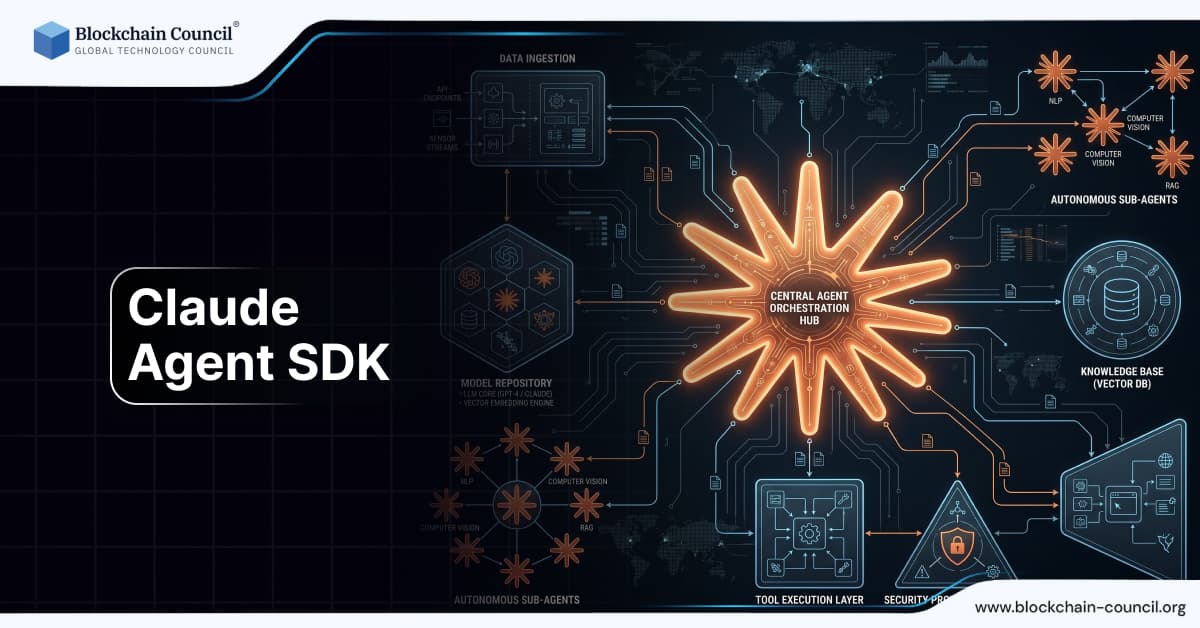
Architecture of Claude Agent SDK
Input Layer
Receives instructions or user queries.
Reasoning Engine
Claude processes the input and determines the next action.
Action Layer
Executes tasks such as API calls or data processing.
Feedback Loop
Results are analyzed and used for further decisions.
Real World Example
Consider an e commerce platform using a Claude based agent:
A customer places an order inquiry
The agent retrieves order details
It checks shipping status
It responds with real time updates
This process happens without human intervention.
Key Features of Claude Agent SDK
Context Awareness
Agents understand ongoing interactions and maintain context.
Tool Integration
They can connect with APIs, databases, and services.
Multi Step Reasoning
Agents can break down complex tasks into smaller steps.
Customization
Developers can define rules and behaviors.
Benefits of Using Claude Agent SDK
Efficiency
Automates repetitive tasks.
Accuracy
Reduces human error.
Cost Reduction
Minimizes operational expenses.
Scalability
Supports large scale deployments.
Claude Agent SDK vs Traditional APIs
Traditional APIs
Require explicit instructions
Limited flexibility
Manual orchestration
Agent Based Systems
Autonomous behavior
Adaptive decision making
Reduced manual control
Use Cases
Customer Support
Automated chat systems handling queries.
Software Development
Agents assisting with coding and debugging.
Data Analysis
Automated data processing and insights.
Marketing Automation
Campaign management and personalization.
Role of AI in Agent Development
Natural Language Processing
Enables understanding of user input.
Machine Learning
Improves decision making over time.
Automation
Executes tasks without human input.
Developers can enhance their expertise through the AI Powered coding expert Course.
Challenges in Using Claude Agent SDK
Complexity
Building agents requires advanced knowledge.
Control Issues
Agents may behave unpredictably.
Security Risks
Integration with external systems introduces vulnerabilities.
Best Practices
Define Clear Objectives
Ensure agents have specific goals.
Monitor Performance
Track actions and outcomes.
Implement Safeguards
Prevent unintended actions.
Integration with Development Tools
IDEs
Enhances coding workflows.
Cloud Platforms
Supports scalable deployment.
APIs
Enables communication with external systems.
Marketing and Business Perspective
Improved Customer Experience
Faster and more accurate responses.
Operational Efficiency
Reduced manual workload.
Competitive Advantage
Early adoption of AI agents.
Professionals can explore these strategies through the AI powered marketing course.
Recent Developments
Advanced Agent Capabilities
Improved reasoning and decision making.
Better Integration Tools
Simplified API connections.
Increased Adoption
More organizations are using AI agents.
Future of Claude Agent SDK
Autonomous Systems
Agents will operate with minimal supervision.
Enhanced Intelligence
Improved learning and adaptation.
Broader Applications
Use across industries and sectors.
Impact on Developers
New Skill Requirements
Understanding AI and automation is essential.
Increased Productivity
Agents assist with complex tasks.
Innovation Opportunities
Developers can build advanced systems.
Conclusion
Claude Agent SDK represents a significant advancement in artificial intelligence, enabling the creation of systems that can act, decide, and adapt. As businesses continue to adopt AI driven solutions, agent based architectures will become increasingly important.
Understanding how to design, implement, and manage these systems is essential for developers and organizations aiming to stay competitive in the evolving technological landscape.
FAQs
1. What is Claude Agent SDK?
Claude Agent SDK is a toolkit that allows developers to build intelligent AI agents capable of performing tasks and making decisions. These agents use Claude models to process information, analyze context, and interact with external systems. They are designed to automate workflows, reduce manual effort, and improve efficiency across applications. It is considered a key component in modern AI driven development.
2. How does it differ from traditional AI tools?
Traditional AI tools are primarily focused on responding to prompts or generating outputs based on user input. In contrast, Claude Agent SDK enables systems to take actions, execute workflows, and make decisions autonomously. This makes agents more dynamic and capable of handling complex, multi step processes. It represents a major shift from passive assistance to active execution.
3. What are AI agents used for?
AI agents are used for a wide range of applications including customer support, automation, data processing, and decision making. They can handle repetitive tasks efficiently and assist in complex workflows that require multiple steps. Businesses use them to improve productivity, reduce operational costs, and enhance user experience. Their versatility makes them valuable across industries.
4. Is Claude Agent SDK suitable for beginners?
While beginners can explore the SDK, it may initially seem complex due to the need for programming and AI knowledge. Understanding concepts such as APIs, workflows, and system integration is important. With structured learning and consistent practice, beginners can gradually build proficiency. Starting with simple projects is often recommended.
5. What programming languages are supported?
The SDK typically supports widely used programming languages in AI and software development environments. Integration depends on the platform and tools being used in a project. Developers can select languages that best fit their workflows and technical requirements. Flexibility in language support allows broader adoption.
6. How does it improve productivity?
Claude Agent SDK improves productivity by automating repetitive and time consuming tasks. Developers and businesses can delegate routine processes to AI agents, allowing them to focus on higher level work. This leads to faster execution, improved efficiency, and better use of resources. Over time, productivity gains become significant.
7. What industries use AI agents?
AI agents are widely used in industries such as technology, finance, healthcare, e commerce, and marketing. These sectors benefit from automation, faster decision making, and improved customer interactions. Adoption continues to grow as businesses recognize the value of intelligent systems. The impact is expanding across nearly every domain.
8. Are AI agents secure?
AI agent security depends heavily on how they are implemented and managed. Proper safeguards, monitoring systems, and access controls are necessary to ensure safe operation. Without these measures, agents could introduce vulnerabilities. Security should always be a priority when deploying AI systems.
9. Can AI agents learn over time?
Some AI agents are designed to learn and adapt based on data and feedback. This learning capability allows them to improve performance and make better decisions over time. The extent of learning depends on system design and integration with machine learning models. Continuous improvement is a key advantage.
10. What are the risks of using AI agents?
Risks include unpredictable behavior, integration challenges, and potential security vulnerabilities. Without proper monitoring, agents may make incorrect decisions or perform unintended actions. These risks highlight the importance of testing, validation, and oversight. Effective risk management ensures safer deployment.
11. How do agents interact with APIs?
Agents use APIs to communicate with external systems, retrieve data, and perform actions. This allows them to integrate with databases, applications, and services. API interaction expands the capabilities of agents significantly. It enables them to function within complex environments.
12. What is context awareness?
Context awareness allows agents to understand ongoing interactions and maintain continuity across tasks. This improves the relevance and accuracy of their actions and responses. By remembering previous inputs, agents can provide more intelligent outputs. It enhances overall user experience.
13. How can developers learn to use it?
Developers can learn by taking courses, exploring documentation, and building practical projects. Hands on experience is crucial for understanding how agents operate. Continuous learning helps improve skills and confidence. Structured training programs can accelerate progress.
14. What tools are needed?
Developers typically use integrated development environments, APIs, and cloud platforms when working with the SDK. These tools support building, testing, and deploying AI agents. The choice of tools depends on project requirements and scale. A proper setup ensures smooth development.
15. What is the future of AI agents?
The future of AI agents involves greater autonomy, improved intelligence, and deeper integration into everyday systems. They will handle more complex tasks and operate with minimal human intervention. Adoption will continue to grow across industries. Innovation in this field is expected to accelerate.
16. Can businesses benefit from this SDK?
Businesses can significantly benefit by improving efficiency, reducing costs, and enhancing customer experiences. AI agents streamline operations and enable faster decision making. This leads to better outcomes and competitive advantages. Adoption is becoming increasingly common.
17. How does it affect developers?
Developers gain access to powerful tools that allow them to build advanced systems and automate complex workflows. This increases productivity and opens new opportunities for innovation. However, it also requires learning new skills. The impact is both empowering and demanding.
18. What are common challenges?
Common challenges include system complexity, integration issues, and maintaining control over agent behavior. Developers must carefully design and test systems to ensure reliability. Addressing these challenges improves performance and stability. Preparation is essential.
19. Is it scalable?
Yes, Claude Agent SDK supports scalability through cloud integration and efficient system design. Agents can handle increasing workloads without significant performance issues. This makes it suitable for enterprise applications. Scalability is one of its key strengths.
20. Why is Claude Agent SDK important?
It enables the creation of intelligent systems that can act, decide, and adapt in real time. This represents a major evolution in artificial intelligence technology. It supports innovation, efficiency, and automation across industries. Its importance will continue to grow as AI adoption increases.
Related Articles
View All
Claude Ai
How to Use Claude Fable 5.1 for Free
Find out whether Claude Fable 5.1 is available for free, which Claude plans provide access, and what users need to know before trying Anthropic’s latest AI model.
Claude Ai
Anthropic's New Claude Fable 5.1 and Mythos 5.1 Update: What's New?
Anthropic’s Claude Fable 5.1 and Mythos 5.1 update brings stronger coding, long-running agentic workflows, research, vision, and knowledge-work capabilities. Fable 5.1 is generally available and introduces cheaper cache reads, potentially reducing typical workload costs by about 25% and highly agentic workloads by up to 45%. Mythos 5.1 uses the same underlying model but offers expanded cybersecurity and biology capabilities to vetted organizations through trusted-access programs.

Claude Ai
Fable 5 vs Claude vs ChatGPT: Which AI Model Should You Choose?
Compare Fable 5, Claude, and ChatGPT across coding, research, DevOps, cost, context, and governance to choose the right AI model.
Trending Articles
AWS Career Roadmap
A step-by-step guide to building a successful career in Amazon Web Services cloud computing.

Top 5 DeFi Platforms
Explore the leading decentralized finance platforms and what makes each one unique in the evolving DeFi landscape.
What is AWS? A Beginner's Guide to Cloud Computing
Everything you need to know about Amazon Web Services, cloud computing fundamentals, and career opportunities.