

Anthropic Files S-1 for Proposed IPO: What We Know
 Suyash Raizada
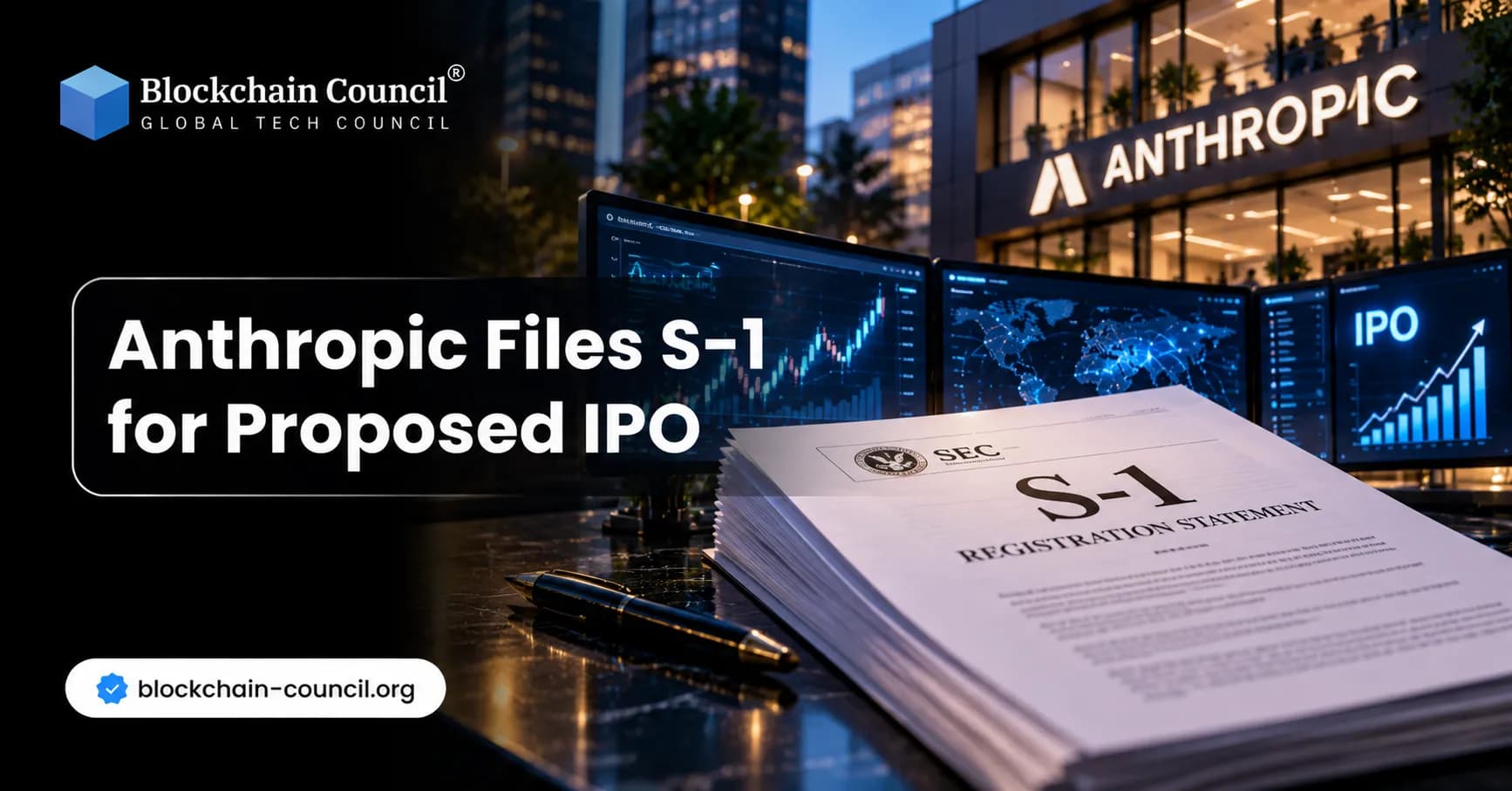
On October 26, 2026, Anthropic took the biggest step in its corporate history. The company filed an S-1 registration statement with the U.S. Securities and Exchange Commission, starting the public process for an initial public offering of its Class A common stock. The maker of the Claude AI models plans to list on the Nasdaq Global Select Market under the ticker symbol ANT. The document is one of the most closely read in technology this year, because it opens the books on a company that grew from a research lab into a major enterprise software supplier in only a few years.
This guide is for beginners, investors and technology leaders alike. It explains what the filing says, which numbers matter, and what is still unknown. If you want to understand the AI fundamentals behind the headlines, a credential such as the Certified Artificial Intelligence (AI) Expert program is one practical place to start.

Anthropic Files S-1: The Official Announcement
Anthropic published its own statement on the same day, in the Announcements section of its website.
What the Official Statement Says
The company said it filed a registration statement on Form S-1 with the SEC relating to the proposed initial public offering of its Class A common stock. It also said it intends to list the shares on the Nasdaq Global Select Market under the symbol “ANT.” The number of shares to be offered and the price range have not been determined.
The statement names Goldman Sachs & Co. LLC and Morgan Stanley & Co. LLC as the places where copies of the preliminary prospectus can be requested once it is available.
The Legal Notice Attached to the Announcement
Anthropic included the standard securities disclaimer. The registration statement has been filed but has not yet become effective, so the shares cannot be sold and offers to buy cannot be accepted until it does. The announcement is not an offer to sell securities or a request to buy them. The offering will be made only through a prospectus.
You can read the full statement on the Anthropic newsroom at https://www.anthropic.com/news/s1-sec.
What Is an S-1 and Why Does It Matter?
An S-1 is the registration form a company files with the SEC before it sells shares to the public for the first time. Think of it as a detailed report card. It describes the business, the financial results, the risks, the leaders and how the company plans to use the money it raises.
Anthropic’s path to this point was gradual. On June 1, 2026, the company announced that it had confidentially submitted a draft registration statement to the SEC. The October filing is the public version, which means everyone can now read what regulators have been reviewing.
For readers who work with Claude every day, the filing also shows how the product is sold and funded. Teams that depend on Claude for coding, writing and analysis may find that a credential like the Certified Claude AI Expert certification helps them connect the product’s features to the business strategy the S-1 describes.
Key Facts at a Glance
Here are the main points from the filing and its coverage:
Filing date: October 26, 2026, accepted by the SEC on the morning of that day.
Security offered: Class A common stock, sold by Anthropic and by selling stockholders named in the document.
Exchange and ticker: Nasdaq Global Select Market, symbol ANT.
Lead banks: Goldman Sachs and Morgan Stanley, joined by a long list of other underwriters including J.P. Morgan, Citigroup, Barclays and BofA Securities.
Price and share count: not yet set.
Structure: Delaware public benefit corporation with a Long-Term Benefit Trust.
The Financial Picture Inside the Filing
The financial section is where the filing draws the most attention. The figures below come from the filing as reported by major outlets, so treat them as reported numbers rather than audited conclusions of your own.
Revenue Growth
Anthropic reported about $16.29 billion in revenue for the six months ended June 30, 2026. In the same period of 2025, the figure was about $1.16 billion. The filing says revenue grew 1,368% year over year in the second quarter alone. Media reports also say the company posted its first quarterly operating profit in the second quarter, at roughly $974 million.
Customers and Retention
The filing describes a customer base that is growing in both size and depth. As of September 30, 2026, it reports more than 11,900 customers paying at least $100,000 a year, more than 1,900 paying at least $1 million and about 250 paying at least $10 million. Net revenue retention was approximately 900%. In plain language, qualified customers were spending roughly nine times what they spent a year earlier.
Most revenue comes from businesses, often through cloud partners such as Amazon Web Services, Google Cloud and Microsoft Azure. The filing does not break out individual subscribers such as Claude Pro and Max users, but coverage suggests they account for a minority of revenue. Overseas revenue for the first half was reported at more than $4.5 billion.
Losses Alongside Growth
Growth is expensive. Reports on the filing put the net loss for the first half of 2026 at roughly $80 billion. The company has raised about $141.1 billion in total capital and held $112.4 billion in cash and equivalents as of June 30, 2026, plus $19.3 billion in short-term investments. Coverage also notes that the company reached about $6.6 million in trailing revenue per employee, with a team of around 5,300 people.
Compute: The Biggest Cost and the Biggest Bet
Training and running AI models takes enormous computing power. The filing indicates that Anthropic plans to spend at least $542 billion on data centers and cloud computing. It also describes a compute agreement with SpaceX valued at $3.1 billion per month, according to reporting on the document. Anthropic uses chips from Nvidia, AMD, Amazon and Google, which spreads its supplier risk.
This is why the IPO matters well beyond one company. Chip makers, cloud providers and power suppliers all benefit when an AI lab commits to this scale of infrastructure. Market reaction on the day of the filing reflected that, with semiconductor stocks rising sharply.
Professionals who want to understand the hardware, cloud and infrastructure layers behind AI can explore a Tech Certification to build knowledge of the emerging technologies that power these investments.
Governance: A Structure With No Direct Precedent
Anthropic told investors that its capital and governance structure has no direct public company precedent. Several parts of the design are unusual.
A Public Benefit Corporation
Anthropic is a Delaware public benefit corporation. Its charter states a purpose of the responsible development and maintenance of advanced AI for the long-term benefit of humanity. That means the board must weigh this mission alongside shareholder returns.
The Long-Term Benefit Trust
The Long-Term Benefit Trust, created in 2023, has five financially disinterested trustees. Through Class T stock, it can elect and remove directors who make up a majority of the board. Because of this power, Anthropic qualifies as a controlled company under Nasdaq rules. The filing says it expects to use only the exemption for its nominating and corporate governance committee, and that its audit and compensation committees are fully independent.
Founder Voting Power and Share Classes
Just before the offering closes, Anthropic will issue a single Class F share to an entity whose members are the seven co-founders: Dario Amodei, Daniela Amodei, Tom Brown, Jack Clark, Jared Kaplan, Sam McCandlish and Christopher Olah. That one share carries 50.1% of total voting power on most shareholder matters. Class A shares carry one vote each. Class N shares, held mostly by strategic partners, carry no general voting rights.
Giving Back
The filing says Anthropic contributed 5% of its fully diluted shares to the Anthropic Public Benefit Fund. Each co-founder has also pledged to dedicate 80% of their personal Anthropic equity to philanthropy.
Risks Investors Should Read Carefully
The S-1 contains more than 90 pages of risk factors. For a beginner, the main themes are easy to follow:
Compute dependence: the business relies on securing enough chips and data center capacity.
Key people: losing co-founders or top researchers could hurt progress.
Competition: other labs and big technology companies are racing in the same market.
Model behavior: the company warns that models may develop capabilities it does not anticipate and that misuse or failed safeguards could cause real-world harm, which could exceed what insurance covers.
Concentration: large customers, cloud partners that are also investors, and concentrated voting power are all listed as risks.
Government disputes: the filing discusses a clash with the Pentagon that the company says could cause material revenue losses, along with a court ruling in the company’s favor on constitutional grounds.
None of this means the offering will fail. Every S-1 lists risks, but the specific wording shows what management itself considers most serious.
What We Do Not Know Yet
Several details are still open. The share count and price range are blank. Some outlets have reported a valuation between $1.5 trillion and $2 trillion and a possible mid-November debut. Anthropic’s official statement and the filing cover do not confirm either claim, so treat them as unverified. An earlier funding round in May was reported at a valuation of $965 billion.
The next steps are standard. The SEC will review the document and the company may file amendments. A price range will follow, and the registration statement must become effective before any shares can be sold. Market conditions can still change the timing.
What the IPO Means for Businesses and Professionals
For companies, a public Anthropic means more transparency about pricing power, product direction and financial stability. That helps procurement teams judge whether Claude can be a long-term supplier. For workers, it confirms that AI skills are moving from optional to expected.
As artificial intelligence becomes part of everyday business operations, employers increasingly need people who can apply AI knowledge responsibly and effectively. Evaluating candidates on relevant skills, reasoning, and practical understanding can support stronger hiring decisions. HireValid can be explored by organisations seeking structured candidate assessments.
Individuals can prepare in several ways. Learn how large language models work, practice with real tools, and understand privacy and safety basics. Keep reading primary sources such as the S-1 itself, which is free on the SEC website.
Conclusion
The decision to file an S-1 marks Anthropic’s move from private lab to a company ready for public scrutiny. The filing shows extraordinary revenue growth, deep enterprise adoption, huge compute commitments and heavy losses, all inside a governance model built around a public benefit mission. The key unknowns are price, share count and timing.
For readers who plan to talk about AI products, advise clients or create content in this fast changing market, communication skills matter as much as technical ones. A Marketing Certification can help you explain complex technology stories like this one clearly and responsibly. Keep following official Anthropic and SEC updates as the offering moves toward effectiveness.
FAQs
1. What is Anthropic's proposed IPO?
Anthropic's proposed initial public offering (IPO) would allow investors to purchase shares of the AI company through the public stock market. The company has filed the registration statement needed to begin the formal process, but the IPO is not yet complete and its shares are not yet publicly trading.
2. What does it mean that Anthropic filed an S-1?
An S-1 is a registration statement submitted to the SEC before a U.S. company conducts a public offering. It provides information about the business, financial performance, risks, ownership, and proposed offering. The SEC reviews the filing before the registration statement can become effective.
3. When did Anthropic file its S-1 registration statement?
Anthropic publicly filed its S-1 on October 26, 2026. The public filing followed an earlier confidential draft submission, which allowed the company to begin the regulatory review process before making its registration statement public.
4. What ticker symbol will Anthropic use?
Anthropic intends to list its Class A common stock on the Nasdaq Global Select Market under the ticker symbol ANT. The proposed ticker is part of the company's IPO plans and does not mean the stock is already available for public trading.
5. How much money does Anthropic plan to raise through its IPO?
Anthropic has not yet disclosed the final amount it intends to raise. The number of shares offered and the IPO price range remain undetermined, so investors cannot yet calculate the final offering size or the company's IPO valuation.
6. How much revenue did Anthropic generate before its IPO?
According to reporting on the S-1, Anthropic generated approximately $16.3 billion in revenue during the first half of 2026, compared with $4.6 billion for the full year of 2025. This reflects rapid business growth, although revenue growth alone does not establish long-term profitability.
7. Is Anthropic profitable?
Anthropic has reported operating losses despite its rapid revenue growth. Reporting on the S-1 indicates an operating loss of approximately $693 million in the first half of 2026, compared with $2.1 billion in the same period of 2025. Its net loss was much larger because of substantial noncash accounting adjustments.
8. What does Anthropic do?
Anthropic develops artificial intelligence systems, including the Claude family of AI models. Its products support activities such as coding, research, document analysis, business automation, and conversational assistance. The company also provides AI services for developers and enterprise customers.
9. Why is Anthropic going public?
An IPO can provide a company with access to public capital, liquidity for certain existing shareholders, and a publicly traded valuation. Anthropic's exact financial objectives for this offering will become clearer through its prospectus and subsequent disclosures. Filing an S-1 does not guarantee that the IPO will proceed.
10. What valuation could Anthropic achieve in its IPO?
Anthropic's final IPO valuation has not been established in the filing announcement. Market speculation about a multibillion-dollar or even exceptionally large valuation should not be treated as a confirmed figure. The proposed share price, share count, financial disclosures, and investor demand will be important in determining its eventual market capitalization.
11. Who is leading Anthropic?
Anthropic was co-founded by Dario Amodei and Daniela Amodei, alongside other researchers and executives. Dario Amodei serves as CEO, while Daniela Amodei serves as president. Their leadership has helped shape the company's focus on advanced AI development and safety.
12. How many enterprise customers does Anthropic have?
The IPO filing reportedly shows substantial growth in large enterprise accounts. As of September 30, 2026, Anthropic had more than 11,900 customers generating at least $100,000 in trailing-12-month revenue, including more than 1,900 spending at least $1 million and approximately 250 spending at least $10 million.
13. What are the biggest risks facing Anthropic?
Key risks include intense competition in AI, the cost of computing infrastructure, dependence on strategic partners, evolving regulation, and uncertainty about future profitability. The company also faces technical and safety challenges associated with developing increasingly capable AI systems. Investors should examine the risk factors in the full registration statement.
14. How much is Anthropic spending on AI infrastructure?
Anthropic's infrastructure commitments are substantial. Reporting on the prospectus describes hundreds of billions of dollars in commitments involving computing, cloud services, and infrastructure partners over time. These commitments highlight the capital-intensive nature of advanced AI development and make future revenue growth and capacity utilization important considerations.
15. What is Anthropic's relationship with Amazon and Google?
Amazon and Google are important strategic partners in Anthropic's AI ecosystem, providing cloud infrastructure and other support. These relationships can help Anthropic access the computing resources needed to train and operate advanced models, while also creating dependencies that investors should evaluate.
16. Will public investors have control over Anthropic after the IPO?
Not necessarily. Anthropic's proposed governance structure gives its founders and special governance arrangements significant influence over the company. The S-1 describes a structure in which the founders' special Class F shares would collectively hold 50.1% of voting power, while the Long-Term Benefit Trust would have important board-appointment authority. This means ordinary public shareholders may have limited influence over certain corporate decisions.
17. When will Anthropic's IPO take place?
A final IPO date has not been confirmed. The company must complete the SEC review process, publish the relevant final offering details, and satisfy the requirements for the registration statement to become effective. The timetable can change depending on regulatory review and market conditions.
18. Can retail investors buy Anthropic shares now?
No. Filing an S-1 does not make a company's shares immediately available for public trading. Retail investors will need to wait until the offering is completed and the shares begin trading, subject to their broker's access and applicable eligibility requirements.
19. How can investors evaluate Anthropic before its IPO?
Investors should review the prospectus for revenue growth, operating expenses, cash flow, infrastructure commitments, customer concentration, governance, competition, and risk factors. They should also compare the eventual IPO valuation with realistic expectations for future growth rather than basing a decision solely on enthusiasm around AI.
20. Why is Anthropic's proposed IPO important for the AI industry?
Anthropic's IPO could provide public-market investors with a more direct way to participate in the growth of a major AI developer. It may also offer a clearer view of the financial realities behind advanced AI, including infrastructure costs, enterprise demand, governance, and the challenge of turning rapid revenue growth into sustainable profitability.
Related Articles
View All
Claude Ai
Anthropic Launches Claude Duet: What You Need to Know
Anthropic has launched Claude Duet, a proactive AI agent that sends morning briefs, watches your connected apps, and works on tasks in the cloud. Learn how it works, who can use it, what it costs, and where it falls short.

Claude Ai
Anthropic IPO: What the Confidential S-1 Filing Signals and What to Watch Next
Anthropic has confidentially filed an S-1 for an IPO. Learn what the Anthropic IPO signal means, what is known, and which risks to watch when the S-1 goes public.
Claude Ai
Anthropic Introduces AI Watermarks for Claude-Generated Content
Anthropic’s AI watermarking initiative for Claude-generated content highlights growing efforts to improve AI transparency, content provenance, and responsible AI use. Explore how AI watermarks can help identify machine-generated material, their potential applications, and the technical limitations involved.
Trending Articles
The Role of Blockchain in Ethical AI Development
How blockchain technology is being used to promote transparency and accountability in artificial intelligence systems.
What is AWS? A Beginner's Guide to Cloud Computing
Everything you need to know about Amazon Web Services, cloud computing fundamentals, and career opportunities.
Can DeFi 2.0 Bridge the Gap Between Traditional and Decentralized Finance?
The next generation of DeFi protocols aims to connect traditional banking with decentralized finance ecosystems.