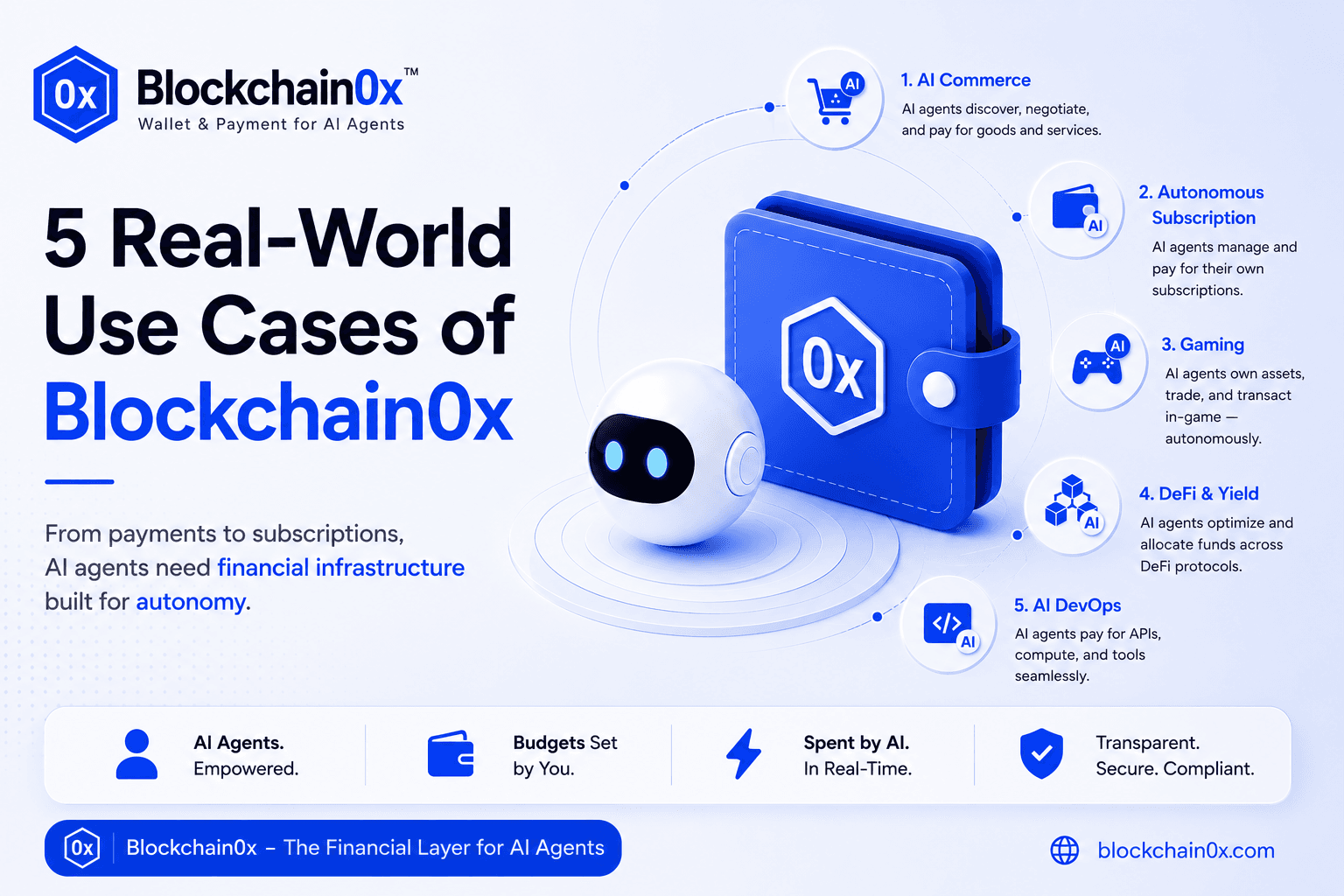
Top Real-World Use Cases of Blockchain0x: DeFi, NFTs, Identity, and Enterprise Applications

Blockchain0x use cases are increasingly visible across four practical categories: DeFi, NFTs and tokenization, digital identity, and enterprise workflows such as settlement, provenance, and compliance recordkeeping. Adoption is strongest where blockchain addresses high-friction coordination problems, particularly in financial infrastructure and multi-party enterprise processes. Identity and many NFT applications remain promising but uneven, held back by regulatory uncertainty, interoperability gaps, and user experience constraints.
This guide breaks down the top real-world use cases of Blockchain0x, covering what is working today, where adoption is still emerging, and what professionals need to know to evaluate solutions responsibly.

1) DeFi: The Most Mature Consumer-Facing Blockchain0x Use Case
Decentralized finance (DeFi) refers to financial services built on public blockchains and smart contracts, including trading, lending, derivatives, payments, and stablecoin settlement. Market activity remains concentrated on a smaller set of chains and protocols, with Ethereum widely recognized as a foundational layer even as usage becomes increasingly multi-chain.
Why DeFi Is Gaining Real-World Traction
- Stablecoins as payment and settlement rails: Stablecoins have become a major on-chain instrument for payments and exchange settlement. Visa has publicly discussed settling transactions using USD Coin, reflecting how blockchain rails are being tested and integrated into mainstream payment infrastructure.
- Maturing products beyond early yield farming: DeFi has expanded toward more institutional-style products, including tokenized treasury exposure and on-chain liquidity management.
- Programmable money: Smart contracts enable conditional settlement, automated margining, and transparent collateral management, which can reduce reconciliation overhead in certain workflows.
Real-World DeFi Use Cases
- Cross-border transfers: Blockchain-based transfers can reduce intermediaries and accelerate settlement compared with traditional correspondent banking routes.
- Stablecoin payments: Exchanges, fintech apps, wallets, and some merchants use stablecoins for near real-time settlement and treasury movement.
- On-chain lending and collateralized borrowing: A core DeFi primitive where users borrow against crypto collateral under transparent, rules-based smart contracts.
Constraints and Risks Professionals Must Account For
- Smart contract risk: Vulnerabilities, oracle failures, and integration bugs can cause losses even when the underlying business logic is sound.
- Liquidity fragmentation: Multi-chain growth can split liquidity across networks and venues, affecting execution quality and risk management.
- Regulatory scrutiny: Securities classification, custody rules, market integrity obligations, and compliance requirements materially shape which DeFi models can scale.
Professionals building DeFi expertise can explore Blockchain Council training paths such as the Certified DeFi Expert program or the broader Certified Blockchain Expert certification to strengthen fundamentals in smart contracts, tokens, and on-chain market structure.
2) NFTs and Tokenization: Moving Beyond Collectibles Into Rights and Access
NFTs are smart-contract-based tokens that represent unique ownership or rights on a blockchain. While NFTs became mainstream through digital art and collectibles, the underlying concept is broader: NFTs can encode ownership, licensing, entitlements, and access rules for many categories of assets.
How NFT Utility Is Evolving
The NFT market has shifted from speculative profile-picture collecting toward practical utility, including token-gated access and real-world asset representation. Many advanced NFT applications are still early-stage or not yet widely adopted, which is an important consideration for teams planning production deployments.
Real-World NFT and Tokenization Use Cases
- Digital collectibles and gaming assets: The most established NFT category, where ownership and transferability are central to the value proposition.
- Art provenance: NFTs can record creator attribution and ownership history, supporting provenance tracking for fine art and digital works.
- Tokenized real-world assets: NFTs can represent ownership or fractional interests in property and other high-value assets, depending on legal structure and custody arrangements.
- Insurance and debt instruments: Policy terms or loan agreements can be represented as tokens, enabling automation and transfer rules under defined conditions.
- Customer rewards and memberships: Brands can issue tokenized perks, special privileges, and tradable loyalty benefits via NFTs.
What Holds NFT Adoption Back
- User experience and key management: Wallet setup, signing flows, and recovery remain obstacles for mainstream users.
- Standardization and interoperability: Cross-platform portability of rights and metadata is still inconsistent across ecosystems.
- Legal enforceability: Token ownership does not automatically equal legal ownership or enforceable rights unless contracts and jurisdictional rules are properly aligned.
For teams building tokenized products, Blockchain Council's NFT-related certifications and the Certified Smart Contract Developer pathway can help align technical design with token standards, metadata practices, and security considerations.
3) Identity: Self-Sovereign Identity, Data Portability, and Fraud Reduction
Blockchain identity focuses on giving individuals and organizations greater control over credentials while reducing reliance on centralized identity providers. Industry frameworks commonly address three core themes: self-sovereign identity, data monetization, and data portability.
Where Blockchain Identity Helps in the Real World
- Citizen identity verification: Verifiable credentials can reduce identity fraud by enabling cryptographic proof of claims.
- Selective disclosure: Users can prove specific attributes, such as age eligibility, without exposing unnecessary personal data.
- Reusable compliance credentials: Verified attestations could reduce repeated KYC submissions across services, provided institutions accept shared standards.
- Digital identity for housing and services: Verified credentials can reduce friction in renting, purchasing property, and accessing financial services.
Why Identity Is Promising but Hard to Scale
- Interoperability requirements: Identity systems must work across governments, banks, employers, universities, and service providers simultaneously.
- Governance and revocation: Credential revocation, issuer trust frameworks, and dispute resolution processes require robust governance structures.
- Privacy and recovery: Systems must support privacy-preserving verification and safe recovery methods without reintroducing central points of failure.
- Regulatory acceptance: Adoption depends on legal recognition of digital credentials and alignment with data protection regulations.
Blockchain identity is best understood as an evolving infrastructure layer rather than a fully mature mass-market category. For professionals, the key is understanding which parts of the identity stack belong on-chain versus off-chain, and how verifiable credentials integrate with existing authentication standards.
Blockchain Council learning tracks such as Certified Blockchain Expert provide foundational architecture knowledge, while the Certified Cybersecurity Expert program covers identity security, threat modeling, and secure credential lifecycle management.
4) Enterprise Applications: Settlement, Provenance, Compliance, and Recordkeeping
Enterprise blockchain deployments are often less visible than DeFi, but they can deliver clear operational value. Many business deployments are permissioned or consortium-based because enterprises need governance, access control, privacy boundaries, and integration with existing systems.
What Enterprises Actually Want From Blockchain
- Shared source of truth across parties: A tamper-evident ledger can reduce disputes when multiple organizations need to update shared records.
- Auditability and traceability: Immutable event histories can improve forensic investigation and regulatory reporting.
- Programmable workflows: Smart contracts can automate cross-company rules, approvals, and settlement logic.
Real-World Enterprise Blockchain0x Use Cases
- Supply chain traceability: Tracking handoffs and provenance in manufacturing, food, and healthcare supply chains.
- Pharmaceutical cold-chain monitoring: Recording storage and distribution events for temperature-sensitive medicines and vaccines.
- Compliance tracking: Maintaining auditable logs for regulatory reporting and internal controls.
- Cross-company reconciliation: Using smart contracts to reduce manual matching of invoices, shipments, and settlement records.
- Healthcare records management: Improving the integrity of record access and changes while keeping sensitive data appropriately protected.
Adoption Signals and Barriers
Industry data has indicated a gradual increase in enterprise blockchain projects reaching production, though deployment rates remain modest relative to pilot activity. Enterprises continue to face practical barriers regardless of overall trend direction:
- Integration complexity: Connecting blockchain systems to ERPs, identity and access management platforms, data warehouses, and partner systems can be costly and time-consuming.
- Consortium design: Governance, data sharing rules, onboarding processes, and liability allocation are often harder to resolve than the underlying technology.
- ROI justification: Many workflows can be addressed with conventional databases, sometimes at lower cost, so blockchain must justify itself through demonstrable multi-party coordination benefits.
For enterprise teams, Blockchain Council courses covering enterprise blockchain architecture and deployment are natural next steps to learn network design, governance models, and production deployment patterns.
5) Comparative View: Which Blockchain0x Use Cases Are Most Mature?
When evaluating Blockchain0x use cases, maturity depends on adoption depth, regulatory clarity, and integration readiness:
- DeFi: Highest consumer adoption, driven by stablecoins and on-chain financial primitives, but sensitive to regulatory developments and smart contract risk.
- NFTs: Mixed maturity. Collectibles and gaming are well established; broader tokenization and rights layers are growing but remain uneven.
- Identity: Emerging. Strong long-term potential, but adoption is constrained by governance, revocation mechanisms, interoperability, and privacy requirements.
- Enterprise: Selective but practical. Most successful in multi-party workflows that require shared records, auditability, and traceability.
6) Future Outlook: Where Blockchain0x Is Most Likely to Expand
The most credible medium-term trajectory is not that blockchain replaces all conventional systems, but that it continues to gain ground where shared trust, auditability, and programmatic settlement are the core problems to solve.
- DeFi is likely to expand through stablecoins, tokenized treasury products, and more regulated on-chain finance models.
- NFTs are increasingly positioned as a digital rights and access layer, extending well beyond collectibles.
- Identity may grow steadily through verifiable credentials, privacy-preserving authentication, and reusable compliance attestations.
- Enterprise blockchain will likely succeed in narrow, high-friction workflows, particularly supply chain, trade finance, and compliance recordkeeping.
Conclusion
The top real-world Blockchain0x use cases are already taking shape across DeFi, NFTs, identity, and enterprise infrastructure. DeFi leads in mature, consumer-facing adoption through stablecoin settlement and core financial primitives. Enterprise blockchain continues to deliver practical value in provenance, compliance, and multi-party recordkeeping. NFTs are evolving toward tokenized rights and access management, while identity remains a high-potential area that demands careful design around interoperability, governance, and privacy.
For professionals and teams, the best approach is to start with a clear problem statement, determine what must be on-chain versus off-chain, and build with security and regulatory requirements firmly in mind. Developing these skills through structured learning, including Blockchain Council certifications in blockchain architecture, DeFi, smart contracts, and cybersecurity, can help practitioners move from experimentation to production-ready delivery.
Related Articles
View AllBlockchain0x
What Is Blockchain0x? A Beginner-Friendly Guide to Meaning, Vision, and Use Cases
Blockchain0x is not a known public protocol. Learn what "0x" means in Ethereum, how blockchain works, and the real-world use cases a Blockchain0x-style system would target.
Blockchain0x
Wallets and payments for AI agents: Architecture, use cases, and risk controls
Wallets and payments for AI agents enable secure, policy-controlled transactions across cards, banks, and crypto rails, unlocking agentic commerce with auditability.
Blockchain0x
The Future of Blockchain0x: Roadmap, Ecosystem Growth, Partnerships, and Adoption Trends
Explore the future of Blockchain0x across interoperability, governance, tokenization, partnerships, and enterprise adoption trends shaping real-world blockchain growth.
Trending Articles
Top 5 DeFi Platforms
Explore the leading decentralized finance platforms and what makes each one unique in the evolving DeFi landscape.
Can DeFi 2.0 Bridge the Gap Between Traditional and Decentralized Finance?
The next generation of DeFi protocols aims to connect traditional banking with decentralized finance ecosystems.
Blockchain in Supply Chain Provenance Tracking
Supply chains are under pressure to prove not just efficiency, but also authenticity, sustainability, and fairness. Customers want to know if their coffee really is fair trade, if the diamonds are con