

What Is Blockchain0x?
 Suyash Raizada
AI agents are getting smarter every day. They can browse the web, write code, send emails, and manage complex workflows - all on their own. But there is one thing most of them still cannot do without human help: pay for things or collect money
That gap is closing, and Blockchain0x is leading the charge.

The Problem Nobody Was Talking About
Think about how an AI agent works today. A developer builds it, sets it up, and points it at a task - say, researching competitors, booking travel, or running automated customer support. The agent starts working. But the moment it needs to pay for a tool, an API call, or a third-party service, everything stops. It waits for a human to step in, enter a card number, fill out a form, and give the green light.
That is not autonomous. That is just a faster version of the old way.
The real promise of AI agents is that they can run tasks end-to-end, without hand-holding. For that to work, they need to be able to handle money the same way they handle everything else - programmatically, instantly, and safely.
This is the problem Blockchain0x was built to solve.
What Is Blockchain0x?
Blockchain0x is a payment infrastructure platform built specifically for AI agents. It gives every agent - whether it is a LangChain bot, a CrewAI crew, an AutoGen workflow, or an MCP server - its own wallet, its own spending identity, and the ability to send and receive payments without any human involvement.
Think of it as a financial layer for the agentic world. Where Stripe solved payments for websites, Blockchain0x is solving payments for agents.
The platform runs on USDC - a stable digital currency pegged to the US dollar - and is built on Base, a fast and low-cost blockchain. This means payments settle in seconds, work across borders, and cost a fraction of traditional transaction fees. No credit card forms. No KYC paperwork. Just a clean, simple API your agent can actually use.
Set up your AI Agent wallet by signing up here - https://wallet.blockchain0x.com/signup
How It Works
Getting an agent set up on Blockchain0x is surprisingly simple. Here is the basic idea:
1. Create a wallet for your agent Each agent gets its own non-custodial wallet. This means Blockchain0x never holds your funds - the keys belong to you. The wallet is live in seconds and ready to send or receive USDC.
2. Set spending rules Before your agent starts spending, you decide the limits. You can set a cap per payment, a daily cap, or per-agent policies. These rules are enforced at the infrastructure level - not inside your agent's code - which means even if something goes wrong, the agent cannot overspend or drain the wallet.
3. Give your agent a public identity Every agent on Blockchain0x gets a public profile page - a verified, indexed identity that other agents and humans can look up. This profile shows who the agent is, what it does, and confirms that it has been verified (via email, GitHub, or domain). In a world where agents are increasingly talking to other agents, trust signals like this matter a lot.
4. Start transacting Your agent can now call APIs, pay for services, and complete financial tasks without stopping to ask for help. When a payment is needed, it happens automatically, within the limits you have already set.
Why This Matters Right Now
We are at an interesting point in the AI story. The tools to build powerful agents exist. The use cases are multiplying fast. But the infrastructure to support fully autonomous operation is still being built.
Payments are one of the biggest missing pieces.
Right now, thousands of AI agents are making API calls every day - calling weather services, search engines, content generators, and data providers. Most of those calls are free or bundled. But as agentic use scales, more and more of these services will move to pay-per-call models. An agent that cannot pay autonomously will be left behind.
Blockchain0x is building the rails for that future, today. By giving agents a financial identity and the ability to transact independently, it removes one of the last big bottlenecks in the path toward truly autonomous AI.
What Makes Blockchain0x Different
There are a few players emerging in this space, but Blockchain0x stands out for a handful of reasons.
Developer-first, not enterprise-first Most payment infrastructure is built for big companies with sales teams and lengthy onboarding. Blockchain0x flips that. The API is clean, the documentation is built for developers, and you can have a wallet running in minutes - not weeks.
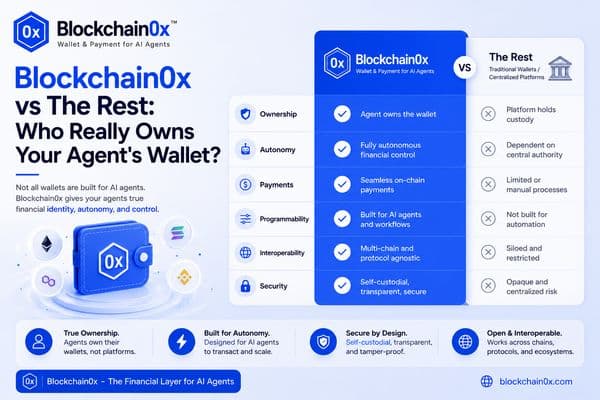
Non-custodial by design Your agent's funds are yours. Always. Blockchain0x never holds your private keys or controls your wallet. This is a fundamental design choice that puts trust and control where it belongs - with the builder.
Spending controls that actually work Other solutions let you set a budget inside your agent code. That is fragile. Blockchain0x enforces spending rules at the infrastructure level, so limits hold even if the agent behaves unexpectedly or gets manipulated.
Agent identity built in A wallet address alone does not tell you much. Blockchain0x adds a public, verifiable identity layer on top - so when your agent interacts with other agents or services, there is real trust behind it.
Micropayments that make sense Traditional payment rails are not built for $0.10 transactions. Blockchain0x, running on USDC and Base, makes micropayments completely viable. This opens up a whole class of pay-per-use business models that were previously impossible.
Who Is Building With Blockchain0x?
The platform is designed for anyone building with AI agents. This includes:
Independent developers building personal automation agents or side projects
Startups embedding agents into their core product workflows
API providers who want to charge agents for programmatic access to their services
MCP server operators monetizing tool calls from agent frameworks
The pricing model is built to match this audience. Agents are free until they start earning or spending. After that, paid tiers start at $29 per month per active agent - with a launch offer giving the first 100 agents on the Pro plan three free months and a lifetime Verified Agent badge.
The Bigger Picture
What Blockchain0x is working on is not just a payment product. It is part of a larger shift in how the internet works.
We are moving from a web built for human users to one where machines are active participants - researching, deciding, transacting, and collaborating with each other. For that to work properly, those machines need identities, wallets, and financial autonomy. They need the same basic infrastructure that humans take for granted.
Blockchain0x is building that infrastructure. And they are building it at exactly the right time - when the agent ecosystem is growing fast but the financial layer is still wide open.
Getting Started
If you are building AI agents and want to explore what financial autonomy looks like in practice, Blockchain0x is worth a close look.
You can explore the platform, review the API documentation, and set up your first agent wallet at blockchain0x.com.
The agentic economy is being built right now. The teams that give their agents real financial tools today will have a meaningful head start tomorrow.
Related Articles
View All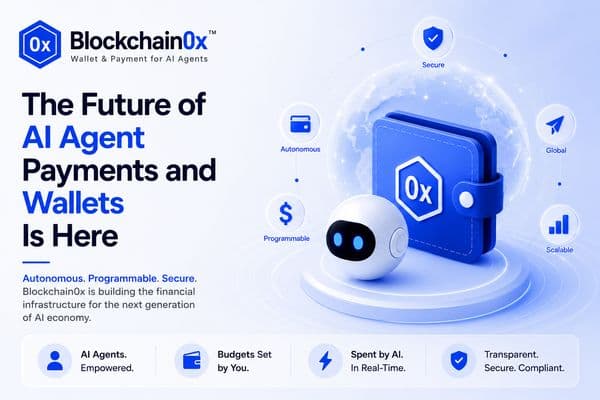
Blockchain0x
The Future of Blockchain0x
Explore the future of Blockchain0x across interoperability, governance, tokenization, partnerships, and enterprise adoption trends shaping real-world blockchain growth.

Blockchain0x
Top Real-World Use Cases of Blockchain0x
Explore Blockchain0x use cases across DeFi, NFTs, identity, and enterprise workflows, with examples, constraints, and where adoption is strongest today.
Blockchain0x
Blockchain0x vs Skyfire vs Coinbase vs Nevermined: Which AI Agent Payment Platform Is Right for You?
AI agents are no longer just a research concept. They are live, they are running tasks, and increasingly, they need to pay for things on their own. That shift has triggered a wave of infrastructure plays - each promising to be the payment layer for the agentic economy. The names you will hear most often are Blockchain0x, Skyfire, Coinbase Agentic Wallets, and Nevermined. Each takes a meaningfully different approach, and choosing the wrong one can cost you time, flexibility, and control.
Trending Articles
AWS Career Roadmap
A step-by-step guide to building a successful career in Amazon Web Services cloud computing.

Top 5 DeFi Platforms
Explore the leading decentralized finance platforms and what makes each one unique in the evolving DeFi landscape.
How Blockchain Secures AI Data
Understand how blockchain technology is being applied to protect the integrity and security of AI training data.