

Blockchain0x: The Complete Guide to AI Agent Wallets, Payments, and Financial Identity in 2026
 Suyash Raizada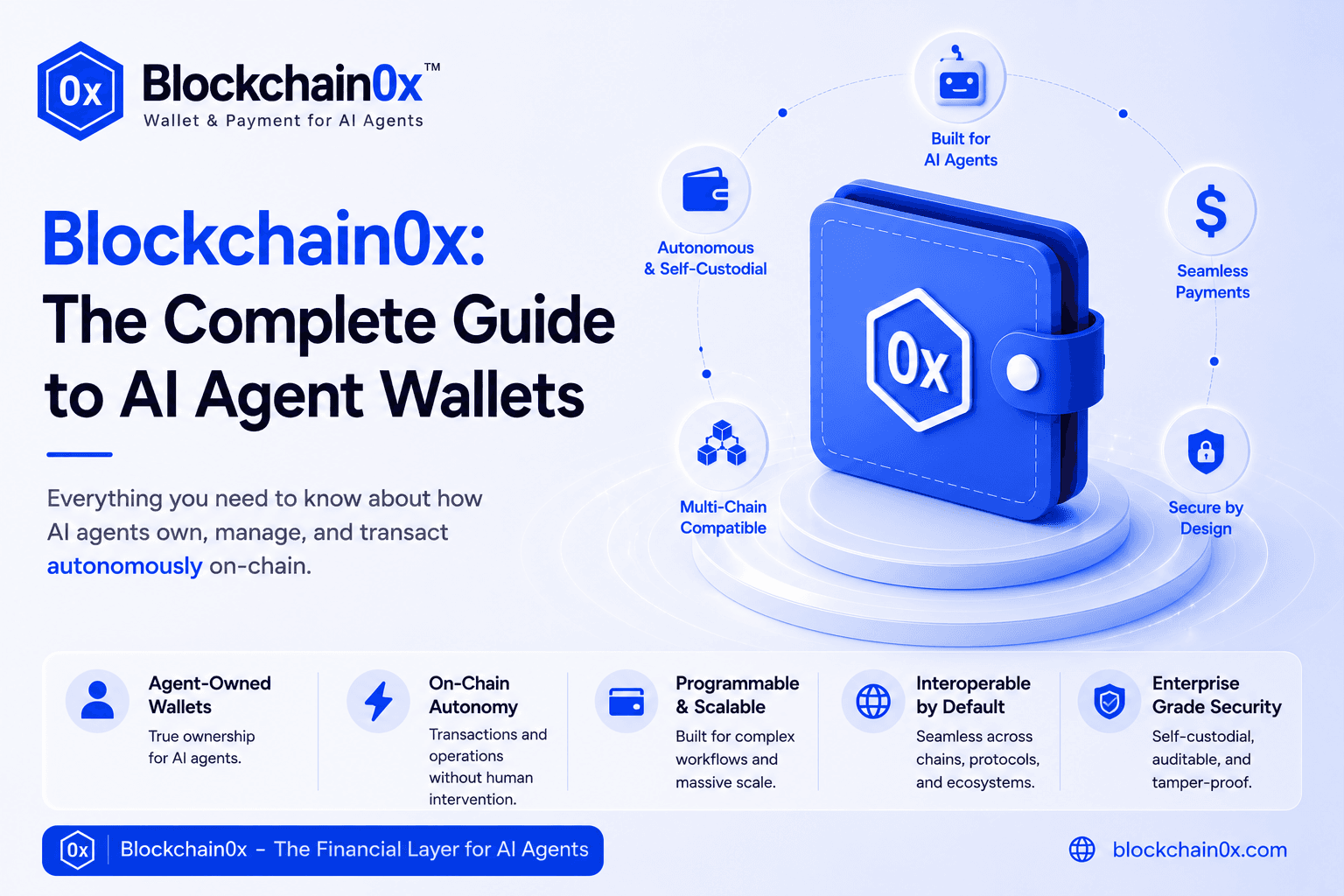
Introduction: The Financial Gap in the AI Agent Economy
Artificial intelligence has crossed a threshold. Agents are no longer prototypes in a research lab - they are live systems handling real work. They browse the web, execute code, send emails, summarise documents, manage workflows, and make decisions at machine speed. The companies and developers who build these agents are reshaping how work gets done.
But there is a problem that has been quietly holding the entire category back: AI agents cannot pay for things.

Every time an agent hits a paywall, a paid API, a metered tool, or a subscription service, the workflow breaks. The agent pauses. A human steps in, enters credentials, approves a transaction, and the agent continues. That single moment of dependency - repeated thousands of times a day across millions of agent workflows - represents one of the most significant unsolved problems in the AI industry today.
The infrastructure to solve it has been slow to arrive because it requires two things that do not naturally go together: the speed and programmability of blockchain payments, and the simplicity of a developer-first product that non-crypto builders can actually use.
Blockchain0x is the platform that bridges those two things. It is non-custodial payment infrastructure built specifically for AI agents - giving every agent a wallet, a budget, a verified identity, and the ability to transact autonomously within limits that developers control.
This guide covers everything: what Blockchain0x is, how it works, what it costs, who it is for, how it compares to alternatives, and why it is positioned to become the default financial layer for the agentic economy.
What Is Blockchain0x?
Blockchain0x is a non-custodial AI agent wallet and payment infrastructure platform. It is built on USDC - the US dollar-pegged stablecoin issued by Circle - and runs on Base, Coinbase's Ethereum Layer 2 blockchain. It was built by Recordskeeper Inc. and is designed for AI agent builders, MCP server operators, and API providers who need a clean, reliable way to give their agents financial capability.
In plain terms: Blockchain0x gives every AI agent its own wallet, its own payment identity, and the tools to send and receive money - without a human having to intervene every time a transaction needs to happen.
The platform is accessible at blockchain0x.com, and agents can be set up and transacting within minutes at wallet.blockchain0x.com/signup.
The Core Idea Behind Blockchain0x
An AI agent cannot fill in a credit card form. It cannot sign up for an account, remember a password, or complete a human checkout flow. What it can do - if the infrastructure exists - is read a 402 Payment Required HTTP response, parse a hosted payment URL, send USDC, and continue with its task.
That single flow - receive a payment request, pay in USDC, proceed - is the only checkout that actually works for autonomous software. Blockchain0x is built around it. Every product decision the platform has made flows from the insight that agent-native payments must be programmable, fast, cheap, and ownership-preserving.
Why Now? The Market Forces Behind Blockchain0x
To understand why Blockchain0x exists and why it matters in 2026, it helps to understand the three forces that have converged to make this category real.
The Protocol Layer Is Being Established
In 2026, the three largest payment infrastructure companies in the world each shipped agent-payment protocols. Coinbase launched x402 - a protocol that revives the dormant HTTP 402 status code to enable machine-to-machine payments over USDC. Google launched AP2 (Agent Payment Protocol 2.0). Circle released its Agent Stack. The rails are not theoretical anymore. They are live on Base, built on USDC, and compatible with the EVM stack that most agent builders already use.
AI Agents Are Already Consuming Paid APIs
LangChain, CrewAI, AutoGen, and the OpenAI Agents SDK all ship with HTTP tool calls built in. MCP server operators - the people running the tools that agents call - are seeing thousands of programmatic invocations daily. The vast majority of those calls go uncompensated because there is no standard way for an agent to pay. The demand for a payment layer is not coming - it is already here.
Micropayments Are Now Economically Viable
Traditional payment rails - credit cards, ACH, wire transfers - were built for human-scale transactions. A $0.10 API call is not economically viable on a card network once you account for processing fees. USDC on Base changes that. Transaction costs are a fraction of a cent. Settlement happens in seconds. Payments that were previously too small to be worth charging for are now practical to monetise at scale.
Blockchain0x is positioned at the intersection of all three forces - and it is building the middle layer that sits between the protocol (x402, AP2) and the merchant (Stripe, Coinbase Commerce), owning the per-agent surface where individual agents get a wallet, an identity, a public page, and a billing relationship.
The Blockchain0x Product: A Full Breakdown
Blockchain0x is not a single feature - it is a layered product with five distinct capabilities. Understanding each one clarifies why it is built the way it is.
1. Agent Wallets
Every agent on Blockchain0x gets its own USDC wallet on Base. These are non-custodial wallets - which means Blockchain0x never holds the private keys and never controls the funds. Developers connect an existing EVM wallet via RainbowKit or Reown during setup, and the agent's USDC sits in a wallet the developer controls directly on Base.
Each wallet comes with a public, indexable profile page. This page is not just a receipt address - it is a publicly accessible identity for the agent, discoverable by other agents and humans alike, with a QR code and a hosted pay link that any Base-compatible wallet can use to send USDC.
Spinning up a wallet takes seconds. There is no crypto setup required, no understanding of seed phrases necessary, and no KYC requirement at the start. The entry point is an email address and a six-digit OTP code.
2. Payment API
The Blockchain0x Payment API is a REST API that requires no SDK. It gives developers programmatic control over payment requests, monitoring, and webhooks using standard HTTP calls.
The core flow is simple: send a POST request to https://api.blockchain0x.com/v1/payment-requests with your agent ID and the amount in Wei. The API returns a payment request object with a hosted checkout URL that the agent can share with whoever needs to pay. Blockchain0x monitors Base for the incoming USDC transaction, confirms it on-chain, and fires a signed webhook the moment the payment lands.
Key technical features of the Payment API include signed webhook payloads using HMAC-SHA256, idempotent payment creation with auto-generated idempotency keys, and full compatibility with the x402 payment flow. The API is designed to be copy-paste functional for the most common agent frameworks - LangChain, CrewAI, MCP, and OpenAI Agents SDK all have ready-made integration snippets available in the documentation.
The webhook events currently supported are payment.received, payment.sent, and wallet.deployed - covering the full lifecycle of an agent's financial activity.
3. Agent Identity
One of the most underrated features of Blockchain0x is its agent identity system. Every agent gets a public, indexed profile page that carries verification badges for email, GitHub, and domain - trust signals that both humans and other agents can read and verify programmatically.
In a world where agents are increasingly transacting with other agents, this matters enormously. A wallet address alone conveys no information about who or what is behind a payment. An indexed, verifiable identity page - with badges, transaction history, and a named profile - is what makes an agent look and operate like a real business rather than an anonymous on-chain address.
This public identity layer is one of the clearest points of differentiation between Blockchain0x and a raw x402 setup. With just x402, you have an address. With Blockchain0x, you have an address plus a profile, plus verification, plus spend history, plus a billing relationship - the full stack of what makes an agent trustworthy to interact with.
4. Spending Controls
Blockchain0x enforces spending limits at the infrastructure level - not inside the agent's own code. This distinction is critical.
Any spending control implemented inside an agent's logic is only as secure as the agent itself. If the agent is prompt-injected, manipulated, or simply buggy, those controls can be bypassed. Blockchain0x removes that vulnerability by enforcing per-transaction caps and per-period allowances at the API layer, before any payment is authorised. The agent's code physically cannot exceed the limits set in the dashboard, regardless of what instructions the agent receives.
Spend permission caps scale with plan tier: up to $50 per period on Free, up to $10,000 on Pro, and up to $100,000 on Business. The dashboard logs all activity, including transactions the agent attempted but was blocked from completing, giving developers full auditability over what their agents are doing financially.
Spending controls are set in the dashboard and exposed as read-only through the API - meaning the agent can read its own limits but cannot modify them.
5. MCP Server Integration
Blockchain0x includes native support for the Model Context Protocol (MCP), making it directly accessible to agents built on frameworks that support MCP tool calls. This is increasingly important as the MCP ecosystem grows and more agent frameworks adopt it as the standard for tool integration.
MCP server operators can use Blockchain0x to monetise their tool calls - charging agents per invocation, per data query, or per task completion, with USDC settling instantly on Base and a webhook firing into their system the moment payment is confirmed.
How Blockchain0x Works: Step by Step
Getting from zero to a financially capable agent on Blockchain0x takes four steps and approximately five minutes.
Step 1 - Sign Up With Email OTP There is no lengthy registration form and no KYC requirement to start. Enter an email address, receive a six-digit code, and the workspace is ready. This design choice is intentional - Blockchain0x is built for developers who want to ship, not for compliance teams who want to onboard.
Step 2 - Create the Agent Wallet Give the agent a name, choose a URL slug for the public profile, select a plan, and set initial spend caps. The wallet is generated on Base and the public agent page goes live immediately.
Step 3 - Receive USDC on Base Share the agent's public page or the hosted pay link with whoever needs to pay. Blockchain0x monitors the Base blockchain for incoming USDC transactions automatically - there is no polling required on the developer's side.
Step 4 - Get a Webhook on Every Payment The moment a payment lands on-chain, Blockchain0x fires a signed webhook to the developer's endpoint with a payment.received event payload. This webhook triggers the next step in the agent's workflow - releasing a service, unlocking a capability, or continuing a task.
The entire architecture is designed around this single loop: payment received, webhook fired, agent continues. It is the smallest possible surface area for a developer to implement, which is precisely the point.
Who Is Blockchain0x Built For?
Blockchain0x is not a general-purpose payments platform. It is designed for a specific and growing audience of builders who have a specific and unsolved problem.
AI Agent Developers
Anyone building autonomous agents using LangChain, CrewAI, AutoGen, the OpenAI Agents SDK, or any other agent framework who wants those agents to be able to pay for tools and services without human intervention. Blockchain0x gives these developers a clean API to add payment capability to their agents in an afternoon.
MCP Server Operators
The people running MCP servers - the tools and services that agents call programmatically - often have no good way to monetise those calls. Blockchain0x gives MCP operators a payment layer that agents can interact with natively, turning free tool invocations into paid, instant USDC settlements.
API Providers
Any API provider who wants to charge programmatic callers - including AI agents - per request rather than through traditional subscription billing. Blockchain0x enables pay-per-call business models that are not economically viable on card rails but work perfectly on USDC over Base.
Independent Developers and Small Teams
The platform is explicitly designed to serve solo developers and small teams who cannot afford a sales process, do not want enterprise contracts, and need to move fast. The free tier, email OTP signup, and five-minute setup time are all deliberate product choices aimed at this audience.
Blockchain0x Pricing: How It Works
Blockchain0x uses a Cloudflare-style pricing model: free for every agent, with paid upgrades for agents that start producing revenue. Developers pay only for the agents that earn - a model that aligns the platform's incentives directly with the developer's success.
Free Plan - $0 per Agent per Month
The Free plan includes a public agent page, USDC receive capability on Base, basic spend caps with a Spend Permission cap up to $50, and an email verification badge. There is a 10% fee on outflows (0% on funding). No card required to start. This tier is designed for developers who want to explore the platform, ship a prototype, or run an agent that receives payments but does not yet generate significant volume.
Pro Plan - $29 per Agent per Month (or $290 per Year)
The Pro plan adds the full payment API, signed webhook events, a Verified Agent badge, a Spend Permission cap up to $10,000, and CSV export. The outflow fee drops to 4%. This is the tier designed for agents that are actively earning - the point at which the platform's billing relationship kicks in and the developer's agent is operating as a real economic participant.
Business Plan - $49 per Agent per Month
The Business plan is designed for teams running multiple revenue-producing agents. It includes everything in Pro plus priority support, higher API rate limits, audit logs, a Spend Permission cap up to $100,000, and team seats. The outflow fee drops further to 2%.
The Launch Offer
Blockchain0x is currently running a launch promotion for the first 100 agents upgraded to the Pro plan: three months of subscription fees waived and a permanent Verified Agent badge on the public page that persists even if the agent is later downgraded. This offer is limited, applies once per workspace, and is designed to reward early adopters who are building in the category before it becomes mainstream.
Blockchain0x Integrations: What It Works With
One of the most practically important aspects of Blockchain0x is how it integrates with the tools developers are already using to build agents.
LangChain
LangChain is one of the most widely used frameworks for building LLM-powered applications and agents. Blockchain0x provides copy-paste integration snippets that let LangChain-built agents create payment requests, monitor for payment confirmation via webhooks, and continue their workflow once payment is received.
CrewAI
CrewAI is a framework for orchestrating multi-agent systems where different agents collaborate on complex tasks. Blockchain0x integrates directly with CrewAI workflows, allowing agent crews to handle payment steps as part of their task execution without breaking the orchestration loop.
OpenAI Agents SDK
The OpenAI Agents SDK is increasingly the choice of developers building production-grade agents on top of GPT-4 and related models. Blockchain0x integration with the Agents SDK allows payment capability to be added as a tool within an agent's available actions.
MCP (Model Context Protocol)
Blockchain0x includes native MCP server support, making it accessible to any agent or framework that implements the Model Context Protocol for tool calls. This is rapidly becoming the most important integration surface as MCP adoption grows across the agent ecosystem.
x402 Protocol Compatibility
Blockchain0x is fully compatible with the x402 protocol developed by Coinbase. This means agents built on Blockchain0x can interact with any service that implements x402 for payment-gating, and any x402-compatible agent can pay into a Blockchain0x-powered endpoint. Compatibility with the dominant open protocol in this space is a deliberate choice that keeps Blockchain0x interoperable rather than isolated.
Blockchain0x vs The Competition: A Detailed Look
The AI agent payments space is crowded and getting more crowded. Understanding where Blockchain0x sits relative to the other players is important for any developer evaluating which platform to build on.
Blockchain0x vs Skyfire
Skyfire is a well-funded competitor backed by Coinbase Ventures and a16z CSX. It settles in USDC through its KYAPay rail and has built a Know Your Agent (KYA) trust framework that adds identity verification at the network level.
The key difference is who these platforms are designed for. Skyfire targets large enterprises with structured onboarding, sales-led contracts, and procurement processes. It is a serious product for serious organisations with compliance requirements and dedicated engineering teams.
Blockchain0x targets the individual developer who wants to ship a financially capable agent in an afternoon. Per-agent pricing instead of master agreements. Email OTP instead of procurement. A public page that goes live in seconds instead of a contract negotiation that takes weeks. For the vast majority of developers building in this space today, Blockchain0x gets them to production faster and more cheaply.
Blockchain0x vs Coinbase Agentic Wallets
Coinbase's entry into this space is the hardest to ignore. The x402 protocol crossed 100 million transactions in Q1 2026, and Agentic Wallets are deeply integrated into Coinbase's developer platform with strong documentation and wide ecosystem support.
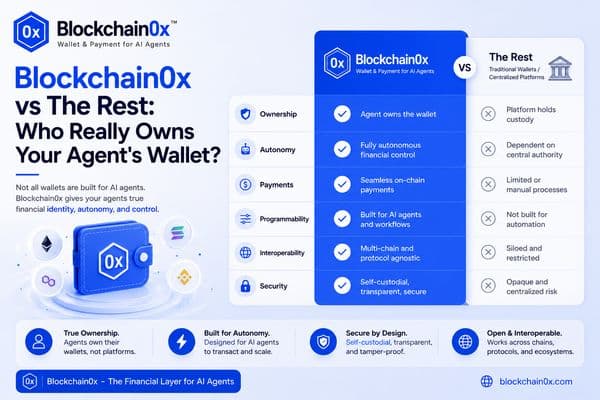
The critical difference is custody. Coinbase holds the private keys to Agentic Wallets. The developer does not control the wallet directly - they control it through Coinbase's infrastructure. For many developers, particularly those in the Web3 space who care deeply about ownership and decentralisation, this is a deal-breaker. Your agent's financial autonomy has a ceiling defined by Coinbase's systems, not by your own.
Blockchain0x is non-custodial by design. The developer connects their own EVM wallet and controls the private keys directly. Blockchain0x monitors the chain and provides the tooling, but it never touches the funds.
Blockchain0x vs Nevermined
Nevermined is the broadest platform in this category. It combines fiat and crypto settlement, real-time usage metering, and delegated spending controls, and has partnered with Visa and Coinbase to let businesses enrol Visa cards and delegate spending authority to agents across both traditional and crypto payment rails.
The breadth is Nevermined's strength and its complexity. It is built for large product teams running sophisticated multi-rail payment workflows. For a developer who needs an agent wallet and a clean API to get started - which describes the majority of builders in this space today - Nevermined is more infrastructure than the problem requires.
Blockchain0x vs Raw x402
The simplest comparison is between Blockchain0x and just implementing x402 directly without a platform layer. A raw x402 setup gives a developer a protocol and a wallet address. Blockchain0x gives a developer everything that sits on top: an indexable public page, verification badges, spend caps, transaction logs, a billing relationship, webhook infrastructure, and a SaaS management layer.
For a developer who wants to go deep into the protocol and build everything from scratch, raw x402 is an option. For a developer who wants to ship a product rather than build infrastructure, Blockchain0x is the faster path.
Where Blockchain0x Sits in the Stack
This is perhaps the clearest articulation of Blockchain0x's position: it is the middle layer between the protocol and the merchant.
The protocol layer is being built by Coinbase (x402), Google (AP2), and Circle (Agent Stack). The merchant layer is being built by Stripe and Coinbase Commerce. Blockchain0x owns the per-agent surface that sits between those two layers - the wallet, the identity page, the spend policy, the verification badge, and the billing relationship that turns a wallet address into a trusted, accountable economic participant.
The Technical Architecture of Blockchain0x
For developers evaluating Blockchain0x from a technical perspective, the architecture choices are worth understanding in detail.
Why USDC on Base?
Blockchain0x is built on USDC issued natively by Circle on Base - not a bridged version of USDC from another chain. This distinction matters for settlement certainty. Native USDC on Base settles with the highest confidence and the lowest cost, with transaction fees that are a fraction of a cent and confirmation times of seconds rather than minutes.
Base was chosen over Solana, Ethereum mainnet, and Polygon for a combination of reasons: the lowest transaction costs among USDC-supporting chains today, native USDC issuance by Circle, and the deepest alignment with the x402 protocol ecosystem where the majority of agent payment activity is happening. The architecture is built with chain adapters from day one, meaning Solana support and other chains can be added without requiring changes to developer integration code.
Webhook Security: HMAC-SHA256
Every webhook payload sent by Blockchain0x is signed using HMAC-SHA256. This means the developer's receiving endpoint can verify that the webhook genuinely came from Blockchain0x and has not been tampered with in transit. Without this signing, a malicious actor could send a fake payment.received webhook to an unprotected endpoint and cause an agent to release a service without a real payment having occurred. The HMAC-SHA256 signing requirement eliminates this attack vector.
Idempotency
Payment creation through the Blockchain0x API is idempotent - the API automatically generates and enforces idempotency keys on payment requests. This means that if a payment request is submitted multiple times (due to network retry logic, for example), only one payment request is created. This is a critical safety feature in agent workflows, where retry logic is common and duplicate payments would be a serious operational problem.
Non-Custodial Architecture
The non-custodial design of Blockchain0x means the platform's role is to monitor the blockchain, provide tooling, and fire webhooks - not to hold or move funds on the developer's behalf. The developer's EVM wallet, connected via RainbowKit or Reown at setup, is the actual custodian of the agent's USDC. Blockchain0x watches the chain and provides the product layer on top. This architecture means that even if Blockchain0x experienced a service disruption, the developer's funds would be unaffected and accessible directly on-chain.
The Business Case for Building on Blockchain0x
Beyond the technical details, there is a straightforward business case for why developers and teams should be building on Blockchain0x now rather than waiting for the category to mature.
The Window for Early Movers Is Open
The AI agent payment category is being defined right now. The protocol layer (x402, AP2) was established in 2026. The first developer tools and platforms are shipping in 2026 and 2026. The teams that build payment capability into their agents today are the ones that will have the most mature, battle-tested payment infrastructure when the category hits mainstream adoption.
Waiting for the dust to settle is a viable strategy in many technology categories. In a category where network effects matter - where verified agent identities, transaction histories, and trust signals accumulate over time - being early has compounding value.
Monetisation Models That Were Previously Impossible
Blockchain0x makes viable a class of monetisation models that simply did not work on traditional payment rails. Pay-per-API-call pricing at $0.10 per invocation. Agent-to-agent micropayments for delegated tasks. Real-time per-query data access billing. Autonomous subscription management. Each of these requires cheap, fast, programmable payments - exactly what USDC on Base provides, and exactly what Blockchain0x wraps with a developer-friendly product layer.
Revenue Without Human Involvement
Perhaps the most powerful economic argument for Blockchain0x is the simplest one: it allows developers to build services that generate revenue without requiring a human to process each transaction. An MCP server operator who implements Blockchain0x can charge thousands of agent invocations per day automatically, with USDC settling into their wallet on Base and webhooks firing into their system in real time. No invoices. No payment processing delays. No chargebacks. No card network fees eating into micropayment economics.
Common Questions About Blockchain0x
Does Blockchain0x Hold My Private Keys or My Funds?
No. Blockchain0x is non-custodial. Developers connect an existing EVM wallet via RainbowKit or Reown during setup. Blockchain0x never sees the private keys. The agent's USDC sits in a wallet the developer controls directly on Base. Blockchain0x monitors the chain for incoming payments and provides the product layer, but it never holds funds.
Do You Need to Understand Crypto to Use Blockchain0x?
No. The signup flow is an email address and a six-digit OTP code. There is no requirement to understand seed phrases, gas fees, or blockchain mechanics to receive a first USDC payment. The agent page generates a QR code and a hosted pay link that any wallet on Base can pay. For developers who want to go deeper into the technical layer, the x402 protocol support and webhook infrastructure are available without additional setup.
Can an Agent Be Manipulated into Draining the Wallet?
No - because spending controls are enforced at the API layer, not in the agent's code. Every outgoing payment is checked against the active per-period allowance and per-transaction cap before the API accepts it. The agent cannot exceed those limits even if its logic is manipulated or it receives malicious instructions. Spend permissions are set in the dashboard (read-only through the API), and the dashboard logs all activity including attempted but blocked transactions.
Why USDC on Base Rather Than Other Chains?
Base has the lowest transaction costs and fastest confirmation among USDC-supporting chains today, with native USDC issued by Circle rather than a bridged version. Solana support is on the roadmap, with Ethereum mainnet and Polygon following based on demand. The architecture uses chain adapters from day one, which means developer integration code stays the same when additional chains become available.
What Happens to an Inactive Agent?
Free agents with no activity for 90 days are automatically archived - the public page is hidden and the agent stops accepting payments, but the wallet address and full transaction history are preserved. Re-activation is available at any time from the dashboard. Paid agents on Pro or Business plans are not archived as long as the subscription is active. When a paid subscription is cancelled, the agent converts to Free and enters the same 90-day activity cycle.
Is Blockchain0x x402 Compatible?
Yes. Blockchain0x is fully compatible with the Coinbase x402 protocol. Agents built on Blockchain0x can interact with any x402-compatible service, and x402-compatible agents can pay into Blockchain0x-powered endpoints. This interoperability is by design - Blockchain0x is built to sit on top of the open protocol layer, not to replace it.
The Road Ahead: What the Agentic Economy Looks Like
The numbers that frame the opportunity are significant. MarketsandMarkets projects the AI agents market will grow from $7.84 billion in 2025 to $52.62 billion by 2030, a compound annual growth rate of 46.3%. McKinsey estimates that AI agents could mediate between $3 trillion and $5 trillion of global commerce by 2030. Every dollar of that commerce that moves programmatically between agents and services will need a payment layer.
The infrastructure being built right now will determine who captures that layer. The protocol standards (x402, AP2) are being set by the largest players in the industry. The merchant-facing products (Stripe for agents, Coinbase Commerce) are being built by established payment companies. The per-agent identity, wallet, and billing surface - the piece that individual agents need to participate as real economic actors - is where Blockchain0x is focused.
This is not a distant vision. Agents are transacting today. MCP servers are being called thousands of times a day without compensation. API providers are leaving revenue on the table because there is no clean way for an agent to pay them. The problem is live and the market for the solution is forming right now.
Getting Started With Blockchain0x
Starting with Blockchain0x requires no crypto expertise, no sales call, and no lengthy setup process.
Go to blockchain0x.com to explore the platform, read the product documentation, and understand the full feature set. When ready to build, create the first agent wallet at wallet.blockchain0x.com/signup. The signup flow takes an email address and a six-digit code. The wallet is live in seconds.
For developers who want to go deeper before building, the full API reference is available at docs.blockchain0x.com, with copy-paste integration snippets for LangChain, CrewAI, MCP, and the OpenAI Agents SDK.
For teams running agents that are already earning, or that are expected to start earning soon, the Pro plan at $29 per agent per month is the right starting point. The current launch offer - three months of Pro free for the first 100 agents, plus a lifetime Verified Agent badge - is available automatically at signup.
Conclusion: The Financial Layer the Agentic Economy Has Been Waiting For
AI agents are smart. They are fast. They can handle complex, multi-step tasks with minimal human oversight. But without the ability to pay for things autonomously, they are not truly independent. Every payment that requires human intervention is a bottleneck - not just in that single workflow, but in the broader promise of what agentic AI is supposed to deliver.
Blockchain0x removes that bottleneck. It gives every agent a wallet, a budget, a verified identity, and the infrastructure to participate in the economy on its own terms - within the limits that developers set, with the security that non-custodial architecture provides, and with the simplicity that developer-first design demands.
The agentic economy is being built right now. The teams that give their agents real financial capability today - with the right infrastructure behind it - will be the ones that look back in three years and realise they moved at exactly the right time.
Explore Blockchain0x at blockchain0x.com and create your first agent wallet at wallet.blockchain0x.com/signup.
Related Articles
View All
Blockchain0x
blockchain0x Explained: Wallets and USDC Payments for AI Agents on Base
Learn what blockchain0x is, how it enables AI agents to use USDC on Base, and what to evaluate for security, budgets, and compliant machine payments.
Blockchain0x
Blockchain0x vs Skyfire vs Coinbase vs Nevermined: Which AI Agent Payment Platform Is Right for You?
AI agents are no longer just a research concept. They are live, they are running tasks, and increasingly, they need to pay for things on their own. That shift has triggered a wave of infrastructure plays - each promising to be the payment layer for the agentic economy. The names you will hear most often are Blockchain0x, Skyfire, Coinbase Agentic Wallets, and Nevermined. Each takes a meaningfully different approach, and choosing the wrong one can cost you time, flexibility, and control.

Blockchain0x
Wallets and payments for AI agents: Architecture, use cases, and risk controls
Wallets and payments for AI agents enable secure, policy-controlled transactions across cards, banks, and crypto rails, unlocking agentic commerce with auditability.
Trending Articles
AWS Career Roadmap
A step-by-step guide to building a successful career in Amazon Web Services cloud computing.
How Blockchain Secures AI Data
Understand how blockchain technology is being applied to protect the integrity and security of AI training data.
Claude AI Tools for Productivity
Discover Claude AI tools for productivity to streamline tasks, manage workflows, and improve efficiency.