

Zero-Knowledge Proofs for Tax Compliance: Verifying Taxpayer Information Without Exposing Sensitive Data
Integrating Artificial Intelligence and Blockchain for a Privacy-First Compliance Architecture
The Core Problem
Tax compliance verification is structurally adversarial to privacy. Authorities want full financial visibility. Taxpayers want confidentiality, and both positions are reasonable. The traditional resolution, centralized data collection, has proven catastrophically fragile. The 2015 IRS "Get Transcript" breach exposed 700,000 records; the 2017 Equifax breach affected 147 million taxpayer profiles. Neither failure was an anomaly. Both are what happens when sensitive data is aggregated into a single-target architecture.

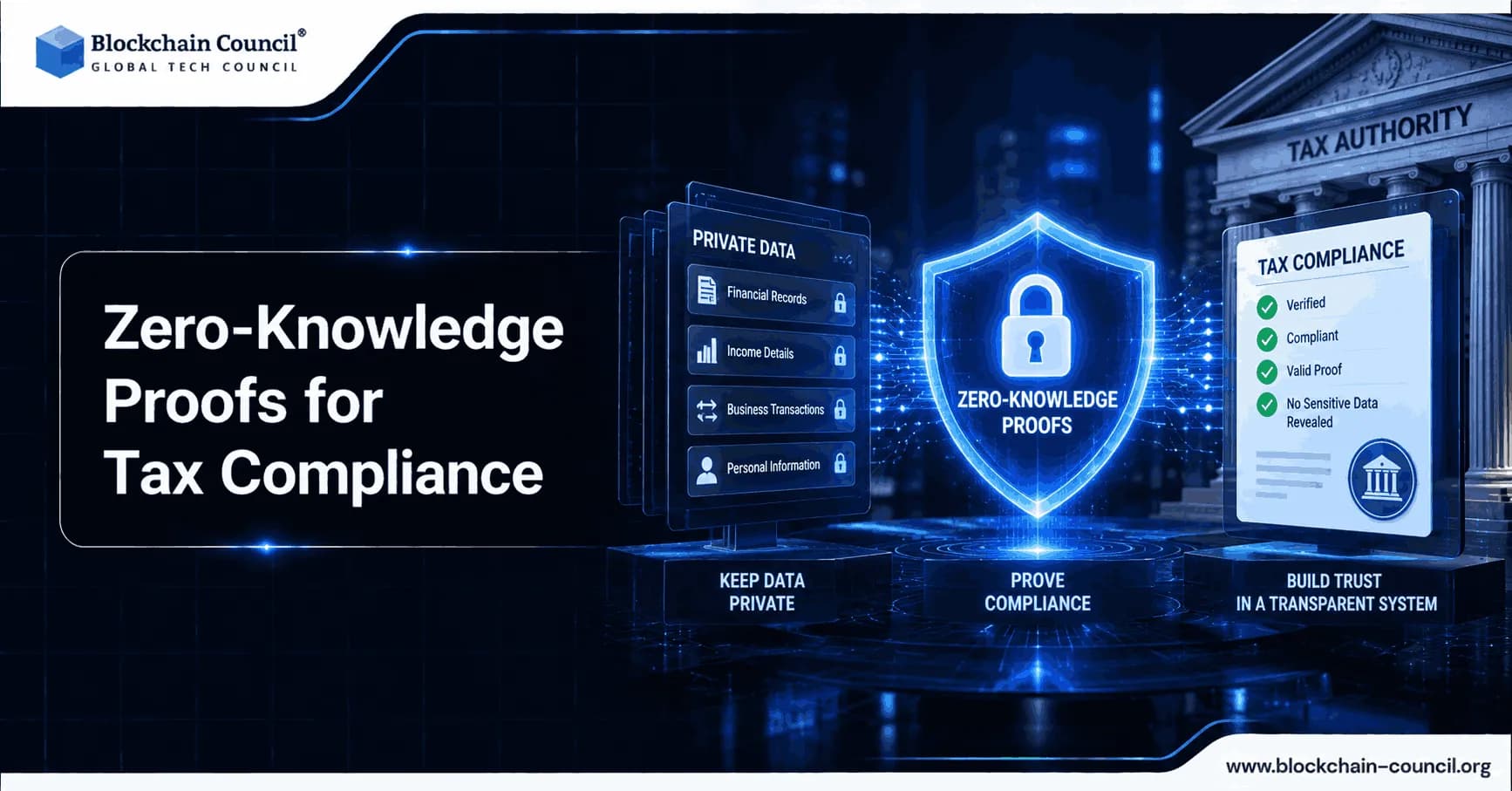
Zero-knowledge proofs (ZKPs) invert this model. A ZKP is a cryptographic protocol enabling a prover to convince a verifier that a statement is true without revealing any information beyond the statement's validity. A taxpayer can prove "my income exceeds $75,000" or "I qualify for the Earned Income Tax Credit" without disclosing payroll records or employer identity. Combined with artificial intelligence for risk scoring and blockchain for tamper-resistant enforcement, ZKPs form a three-pillar architecture that stays private while remaining analytically capable and permanently auditable.
A synthesis of 175 studies published between 2010 and 2026 confirms the technical feasibility. It also exposes a production-readiness gap that needs closing quickly.
The Three-Pillar Architecture
Each technology addresses a distinct failure mode in legacy compliance:
Pillar | Function in Tax Compliance | Problem Solved |
Zero-Knowledge Proofs | Verify statements without data exposure | Privacy vs. transparency conflict |
Artificial Intelligence | Risk-score returns, automate audit selection | Manual audit bottlenecks, high false-negative rates |
Blockchain | Smart-contract enforcement, immutable proof anchoring | Audit trail tampering, cross-border disputes |
The division of labour is clean. AI identifies who needs scrutiny; ZKPs verify compliance without exposure; blockchain records that verification permanently.
ZKP Protocol Selection
Three protocol families dominate applied tax research:
Protocol | Proof Size | Verification Time | Trusted Setup | Post-Quantum | Best Tax Use Case |
Groth16 (zk-SNARK) | ~200 bytes | < 10 ms | Required | No | On-chain verification, smart contracts |
zk-STARKs | 100-200 KB | 50-100 ms | None | Yes | AI-inference circuits, long-term deployments |
Bulletproof | ~1-2 KB | 20-50 ms | None | No | Income bracket range proofs |
Schnorr | ~64 bytes | < 5 ms | None | No | Asset declaration, address binding |
Groth16 leads on production readiness, with roughly 200-byte proofs and millisecond latency. The catch is the trusted setup: security depends on a multi-party computation ceremony with more than 100 participants. zk-STARKs eliminate the trusted setup and offer post-quantum resistance; Hui (2025) reports 46% faster proof generation than Groth16 on identity verification workloads, which suits them to AI-augmented inference circuits. Bulletproofs give logarithmic proof sizes native to range proofs, which map precisely onto tax bracket eligibility structures.
Artificial Intelligence Integration
AI sits upstream of cryptographic verification. That placement is what lets the system stay analytically capable without giving up privacy.
ZKP-Shielded Audit Selection. Gradient-boosted trees and transformer anomaly detectors score returns for fraud risk. Liu (2026) demonstrates zero-knowledge transformer inference: authorities verify that an AI model correctly flagged a return without accessing the underlying data. That satisfies GDPR Article 22, the right to explanation for automated decisions, while keeping the investigation confidential. Legacy audit systems run false-positive rates of 8-12%. ZK-verified AI pipelines target below 2%.
Federated Learning for Cross-Border Compliance. Tax authorities cannot share taxpayer data across jurisdictions, which has long capped what cross-border fraud detection can do. Federated learning trains a shared model locally at each authority, ZKPs verify that the gradient updates are correct, and blockchain records model version provenance. The result is a globally trained model with zero cross-border data transfer, which addresses GDPR, sovereignty constraints and BEPS audit opacity at once.
NLP-Driven Form Parsing. Large language models parse unstructured submissions (invoices, receipts, multilingual filings) into structured fields fed to ZKP circuits. AI handles the semantic complexity and the ZKP handles the privacy. In pilot configurations the pipeline cut manual processing by an estimated 60-80% (Sahu, 2023).
Blockchain Integration
Blockchain contributes two things: programmable enforcement through smart contracts, and tamper-resistant anchoring of ZKP verification events.
Smart Contracts for Automated Collection. Karakostas (2022) demonstrates programmable money withholding VAT/GST automatically at the transaction layer, which closes the filing gap rather than narrowing it. ZKPs prove transaction validity without revealing counterparty identities or amounts. On Ethereum Layer-2, per-transaction costs fall below $0.01, which is what makes national-scale deployment economically plausible.
Immutable Audit Trails. Fatz et al. (2020) anchor ZKP-verified VAT transactions on-chain as timestamped hashes. The result is legally admissible, tamper-proof, and auditable without exposing the underlying proof, which cleanly separates audit access from data access.
Cross-Border Transfer Pricing. Multinationals prove transfer pricing compliance to multiple jurisdictions through one shared blockchain. Each authority verifies against the same on-chain commitment without seeing another's query, outperforming the OECD CbCR regime's full-disclosure requirement.
Performance Reality and KPIs
Benchmarks are scarce. Some 73% of surveyed papers provide no metrics at all despite claiming "practical" implementations:
Androulaki et al. (2010): 100M accounts require 4.8 × 10¹¹ modular exponentiations quarterly. GPUs (1,000 exp/sec): ~15 years runtime; ASICs (25,000 exp/sec): ~7 months. National-scale deployment demands tens of millions in hardware.
zk-X509 (Bak, 2026): ECDSA P-256 achieves 11.8M cycles; on-chain cost ~300K gas per verification.
zkFi (Sahu, 2023): 1,000-constraint Groth16 circuits (typical return) generate proofs in 100 ms to 1 s on consumer hardware.
Production KPI targets (from gap analysis across 175 research papers):
KPI | Target | Current Best |
Proof generation (P95) | < 5s, consumer hardware | ~1s (lab conditions) |
Verification latency | < 100 ms | < 10 ms (Groth16) |
On-chain cost | < $1 per verification | ~$15-30 (L1 Ethereum) |
AI audit false-positive rate | < 2% | ~8-12% (legacy systems) |
Proof success rate | > 99.9% | Unmeasured at scale |
Layer-2 networks (Optimism, StarkNet) already achieve $0.01-0.10 per verification, inside the target range.
Critical Gaps
Performance Transparency. With 73% of papers lacking reproducible benchmarks, neither cost-benefit analysis nor capacity planning is possible.
Protocol Fragmentation. No OECD/ISO standard governs ZKP protocols for tax. Cross-jurisdiction proof verification fails when protocols diverge, and that is a direct BEPS enforcement risk.
AI Model Accountability. ZK inference proves a model produced a given output. It proves nothing about whether that model was fairly trained or meets EU AI Act requirements, and governance frameworks for ZK-AI pipelines remain undefined.
Legal Admissibility. No jurisdiction has legislated ZKP-based filing status. Liability for circuit bugs, admissibility of proofs in disputes, and protocols for expert verification are all still open.
Blockchain Scalability. Ethereum mainnet runs at roughly 15 TPS, nowhere near enough for tax-season peaks. Layer-2 rollups reduce costs but introduce new trust assumptions.
Recommendations
For tax authorities: Launch benchmarked pilots (10,000-100,000 volunteers) by 2027 using hybrid off-chain ZKP generation with on-chain hash anchoring (−95% gas costs). Integrate AI fraud-scoring with ZK-verified inference for algorithmic accountability. Mandate P95 generation times and per-verification cost in vendor RFPs.
For fintech engineers: Standardize on Groth16 + circom/snarkjs for MVPs; migrate to zk-STARKs for AI-heavy circuits requiring post-quantum security. Target < 10s proof generation on 2020-vintage smartphones via WebAssembly. Deploy smart contracts on Layer-2. Build 0.1-1% manual audit fallback with cryptographic expert review.
For policy architects: Draft ZKP legislation covering proof admissibility, circuit-bug liability, and ZK-AI algorithmic accountability. Initiate OECD/ISO protocol standardization. Mandate privacy impact assessments and WCAG-compliant interfaces to prevent compliance equity gaps.
For professionals working with emerging blockchain infrastructure, privacy technologies, and decentralized systems, a Tech Certification can complement practical knowledge by helping build broader technical capabilities relevant to rapidly evolving technology environments.
Conclusion
Taken together, ZKPs, AI and blockchain produce a compliance architecture that beats every predecessor on privacy, accuracy and tamper resistance at the same time. ZKPs remove unnecessary exposure. AI raises fraud detection accuracy while staying accountable through ZK verification. Blockchain enforces compliance programmatically and keeps a permanent record of every verification. What remains is operational rather than cryptographic. Benchmarks are missing, protocols are fragmented, legal frameworks do not exist, and nobody has defined AI governance for ZK inference pipelines. The 2026-2029 window will decide which jurisdictions write the global standard and which ones adopt what others wrote.
For organizations communicating complex privacy, AI, and blockchain solutions to technical and business audiences, a Marketing Certification can provide complementary knowledge for presenting emerging technology concepts and reaching relevant audiences effectively.
Synthesized from 175 peer-reviewed papers (2010-2026) across SciSpace, Google Scholar, and arXiv. Key sources: Berke et al. (2024), Fatz et al. (2020), Androulaki et al. (2010), Karakostas (2022), Li et al. (2019), Hui (2025), Bak (2026), Liu (2026), Sahu (2023)
[1] A. Berke, T. South, R. Mahari, K. Larson, and A. Pentland, “Poster: zkTax: A Pragmatic Way to Support Zero-Knowledge Tax Disclosures,” pp. 4952-4954, Dec. 2024, doi: 10.1145/3658644.3691421.
[2] F. Fatz, P. Hake, and P. Fettke, “Confidentiality-preserving Validation of Tax Documents on the Blockchain.,” pp. 1262-1277, Jan. 2020.
[3] A. Berke, T. South, R. Mahari, K. Larson, and A. Pentland, “zkTax: A pragmatic way to support zero-knowledge tax disclosures,” Jan. 2023, doi: 10.48550/arxiv.2311.13008.
[4] E. Androulaki, B. Vo, and S. M. Bellovin, “Privacy-preserving, taxable bank accounts,” pp. 37-54, Sept. 2010, doi: 10.1007/978-3-642-15497-3_3.
[5] O. Shokirovich and G. Yuldasheva, “Blockchain-Powered Smart Contracts for Automated Tax Compliance”, [Online]. Available: https://ieeexplore.ieee.org/abstract/document/11234589/
[6] Y. Liu, “Privacy preserving and auditable tax fraud detection using zero knowledge transformer inference”, [Online]. Available: https://link.springer.com/article/10.1007/s44163-026-01882-0
[7] I. FAITH, “A SECURE AI-BLOCKCHAIN INNOVATION METHODOLOGY FOR MODERNIZING TAX ADMINISTRATION, ENHANCING AUDIT TRANSPARENCY, AND …”, [Online]. Available: https://accsaglobal.org/wp-content/uploads/2026/05/ACCSA-Global-Conference-Proceedings-Done.pdf#page=155
[8] Y. Sun and S. Bai, “A Study on Privacy Protection Framework for E-Government Based on Zero-Knowledge Proofs”, [Online]. Available: https://ieeexplore.ieee.org/abstract/document/11368954/
[9] Z. Wang, “Research on Tax Data Sharing and Privacy Protection Mechanism Based on Blockchain Technology,” Jan. 2025, doi: 10.1109/icpeca63937.2025.10928782.
[10] D. Bogdanov, E. Brito, A. Jaakson, P. Laud, and R.-M. Rebane, “Zero-knowledge proof-of-location protocols for vehicle subsidies and taxation compliance,” arXiv.org, June 2025, doi: 10.48550/arxiv.2506.16812.
[11] A. Tileubaevna, A. Tileubaevich, and S. Ulı, “THE ROLE OF ZERO-KNOWLEDGE PROOFS IN ENHANCING CRYPTOGRAPHIC PROTOCOLS”, [Online]. Available: https://cyberleninka.ru/article/n/the-role-of-zero-knowledge-proofs-in-enhancing-cryptographic-protocols
[12] H. Al-Aswad, H. Hasan, W. Elmedany, M. Ali, and C. Balakrishna, “Towards a Blockchain-Based Zero-Knowledge Model for Secure Data Sharing and Access,” pp. 76-81, Aug. 2019, doi: 10.1109/FICLOUDW.2019.00027.
[13] W. Li, L. Chen, L. Xin, Z. Xiao, and X. Jiajun, “Applications on traceable range proofs from fully regulatable privacy-preserving blockchains.,” IACR Cryptology ePrint Archive, vol. 2019, p. 1102, Jan. 2019.
[14] “A Blockchain-based Certificable and Redactable E-taxing Protocol,” Journal of Innovation and Social Science Research, vol. 9, no. 1, Jan. 2022, doi: 10.53469/jissr.2022.09(01).27.
[15] K. A. Gatea, “A formal architecture for privacy-preserving credential verification using blockchain and zero-knowledge proofs,” International Journal of Apllied Mathematics, vol. 38, no. 7s, pp. 1350-1375, Oct. 2025, doi: 10.12732/ijam.v38i7s.654.
[16] N. Sahu, “zkFi: Privacy-Preserving and Regulation Compliant Transactions using Zero Knowledge Proofs,” arXiv.org, vol. abs/2307.00521, July 2023, doi: 10.48550/arXiv.2307.00521.
[17] Y. Hui, “A Scalable, Privacy-Preserving Decentralized Identity and Verifiable Data Sharing Framework based on Zero-Knowledge Proofs,” Oct. 2025, doi: 10.48550/arxiv.2510.09715.
[18] D. Karakostas, “Filling the Tax Gap via Programmable Money,” pp. 281-288, Jan. 2022, doi: 10.1007/978-3-030-93944-1_18.
[19] Y. Bak, “zk-X509: Privacy-Preserving On-Chain Identity from Legacy PKI via Zero-Knowledge Proofs,” Mar. 26, 2026. [Online]. Available: https://arxiv.org/abs/2603.25190v2
Related Articles
View All
Blockchain
Blockchain in Financial Services: Payments, Lending, Compliance, and Tokenization
Explore how blockchain in financial services is changing payments, lending, compliance, custody, and tokenization with real use cases and trade-offs.

Blockchain
Why Blockchain Is the Future of Digital Trust, Finance, and Data Security
Blockchain is becoming core infrastructure for digital trust, finance, and data security through shared ledgers, stablecoins, smart contracts, and verifiable records.

Blockchain
What Is Blockchain Intelligence? A Complete Guide to On-Chain Data Analysis
Learn what blockchain intelligence means, how on-chain data analysis works, and how professionals use it for compliance, trading, investigations, and risk.
Trending Articles
The Role of Blockchain in Ethical AI Development
How blockchain technology is being used to promote transparency and accountability in artificial intelligence systems.

Top 5 DeFi Platforms
Explore the leading decentralized finance platforms and what makes each one unique in the evolving DeFi landscape.
How to Install Claude Code
Learn how to install Claude Code on macOS, Linux, and Windows using the native installer, plus verification, authentication, and troubleshooting tips.