

What is Testnet?
 Council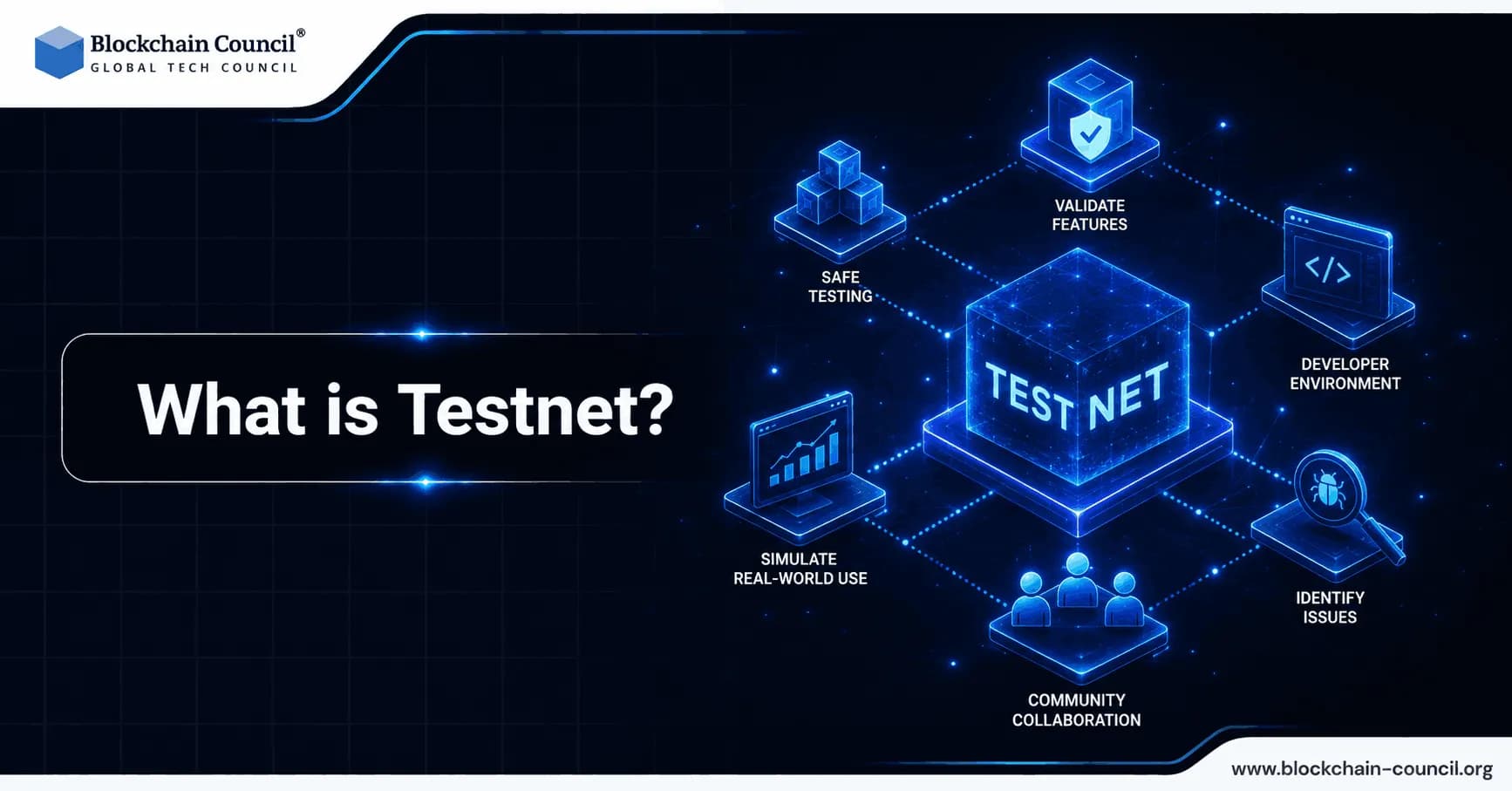
Summary
A Testnet is a controlled Blockchain network used for testing and experimentation in the world of cryptocurrencies and Blockchain technology.
It allows developers to experiment and refine their applications without risking real funds or assets.

Testnets mirror the main Blockchain but exist solely for testing and refining purposes.
They play a critical role in the development and quality assurance of Blockchain applications.
Key features of a Testnet include isolation from the main network, using tokens with no real value, receiving constant updates, and being both public and private.
Testnets employ various consensus mechanisms to mimic real network behavior.
Testnet faucets distribute free Testnet tokens for testing purposes.
Testnets offer low latency for quick transaction confirmations.
They can be reset to a genesis block for iterative development and troubleshooting.
Testnets often have active communities providing support and feedback to developers.
Introduction
In the world of cryptocurrencies and Blockchain technology, the term “Testnet” is often thrown around. But what exactly is a Testnet, and why is it so crucial in the development of Blockchain projects? To put it simply, Testnet serves as a sandbox environment where developers can experiment, test their applications, and identify potential issues before deploying them on the mainnet. But there’s more to it.
In this article, we will find the answer to “What is a Testnet?” in detail. Further we will analyze its stand-out features and how it works. By the end of this, you’ll have a comprehensive understanding of what a Testnet is and how it plays a pivotal role in the Blockchain ecosystem.
What is a Testnet?
A Testnet is a dedicated and controlled Blockchain network designed exclusively for the purpose of testing and experimentation. It mirrors the functionality of the main Blockchain (mainnet) but operates in a risk-free environment, ensuring that no real funds or assets are at stake during testing activities.
In the realm of Blockchain technology, a Testnet serves as a secure playground, enabling developers to experiment and innovate without the fear of real-world consequences. It’s a virtual sandbox, mirroring the main Blockchain network but existing solely for testing and refining purposes.
Testnets play a critical role in the development and refinement of Blockchain applications and features. They offer developers a secure space to assess, validate, and enhance their innovations before implementing them on the mainnet. By doing so, Testnets serve as a vital component of quality assurance and risk mitigation in the Blockchain ecosystem.
Also Read- How Can Developers Use Google Bard?
Features of a Testnet
After knowing the definition of a Testnet, let’s now understand the key features of a Testnet that makes it so crucial in Blockchain development:
Isolation: Testnets are like isolated sandboxes within the Blockchain ecosystem. They are separated from the main network, meaning that any activities or experiments carried out on the Testnet have no impact on the actual Blockchain. This isolation ensures that developers can test their applications, smart contracts, or transactions without worrying about real-world consequences.
No Real Value: Testnets use tokens that have no real monetary value. For instance, Ethereum’s mainnet uses ETH, but its Testnet counterpart, Ropsten, uses test ETH (tETH), which has no real-world value. This critical distinction prevents accidental financial losses during testing and encourages developers to explore freely.
Constant Updates: Testnets are dynamic environments that evolve alongside their corresponding mainnets. This means that they receive regular updates, including protocol upgrades and improvements. By mimicking the main network’s conditions, Testnets provide a close-to-real experience, allowing developers to prepare for changes and new features effectively.
Public and Private: There are two main types of Testnets: public and private. Public Testnets are accessible to anyone interested in testing their Blockchain applications. In contrast, private Testnets restrict access to a select group, making them ideal for projects that require confidentiality during development or specific testing scenarios.
Mining Methods: Testnets often employ various consensus mechanisms to mirror the real network’s behavior. For example, a Testnet may use Proof of Work (PoW) or Proof of Stake (PoS) for block validation, providing developers with a realistic testing environment for different Blockchain technologies.
Faucets: Testnet faucets are tools that distribute free Testnet tokens to users. These tokens are essential for conducting tests without requiring actual cryptocurrency. Users can request Testnet tokens from faucets, which helps them participate in transactions, deploy smart contracts, and test various functionalities within the Blockchain ecosystem.
Low Latency: Transactions on Testnets confirm quickly. This feature is crucial for developers who want to experiment with different scenarios efficiently. Low latency ensures that testing results are available rapidly, allowing developers to make informed decisions and refine their applications promptly.
Reset Capabilities: Testnets can be reset to a genesis block, which is the first block in a Blockchain. This reset capability provides a clean slate for developers to retest their applications or start fresh with new ideas. It’s a valuable feature for iterative development and troubleshooting.
Realistic Data: Some Testnets replicate real Blockchain data. This means that developers can analyze and experiment with data that resembles what they would encounter on the mainnet. This feature is particularly useful for testing real-world use cases and fine-tuning applications accordingly.
Community Support: Testnets often have active and supportive communities. These communities provide guidance, answer questions, and offer assistance to developers. Engaging with these communities can be immensely beneficial for individuals looking to learn, troubleshoot, and collaborate with like-minded Blockchain enthusiasts.
Also Read- 5 Must-Have AI Skills In 2024
Advantages of a Testnet
We know “What is a Testnet?” And we have also learned the features of a Testnet. But what makes it so beneficial? What are the advantages of a Testnet? Let’s figure out:
Risk-Free Testing
Testnets provide a safe environment for developers to experiment without the fear of losing real cryptocurrencies. It’s like a sandbox where you can test your applications and smart contracts without any financial risk.
Bug Detection
Identifying and fixing bugs in a real Blockchain can be costly and risky. Testnets allow you to discover and address issues in your code before deploying it on the mainnet, saving time and resources.
Faster Development
With Testnets, you can accelerate the development process. You don’t have to wait for block confirmations or deal with congested networks. This speed is a boon for developers working on time-sensitive projects.
Cost-Efficiency
Transacting on the mainnet incurs transaction fees. Testnets are cost-effective, as transactions are typically free. You can test your applications and smart contracts as much as needed without burning a hole in your pocket.
Realistic Simulations
Testnets aim to replicate the mainnet environment as closely as possible. This means you can assess how your project will perform in real-world scenarios, making your testing more meaningful.
Community Feedback
Testnets often attract a community of developers and users eager to provide feedback. This input can be invaluable for improving your project and addressing any potential issues.
Protocol Upgrades
Developers use Testnets to test protocol upgrades and new features before deploying them on the mainnet. This ensures a smoother transition and minimizes disruptions for users.
Security Testing
Testnets allow you to assess the security of your project thoroughly. By identifying vulnerabilities in a safe environment, you can prevent security breaches on the mainnet.
Also Read- Top 5 Artificial Intelligence Trends In 2024
How does Testnet Work?
Now that we know the answer to the question: “What is a Testnet?”, it is important to understand how a Testnet works. Let’s find out how a Testnet works!
For Users:
Step 1: Choose a Testnet:
Select a suitable Testnet from options like Ethereum’s Ropsten, Kovan, or Rinkeby, Solana’s Devnet or Testnet, Polygon’s Mumbai, Avalanche’s Fuji Testnet, or Binance Smart Chain’s Testnet.
Step 2: Set Up a Testnet Wallet:
Create a dedicated Testnet wallet using platforms like Metamask, Trust Wallet, or Phantom. This wallet is designed to work with Testnets.
Step 3: Acquire Testnet Tokens:
Obtain Testnet tokens for free from a Testnet faucet. These tokens are essential for conducting transactions, paying gas fees, and interacting with Testnet applications.
Step 4: Interact with the Testnet:
With Testnet tokens in your wallet, you can engage with the Testnet. This includes deploying smart contracts, sending and receiving Testnet tokens, and using Testnet applications to test various functionalities.
Step 5: Provide Feedback:
If you encounter any issues or have suggestions, report them to the developers. Your feedback contributes to improving the stability and security of the Testnet.
For Development Teams:
Step 1: Choose a Testnet:
Development teams select a compatible Testnet for their Blockchain platform.
Step 2: Set Up Testnet Wallets:
Create Testnet wallets corresponding to the chosen Testnets.
Step 3: Obtain Testnet Tokens:
Acquire Testnet tokens for transaction fees and gas costs from Testnet faucets.
Step 4: Deploy Smart Contracts and dApps:
Start deploying smart contracts and decentralized applications (dApps) on the Testnet.
Step 5: Test Extensively:
Thoroughly test smart contracts and dApps, ensuring they function correctly, debugging any issues, and stress-testing them under heavy loads.
Step 6: Gather Community Feedback:
Use the Testnet to gather feedback from the community. This feedback helps improve the functionality, usability, and security of smart contracts and dApps.
Step 7: Deploy to Mainnet:
Once confident in the performance and security of smart contracts and dApps, deploy them to the mainnet for real-world use.
Also Read- How Can Developers Use Google Bard?
Conclusion
In conclusion, Testnets are indispensable tools in the world of Blockchain development. They provide a safe and controlled environment for testing, refining, and ensuring the reliability and security of Blockchain applications. As we’ve explored in this article, Testnets serve as a critical bridge between development and deployment, enabling developers to work out the kinks and iron out the bugs before going live on the mainnet. By grasping the nuances of Testnets, you are better equipped to appreciate their role in the continuous evolution of Blockchain technology, making it more robust, secure, and resilient. But is finding the answer to what a Testnet is enough to get into the Blockchain world? Blockchain technology is rapidly evolving and if you want to be one of the most sought-after professionals in this realm then getting certified is a must.
Consider getting a Blockchain certification by the Blockchain Council and be ready to lead the digital revolution!
Frequently Asked Questions
1. What is a testnet in blockchain?
A testnet is a blockchain network designed for testing applications, smart contracts, wallets, and protocol upgrades without using real cryptocurrency or risking valuable digital assets. It provides a safe environment where developers and users can experiment before deploying to a live blockchain, known as the mainnet.
2. Why are testnets important?
Testnets allow developers to identify bugs, validate smart contracts, optimize performance, and evaluate new features before they reach production. This reduces the likelihood of costly errors, security vulnerabilities, and failed transactions on the mainnet.
3. How does a testnet work?
A testnet functions similarly to its corresponding mainnet but uses test tokens that have no real monetary value. Developers can deploy contracts, execute transactions, interact with decentralized applications (dApps), and simulate real-world conditions without financial risk.
4. What is the difference between a testnet and a mainnet?
A mainnet is the live production blockchain where transactions involve real digital assets and have economic consequences. A testnet is a separate environment used for development and testing, where tokens are intended solely for experimentation and generally cannot be exchanged for real value.
5. What are testnet tokens?
Testnet tokens are cryptocurrencies created specifically for testing blockchain applications. They mimic the behavior of real tokens but are distributed freely through faucets or developer programs and are not intended to have market value.
6. How do you get testnet tokens?
Most blockchain ecosystems provide testnet faucets that distribute free test tokens to developers and users. Some ecosystems may require wallet verification, social authentication, or rate limits to prevent abuse.
7. What is a blockchain faucet?
A blockchain faucet is an online service that distributes small amounts of testnet cryptocurrency to users for development and testing purposes. Faucets help developers pay simulated transaction fees while building and testing blockchain applications.
8. Which blockchain networks have testnets?
Many blockchain ecosystems offer dedicated test networks, including Ethereum (such as Sepolia), Polygon, Base, Arbitrum, Optimism, Solana, Avalanche, BNB Chain, Sui, Aptos, Cosmos, Polkadot, and numerous other Layer 1 and Layer 2 networks.
9. Why do developers use testnets before deploying smart contracts?
Smart contracts are often immutable after deployment, making thorough testing essential. Testnets allow developers to validate business logic, security controls, gas usage, access permissions, integrations, and user interactions before contracts manage real assets.
10. Can anyone use a testnet?
Yes. Most public blockchain testnets are open to developers, students, researchers, and blockchain enthusiasts. Anyone with a compatible wallet and testnet tokens can typically interact with supported applications and smart contracts.
11. What can you test on a blockchain testnet?
Developers can test smart contracts, wallets, decentralized finance (DeFi) protocols, NFT marketplaces, decentralized autonomous organizations (DAOs), blockchain games, token transfers, governance systems, cross-chain bridges, and other Web3 applications.
12. Are testnet transactions permanent?
Testnet transactions are generally recorded on the test blockchain, but testnets may occasionally be reset, upgraded, or discontinued. Unlike mainnets, long-term persistence is not always guaranteed because testnets are intended for development rather than production use.
13. What are the limitations of testnets?
Testnets may have lower network activity, different validator participation, periodic resets, limited infrastructure, and performance characteristics that differ from production environments. Results obtained on a testnet should be validated before deployment to a mainnet.
14. What tools are commonly used with testnets?
Developers frequently use tools such as Hardhat, Foundry, Remix IDE, Truffle, OpenZeppelin Contracts, Ethers.js, Web3.js, MetaMask, Tenderly, Block Explorers, Chainlink test services, and various cloud-based blockchain development platforms.
15. How do testnets support blockchain security?
Testnets allow developers to identify vulnerabilities, conduct smart contract audits, simulate attack scenarios, evaluate protocol upgrades, perform stress testing, and improve application reliability before exposing systems to real users and valuable digital assets.
16. What common mistakes should beginners avoid?
Common mistakes include sending real cryptocurrency to testnet addresses, confusing testnet and mainnet wallets, deploying untested code directly to production, overlooking network configuration settings, using the wrong RPC endpoints, and assuming testnet performance exactly matches mainnet behavior.
17. What are best practices for using testnets?
Best practices include testing thoroughly before mainnet deployment, documenting all experiments, using version control, validating security assumptions, monitoring gas usage, maintaining separate wallets for testnet and mainnet activities, and confirming network settings before signing transactions.
18. How do testnets fit into the blockchain development lifecycle?
Testnets are a core part of blockchain development, supporting coding, debugging, integration testing, security validation, user acceptance testing, performance evaluation, and pre-production deployment. They help teams improve quality before releasing applications to production networks.
19. What trends are shaping blockchain testnets in 2025-2026?
Key trends include AI-assisted smart contract testing, automated security validation, zero-knowledge (ZK) testing environments, cross-chain interoperability testing, Layer 2 developer networks, realistic blockchain simulators, cloud-native testing platforms, and tighter integration with DevSecOps and CI/CD workflows.
20. What is the future of blockchain testnets?
Blockchain testnets are expected to become more sophisticated, offering better simulation of production environments, improved developer tooling, automated security testing, and seamless integration with continuous deployment pipelines. As blockchain adoption expands across finance, gaming, supply chains, and enterprise applications, testnets will remain essential for building secure, reliable, and scalable decentralized systems. Writing code directly to a live blockchain without testing first is rather like test-driving a parachute after you've already jumped. The testnet exists so nobody has to discover bugs at terminal velocity.
Related Articles
View All
Blockchain
Beyond Cryptocurrency: How Blockchain Is Transforming Real-World Industries
Explore how blockchain works beyond cryptocurrency in banking, supply chains, healthcare, tokenisation, CBDCs, and government, plus key challenges and career paths.

Blockchain
Smart Contracts & dApps: How Blockchain Becomes Programmable
Learn how smart contracts and dApps make blockchain programmable, from Ethereum and tokens to DeFi, NFTs, real use cases, benefits, and key risks.

Blockchain
Public, Private & Consortium Blockchains: Which Network Fits the Use Case?
Compare public, private, and consortium blockchains by security, speed, privacy, and control, with real examples and a simple guide to choosing the right network.
Trending Articles
The Role of Blockchain in Ethical AI Development
How blockchain technology is being used to promote transparency and accountability in artificial intelligence systems.

Top 5 DeFi Platforms
Explore the leading decentralized finance platforms and what makes each one unique in the evolving DeFi landscape.
What is AWS? A Beginner's Guide to Cloud Computing
Everything you need to know about Amazon Web Services, cloud computing fundamentals, and career opportunities.