

What Is Blockchain Threat Intelligence and Why It Matters for Modern Security
 Suyash Raizada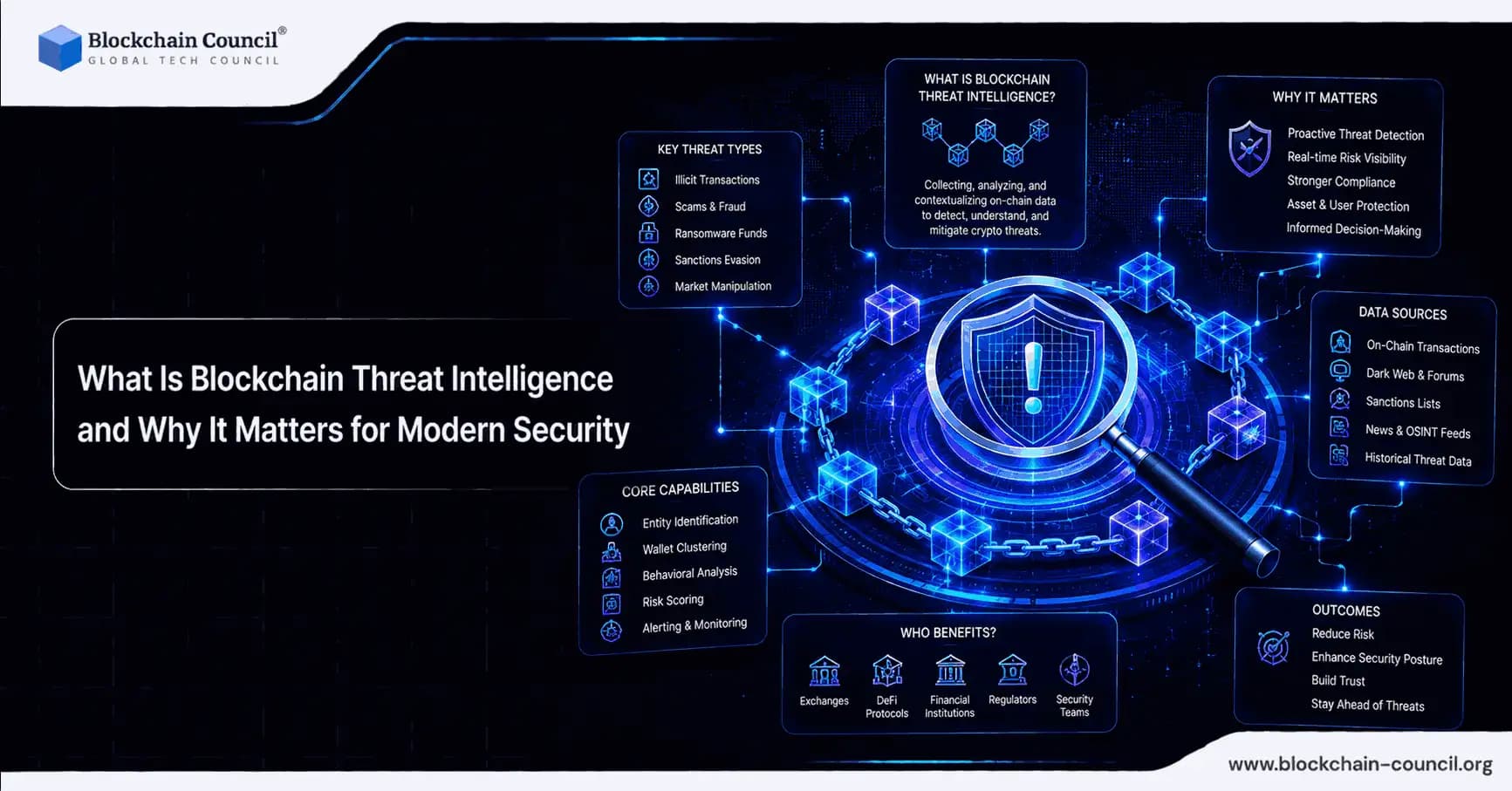
Blockchain threat intelligence is a question more security teams are asking as crypto adoption expands and attacks on wallets, exchanges, bridges, and DeFi protocols become more targeted. Traditional cybersecurity tools were designed for centralized infrastructure. Blockchain-based systems, by contrast, expose a public, immutable transaction layer that adversaries can exploit and defenders can also analyze. Blockchain threat intelligence turns on-chain activity into actionable security and compliance signals, helping organizations investigate incidents, prevent fraud, and meet AML and sanctions obligations.
What is blockchain threat intelligence?
Blockchain threat intelligence is the proactive collection, organization, and analysis of on-chain data to identify risks, detect suspicious behavior, and map relationships between entities operating on blockchain networks. It extends beyond basic blockchain analytics by combining advanced investigation techniques with external datasets to uncover hidden patterns and attribute activity to real-world actors when possible.

In practice, blockchain threat intelligence helps teams answer questions like:
Is this wallet linked to ransomware, scams, or sanctioned entities?
Are these transactions consistent with laundering patterns, bridge exploitation, or flash loan abuse?
Where did the funds come from, where are they going, and what services are involved?
How do we operationalize this insight inside existing SOC workflows and compliance programs?
Blockchain threat intelligence vs blockchain analytics
Blockchain analytics focuses on foundational capabilities such as transaction tracing, address clustering, and basic risk scoring. Blockchain threat intelligence goes further by:
Expanding scope with cross-chain tracking across bridges, DeFi protocols, and multiple networks.
Correlating data by connecting on-chain signals with OSINT, sanctions lists, KYC context, and known threat actor infrastructure.
Detecting behavior through anomaly detection and behavioral pattern recognition, not just linear tracing.
Understand how blockchain threat intelligence helps detect fraud, ransomware activity, wallet risks, and malicious on-chain behavior by building expertise through a Cyber Security Expert, analyzing blockchain threat data using a Python certification, and improving security operations with a Digital marketing course.
Why blockchain threat intelligence matters
Blockchain ecosystems are transparent, but not automatically safe. Threat actors exploit the speed, composability, and cross-chain liquidity of Web3 systems to move funds quickly and obscure intent. Blockchain threat intelligence converts the public ledger into a defensive advantage for:
Faster incident response by connecting a technical exploit to specific attacker-controlled addresses and downstream cash-out routes.
Fraud reduction through early detection of scam typologies, wallet-draining campaigns, and coordinated laundering patterns.
Regulatory compliance by supporting AML monitoring, sanctions screening, and suspicious activity reporting workflows.
Better collaboration because intelligence can be shared across organizations with verifiable integrity.
How blockchain threat intelligence works
Modern blockchain threat intelligence platforms combine multiple layers of analysis to create a fuller picture of risk. Key capabilities include:
1) Address clustering and entity attribution
Investigations often begin with wallet addresses, but meaningful conclusions require context. Clustering techniques group related addresses that likely belong to the same entity or coordinated operation. Attribution enriches those clusters using sources such as open internet data, breach and phishing reporting, dark web intelligence, and exchange or service identifiers.
Outcome: a more realistic view of who is behind activity, not just where funds moved.
2) Cross-chain tracking across bridges and protocols
Attackers frequently route assets through bridges, decentralized exchanges, mixers, and multiple chains to break simple tracing. Cross-chain monitoring follows the value flow across networks and services, improving visibility into laundering routes and potential cash-out points.
Outcome: fewer blind spots when funds leave a single chain.
3) Behavioral pattern analysis and anomaly detection
Threat intelligence platforms look for signals that deviate from typical user or protocol behavior. Common indicators include rapid fund dispersion, newly created wallet clusters with coordinated activity, unusual DeFi interactions, or patterns consistent with flash loan exploitation attempts.
Outcome: earlier warning on evolving threats that do not match known indicators.
4) Incident relationship mapping
Blockchain threat intelligence connects technical incidents to financial outcomes. When a smart contract exploit occurs, investigators map compromised contract interactions to attacker addresses and trace downstream movements. Phishing campaigns can similarly be linked to wallet drains and subsequent fund consolidation.
Outcome: clearer timelines and stronger evidence for response, recovery, and reporting.
5) Sanctions screening and AML-KYC support
Organizations exposed to crypto flows need to screen transactions and counterparties for sanctions risk and money laundering indicators. Blockchain threat intelligence supports monitoring logic that flags exposure to high-risk entities, suspicious transaction patterns, and known illicit services.
Outcome: stronger compliance controls aligned to regulatory expectations.
6) SIEM and SOC integration
Blockchain signals become more useful when they feed existing security operations processes. Integrating on-chain alerts into SIEM workflows supports real-time notifications, correlation with off-chain events, and faster triage. A wallet-draining event, for example, can be correlated with endpoint compromise indicators, phishing telemetry, or identity anomalies.
Outcome: unified security monitoring across centralized and decentralized surfaces.
Primary use cases in enterprises and Web3
Blockchain threat intelligence is used by exchanges, financial institutions, DeFi teams, and enterprises that accept or hold digital assets. Common use cases include:
Incident response and investigations
Ransomware payment tracing to follow funds across wallets, services, and exchanges for disruption and reporting.
Smart contract exploit investigations to identify attacker addresses and track stolen assets.
Phishing and wallet drain response to connect victim flows to receiving clusters and potential cash-out routes.
Fraud and scam detection
Detection of coordinated scam wallets and rapid dispersal patterns.
Identification of high-risk counterparties interacting with a platform or treasury.
Monitoring token movement anomalies that suggest manipulation or laundering.
DeFi ecosystem monitoring
Surveillance of liquidity pools for abnormal withdrawals and exploit-like sequences.
Bridge monitoring for exploit attempts and suspicious routing behavior.
Tracking protocol interactions that may indicate insider risk or governance abuse.
Regulatory compliance and reporting
Sanctions exposure screening for wallets and transaction counterparties.
AML monitoring and case management support using on-chain traceability.
Automated identification of activity that may require regulatory notification.
Law enforcement and regulatory operations
Authorities use blockchain threat intelligence to trace illicit fund flows across jurisdictions, support forensic investigations, and improve attribution through combined on-chain and off-chain evidence.
Key tools and platform landscape
The blockchain threat intelligence ecosystem includes platforms known for transaction tracing, entity attribution, and risk monitoring across networks. Commonly cited providers include TRM Labs, Chainalysis, Elliptic, and Beacon Network. While capabilities differ, most mature solutions focus on:
Real-time monitoring and alerting
Entity graphs and attribution datasets
Cross-chain coverage and DeFi visibility
Compliance workflows for AML and sanctions screening
Emerging innovations: privacy-preserving intelligence and explainable AI
Two technical directions are shaping the next phase of blockchain threat intelligence.
Privacy-preserving threat intelligence sharing
Research into blockchain-based cyber threat intelligence systems highlights architectures that enable collaboration without exposing raw telemetry. Techniques commonly discussed include differential privacy, zero-knowledge proofs, homomorphic encryption, secure multi-party computation, and federated learning. The goal is to share useful indicators and analytical models while minimizing leakage of sensitive organizational data.
Explainable AI for accountable decisions
AI is increasingly used to detect anomalies and classify risk. Explainable AI helps analysts and auditors understand why activity was flagged, improving trust, reducing operational friction, and supporting compliance documentation when decisions affect customer onboarding or transaction approvals.
Challenges and limitations to plan for
Blockchain threat intelligence is a powerful capability, but it has real limitations. Organizations should account for:
False positives from complex but legitimate DeFi activity that resembles laundering patterns.
Cross-chain complexity as assets move through many networks and protocols, increasing investigation cost.
Smart contract opacity when exploit logic is sophisticated and requires specialist review.
Privacy and ethics including the risk of overreach and the possibility of incorrect attribution through clustering.
Regulatory ambiguity because rules and expectations vary by jurisdiction and change quickly.
Skills and learning path for blockchain threat intelligence
Teams adopting blockchain threat intelligence benefit from a blended skill set across security, data analysis, and Web3. Practical focus areas include:
Blockchain fundamentals: transaction models, consensus, wallets, smart contracts, bridges, and DeFi mechanics.
Cybersecurity operations: incident response, threat modeling, detection engineering, and investigation methods.
Compliance knowledge: AML concepts, sanctions screening, and audit-ready reporting processes.
Tool proficiency: graph analysis, on-chain tracing workflows, and SIEM integrations.
Learn how blockchain threat intelligence platforms use transaction analysis, wallet attribution, and behavioral monitoring to strengthen cybersecurity defenses by mastering crypto security through a Cryptocurrency Expert, developing blockchain monitoring systems using a Node JS Course, and scaling security-focused blockchain services using an AI powered marketing course.
Conclusion
The public ledger can be transformed into a high-signal security dataset when paired with advanced analytics, off-chain context, and operational workflows. From ransomware tracing and smart contract exploit investigations to AML-KYC support and sanctions screening, blockchain threat intelligence is becoming a foundational capability for any organization handling digital assets. As AI-driven detection, cross-chain visibility, and privacy-preserving collaboration mature, teams that invest in the right tools and skills will be better positioned to reduce risk while supporting compliant growth across the blockchain economy.
FAQs
1. What is blockchain threat intelligence?
Blockchain threat intelligence is the process of collecting and analyzing on-chain data to identify risks. It helps teams detect suspicious wallets, fraud patterns, and illicit fund movements.
2. Why is blockchain threat intelligence important?
It helps organizations respond faster to crypto-related threats and attacks. Teams use it to investigate incidents, prevent fraud, and meet compliance requirements.
3. How is blockchain threat intelligence different from blockchain analytics?
Blockchain analytics focuses on tracing transactions and scoring wallet risks. Blockchain threat intelligence adds deeper context through OSINT, sanctions data, behavior analysis, and threat actor mapping.
4. What risks can blockchain threat intelligence detect?
It can detect ransomware links, scams, sanctioned entities, laundering routes, and suspicious DeFi behavior. This makes the public ledger slightly less of a playground for chaos.
5. What is address clustering in threat intelligence?
Address clustering groups wallets that likely belong to the same user, service, or attacker. It helps analysts understand broader activity instead of reviewing single addresses.
6. What is entity attribution?
Entity attribution connects wallet clusters to real-world services, organizations, or threat actors. It uses on-chain behavior, OSINT, service labels, and external intelligence sources.
7. Why is cross-chain tracking important?
Attackers often move funds through bridges, exchanges, and multiple blockchains. Cross-chain tracking helps investigators follow assets beyond one network.
8. What is behavioral pattern analysis?
Behavioral pattern analysis identifies unusual activity such as rapid fund movement or coordinated wallet behavior. It helps detect threats before they become larger incidents.
9. How does anomaly detection support blockchain security?
Anomaly detection flags transactions or wallet activities that differ from normal behavior. This helps security teams investigate suspicious events more quickly.
10. How does blockchain threat intelligence support incident response?
It links exploits, phishing attacks, or ransomware payments to attacker-controlled wallets. Teams can then trace stolen funds and identify possible cash-out routes.
11. How does it help with fraud detection?
Blockchain threat intelligence identifies scam wallets, wallet-draining campaigns, and laundering patterns. It gives platforms early warning before more users are affected.
12. What role does it play in AML compliance?
It helps screen wallets and transactions for money laundering risks. Organizations use it to detect high-risk entities and support suspicious activity reporting.
13. How does sanctions screening work in blockchain threat intelligence?
Sanctions screening checks whether wallets or counterparties are linked to restricted entities. This helps organizations avoid prohibited transactions and regulatory trouble.
14. Why is SIEM integration useful?
SIEM integration brings blockchain alerts into existing security operations workflows. It helps teams connect on-chain events with phishing, identity, or endpoint signals.
15. What are common blockchain threat intelligence tools?
Common platforms include TRM Labs, Chainalysis, Elliptic, and Beacon Network. These tools support tracing, attribution, monitoring, and compliance workflows.
16. What is privacy-preserving threat intelligence sharing?
It allows organizations to share useful threat signals without exposing sensitive internal data. Techniques may include zero-knowledge proofs, federated learning, and secure computation.
17. How does explainable AI help blockchain threat intelligence?
Explainable AI shows why a transaction or wallet was flagged as risky. This improves analyst trust, audit quality, and decision-making.
18. What are the limitations of blockchain threat intelligence?
Limitations include false positives, cross-chain complexity, privacy concerns, and uncertain attribution. Tools are helpful, but not magical crystal balls, despite what vendors imply.
19. What skills are needed for blockchain threat intelligence?
Professionals need blockchain knowledge, cybersecurity skills, compliance awareness, and data analysis ability. Tool proficiency and clear reporting are also important.
20. What is the future of blockchain threat intelligence?
The future includes AI-driven detection, stronger cross-chain visibility, and privacy-preserving collaboration. Organizations will rely on it more as digital asset threats become increasingly complex.
Related Articles
View All
Blockchain
Blockchain Wallet Security: Private Keys, Seed Phrases, and Common Threats
Learn how to secure your blockchain wallet with safer private key storage, seed phrase backups, hardware wallets, stronger authentication, and threat awareness.

Blockchain
Blockchain Wallets Explained: How They Work, Types, and Security Best Practices
Blockchain wallets manage keys, sign transactions, and secure digital assets. Learn wallet types, risks, best practices, and how to choose the right setup.

Blockchain
Why Blockchain Is the Future of Digital Trust, Finance, and Data Security
Blockchain is becoming core infrastructure for digital trust, finance, and data security through shared ledgers, stablecoins, smart contracts, and verifiable records.
Trending Articles
How Blockchain Secures AI Data
Understand how blockchain technology is being applied to protect the integrity and security of AI training data.
What is AWS? A Beginner's Guide to Cloud Computing
Everything you need to know about Amazon Web Services, cloud computing fundamentals, and career opportunities.
Claude AI Tools for Productivity
Discover Claude AI tools for productivity to streamline tasks, manage workflows, and improve efficiency.