
Top 10 AI Use Cases in Blockchain You Must Know (2026 Guide)

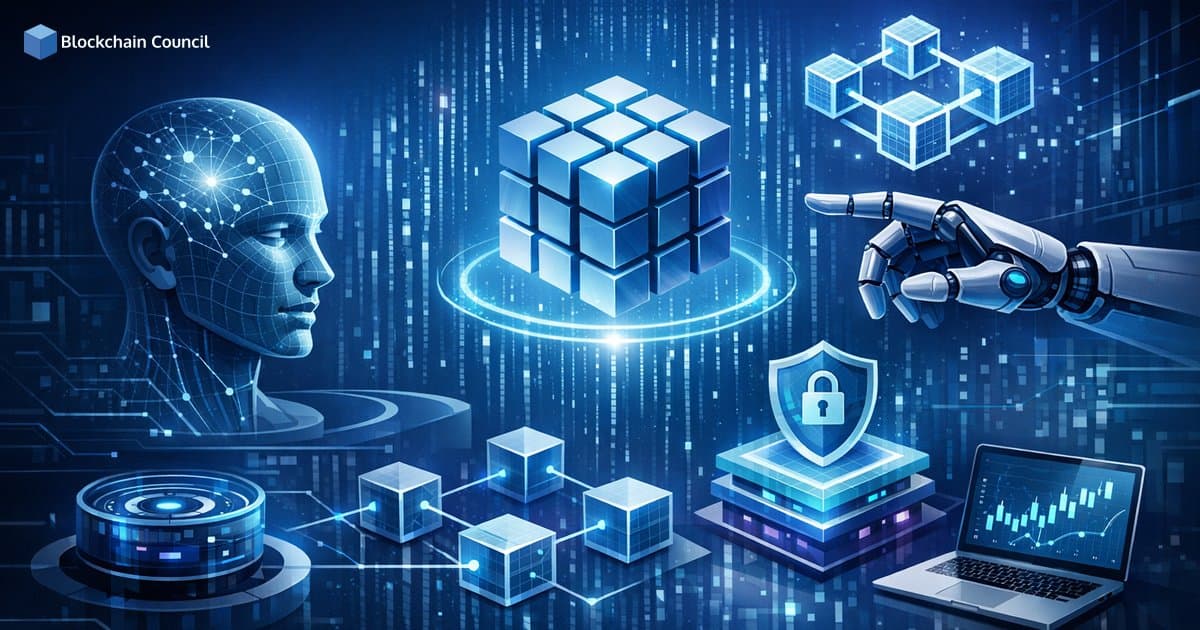
AI use cases in blockchain have moved from experimental pilots to production-grade systems that improve security, automate operations, and unlock new data-driven business models. By combining AI capabilities like real-time anomaly detection and predictive modeling with blockchain features like immutability and transparent audit trails, organizations can build systems that are both intelligent and verifiable. This convergence is especially relevant in 2026 as decentralized finance (DeFi), tokenization, and Web3 applications demand stronger trust, faster automation, and scalable governance.
Below are the top 10 AI applications in blockchain that teams are adopting today, along with practical examples and implementation considerations for professionals.

Why AI and Blockchain Work Together
AI excels at learning patterns from large datasets, scoring risk, and generating predictions. Blockchain excels at maintaining a tamper-resistant history of transactions and events. Together, they enable:
Continuous monitoring of transactions, smart contracts, and user behavior with explainable audit trails.
Automation via smart contracts triggered by AI-driven risk scores or forecasts.
Data integrity for training and validating models, particularly when provenance matters.
New markets such as tokenized real-world assets (RWAs) that require reliable valuation and compliance controls.
Top 10 AI Use Cases in Blockchain
1. Enhanced Security and Fraud Detection
Security is the most mature area for AI use cases in blockchain. Machine learning models analyze transaction graphs, wallet clusters, and behavior signals to flag anomalies in real time. Graph AI is particularly effective for tracing money laundering patterns across addresses and chains.
What AI does: anomaly detection, graph analytics, risk scoring, entity resolution.
What blockchain adds: immutable evidence trails for investigation and compliance.
Example: Elliptic, working with academic and industry partners, trained models on hundreds of millions of transactions and reported a significant improvement in money laundering detection precision, reaching 27% from a low baseline.
Pro tip: For production deployments, prioritize model governance - including false positive management and drift monitoring - and build privacy safeguards into any pipeline that enriches on-chain data with off-chain signals.
2. Smart Contract Optimization and Automated Auditing
Smart contracts concentrate value and risk, making them a prime target for AI-driven auditing. Automated vulnerability scanning is increasingly used to detect common issues like reentrancy flaws, access-control weaknesses, and unsafe external calls.
What AI does: code pattern detection, vulnerability classification, test generation, and continuous post-deployment monitoring.
What blockchain adds: deterministic execution and on-chain traceability of contract behavior.
Professionals building secure Web3 systems often combine training across blockchain security, smart contract development, and AI to address both code and model risk effectively.
3. Supply Chain Management and Traceability
Supply chains require both foresight and proof. AI forecasts demand, predicts delays, and optimizes inventory. Blockchain preserves provenance records, handoffs, and certifications so stakeholders can verify product origin and handling conditions.
What AI does: demand forecasting, disruption prediction, route optimization.
What blockchain adds: end-to-end traceability and tamper-resistant provenance records.
Example: Enterprise traceability networks, including well-known food safety implementations, combine predictive analytics with verifiable tracking to reduce shortages and improve recall response times.
4. Predictive Analytics and Market Forecasting
Crypto markets move quickly, and AI models can process historical prices, liquidity signals, and social sentiment to forecast trends and detect manipulative patterns such as pump-and-dump activity. This is among the most visible AI applications in blockchain that users encounter daily through analytics dashboards and trading tools.
What AI does: time-series forecasting, sentiment analysis, anomaly detection on order flow.
What blockchain adds: transparent on-chain data for backtesting and attribution.
Extreme liquidation events have reached the billion-dollar range in single episodes. Automated detection can reduce exposure by flagging abnormal momentum and liquidity risk earlier than traditional rule-based systems.
5. Tokenization of Real-World Assets (RWAs)
Tokenization has accelerated as institutions explore fractional ownership of assets including real estate, commodities, invoices, and collectibles. AI improves valuation accuracy by incorporating market trends, asset condition signals, and comparable transaction data, while blockchain enables transparent ownership records, transfers, and settlement.
What AI does: valuation modeling, fraud detection in documentation, credit and liquidity risk scoring.
What blockchain adds: programmable ownership, continuous transferability, and auditable history.
Implementation note: RWA systems typically require robust identity frameworks, compliance workflows, and oracle design. AI can assist across all three areas, but governance and data quality remain decisive factors.
6. Decentralized Identity Verification and Privacy-Preserving Access
Identity is a foundational layer for exchanges, enterprise networks, and regulated DeFi. AI-based biometrics - such as facial recognition or liveness detection - can be combined with decentralized identifiers and verifiable credentials stored or referenced via blockchain. Smart contracts can then enforce access policies without exposing raw biometric data.
What AI does: biometric matching, liveness detection, risk-based authentication.
What blockchain adds: decentralized control, verifiable credentials, and auditability.
Teams building identity infrastructure should consider training that spans cybersecurity, blockchain architecture, and AI governance to address privacy, algorithmic bias, and regulatory constraints in parallel.
7. Energy-Efficient Mining and Infrastructure Optimization
Mining and blockchain infrastructure operations can be optimized using AI models that account for real-time hash rates, electricity costs, device performance, and thermal constraints. This supports automated resource allocation and can reduce both operating costs and environmental impact.
What AI does: dynamic workload scheduling, predictive maintenance, cost optimization.
What blockchain adds: measurable performance data and transparent accounting for incentive mechanisms.
Optimizations tend to be most material in regions with variable energy pricing and tighter regulatory scrutiny on energy consumption.
8. Smarter DAOs and Governance Support
Decentralized Autonomous Organizations (DAOs) face persistent challenges around participation rates, proposal overload, and governance attacks. AI agents can summarize proposals, detect collusion patterns, and model likely outcomes based on prior voting behavior. Used carefully, this can improve decision quality without removing human accountability.
What AI does: proposal classification, recommendation systems, voter behavior analysis.
What blockchain adds: transparent voting records and enforceable governance rules.
Best practice: Keep AI advisory rather than authoritative. Publish model assumptions and provide explainability for any governance recommendations surfaced to participants.
9. Automated Trading, Risk Assessment, and DeFi Security
Algorithmic trading and DeFi risk tooling increasingly rely on AI for volatility prediction, portfolio rebalancing, and protocol risk scoring. AI can evaluate tokenomics scenarios, stress-test liquidity pools, and flag exploit conditions earlier than rule-based monitoring tools.
What AI does: volatility forecasting, liquidation risk scoring, strategy optimization.
What blockchain adds: transparent position data and on-chain market signals for real-time monitoring.
Compliance teams also use AI to monitor peer-to-peer transactions and respond to investigations rapidly. Public reporting from major exchanges indicates tens of thousands of law enforcement requests handled annually, with asset freezes linked to cybercrime investigations.
10. Personalized Recommendations and Customer Intelligence in Web3
DeFi and Web3 platforms compete heavily on user experience, and AI can tailor recommendations based on wallet behavior, transaction history, and protocol usage patterns. Blockchain provides reliable interaction logs and makes it easier to verify which actions occurred and when.
What AI does: user segmentation, churn prediction, personalized product routing.
What blockchain adds: transparent user journeys and cross-protocol attribution.
Responsible personalization can improve onboarding and reduce user errors. Poor implementation can expose sensitive behavioral patterns, which makes privacy-by-design a requirement rather than an afterthought.
Implementation Challenges to Plan For
As real-world blockchain AI deployments scale, teams consistently encounter a set of shared constraints:
Explainability: compliance and incident response workflows often require interpretable model outputs, not black-box scores.
Privacy: linking identities to wallet addresses can introduce significant data protection risks, particularly under GDPR and similar frameworks.
Data quality: on-chain data is reliable by design, but training labels and contextual signals typically come from off-chain sources of varying quality.
Compute costs: advanced models can be expensive to train and operate at scale, which requires careful architecture decisions early in the design process.
Where AI Use Cases in Blockchain Are Headed
The most impactful AI use cases in blockchain share a common characteristic: they convert raw on-chain activity into actionable intelligence while preserving the benefits of tamper-resistant records and programmable execution. Near-term growth areas include AI-driven smart contract auditing, graph analytics for DeFi fraud prevention, and RWA tokenization supported by robust valuation and compliance tooling. Longer term, decentralized AI agents and AI-assisted governance systems may help Web3 networks scale without compromising transparency.
For professionals, the fastest path to meaningful impact is building competence across both domains - blockchain architecture and security on one side, and AI model lifecycle management and governance on the other. Structured learning paths that span blockchain, AI, cybersecurity, and smart contract development provide the foundation needed for job-aligned skill development in this field.
Related Articles
View All
Blockchain
Top Ways to Earn Money With Blockchain in 2026: Jobs, Freelancing and Passive Income
Learn how to earn money with blockchain in 2026 through Web3 jobs, blockchain freelancing, DeFi income strategies, NFT earnings, and tokenization services.
Blockchain
Top Blockchain Platforms of 2026
If you are new to Blockchain Technology, this article will help you gain a clear understanding of top Blockchain platforms and decide the best platform for your project.

Blockchain
Blockchain Guide 2026
Imagine a digital ledger that records transactions. But it is not stored in one central location. Instead, it’s spread out across a network of computers. This means that the information stored on the ledger is decentralized and can’t be controlled by any single entity. This decentralized digital ledger is known as Blockchain.
Trending Articles
The Role of Blockchain in Ethical AI Development
How blockchain technology is being used to promote transparency and accountability in artificial intelligence systems.

AWS Career Roadmap
A step-by-step guide to building a successful career in Amazon Web Services cloud computing.
Top 5 DeFi Platforms
Explore the leading decentralized finance platforms and what makes each one unique in the evolving DeFi landscape.